Thank you for visiting SNEWPapers!
Sign up free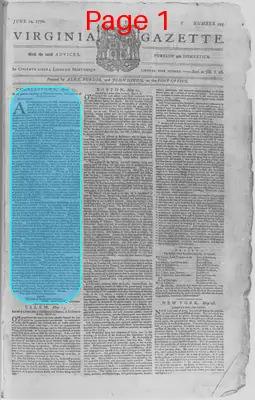
The Virginia Gazette
Richmond, Williamsburg, Richmond County, Virginia
What is this article about?
Letter from Charlestown's general committee to Philadelphia's committee, dated April 25, expressing grief over British repeal of minor duties while ignoring major oppressions, urging colonial unanimity in non-importation and resistance to preserve American liberties against Admiralty and commissioners' powers.
Clipping
OCR Quality
Full Text
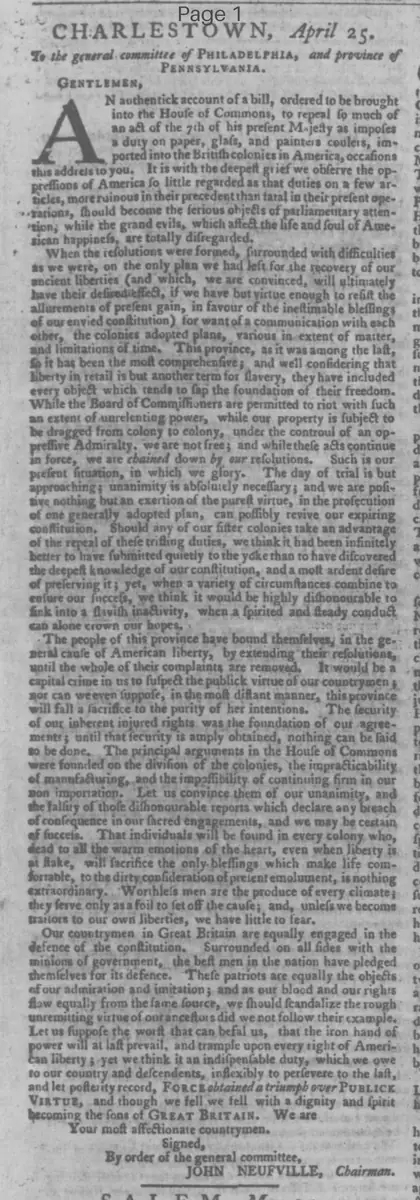
To the general committee of Philadelphia, and province of Pennsylvania,
Gentlemen,
An authentick account of a bill, ordered to be brought into the House of Commons, to repeal so much of an act of the 7th of his present Majesty's as imposes a duty on paper, glass, and painters colours, imported into the British colonies in America, occasions this address to you. It is with the deepest grief we observe the oppressions of America so little regarded as that duties on a few articles, more ruinous in their precedent than fatal in their present operations, should become the serious objects of parliamentary attention, while the grand evils, which affect the life and soul of American happiness, are totally disregarded.
When the resolutions were formed, surrounded with difficulties as we were, on the only plan we had left for the recovery of our ancient liberties (and which, we are convinced, will ultimately have their desired effects, if we have but virtue enough to resist the allurements of present gain, in favour of the inestimable blessings of our envied constitution) for want of a communication with each other, the colonies adopted plans, various in extent of matter, and limitations of time. This province, as it was among the last, it has been the most comprehensive; and well considering that liberty in retail is but another term for slavery, they have included every object which tends to sap the foundation of their freedom.
While the Board of Commissioners are permitted to riot with such an extent of unrelenting power, while our property is subject to be dragged from colony to colony, under the controul of an oppressive Admiralty, we are not free; and while these acts continue in force, we are chained down by our resolutions. Such is our present situation, in which we glory. The day of trial is but approaching; unanimity is absolutely necessary; and we are persuaded nothing but an exertion of the purest virtue, in the prosecution of one generally adopted plan, can possibly revive our expiring constitution. Should any of our sister colonies take an advantage of the repeal of these trifling duties, we think it had been infinitely better to have submitted quietly to the yoke than to have discovered the deepest knowledge of our constitution, and a most ardent desire of preserving it; yet, when a variety of circumstances combine to ensure our success, we think it would be highly dishonourable to sink into a slavish inactivity, when a spirited and steady conduct can alone crown our hopes.
The people of this province have bound themselves, in the general cause of American liberty, by extending their resolutions, until the whole of their complaints are removed. It would be a capital crime in us to suspect the publick virtue of our countrymen nor can we even suppose, in the most distant manner, this province will fall a sacrifice to the purity of her intentions. The security of our inherent injured rights was the foundation of our agreements; until that security is amply obtained, nothing can be said to be done.
The principal arguments in the House of Commons were founded on the division of the colonies, the impracticability of manufacturing, and the impossibility of continuing firm in our non importation. Let us convince them of our unanimity, and the falsity of those dishonourable reports which declare any breach of consequence in our sacred engagements, and we may be certain of success.
That individuals will be found in every colony who, dead to all the warm emotions of the heart, even when liberty is at stake, will sacrifice the only blessings which make life comfortable, to the dirty consideration of present emolument, is nothing extraordinary. Worthless men are the produce of every climate; they serve only as a foil to set off the cause; and, unless we become traitors to our own liberties, we have little to fear.
Our countrymen in Great Britain are equally engaged in the defence of the constitution. Surrounded on all sides with the minions of government, the best men in the nation have pledged themselves for its defence. These patriots are equally the objects of our admiration and imitation; and as our blood and our rights flow equally from the same source, we should scandalize the rough unremitting virtue of our ancestors did we not follow their example.
Let us suppose the worst that can befall us, that the iron hand of power will at last prevail, and trample upon every right of American liberty; yet we think it an indispensable duty, which we owe to our country and descendants, inflexibly to persevere to the last, and let posterity record, Force obtained a triumph over Publick Virtue, and though we fell we fell with a dignity and spirit becoming the sons of GREAT BRITAIN. We are
Your most affectionate countrymen.
Signed,
By order of the general committee,
JOHN NEUFVILLE, Chairman.
What sub-type of article is it?
What keywords are associated?
What entities or persons were involved?
Where did it happen?
Domestic News Details
Primary Location
Charlestown
Event Date
April 25.
Key Persons
Event Details
Letter from Charlestown's general committee, signed by Chairman John Neufville, to Philadelphia's committee, addressing British bill to repeal duties on paper, glass, and painters' colours from the 7th act of his present Majesty; expresses grief over focus on minor duties while ignoring major oppressions; urges colonial unanimity in non-importation resolutions and resistance to Admiralty and commissioners' powers to preserve American liberties and constitution.