Thank you for visiting SNEWPapers!
Sign up free
Domestic News
January 8, 1868
Green Mountain Freeman
Montpelier, Washington County, Vermont
What is this article about?
An article defends the consumption of pork from well-fed swine in New England, describing their diet and care, countering annual criticisms, and quoting Hall's Journal of Health on the importance of proper hog rearing for wholesome meat.
Clipping
OCR Quality
95%
Excellent
Full Text
On Eating Pork.
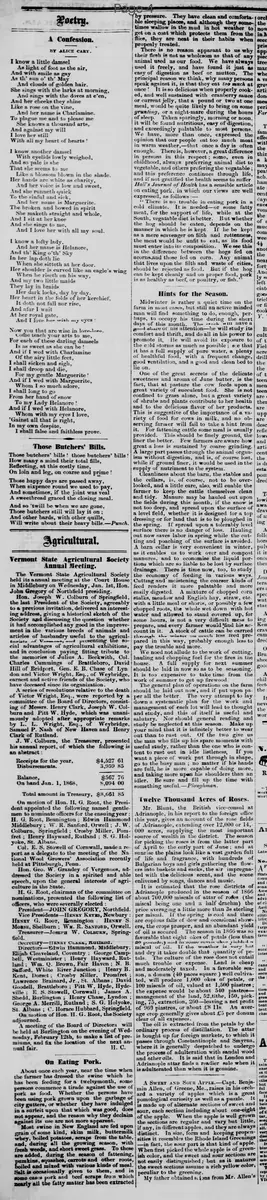
About once each year, near the time when the farmer has dressed the swine which he has been feeding for a twelvemonth, some persons commence a tirade against the use of pork as food. Whether the persons have been using pork grown upon the garbage of city gutters, or whether they have indulged in a surfeit upon that which was good, does not appear, and the reason why they declaim against its use are not more apparent.
Most swine in New England are fed upon grain of some kind, skim milk, buttermilk whey, boiled potatoes, scraps from the table, and, during all the growing season, with fresh weeds, and short sweet grass. To these are added, during the season of fattening, pumpkins, squashes, carrots and other roots, boiled and mixed with various kinds of meal. Salt is occasionally given to them, and in some cases pork and beef scraps from which nearly all the fatty matter has been extracted by pressure. They have clean and comfortable sleeping places, and although they sometimes wallow in the mud in hot weather to get on a coat which protects them from the flies, they are neat in their habits when properly treated.
There is no reason apparent to us why their flesh is not as wholesome as that of any animal used as our food. We have always used it freely, and have found it just as easy of digestion as beef or mutton. The principal reason we think, why many persons speak against it, is that they eat too much at once! "It is so delicious when properly cooked, and well seasoned with cranberry sauce or current jelly, that a pound or two at one meal, would be quite likely to bring on some grunting, or a night-mare during the hours of sleep." Taken "sparingly, morning or noon, it will be found nutritious, easy of digestion, and exceedingly palatable to most persons.
We have, more than once, expressed the opinion that our people eat too much meat in warm weather,—that once a day is often enough. There is, however, a great difference in persons in this respect; some, even in childhood, always preferring animal diet to vegetable, and others preferring the vegetable; and this preference continues through life, and if not gratified the health seems to suffer.
Hall's Journal of Health has a sensible article on eating pork, in which our views are well expressed, as follows:
"There is no trouble in eating pork in a cold climate. It is needed—or some fatty meat, for the support of life, while at the South, vegetable diet is better. But whether the hog should be eaten, depends on the manner in which he is kept. If he be kept as a mere scavenger on filth and rottenness, the meat would be unfit to eat, as its food must enter into its composition. We see this in the difference between the hogs fed on swill and those fed on corn. Any animal that lives upon the filth and waste of cities, should be rejected as food. But if the hog can be kept cleanly and on proper food, pork is as healthy as beef, or poultry, or fish."
About once each year, near the time when the farmer has dressed the swine which he has been feeding for a twelvemonth, some persons commence a tirade against the use of pork as food. Whether the persons have been using pork grown upon the garbage of city gutters, or whether they have indulged in a surfeit upon that which was good, does not appear, and the reason why they declaim against its use are not more apparent.
Most swine in New England are fed upon grain of some kind, skim milk, buttermilk whey, boiled potatoes, scraps from the table, and, during all the growing season, with fresh weeds, and short sweet grass. To these are added, during the season of fattening, pumpkins, squashes, carrots and other roots, boiled and mixed with various kinds of meal. Salt is occasionally given to them, and in some cases pork and beef scraps from which nearly all the fatty matter has been extracted by pressure. They have clean and comfortable sleeping places, and although they sometimes wallow in the mud in hot weather to get on a coat which protects them from the flies, they are neat in their habits when properly treated.
There is no reason apparent to us why their flesh is not as wholesome as that of any animal used as our food. We have always used it freely, and have found it just as easy of digestion as beef or mutton. The principal reason we think, why many persons speak against it, is that they eat too much at once! "It is so delicious when properly cooked, and well seasoned with cranberry sauce or current jelly, that a pound or two at one meal, would be quite likely to bring on some grunting, or a night-mare during the hours of sleep." Taken "sparingly, morning or noon, it will be found nutritious, easy of digestion, and exceedingly palatable to most persons.
We have, more than once, expressed the opinion that our people eat too much meat in warm weather,—that once a day is often enough. There is, however, a great difference in persons in this respect; some, even in childhood, always preferring animal diet to vegetable, and others preferring the vegetable; and this preference continues through life, and if not gratified the health seems to suffer.
Hall's Journal of Health has a sensible article on eating pork, in which our views are well expressed, as follows:
"There is no trouble in eating pork in a cold climate. It is needed—or some fatty meat, for the support of life, while at the South, vegetable diet is better. But whether the hog should be eaten, depends on the manner in which he is kept. If he be kept as a mere scavenger on filth and rottenness, the meat would be unfit to eat, as its food must enter into its composition. We see this in the difference between the hogs fed on swill and those fed on corn. Any animal that lives upon the filth and waste of cities, should be rejected as food. But if the hog can be kept cleanly and on proper food, pork is as healthy as beef, or poultry, or fish."
What sub-type of article is it?
Agriculture
What keywords are associated?
Pork Consumption
Swine Feeding
New England Farming
Dietary Advice
Hog Rearing
Where did it happen?
New England
Domestic News Details
Primary Location
New England
Event Details
Article discusses annual criticisms of pork consumption and defends its wholesomeness when swine are properly fed on grain, milk, vegetables, and clean conditions in New England, quoting Hall's Journal of Health on the importance of hog rearing methods.