Thank you for visiting SNEWPapers!
Sign up free
Poem
October 27, 1791
The New Hampshire Gazette And General Advertiser
Portsmouth, Rockingham County, New Hampshire
What is this article about?
A narrative poem depicting a married couple, Sir John and his lady, on the brink of separation due to accumulated resentments. Their young daughter Betsy, faced with choosing between them, innocently pleads for her parents to love each other, leading to their emotional reconciliation and decision to stay together.
Clipping
OCR Quality
98%
Excellent
Full Text
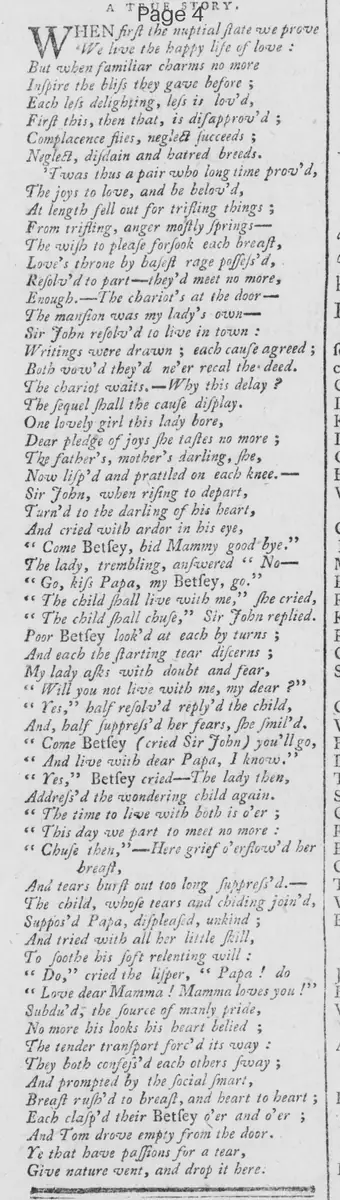
When first the nuptial state we prove,
We live the happy life of love:
But when familiar charms no more
Inspire the bliss they gave before;
Each less delighting, less is lov'd,
First this, then that, is disapproved;
Complacence flies, neglect succeeds;
Neglect, disdain and hatred breeds.
'Twas thus a pair who long time prov'd,
The joys to love, and be belov'd,
At length fell out for trifling things;
From trifling, anger mostly springs--
The wish to please forsook each breast,
Love's throne by basest rage possess'd,
Resolv'd to part--they'd meet no more,
Enough.--The chariot's at the door--
The mansion was my lady's own--
Sir John resolv'd to live in town:
Writings were drawn; each cause agreed;
Both vow'd they'd ne'er recall the deed.
The chariot waits.--Why this delay
The sequel shall the cause display.
One lovely girl this lady bore,
Dear pledge of joys she tastes no more;
The father's, mother's darling, she,
Now lisp'd and prattled on each knee.
Sir John, when rising to depart,
Turn'd to the darling of his heart,
And cried with ardor in his eye,
"Come Betsy, bid Mammy good bye."
The lady, trembling, answered "No--
Go, kiss Papa, my Betsy, go."
"The child shall live with me," he cried,
"The child shall choose," Sir John replied.
Poor Betsy look'd at each by turns;
And each the starting tear discerns;
My lady asks with doubt and fear,
"Will you not live with me, my dear?"
"Yes," half resolv'd reply'd the child,
And, half suppress'd her fears, she smil'd.
"Come Betsy (cried Sir John) you'll go.
And live with dear Papa, I know."
"Yes." Betsy cried--The lady then,
Address'd the wondering child again.
The time to live with both is o'er;
"This day we part to meet no more:
Choose then,"--Here grief o'erflow'd her breast,
And tears burst out too long suppress'd.--
The child, whose tears and chiding join'd,
Suppos'd Papa, displeas'd, unkind;
And tried with all her little skill.
To soothe his soft relenting will:
"Do," cried the lisper, "Papa! do
Love dear Mamma! Mamma loves you!"
Subdu'd; the source of manly pride,
No more his looks his heart belied:
The tender transport forc'd its way:
They both confess'd each others sway;
And prompted by the social smart,
Breast rush'd to breast, and heart to heart:
Each clapp'd their Betsy o'er and o'er;
And Tom drove empty from the door.
Ye that have passions fit a tear,
Give nature vent, and drop it here.
We live the happy life of love:
But when familiar charms no more
Inspire the bliss they gave before;
Each less delighting, less is lov'd,
First this, then that, is disapproved;
Complacence flies, neglect succeeds;
Neglect, disdain and hatred breeds.
'Twas thus a pair who long time prov'd,
The joys to love, and be belov'd,
At length fell out for trifling things;
From trifling, anger mostly springs--
The wish to please forsook each breast,
Love's throne by basest rage possess'd,
Resolv'd to part--they'd meet no more,
Enough.--The chariot's at the door--
The mansion was my lady's own--
Sir John resolv'd to live in town:
Writings were drawn; each cause agreed;
Both vow'd they'd ne'er recall the deed.
The chariot waits.--Why this delay
The sequel shall the cause display.
One lovely girl this lady bore,
Dear pledge of joys she tastes no more;
The father's, mother's darling, she,
Now lisp'd and prattled on each knee.
Sir John, when rising to depart,
Turn'd to the darling of his heart,
And cried with ardor in his eye,
"Come Betsy, bid Mammy good bye."
The lady, trembling, answered "No--
Go, kiss Papa, my Betsy, go."
"The child shall live with me," he cried,
"The child shall choose," Sir John replied.
Poor Betsy look'd at each by turns;
And each the starting tear discerns;
My lady asks with doubt and fear,
"Will you not live with me, my dear?"
"Yes," half resolv'd reply'd the child,
And, half suppress'd her fears, she smil'd.
"Come Betsy (cried Sir John) you'll go.
And live with dear Papa, I know."
"Yes." Betsy cried--The lady then,
Address'd the wondering child again.
The time to live with both is o'er;
"This day we part to meet no more:
Choose then,"--Here grief o'erflow'd her breast,
And tears burst out too long suppress'd.--
The child, whose tears and chiding join'd,
Suppos'd Papa, displeas'd, unkind;
And tried with all her little skill.
To soothe his soft relenting will:
"Do," cried the lisper, "Papa! do
Love dear Mamma! Mamma loves you!"
Subdu'd; the source of manly pride,
No more his looks his heart belied:
The tender transport forc'd its way:
They both confess'd each others sway;
And prompted by the social smart,
Breast rush'd to breast, and heart to heart:
Each clapp'd their Betsy o'er and o'er;
And Tom drove empty from the door.
Ye that have passions fit a tear,
Give nature vent, and drop it here.
What sub-type of article is it?
Ballad
What themes does it cover?
Moral Virtue
Marriage Celebration
What keywords are associated?
Marital Discord
Reconciliation
Child Mediation
Family Love
Moral Lesson
Poem Details
Form / Style
Rhymed Couplets
Key Lines
"Do," Cried The Lisper, "Papa! Do
Love Dear Mamma! Mamma Loves You!"
They Both Confess'd Each Others Sway;
And Prompted By The Social Smart,
Breast Rush'd To Breast, And Heart To Heart:
Ye That Have Passions Fit A Tear,
Give Nature Vent, And Drop It Here.