Thank you for visiting SNEWPapers!
Sign up free
Edwardsville Spectator
Edwardsville, Madison County, Illinois
What is this article about?
At an East India Company proprietors' meeting on February 4, 1819, debate arose over a vote of thanks to Lt. Gen. Sir Thomas Hislop for his East Indies campaign services, focusing on his actions at Talneir fort where treachery led to the slaughter of 300 defenders and execution of the Killedar. Mr. Hume urged postponement for explanation but withdrew his amendment.
Merged-components note: Continuation of the foreign news article from the London Courier dated Feb. 5 about the East India House meeting regarding Lieutenant General Sir Thomas Hislop.
Clippings
1 of 2
OCR Quality
Full Text
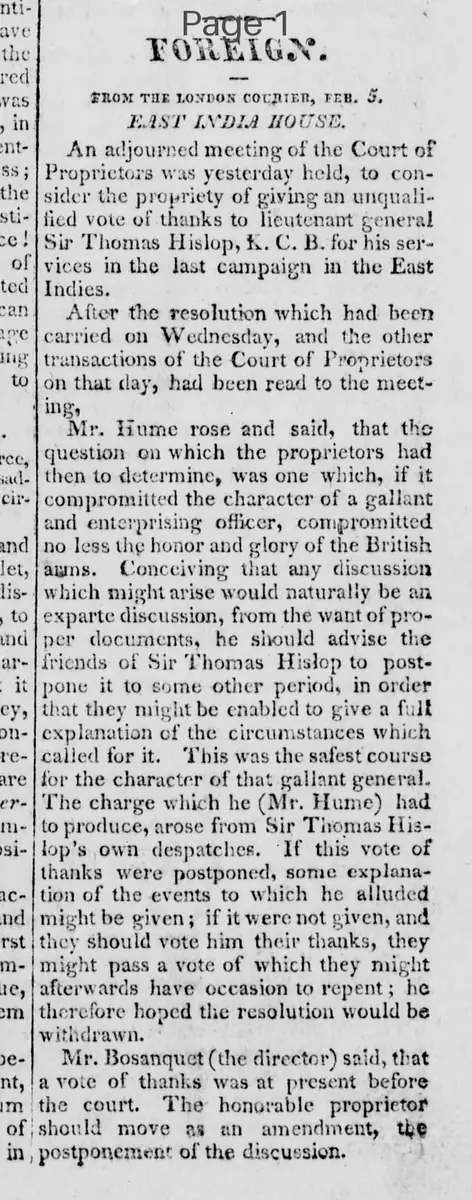
FROM THE LONDON COURIER, FEB. 5.
EAST INDIA HOUSE.
An adjourned meeting of the Court of Proprietors was yesterday held, to consider the propriety of giving an unqualified vote of thanks to lieutenant general Sir Thomas Hislop, K. C. B. for his services in the last campaign in the East Indies.
After the resolution which had been carried on Wednesday, and the other transactions of the Court of Proprietors on that day, had been read to the meeting,
Mr. Hume rose and said, that the question on which the proprietors had then to determine, was one which, if it committed the character of a gallant and enterprising officer, committed no less the honor and glory of the British arms. Conceiving that any discussion which might arise would naturally be an ex parte discussion, from the want of proper documents, he should advise the friends of Sir Thomas Hislop to postpone it to some other period, in order that they might be enabled to give a full explanation of the circumstances which called for it. This was the safest course for the character of that gallant general. The charge which he (Mr. Hume) had to produce, arose from Sir Thomas Hislop's own despatches. 'If this vote of thanks were postponed, some explanation of the events to which he alluded might be given; if it were not given, and they should vote him their thanks, they might pass a vote of which they might afterwards have occasion to repent; he therefore hoped the resolution would be withdrawn.'
Mr. Bosanquet (the director) said, that a vote of thanks was at present before the court. The honorable proprietor should move as an amendment, the postponement of the discussion.
Mr. Pattison (the chairman) said, that it was not usual to withdraw a motion without an amendment in that court; the worthy proprietor might bring the whole question before the notice of the court, if he so pleased.
A gentleman within the bar, whose name we could not learn, said, that the proper documents were not now before the court, or if they were, that few of the proprietors had read them. Some of them ought to be brought forward; at present, the charge to be made only rested on the dictum of the honorable gentleman.
Mr. Hume again rose, and said, that the accusation did not rest on his dictum alone; as circumstances now stood, he felt that he was placed in a very awkward situation, inasmuch as he was himself personally acquainted with Sir Thomas Hislop. All that he intended to do was for the honor of Sir Thomas Hislop; and he should, therefore, not enter into any extraneous discussion; but commence his remarks by desiring the clerk to read certain extracts of despatches and letters which he should point out to him.
The following extracts were accordingly read: 1. An extract from a despatch from Sir Thomas Hislop to the governor-general and commander in chief, dated Camp at Talneir, 28th of February, the purport of which was that Sir Thomas Hislop having determined to reduce the fort of Talneir, sent a letter to the Killedar, demanding him to surrender, and warning him of the consequences which would ensue if he did not. To this the Killedar returned no answer, though Sir Thomas Hislop afterwards learned, that he received the letter. In consequence of this refusal, batteries were opened against the fort, which so alarmed the Killedar, that he sent to solicit terms. He was desired to open his gates, and to surrender himself and his garrison unconditionally, which he promised to do. Some delay, however, taking place, and the day beginning to decline, the guns and Europeans were brought up to the first gate, which was entered by the Europeans at the side, by single files, without requiring to be thrown open; the next gate was found open; and at the third, the Killedar came out by the wicket, with a number of banyans, and surrendered himself to the adjutant general, lieut. col. Conway. The party advanced through another gate, and found the fifth, which led to the body of the place, shut, and the Arabs within still insisting upon terms. After some delay the wicket of this gate was opened from within, and several officers and privates of the Royal Scots entered by it. They were immediately afterwards attacked and struck down with spears and arrows. As soon as this was known to the remainder of the storming party without the walls, they made an attack upon the garrison, and succeeded in it, put the whole, consisting of 300 men, to the sword: "a severe example indeed," says Mr. Thomas Hislop, "but absolutely necessary, and one which I have no doubt will produce the most salutary effect on the future operations in this province. The Killedar I ordered to be hanged on one of the bastions immediately after the place fell. Whether he was accessory or not to the subsequent treachery of his men, his execution was a punishment justly due to his rebellion in the first instance, particularly after the warning he had received in the morning."
The next extract is a letter from the governor general to sir Thomas Hislop, dated some weeks subsequent to the former extract, approving the execution of the Killedar, ordered by sir Thos. Hislop.
The third extract was a direction issued by the governor general to the officer who had captured Bangalore, where a somewhat similar treachery had occurred on the part of the natives, ordering him to bring the two Killedars in command of the place to a drum head court martial of native officers.
The fourth extract was a minute of that court martial, by which it appeared that the two Killedars were acquitted of the charge of instigating their soldiers to the atrocious treachery which had been there committed.
The fifth and last extract was from a despatch of colonel M'Dowal, dated Mujagune, 17th of June, 1818, and which Mr. Hume said that he wished to be read, to show the effect produced on the native powers by the occurrences of Talneir; from which it appeared, that in consequence of the extreme distrust of the garrison, in the promise of the British government to spare their lives, colonel M'Dowal was compelled to sign a paper, pledging his own faith and the faith of the government that no injury should be done for their resistance.
After some conversation not very material between Mr. Pattison, Mr. Hume, Mr. Dixon, and Mr. Elphinstone, Mr. Hume consented to withdraw his amendment, under a consideration that, if he joined the vote of thanks, he was not to be considered as having consented not to bring forward the subject of Talneir on some future occasion.
What sub-type of article is it?
What keywords are associated?
What entities or persons were involved?
Where did it happen?
Foreign News Details
Primary Location
East Indies
Event Date
28th Of February; 17th Of June, 1818
Key Persons
Outcome
300 men put to the sword; killedar hanged
Event Details
Debate at East India House Court of Proprietors on vote of thanks to Sir Thomas Hislop for East Indies campaign, focusing on Talneir fort capture: Killedar surrendered but garrison attacked British troops, leading to massacre of 300 defenders and execution of Killedar. Extracts read from despatches showing approval, comparison to Bangalore incident where Killedars acquitted, and later distrust effects at Mujagune. Amendment for postponement withdrawn.