Thank you for visiting SNEWPapers!
Sign up free
The Northwest Times
Seattle, King County, Washington
What is this article about?
1950 health article on insidious tooth decay affecting the pulp without pain, causes like caries or injury, seriousness of broken teeth, need for immediate dental care, root canal treatments, and dispelling fears of 'dead teeth' with modern sterile methods ensuring long-term safety.
Clipping
OCR Quality
Full Text
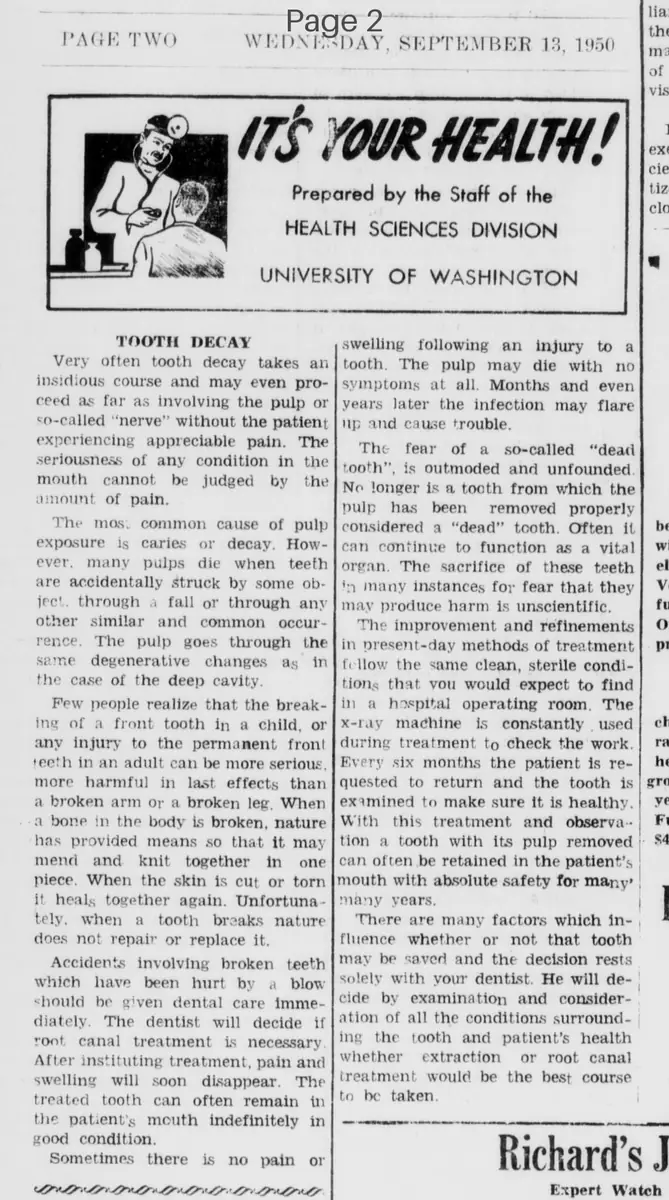
IT'S YOUR HEALTH!
Prepared by the Staff of the
HEALTH SCIENCES DIVISION
UNIVERSITY OF WASHINGTON
Very often tooth decay takes an insidious course and may even proceed as far as involving the pulp or so-called "nerve" without the patient experiencing appreciable pain. The seriousness of any condition in the mouth cannot be judged by the amount of pain.
The most common cause of pulp exposure is caries or decay. However, many pulps die when teeth are accidentally struck by some object, through a fall or through any other similar and common occurrence. The pulp goes through the same degenerative changes as in the case of the deep cavity.
Few people realize that the breaking of a front tooth in a child, or any injury to the permanent front teeth in an adult can be more serious, more harmful in last effects than a broken arm or a broken leg. When a bone in the body is broken, nature has provided means so that it may mend and knit together in one piece. When the skin is cut or torn it heals together again. Unfortunately, when a tooth breaks nature does not repair or replace it.
Accidents involving broken teeth which have been hurt by a blow should be given dental care immediately. The dentist will decide if root canal treatment is necessary. After instituting treatment, pain and swelling will soon disappear. The treated tooth can often remain in the patient's mouth indefinitely in good condition.
Sometimes there is no pain or swelling following an injury to a tooth. The pulp may die with no symptoms at all. Months and even years later the infection may flare up and cause trouble.
The fear of a so-called "dead tooth" is outmoded and unfounded. No longer is a tooth from which the pulp has been removed properly considered a "dead" tooth. Often it can continue to function as a vital organ. The sacrifice of these teeth in many instances for fear that they may produce harm is unscientific.
The improvement and refinements in present-day methods of treatment follow the same clean, sterile conditions that you would expect to find in a hospital operating room. The x-ray machine is constantly used during treatment to check the work. Every six months the patient is requested to return and the tooth is examined to make sure it is healthy. With this treatment and observation a tooth with its pulp removed can often be retained in the patient's mouth with absolute safety for many, many years.
There are many factors which influence whether or not that tooth may be saved and the decision rests solely with your dentist. He will decide by examination and consideration of all the conditions surrounding the tooth and patient's health whether extraction or root canal treatment would be the best course to be taken.
What sub-type of article is it?
What themes does it cover?
What keywords are associated?
Story Details
Story Details
Tooth decay often progresses to pulp involvement without pain; caused by caries or injury like falls. Broken teeth require immediate care; root canal treatment saves teeth unlike natural healing in bones. Modern sterile methods ensure treated teeth function safely long-term, dispelling fears of 'dead teeth'. Dentist decides between extraction and treatment based on examination.