Thank you for visiting SNEWPapers!
Sign up free
Arkansas State Gazette And Democrat
Little Rock, Pulaski County, Arkansas
What is this article about?
President Millard Fillmore's private letter to Collector Hugh Maxwell addresses George Law's reported plan to send the Crescent City to Havana in defiance of Spanish authority, potentially sparking hostilities. Fillmore asserts U.S. citizens cannot initiate war, only Congress can declare it, and warns Law against violating neutrality laws while negotiations with Spain proceed.
Clipping
OCR Quality
Full Text
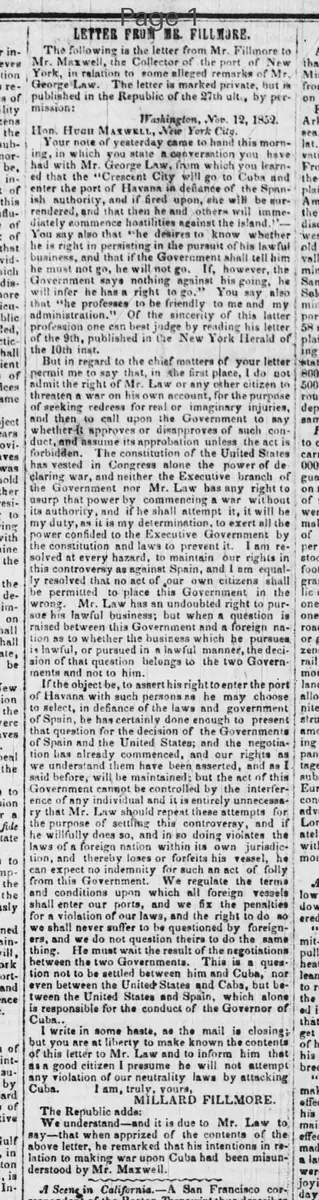
The following is the letter from Mr. Fillmore to Mr. Maxwell, the Collector of the port of New York, in relation to some alleged remarks of Mr. George Law. The letter is marked private, but is published in the Republic of the 27th ult., by permission:
Washington, Nov. 12, 1852.
Hon. Hugh Maxwell, New York City.
Your note of yesterday came to hand this morning, in which you state a conversation you have had with Mr. George Law, from which you learned that the "Crescent City will go to Cuba and enter the port of Havana in defiance of the Spanish authority, and if fired upon, she will be surrendered, and that then he and others will immediately commence hostilities against the island."
You say also that "he desires to know whether he is right in persisting in the pursuit of his lawful business, and that if the Government shall tell him he must not go, he will not go. If, however, the Government says nothing against his going, he will infer he has a right to go." You say also that "he professes to be friendly to me and my administration." Of the sincerity of this latter profession one can best judge by reading his letter of the 9th, published in the New York Herald of the 10th inst.
But in regard to the chief matters of your letter permit me to say that, in the first place, I do not admit the right of Mr. Law or any other citizen to threaten a war on his own account, for the purpose of seeking redress for real or imaginary injuries, and then to call upon the Government to say whether it approves or disapproves of such conduct, and assume its approbation unless the act is forbidden. The constitution of the United States has vested in Congress alone the power of declaring war, and neither the Executive branch of the Government nor Mr. Law has any right to usurp that power by commencing a war without its authority, and if he shall attempt it, it will be my duty, as it is my determination, to exert all the power confided to the Executive Government by the constitution and laws to prevent it. I am resolved at every hazard, to maintain our rights in this controversy as against Spain, and I am equally resolved that no act of our own citizens shall be permitted to place this Government in the wrong. Mr. Law has an undoubted right to pursue his lawful business; but when a question is raised between this Government and a foreign nation as to whether the business which he pursues is lawful, or pursued in a lawful manner, the decision of that question belongs to the two Governments and not to him.
If the object be, to assert his right to enter the port of Havana with such persons as he may choose to select, in defiance of the laws and government of Spain, he has certainly done enough to present that question for the decision of the Governments of Spain and the United States; and the negotiation has already commenced, and our rights as we understand them have been asserted, and as I said before, will be maintained: but the act of this Government cannot be controlled by the interference of any individual and it is entirely unnecessary that Mr. Law should repeat these attempts for the purpose of settling this controversy, and if he willfully does so, and in so doing violates the laws of a foreign nation within its own jurisdiction, and thereby loses or forfeits his vessel, he can expect no indemnity for such an act of folly from this Government. We regulate the terms and conditions upon which all foreign vessels shall enter our ports, and we fix the penalties for a violation of our laws, and the right to do so we shall never suffer to be questioned by foreigners, and we do not question theirs to do the same thing. He must wait the result of the negotiations between the two Governments. This is a question not to be settled between him and Cuba, nor even between the United States and Cuba, but between the United States and Spain, which alone is responsible for the conduct of the Governor of Cuba.
I write in some haste, as the mail is closing; but you are at liberty to make known the contents of this letter to Mr. Law and to inform him that as a good citizen I presume he will not attempt any violation of our neutrality laws by attacking Cuba.
I am, truly, yours,
MILLARD FILLMORE.
The Republic adds:
We understand—and it is due to Mr. Law to say—that when apprised of the contents of the above letter, he remarked that his intentions in relation to making war upon Cuba had been misunderstood by Mr. Maxwell.
What sub-type of article is it?
What themes does it cover?
What keywords are associated?
What entities or persons were involved?
Letter to Editor Details
Author
Millard Fillmore
Recipient
Hon. Hugh Maxwell, New York City
Main Argument
u.s. citizens like george law have no right to initiate war or violate neutrality laws; only congress can declare war, and the government will handle negotiations with spain over access to havana.
Notable Details