Thank you for visiting SNEWPapers!
Sign up free
The Virginia Gazette
Williamsburg, Virginia
What is this article about?
Boston newspaper publishes a letter from the Massachusetts House of Representatives, dated June 30, 1768, to the Earl of Hillsborough, defending their circular letter to other colonies protesting British parliamentary revenue acts as constitutional and loyal, criticizing Governor Bernard's misrepresentations.
Merged-components note: Continuation of the Boston letter to the Earl of Hillsborough, with sequential reading order and coherent flow on colonial grievances.
Clippings
1 of 2
OCR Quality
Full Text
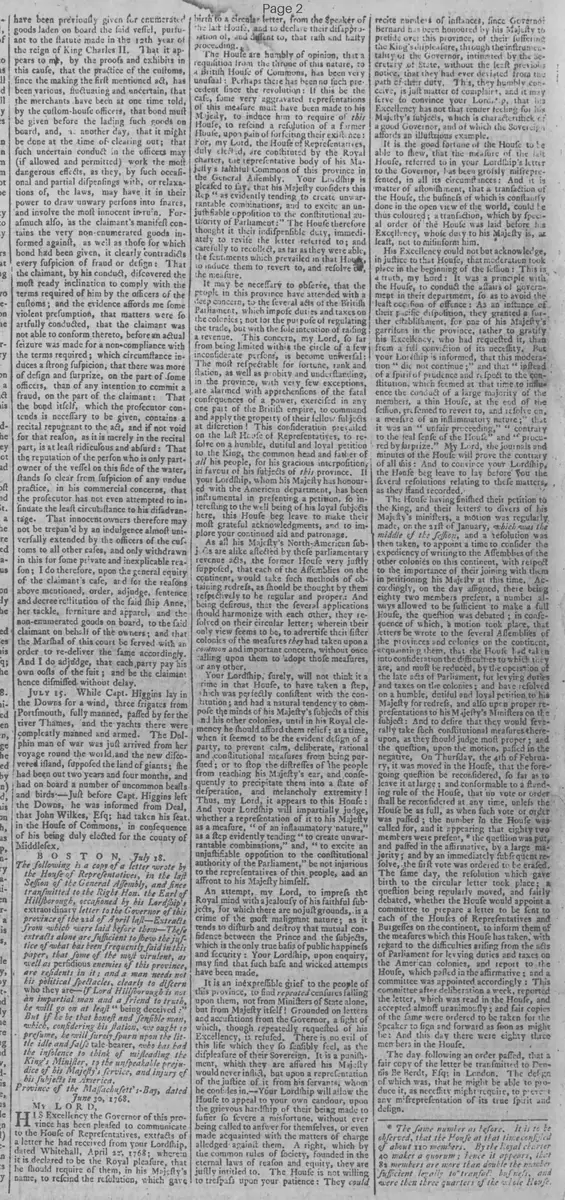
The following is a copy of a letter wrote by the House of Representatives, in the last Session of the General Assembly, and since transmitted to the Right Hon. the Earl of Hillsborough, occasioned by his Lordship's extraordinary letter to the Governor of this province of the 22d of April last—Extracts from which were laid before them. These extracts alone are sufficient to show the justice of what has been frequently said in this paper, that some of the most virulent, as well as perfidious enemies of this province, are residents in it; and a man needs not his political Spectacles, clearly to discern who they are. If Lord Hillsborough is not an impartial man and a friend to truth, he will go on at least being deceived: But if he be that honest and sensible man, which, considering his station, we ought to presume, he will surely Spurn upon the little idle and false tale-bearer, who has had the insolence to think of misleading the King's Minister, to the unspeakable prejudice of his Majesty's service, and injury of his subjects in America.
Province of the Massachusetts-Bay, dated June 30, 1768.
MY LORD,
His Excellency the Governor of this province has been pleased to communicate to the House of Representatives, extracts of a letter he had received from your Lordship, dated Whitehall, April 22. 1768; wherein it is declared to be the Royal pleasure, that he should require of them, in his Majesty's name, to rescind the resolution, which gave birth to a circular letter from the Speaker of the last House, and to declare their disapprobation of, and dissent to, that rash and hasty proceeding.
The House are humbly of opinion, that a requisition from the throne of this nature, to a British House of Commons, has been very unusual: Perhaps there has been no such precedent since the revolution: If this be the case, some very aggravated representations of this measure must have been made to his Majesty, to induce him to require of this House, to rescind a resolution of a former House, upon pain of forfeiting their existence: For, my Lord, the House of Representatives, duly elected, are constituted by the Royal charter, the representative body of his Majesty's faithful Commons of this province in the General Assembly. Your Lordship is pleased to say, that his Majesty considers this step "as evidently tending to create unwarrantable combinations, and to excite an unjustifiable opposition to the constitutional authority of Parliament:" The House therefore thought it their indispensible duty, immediately to revise the letter referred to: and carefully to recollect, as far as they were able, the sentiments which prevailed in that House, to induce them to revert to, and resolve on, the measure.
It may be necessary to observe, that the people in this province have attended with a deep concern, to the several acts of the British Parliament, which impose duties and taxes on the colonies; not for the purpose of regulating the trade, but with the sole intention of raising a revenue. This concern, my Lord, so far from being limited within the circle of a few inconsiderate persons, is become universal: The most respectable for fortune, rank and station, as well as probity and understanding, in the province, with very few exceptions, are alarmed with apprehensions of the fatal consequences of a power, exercised in any one part of the British empire, to command and apply the property of their fellow subjects at discretion! This consideration prevailed on the last House of Representatives, to resolve on a humble, dutiful and loyal petition to the King, the common head and father of all his people, for his gracious interposition, in favour of his subjects of this province. If your Lordship, whom his Majesty has honoured with the American department, has been instrumental in presenting a petition so interesting to the well being of his loyal subjects here, this House beg leave to make their most grateful acknowledgments, and to implore your continued aid and patronage.
As all his Majesty's North-American subjects are alike affected by these parliamentary revenue acts, the former House very justly supposed, that each of the Assemblies on the continent, would take such methods of obtaining redress, as should be thought by them respectively to be regular and proper: And being desirous, that the several applications should harmonize with each other, they resolved on their circular letter; wherein their only view seems to be, to advertise their sister colonies of the measures they had taken upon a common and important concern, without once calling upon them to adopt those measures, or any other.
Your Lordship, surely, will not think it a crime in that House, to have taken a step, which was perfectly consistent with the constitution: and had a natural tendency to compose the minds of his Majesty's subjects of this and his other colonies, until in his Royal clemency he should afford them relief; at a time, when it seemed to be the evident design of a party, to prevent calm, deliberate, rational and constitutional measures from being pursued: or to stop the distresses of the people from reaching his Majesty's ear, and consequently to precipitate them into a state of desperation, and melancholy extremity!
Thus, my Lord, it appears to this House: And your Lordship will impartially judge, whether a representation of it to his Majesty as a measure, "of an inflammatory nature," as a step evidently tending "to create unwarrantable combinations," and, "to excite an unjustifiable opposition to the constitutional authority of the Parliament," be not injurious to the representatives of this people, and an affront to his Majesty himself.
An attempt, my Lord, to impress the Royal mind with a jealousy of his faithful subjects, for which there are no just grounds, is a crime of the most malignant nature; as it tends to disturb and destroy that mutual confidence between the Prince and the subjects, which is the only true basis of public happiness and security: your Lordship, upon enquiry, may find that such base and wicked attempts have been made.
It is an inexpressible grief to the people of this province, to find repeated censures falling upon them, not from Ministers of State alone, but from Majesty itself! Grounded on letters and accusations from the Governor, a sight of which, though repeatedly requested of his Excellency, is refused. There is no evil of this life which they so sensibly feel, as the displeasure of their Sovereign. It is a punishment, which they are assured his Majesty would never inflict, but upon a representation of the justice of it from his servants, whom he confides in. -- Your Lordship will allow the House to appeal to your own candour, upon the grievous hardship of their being made to suffer so severe a misfortune, without ever being called to answer for themselves, or even made acquainted with the matters of charge alledged against them. A right, which by the common rules of society, founded in the eternal laws of reason and equity, they are justly entitled to. The House is not willing to trespass upon your patience: They could recite numbers of instances, since Governor Bernard has been honoured by his Majesty to preside over this province, of their suffering the King's displeasure, though the instrumentality of the Governor, intimated by the Secretary of State, without the least previous notice, that they had ever deviated from the path of their duty. This, they humbly conceive, is just matter of complaint, and it may serve to convince your Lordship, that his Excellency has not that tender feeling for his Majesty's subjects, which is characteristick of a good Governor, and of which the Sovereign affords an illustrious example.
It is the good fortune of the House to be able to show, that the measure of the last House, referred to in your Lordship's letter to the Governor, has been grossly misrepresented, in all its circumstances: And it is matter of astonishment, that a transaction of the House, the business of which is constantly done in the open view of the world, could be thus coloured: a transaction, which by special order of the House was laid before his Excellency, whose duty to his Majesty is, at least, not to misinform him,
His Excellency could not but acknowledge, in justice to that House, that moderation took place in the beginning of the session: This is a truth, my Lord: It was a principle with the House, to conduct the affairs of government in their department, so as to avoid the least occasion of offence: As an instance of their pacific disposition, they granted a further establishment, or one of his Majesty's garrisons in the province, rather to gratify his Excellency, who had requested it, than from a full conviction of its necessity. But your Lordship is informed, that this moderation "did not continue:" and that "instead of a spirit of prudence and respect to the constitution, which seemed at that time to influence the conduct of a large majority of the members, a thin House, at the end of the session, preferred to revert to, and resolve on, a measure of an inflammatory nature;" that it was an "unfair proceeding," "contrary to the real sense of the House" and "procured by surprize." My Lord, the journals and minutes of the House will prove the contrary of all this: And to convince your Lordship, the House beg leave to lay before you the several resolutions relating to these matters, as they stand recorded.
The House having Finished their petition to the King, and their letters to divers of his Majesty's ministers, a motion was regularly made, on the 21st of January, which was the middle of the Session, and a resolution was then taken, to appoint a time to consider the expediency of writing to the Assemblies of the other colonies on this continent, with respect to the importance of their joining with them in petitioning his Majesty at this time. Accordingly, on the day assigned, there being eighty two members present, a number always allowed to be sufficient to make a full House, the question was debated: in consequence of which, a motion took place, that letters be wrote to the several Assemblies of the provinces and colonies on the continent, acquainting them, that the House had taken into consideration the difficulties to which they are, and must be reduced, by the operation of the late acts of Parliament, for levying duties and taxes on the colonies: and have resolved on a humble, dutiful and loyal petition to his Majesty for redress, and also upon proper representations to his Majesty's Ministers on the subject: And to desire that they would severally take such constitutional measures thereupon, as they should judge most proper; and the question, upon the motion, passed in the negative, On Thursday, the 4th of February, it was moved in the House, that the foregoing question be reconsidered, so far as to leave it at large: and conformable to a standing rule of the House, that no vote or order shall be reconsidered at any time, unless the House be as full, as when such vote or order was passed; the number in the House was called for, and it appearing that eighty two members were present, * the question was put, and passed in the affirmative, by a large majority; and by an immediately subsequent resolve, the first vote was ordered to be erased. The same day, the resolution which gave birth to the circular letter took place; a question being regularly moved, and fairly debated, whether the House would appoint a committee to prepare a letter to be sent to each of the Houses of Representatives and Burgesses on the continent, to inform them of the measures which this House has taken, with regard to the difficulties arising from the Acts of Parliament for levying duties and taxes on the American colonies, and report to the House, which passed in the affirmative: and a committee was appointed accordingly: This committee after deliberation a week, reported the letter, which was read in the House, and accepted almost unanimously: and fair copies of the same were ordered to be taken for the Speaker to sign and forward as soon as might be: And this day there were eighty three members in the House. The day following an order passed, that a fair copy of the letter be transmitted to Dennis De Berdt, Esq; in London. The design of which was, that he might be able to produce it, as necessity might require, to prevent any misrepresentation of its true spirit and design.
* The Same number as before. It is to be observed, that the House at that time consisted of about 100 members. By the Royal charter 40 makes a quorum; Hence it appears, that 82 members are more than double the number sufficient legally to transact business, and were then three quarters of the whole House
On Saturday, the 13th of February, in order that no possible occasion might be taken by the Governor, to think that the debates and resolutions were designed to be kept a secret from his Excellency, the House came into the following resolution, viz. Whereas this House hath directed, that a letter be sent to the several Houses of Representatives and Burgesses of the British colonies on the continent, setting forth the sentiments of the House, with regard to the great difficulties that must accrue by the operation of divers acts of Parliament, for levying duties and taxes on the colonies, with the sole and express purpose of raising a revenue: and their proceedings thereon, in a humble, dutiful and loyal petition to the King, and such representations to his Majesty's ministers, as they apprehend may have a tendency to obtain redress: And whereas it is the opinion of this House, that all effectual methods should be taken to cultivate an harmony between the several branches of this government, as being necessary to promote the prosperity of his Majesty's government in this province: Resolved, that a committee wait on his Excellency the Governor, and acquaint him, that a copy of the letter aforesaid, will be laid before him as soon as it can be drafted; as well as of all the proceedings of this House relative to the said affair, if he shall desire it. And a committee was appointed, who waited on his Excellency accordingly. On Monday following the House resolved on the establishment already mentioned, which is observed only to shew your Lordship, that there was at this time no disposition in the House, "to revive unhappy divisions and distractions, prejudicial to the true interest of Great-Britain and the colonies."
The House begs leave to apologize to your Lordship, for the trouble given you, in so particular a narration of facts; which they thought necessary to satisfy your Lordship, that the resolution of the last House, referred to by your Lordship, was not an unfair proceeding, procured by surprize in a thin House, as his Majesty has been informed; but the declared sense of a large majority, when the House was full: That the Governor of the province was made fully acquainted with the measure, and never signified his disapprobation of it to the House, which it is presumed he would have done, in duty to his Majesty, if he had thought that it was of evil tendency: And that therefore that House had abundant reason to be confirmed in their own opinion of the measure, as being the production of moderation and prudence. And the House humbly rely on the Royal clemency, that to petition his Majesty, will not be deemed by him to be inconsistent with a respect to the British constitution, as settled at the revolution by William the Third: That to acquaint their fellow subjects, involved in the same distress, of their having so done, in full hopes of success, even if they had invited the union of all America in one joint application, would not be discountenanced by our most gracious Sovereign, as a measure of an inflammatory nature; that when your Lordship shall in justice lay a true state of these matters before his Majesty, he will no longer consider them as tending to create unwarrantable combinations, or excite an unjustifiable opposition to the constitutional authority of Parliament: That he will then clearly discern who are of that desperate faction, which is continually disturbing the public tranquility, and, that while his arm is extended, for the protection of his distressed and injured subjects, he will frown upon all those, who, to gratify their own passions, have dared even to attempt to deceive him!
The House of Representatives of this province, have more than once, during the administration of Governor Bernard, been under a necessity of intreating his Majesty's ministers to suspend their further judgment, upon such representations of the temper of the people, and the conduct of the Assembly, as they were able to make appear to be injurious: The same indulgence this House now beg of your Lordship: And beseech your Lordship to patronize them so far as to make a favourable representation of their conduct to the King, our Sovereign: It being the highest ambition of this House, and the people whom they represent, to stand before his Majesty in their just character of affectionate and loyal subjects.
Signed by the Speaker.
What sub-type of article is it?
What keywords are associated?
What entities or persons were involved?
Where did it happen?
Domestic News Details
Primary Location
Province Of The Massachusetts Bay
Event Date
June 30, 1768
Key Persons
Outcome
the house requests impartial judgment from hillsborough and continued patronage, emphasizing loyalty to the king and criticizing misrepresentations by the governor.
Event Details
The House responds to Hillsborough's letter demanding rescission of their circular letter on parliamentary revenue acts, arguing it was a constitutional measure to inform sister colonies of their petition to the King for redress, conducted openly in a full House, and not inflammatory; they accuse the Governor of misinforming the Crown and seek fair representation.