Thank you for visiting SNEWPapers!
Sign up free
Literary
June 13, 1835
The Northern Star, And Constitutionalist
Warren, Bristol County, Rhode Island
What is this article about?
A poem inspired by Michaud's account of an Egyptian funeral procession, where the dead pauses at friends' doors for farewell and enemies' for reconciliation. It depicts bearers slowly carrying the deceased, with imagined speeches from the corpse.
Clipping
OCR Quality
98%
Excellent
Full Text
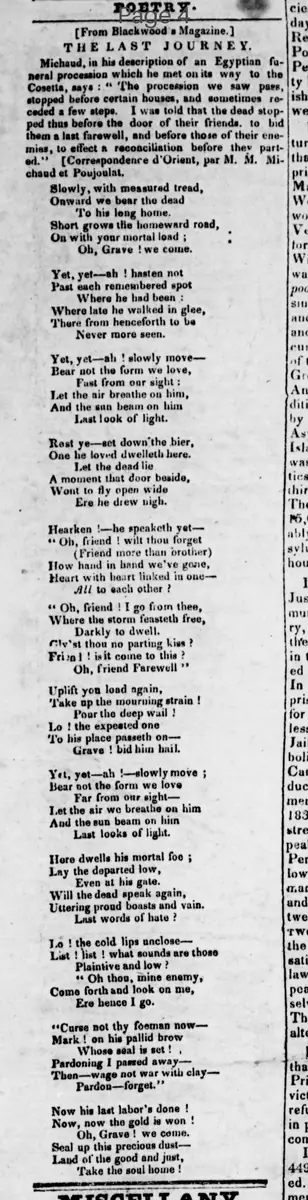
[From Blackwood's Magazine.]
THE LAST JOURNEY.
Michaud, in his description of an Egyptian funeral procession which he met on its way to the Cosetta, says: "The procession we saw passed, stopped before certain houses, and sometimes receded a few steps. I was told that the dead stopped thus before the door of their friends, to bid them a last farewell, and before those of their enemies, to effect a reconciliation before they parted." [Correspondence d'Orient, par MM. Michaud et Poujoulat.]
Slowly, with measured tread,
Onward we bear the dead
To his long home.
Short grows the homeward road,
On with your mortal load;
Oh, Grave! we come.
Yet, yet—ah! hasten not
Past each remembered spot
Where he had been:
Where late he walked in glee,
There from henceforth to be
Never more seen.
Yet, yet—ah! slowly move—
Bear not the form we love,
Fast from our sight:
Let the air breathe on him,
And the sun beam on him
Last look of light.
Rest ye—set down the bier,
One he loved dwelleth here.
Let the dead lie
A moment that door beside,
Wont to fly open wide
Ere he drew nigh.
Hearken!—he speaketh yet—
"Oh, friend! wilt thou forget
(Friend more than brother)
How hand in hand we've gone,
Heart with heart linked in one—
All to each other?
"Oh, friend! I go from thee,
Where the storm feasteth free,
Darkly to dwell.
Clov'st thou no parting kiss?
Fie! is it come to this?
Oh, friend! Farewell!"
Uplift yon load again,
Take up the mourning strain!
Pour the deep wail!
Lo! the expected one
To his place passeth on—
Grave! bid him hail.
Yet, yet—ah! slowly move;
Bear not the form we love
Far from our sight—
Let the air we breathe on him
And the sun beam on him
Last looks of light.
Here dwells his mortal part;
Lay the departed low,
Even at his gate.
Will the dead speak again,
Uttering proud boasts and vain,
Last words of hate?
Lo! the cold lips unclose—
List! list! what sounds are those,
Plaintive and low?
"Oh thou, mine enemy,
Come forth and look on me,
Ere hence I go.
"Curse not thy foeman now—
Mark! on his pallid brow
Whose seal is set!
Pardoning I pass away
Then—wage not war with clay—
Pardon—forget."
Now his last labor's done!
Now, now the goal is won!
Oh, Grave! we come.
Seal up this precious dust—
Land of the good and just,
Take the soul home!
THE LAST JOURNEY.
Michaud, in his description of an Egyptian funeral procession which he met on its way to the Cosetta, says: "The procession we saw passed, stopped before certain houses, and sometimes receded a few steps. I was told that the dead stopped thus before the door of their friends, to bid them a last farewell, and before those of their enemies, to effect a reconciliation before they parted." [Correspondence d'Orient, par MM. Michaud et Poujoulat.]
Slowly, with measured tread,
Onward we bear the dead
To his long home.
Short grows the homeward road,
On with your mortal load;
Oh, Grave! we come.
Yet, yet—ah! hasten not
Past each remembered spot
Where he had been:
Where late he walked in glee,
There from henceforth to be
Never more seen.
Yet, yet—ah! slowly move—
Bear not the form we love,
Fast from our sight:
Let the air breathe on him,
And the sun beam on him
Last look of light.
Rest ye—set down the bier,
One he loved dwelleth here.
Let the dead lie
A moment that door beside,
Wont to fly open wide
Ere he drew nigh.
Hearken!—he speaketh yet—
"Oh, friend! wilt thou forget
(Friend more than brother)
How hand in hand we've gone,
Heart with heart linked in one—
All to each other?
"Oh, friend! I go from thee,
Where the storm feasteth free,
Darkly to dwell.
Clov'st thou no parting kiss?
Fie! is it come to this?
Oh, friend! Farewell!"
Uplift yon load again,
Take up the mourning strain!
Pour the deep wail!
Lo! the expected one
To his place passeth on—
Grave! bid him hail.
Yet, yet—ah! slowly move;
Bear not the form we love
Far from our sight—
Let the air we breathe on him
And the sun beam on him
Last looks of light.
Here dwells his mortal part;
Lay the departed low,
Even at his gate.
Will the dead speak again,
Uttering proud boasts and vain,
Last words of hate?
Lo! the cold lips unclose—
List! list! what sounds are those,
Plaintive and low?
"Oh thou, mine enemy,
Come forth and look on me,
Ere hence I go.
"Curse not thy foeman now—
Mark! on his pallid brow
Whose seal is set!
Pardoning I pass away
Then—wage not war with clay—
Pardon—forget."
Now his last labor's done!
Now, now the goal is won!
Oh, Grave! we come.
Seal up this precious dust—
Land of the good and just,
Take the soul home!
What sub-type of article is it?
Poem
Elegy
Soliloquy
What themes does it cover?
Death Mortality
Friendship
Moral Virtue
What keywords are associated?
Funeral Procession
Death Farewell
Reconciliation
Elegy
Egyptian Custom
Mourning Poem
What entities or persons were involved?
From Blackwood's Magazine
Literary Details
Title
The Last Journey
Author
From Blackwood's Magazine
Subject
Inspired By Michaud's Description Of An Egyptian Funeral Procession
Form / Style
Stanzaic Poem With Imagined Speeches From The Deceased
Key Lines
Slowly, With Measured Tread,
Onward We Bear The Dead
To His Long Home.
"Oh, Friend! Wilt Thou Forget
(Friend More Than Brother)
"Oh Thou, Mine Enemy,
Come Forth And Look On Me,
Ere Hence I Go.
Seal Up This Precious Dust—
Land Of The Good And Just,
Take The Soul Home!