Thank you for visiting SNEWPapers!
Sign up free
Literary
February 10, 1835
The New Hampshire Gazette
Portsmouth, Rockingham County, New Hampshire
What is this article about?
In the village of Thebes, gossip spreads that Mrs. Morrison tried to poison her husband with arsenic in tea and verdigris in marmalade, stemming from a misunderstanding about bell-metal kettles. The rumor is debunked by a witness, but persists until the Morrisons host a party and reveal their ordinary backgrounds, quelling the scandal.
Clipping
OCR Quality
95%
Excellent
Full Text
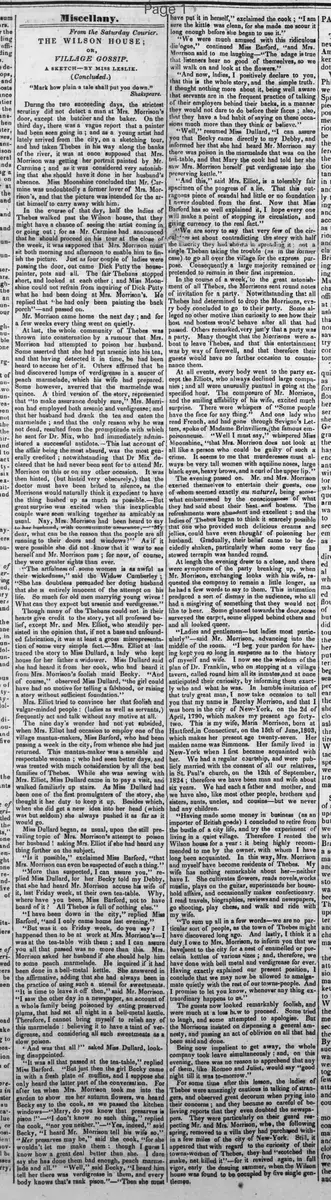
Miscellany.
From the Saturday Courier.
THE 'WILSON' HOUSE;
OR,
VILLAGE GOSSIP:
A SKETCH—BY MISS LESLIE
(Concluded.)
"Mark how plain a tale shall put you down."
Shakspeare.
During the two succeeding days, the strictest scrutiny did not detect a man at Mrs. Morrison's door, except the butcher and the baker. On the third day, there was a vague report that a painter had been seen going in; and as a young artist had lately arrived from the city, on a sketching tour, and had taken Thebes in his way along the banks of the river, it was at once supposed that Mrs. Morrison was getting her portrait painted by Mr. Carmine; and as it was considered very astonishing that she should have it done in her husband's absence. Miss Moonshine concluded that Mr. Carmine was undoubtedly a former lover of Mrs. Morrison's, and that the picture was intended for the artist himself to carry away with him.
In the course of that day, half the ladies of Thebes walked past the Wilson house, that they might have a chance of seeing the artist coming in or going out; for as Mr. Carmine had announced that he should proceed on his tour at the close of the week, it was supposed that Mrs. Morrison must sit both morning and afternoon to enable him to finish the picture. Just as our couple of ladies were passing the door, out came Dick Putty the house-painter, pots and all. The fair Thebans stopped short, and looked at each other; and Miss Moonshine could not refrain from inquiring of Dick Putty what he had been doing at Mrs. Morrison's. He replied that "he had only been painting the back porch"—and passed on.
Mr. Morrison came home the next day; and for a few weeks every thing went on quietly.
At last, the whole community of Thebes was thrown into consternation by a rumour that Mrs. Morrison had attempted to poison her husband. Some asserted that she had put arsenic into his tea, and that having detected it in time, he had been heard to accuse her of it. Others affirmed that he had discovered lumps of verdigrease in a saucer of peach marmelade, which his wife had prepared. Some however, averred that the marmelade was quince. A third version of the story, represented that "to make assurance doubly sure" Mrs. Morrison had employed both arsenic and verdigrease; and that her husband had drank the tea and eaten the marmelade; and that the only reason why he was not dead, resulted from the promptitude with which he sent for Dr. Mix, who had immediately administered a successful antidote.—This last account of the affair being the most absurd, was the most generally credited; notwithstanding that Dr. Mix declared that he had never been sent for to attend Mr. Morrison on this or on any other occasion. It was then hinted, (but hinted very obscurely,) that the doctor must have been bribed to silence, as the Morrisons would naturally think it expedient to have the thing hushed up as much as possible.—But great surprise was excited when this inexplicable couple were seen walking together as amicably as usual. Nay, Mrs. Morrison had been heard to say to her husband, with consummate assurance,—"My dear, what can be the reason that the people are all running to their doors and windows?" As if it were possible she did not know that it was to see herself and Mr. Morrison pass; for now, of course, they were greater sights than ever.
,"The artfulness of some women is as awful as their wickedness," said the Widow Cumberley; "She has doubtless persuaded her doting husband that she is entirely innocent of the attempt on his life. So much for old men marrying young wives! What can they expect but arsenic and verdigrease."
Though many of the Thebans could not in their hearts give credit to the story, yet all professed belief, except Mr. and Mrs. Elliot, who steadily persisted in the opinion that, if not a base and unfounded fabrication, it was at least a gross misrepresentation of some very simple fact.—Mrs. Elliot at last traced the story to Miss Dullard, a lady who kept house for her father a widower. Miss Dullard said she had heard it from her cook, who had heard it from Mrs. Morrison's foolish maid Becky. "And of course," observed Miss Dullard, "the girl could have had no motive for telling a falsehood, or raising a story without sufficient foundation."
Mrs. Elliot tried to convince her that foolish and vulgar-minded people: (ladies as well as servants,) frequently act and talk without any motive at all.
The nine day's wonder had not yet subsided, when Mrs. Elliot had occasion to employ one of the village mantua-makers, Miss Barford, who had been passing a week in the city, from whence she had just returned. This mantua-maker was a sensible and respectable woman; who had seen better days, and was treated with much consideration by all the best families of Thebes. While she was sewing with Mrs. Elliot, Miss Dullard came in to pay a visit, and walked familiarly up stairs. As Miss Dullard had been one of the first promulgaters of the story, she thought it her duty to keep it up. Besides which, when she did get a new idea into her head (which was but seldom) she always pushed it as far as it would go.
Miss Dullard began, as usual, upon the still prevailing topic of Mrs. Morrison's attempt to poison her husband! asking Mrs. Elliot if she had heard any thing further on the subject.
"Is it possible," exclaimed Miss Barford, "that Mrs. Morrison can even be suspected of such a thing."
"More than suspected, I can assure you," replied Miss Dullard, for her Becky told my Debby, that she had heard Mr. Morrison accuse his wife of it, last Friday week, at their own tea-table. Why, where have you been, Miss Barford, not to have heard of it? All Thebes is full of nothing else."
"I have been down in the city," replied Miss Barford, "and I only came home last evening."
"But was it on Friday week, do you say? I happened then to be at work at Mrs. Morrison's—I was at the tea-table with them; and I can assure you all that passed was no more than this. Mrs. Morrison asked her husband if she should help him to some peach marmelade. He inquired if it had been done in a bell-metal kettle. She answered in the affirmative, adding that she had always been in the practice of using such a utensil for sweetmeats.
"It is time to leave it off then," said Mr. Morrison. "I saw the other day in a newspaper, an account of a whole family being poisoned by eating preserved plums, that had set all night in a bell-metal kettle. Therefore, I cannot bring myself to relish any of this marmelade: believing it to have a taint of verdigrease, and considering all such sweetmeats as a slow poison."
"And was that all?" asked Miss Dullard, looking disappointed.
"It was all that passed at the tea-table," replied Miss Barford. "But just then the girl Becky came in with a fresh plate of muffins, and I suppose she only heard the latter part of the conversation. For after tea when Mrs. Morrison took me into the garden to show me her autumn flowers, we heard Becky say to the cook, as we passed the kitchen windows—"Mery, do you know that presarves is pison!"—"I don't know no such thing," replied the cook, "nor you neither." "Yes, indeed," said Becky, "I heard Mr. Morrison tell his wife so."
"Her presarves may be," said the cook, "for she wouldn't let me make them: though I guess I know how a great deal better than she. I dare say she has done them bad enough, peach marmelade and all." "Well," said Becky, "I heard him tell her there was verdigrease in them, and every body knows that's rank pison." "Then she must have put it in herself," exclaimed the cook; "I am sure the kettle was clean, for she made me scour it long enough before she began to use it."
We were much amused with this ridiculous dialogue," continued Miss Barford, "and Mrs. Morrison said to me laughing—'The adage is true that listeners hear no good of themselves, so we will walk on and look at the flowers.'"
"And now, ladies, I positively declare to you, that this is the whole story, and the simple truth. I thought nothing more about it, being well aware that servants are in the frequent practice of talking of their employers behind their backs, in a manner they would not dare to do before their faces; also, that they have a bad habit of saying on these occasions much more than they think or believe."
"Well," resumed Miss Dullard, "I can assure you that Becky came directly to my Debby, and informed her that she had heard Mr. Morrison say there was poison in the marmelade that was on the tea-table, and that Mary the cook had told her she saw Mrs. Morrison herself put verdigrease into the preserving kettle."
"And this," said Mrs. Elliot, "is a tolerably fair specimen of the progress of a lie. That this outrageous piece of scandal had little or no foundation I never doubted from the first. Now that Miss Barford has so well explained it, I hope every one will make a point of stopping its circulation, and giving currency to the real fact."
"We are sorry to say that very few of the circulators set about contradicting the story with half the alacrity they had shown in spreading it; not a single Theban taking the trouble (as in the former case), to go all over the village for the express purpose. Consequently a large majority remained or pretended to remain in their first impression.
In the course of a week, "to the great astonishment of all Thebes, the Morrisons sent round notes of invitation for a party. Notwithstanding that all Thebes had determined to drop the Morrisons, every body concluded to go to their party. Some alleged no other motive than curiosity to see how their host and hostess would behave after all that had passed. Others remarked, very justly that a party was a party. Many thought that the Morrisons were about to leave Thebes, and that this entertainment was by way of farewell, and that therefore their guests would have no farther occasion to countenance them.
At all events, every body went to the party except the Elliots, who always declined large companies; and all were unusually punctual in going at the specified hour. The composure of Mr. Morrison, and the smiling affability of his wife, excited much surprise. There were whispers of "Some people have the face for any thing." And one lady who read French, and had gone through Sevigne's Letters, spoke of Madame Brinvilliers, the famous empoisonneuse. "Well I must say," whispered Miss Moonshine, "that Mrs. Morrison does not look at all like a person who could be guilty of such a crime. It seems to me that murderesses must always be very tall women with aquiline noses, large black eyes, heavy brows, and a curl of the upper lip.'
The evening passed on. Mr. and Mrs. Morrison exerted themselves to entertain their guests, one of whom seemed exactly au naturel, being somewhat embarrassed by the consciousness of what they had said about their host and hostess. The refreshments were abundant and excellent; and the ladies of Thebes began to think it scarcely possible that one who provided such delicious creams and jellies, could have even thought of poisoning her husband. Gradually, their belief came to be decidedly shaken, particularly when some very fine stewed terrapin was handed round.
At length the evening drew to a close, and there were symptoms of the party breaking up, when Mr. Morrison, exchanging looks with his wife, requested the company to remain a little longer, as he had a few words to say to them. This intimation produced a sort of dismay in the audience, who all had a misgiving of something that they would not like to hear. Some glanced towards the door, some surveyed the carpet, some slipped behind others and all looked queer.
"Ladies and gentlemen—but ladies most particularly"—said Mr. Morrison, advancing into the middle of the room. "I beg your pardon for having kept you so long in suspense as to the history of myself and wife. I now see the wisdom of the plan of Dr. Franklin, who on stopping at a village tavern, called round him all its inmates, and at once anticipated their curiosity, by informing them exactly who and what he was. In humble imitation of that truly great man, I now take occasion to tell you that my name is Barclay Morrison, and that I was born in the city of New-York, on the 2d of April, 1790, which makes my present age forty-two. This is my wife, Maria Morrison, born at Hartford, in Connecticut, on the 15th of June, 1803, which makes her present age twenty-seven. Her maiden name was Simmons. Her family lived in New-York when I first became acquainted with her. We had a regular courtship, and were publicly married with the consent of all our relatives, in St. Paul's church, on the 12th of September, 1824; therefore we have been man and wife about six years. We had each a father and mother, and we have also, like most other people, brothers and sisters, aunts, uncles, and cousins—but we never had any children.
"Having made some money in business (as an importer of British goods) I concluded to retire from the bustle of a city life, and try the experiment of living in a quiet village. Therefore I rented the Wilson house for a year: it being highly recommended to me by the owner, with whom I have long been acquainted. In this way, Mrs. Morrison and myself have become residents of Thebes. My wife has nothing remarkable about her—neither have I. She cultivates flowers, reads novels, works muslin, plays on the guitar, superintends her household affairs, and occasionally makes confectionary. I read travels, biographies, reviews and newspapers, go shooting, play chess, and walk and ride with my wife.
"To sum up all in a few words—we are no particular sort of people, as the town of Thebes might have discovered long ago. And lastly, I think it a duty I owe to Mrs. Morrison, to inform you that we have sent to the city for a nest of enamelled or porcelain kettles of various sizes; and, therefore, we have done with bell metal and verdigrease for ever. Having exactly explained our present position, I conclude that we may now be allowed to amalgamate quietly with the rest of our towns-people. And I promise to let you know, whenever any thing extraordinary happens to us."
The guests now looked remarkably foolish, and were much at a loss how to proceed. Some tried to laugh, and some attempted to apologise. But the Morrisons insisted on dispensing a general amnesty, and passing an act of oblivion on all that had been said and done.
Being now impatient to get away, the whole company took leave simultaneously; and, on this evening, there was no reason to apprehend that any of them, like Romeo and Juliet, would say "good night till it was to-morrow."
For some time after this lesson, the ladies of Thebes were amazingly cautious in talking of strangers, and observed great decorum when prying into their concerns; and they became so careful of believing reports that they even doubted the newspapers. They were particularly on their guard respecting Mr. and Mrs. Morrison, who, the following spring, removed to a villa they had purchased within a few miles of the city of New-York. Still, it appeared that with regard to the curiosity of their townswomen of Thebes, they had "scotched the snake, not killed it"—for it revived again, in full vigor, early the ensuing summer, when the Wilson house was found to be occupied by five single gentlemen,
From the Saturday Courier.
THE 'WILSON' HOUSE;
OR,
VILLAGE GOSSIP:
A SKETCH—BY MISS LESLIE
(Concluded.)
"Mark how plain a tale shall put you down."
Shakspeare.
During the two succeeding days, the strictest scrutiny did not detect a man at Mrs. Morrison's door, except the butcher and the baker. On the third day, there was a vague report that a painter had been seen going in; and as a young artist had lately arrived from the city, on a sketching tour, and had taken Thebes in his way along the banks of the river, it was at once supposed that Mrs. Morrison was getting her portrait painted by Mr. Carmine; and as it was considered very astonishing that she should have it done in her husband's absence. Miss Moonshine concluded that Mr. Carmine was undoubtedly a former lover of Mrs. Morrison's, and that the picture was intended for the artist himself to carry away with him.
In the course of that day, half the ladies of Thebes walked past the Wilson house, that they might have a chance of seeing the artist coming in or going out; for as Mr. Carmine had announced that he should proceed on his tour at the close of the week, it was supposed that Mrs. Morrison must sit both morning and afternoon to enable him to finish the picture. Just as our couple of ladies were passing the door, out came Dick Putty the house-painter, pots and all. The fair Thebans stopped short, and looked at each other; and Miss Moonshine could not refrain from inquiring of Dick Putty what he had been doing at Mrs. Morrison's. He replied that "he had only been painting the back porch"—and passed on.
Mr. Morrison came home the next day; and for a few weeks every thing went on quietly.
At last, the whole community of Thebes was thrown into consternation by a rumour that Mrs. Morrison had attempted to poison her husband. Some asserted that she had put arsenic into his tea, and that having detected it in time, he had been heard to accuse her of it. Others affirmed that he had discovered lumps of verdigrease in a saucer of peach marmelade, which his wife had prepared. Some however, averred that the marmelade was quince. A third version of the story, represented that "to make assurance doubly sure" Mrs. Morrison had employed both arsenic and verdigrease; and that her husband had drank the tea and eaten the marmelade; and that the only reason why he was not dead, resulted from the promptitude with which he sent for Dr. Mix, who had immediately administered a successful antidote.—This last account of the affair being the most absurd, was the most generally credited; notwithstanding that Dr. Mix declared that he had never been sent for to attend Mr. Morrison on this or on any other occasion. It was then hinted, (but hinted very obscurely,) that the doctor must have been bribed to silence, as the Morrisons would naturally think it expedient to have the thing hushed up as much as possible.—But great surprise was excited when this inexplicable couple were seen walking together as amicably as usual. Nay, Mrs. Morrison had been heard to say to her husband, with consummate assurance,—"My dear, what can be the reason that the people are all running to their doors and windows?" As if it were possible she did not know that it was to see herself and Mr. Morrison pass; for now, of course, they were greater sights than ever.
,"The artfulness of some women is as awful as their wickedness," said the Widow Cumberley; "She has doubtless persuaded her doting husband that she is entirely innocent of the attempt on his life. So much for old men marrying young wives! What can they expect but arsenic and verdigrease."
Though many of the Thebans could not in their hearts give credit to the story, yet all professed belief, except Mr. and Mrs. Elliot, who steadily persisted in the opinion that, if not a base and unfounded fabrication, it was at least a gross misrepresentation of some very simple fact.—Mrs. Elliot at last traced the story to Miss Dullard, a lady who kept house for her father a widower. Miss Dullard said she had heard it from her cook, who had heard it from Mrs. Morrison's foolish maid Becky. "And of course," observed Miss Dullard, "the girl could have had no motive for telling a falsehood, or raising a story without sufficient foundation."
Mrs. Elliot tried to convince her that foolish and vulgar-minded people: (ladies as well as servants,) frequently act and talk without any motive at all.
The nine day's wonder had not yet subsided, when Mrs. Elliot had occasion to employ one of the village mantua-makers, Miss Barford, who had been passing a week in the city, from whence she had just returned. This mantua-maker was a sensible and respectable woman; who had seen better days, and was treated with much consideration by all the best families of Thebes. While she was sewing with Mrs. Elliot, Miss Dullard came in to pay a visit, and walked familiarly up stairs. As Miss Dullard had been one of the first promulgaters of the story, she thought it her duty to keep it up. Besides which, when she did get a new idea into her head (which was but seldom) she always pushed it as far as it would go.
Miss Dullard began, as usual, upon the still prevailing topic of Mrs. Morrison's attempt to poison her husband! asking Mrs. Elliot if she had heard any thing further on the subject.
"Is it possible," exclaimed Miss Barford, "that Mrs. Morrison can even be suspected of such a thing."
"More than suspected, I can assure you," replied Miss Dullard, for her Becky told my Debby, that she had heard Mr. Morrison accuse his wife of it, last Friday week, at their own tea-table. Why, where have you been, Miss Barford, not to have heard of it? All Thebes is full of nothing else."
"I have been down in the city," replied Miss Barford, "and I only came home last evening."
"But was it on Friday week, do you say? I happened then to be at work at Mrs. Morrison's—I was at the tea-table with them; and I can assure you all that passed was no more than this. Mrs. Morrison asked her husband if she should help him to some peach marmelade. He inquired if it had been done in a bell-metal kettle. She answered in the affirmative, adding that she had always been in the practice of using such a utensil for sweetmeats.
"It is time to leave it off then," said Mr. Morrison. "I saw the other day in a newspaper, an account of a whole family being poisoned by eating preserved plums, that had set all night in a bell-metal kettle. Therefore, I cannot bring myself to relish any of this marmelade: believing it to have a taint of verdigrease, and considering all such sweetmeats as a slow poison."
"And was that all?" asked Miss Dullard, looking disappointed.
"It was all that passed at the tea-table," replied Miss Barford. "But just then the girl Becky came in with a fresh plate of muffins, and I suppose she only heard the latter part of the conversation. For after tea when Mrs. Morrison took me into the garden to show me her autumn flowers, we heard Becky say to the cook, as we passed the kitchen windows—"Mery, do you know that presarves is pison!"—"I don't know no such thing," replied the cook, "nor you neither." "Yes, indeed," said Becky, "I heard Mr. Morrison tell his wife so."
"Her presarves may be," said the cook, "for she wouldn't let me make them: though I guess I know how a great deal better than she. I dare say she has done them bad enough, peach marmelade and all." "Well," said Becky, "I heard him tell her there was verdigrease in them, and every body knows that's rank pison." "Then she must have put it in herself," exclaimed the cook; "I am sure the kettle was clean, for she made me scour it long enough before she began to use it."
We were much amused with this ridiculous dialogue," continued Miss Barford, "and Mrs. Morrison said to me laughing—'The adage is true that listeners hear no good of themselves, so we will walk on and look at the flowers.'"
"And now, ladies, I positively declare to you, that this is the whole story, and the simple truth. I thought nothing more about it, being well aware that servants are in the frequent practice of talking of their employers behind their backs, in a manner they would not dare to do before their faces; also, that they have a bad habit of saying on these occasions much more than they think or believe."
"Well," resumed Miss Dullard, "I can assure you that Becky came directly to my Debby, and informed her that she had heard Mr. Morrison say there was poison in the marmelade that was on the tea-table, and that Mary the cook had told her she saw Mrs. Morrison herself put verdigrease into the preserving kettle."
"And this," said Mrs. Elliot, "is a tolerably fair specimen of the progress of a lie. That this outrageous piece of scandal had little or no foundation I never doubted from the first. Now that Miss Barford has so well explained it, I hope every one will make a point of stopping its circulation, and giving currency to the real fact."
"We are sorry to say that very few of the circulators set about contradicting the story with half the alacrity they had shown in spreading it; not a single Theban taking the trouble (as in the former case), to go all over the village for the express purpose. Consequently a large majority remained or pretended to remain in their first impression.
In the course of a week, "to the great astonishment of all Thebes, the Morrisons sent round notes of invitation for a party. Notwithstanding that all Thebes had determined to drop the Morrisons, every body concluded to go to their party. Some alleged no other motive than curiosity to see how their host and hostess would behave after all that had passed. Others remarked, very justly that a party was a party. Many thought that the Morrisons were about to leave Thebes, and that this entertainment was by way of farewell, and that therefore their guests would have no farther occasion to countenance them.
At all events, every body went to the party except the Elliots, who always declined large companies; and all were unusually punctual in going at the specified hour. The composure of Mr. Morrison, and the smiling affability of his wife, excited much surprise. There were whispers of "Some people have the face for any thing." And one lady who read French, and had gone through Sevigne's Letters, spoke of Madame Brinvilliers, the famous empoisonneuse. "Well I must say," whispered Miss Moonshine, "that Mrs. Morrison does not look at all like a person who could be guilty of such a crime. It seems to me that murderesses must always be very tall women with aquiline noses, large black eyes, heavy brows, and a curl of the upper lip.'
The evening passed on. Mr. and Mrs. Morrison exerted themselves to entertain their guests, one of whom seemed exactly au naturel, being somewhat embarrassed by the consciousness of what they had said about their host and hostess. The refreshments were abundant and excellent; and the ladies of Thebes began to think it scarcely possible that one who provided such delicious creams and jellies, could have even thought of poisoning her husband. Gradually, their belief came to be decidedly shaken, particularly when some very fine stewed terrapin was handed round.
At length the evening drew to a close, and there were symptoms of the party breaking up, when Mr. Morrison, exchanging looks with his wife, requested the company to remain a little longer, as he had a few words to say to them. This intimation produced a sort of dismay in the audience, who all had a misgiving of something that they would not like to hear. Some glanced towards the door, some surveyed the carpet, some slipped behind others and all looked queer.
"Ladies and gentlemen—but ladies most particularly"—said Mr. Morrison, advancing into the middle of the room. "I beg your pardon for having kept you so long in suspense as to the history of myself and wife. I now see the wisdom of the plan of Dr. Franklin, who on stopping at a village tavern, called round him all its inmates, and at once anticipated their curiosity, by informing them exactly who and what he was. In humble imitation of that truly great man, I now take occasion to tell you that my name is Barclay Morrison, and that I was born in the city of New-York, on the 2d of April, 1790, which makes my present age forty-two. This is my wife, Maria Morrison, born at Hartford, in Connecticut, on the 15th of June, 1803, which makes her present age twenty-seven. Her maiden name was Simmons. Her family lived in New-York when I first became acquainted with her. We had a regular courtship, and were publicly married with the consent of all our relatives, in St. Paul's church, on the 12th of September, 1824; therefore we have been man and wife about six years. We had each a father and mother, and we have also, like most other people, brothers and sisters, aunts, uncles, and cousins—but we never had any children.
"Having made some money in business (as an importer of British goods) I concluded to retire from the bustle of a city life, and try the experiment of living in a quiet village. Therefore I rented the Wilson house for a year: it being highly recommended to me by the owner, with whom I have long been acquainted. In this way, Mrs. Morrison and myself have become residents of Thebes. My wife has nothing remarkable about her—neither have I. She cultivates flowers, reads novels, works muslin, plays on the guitar, superintends her household affairs, and occasionally makes confectionary. I read travels, biographies, reviews and newspapers, go shooting, play chess, and walk and ride with my wife.
"To sum up all in a few words—we are no particular sort of people, as the town of Thebes might have discovered long ago. And lastly, I think it a duty I owe to Mrs. Morrison, to inform you that we have sent to the city for a nest of enamelled or porcelain kettles of various sizes; and, therefore, we have done with bell metal and verdigrease for ever. Having exactly explained our present position, I conclude that we may now be allowed to amalgamate quietly with the rest of our towns-people. And I promise to let you know, whenever any thing extraordinary happens to us."
The guests now looked remarkably foolish, and were much at a loss how to proceed. Some tried to laugh, and some attempted to apologise. But the Morrisons insisted on dispensing a general amnesty, and passing an act of oblivion on all that had been said and done.
Being now impatient to get away, the whole company took leave simultaneously; and, on this evening, there was no reason to apprehend that any of them, like Romeo and Juliet, would say "good night till it was to-morrow."
For some time after this lesson, the ladies of Thebes were amazingly cautious in talking of strangers, and observed great decorum when prying into their concerns; and they became so careful of believing reports that they even doubted the newspapers. They were particularly on their guard respecting Mr. and Mrs. Morrison, who, the following spring, removed to a villa they had purchased within a few miles of the city of New-York. Still, it appeared that with regard to the curiosity of their townswomen of Thebes, they had "scotched the snake, not killed it"—for it revived again, in full vigor, early the ensuing summer, when the Wilson house was found to be occupied by five single gentlemen,
What sub-type of article is it?
Prose Fiction
Satire
What themes does it cover?
Social Manners
Moral Virtue
What keywords are associated?
Village Gossip
Scandal Rumor
Poison Misunderstanding
Thebes Community
Morrison Couple
Social Satire
Servant Chatter
What entities or persons were involved?
By Miss Leslie
Literary Details
Title
The 'Wilson' House; Or, Village Gossip: A Sketch
Author
By Miss Leslie
Key Lines
"Mark How Plain A Tale Shall Put You Down." Shakspeare.
"The Artfulness Of Some Women Is As Awful As Their Wickedness," Said The Widow Cumberley; "She Has Doubtless Persuaded Her Doting Husband That She Is Entirely Innocent Of The Attempt On His Life. So Much For Old Men Marrying Young Wives! What Can They Expect But Arsenic And Verdigrease."
"And This," Said Mrs. Elliot, "Is A Tolerably Fair Specimen Of The Progress Of A Lie."
"To Sum Up All In A Few Words—We Are No Particular Sort Of People, As The Town Of Thebes Might Have Discovered Long Ago."
For Some Time After This Lesson, The Ladies Of Thebes Were Amazingly Cautious In Talking Of Strangers, And Observed Great Decorum When Prying Into Their Concerns;