Thank you for visiting SNEWPapers!
Sign up free
Literary
April 9, 1925
Paris Express
Paris, Logan County, Arkansas
What is this article about?
In 'The Blue Circle' by Elizabeth Jordan, Renshaw, a young man with a mental obsession from a past shock, arrives at Tawno Ker, the home of invalid David Campbell, seeking employment. He encounters mysterious sounds and the butler's subtle disapproval, beginning his integration into the household with its attractive granddaughter.
Merged-components note: Image is embedded within the serialized story columns based on bbox overlap.
Clipping
OCR Quality
75%
Good
Full Text
The Blue Circle
By ELIZABETH JORDAN
MYSTERY AND LOVE
Here's a story by Elizabeth Jordan, which, of course, is assurance that it's a tale worth reading. It's a sort of "ghost story"—a big old house full of mysterious noises of the kind that give you cold shivers up your back. The hero is a young man who has had a mental shock which has not impaired his mind, but has given him a singular obsession. He takes employment with an old invalid, with an attractive granddaughter. And immediately his adventures begin. He starts out with the hostility of the pretty granddaughter and the tolerance of the old man. But events quickly change all that. The hero finds himself and clears up the mystery and, of course, wins the girl.
It's a wonder that Elizabeth Jordan finds time to write the stories that have given her a large public. Never was there a woman who had more irons in the fire. She's been a newspaper writer and editor and magazine editor and literary adviser. Nowadays she's a member of Mayor's Committee of Women, New York; Big Sisters' association, National Institute of Social Sciences, Authors' League of America, American Commission of Mercy, Society of American Dramatists and Composers, American P. E. N., vice president Notre Dame Alumni association, regent National Woman's Suffrage association, etc., etc.
Chapter I
-1-
A Man Cast Down.
Renshaw stopped at the entrance to the grounds of the country house he was approaching and surveyed the building with the detached expression of a baby that is being kissed. Presumably, something agreeable was happening to him, but he could not whip up much interest in the episode. He had arrived at Tawno Ker, the home of David Campbell, and, incidentally, his own future home. In the absence of any conveyance, he had walked from the station—a little matter of a mile and a half—and he was more than ready to set down his handbag and feel sorry for himself and remove some of the dust of the road from his shoes before he appeared to his new employer.
The fact that the employer did not as yet realize that Renshaw was to be his new employee did not disturb the young man. Campbell would know that soon enough. In the meantime there was the place to be looked over. Possibly he, Renshaw, would not like the place—in which case, of course, he need not present himself to its owner.
He took off his hat, however, and, leaning languidly against a stone pillar of the wide gateway, let the late October breeze cool his head. It was a strikingly well-shaped head, obviously capable of more interior work than its owner was now requiring of it. Of late, Renshaw had lost interest in most matters. For two years he had stood outside of himself, watching the undirected course of his existence.
He turned upon the driveway leading to the old red brick house before him a pair of eyes that matched his hair in color. They were very dark brown eyes, almost black. Nature, in giving them to him, had shown characteristic indifference to the sufferings of women. But it was long since Renshaw had turned those eyes on women—or, indeed, on anything else—with other than the remote expression that had become habitual to them.
With this expression he surveyed the two rows of maple trees that guarded the driveway, like lines of footmen in gorgeous livery separating to permit visitors to pass. He really must look at the place. Yes, he must. He must decide whether or not he was going into that house to see David Campbell and work for him. He lashed his will to the task, and his will, like an unwilling horse, shied and side-stepped. He forced it to the effort. He would look at the house, anyway—and then, an inner voice again suggested, perhaps he wouldn't have to go in.
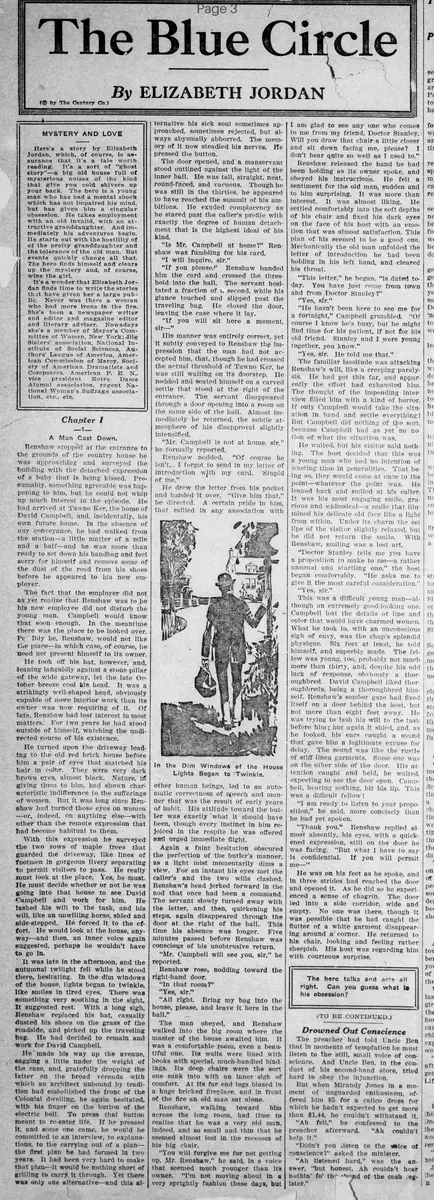
It was late in the afternoon, and the autumnal twilight fell while he stood there, hesitating. In the dim windows of the house, lights began to twinkle, like smiles in tired eyes. There was something very soothing in the sight. It suggested rest. With a long sigh, Renshaw replaced his hat, casually dusted his shoes on the grass of the roadside, and picked up the traveling bag. He had decided to remain and work for David Campbell.
He made his way up the avenue, sagging a little under the weight of the case, and, gratefully dropping the latter on the broad veranda with which an architect unbound by tradition had embellished the front of the Colonial dwelling, he again hesitated, with his finger on the button of the electric bell. To press that button meant to re-enter life. If he pressed it, and some one came, he would be committed to an interview, to explanations, to the carrying out of a plan—the first plan he had formed in two years. It had been very hard to make that plan—it would be nothing short of grilling to carry it through. Yet there was only one alternative—and this alternative his sick soul sometimes approached, sometimes rejected, but always abysmally abhorred. The memory of it now steadied his nerves. He pressed the button.
The door opened, and a manservant stood outlined against the light of the inner hall. He was tall, straight, neat, round-faced, and vacuous. Though he was still in the thirties, he appeared to have reached the summit of his ambitions. He exuded complacency as he stared past the caller's profile with exactly the degree of human detachment that is the highest ideal of his kind.
"Is Mr. Campbell at home?" Renshaw was fumbling for his card.
"I will inquire, sir."
"If you please." Renshaw handed him the card and crossed the threshold into the hall. The servant hesitated a fraction of a second, while his glance touched and slipped past the traveling bag. He closed the door, leaving the case where it lay.
"If you will sit here a moment, sir—"
His manner was entirely correct, yet it subtly conveyed to Renshaw the impression that the man had not accepted him, that, though he had crossed the actual threshold of Tawno Ker, he was still waiting on its doorstep. He nodded and seated himself on a carved settle that stood at the right of the entrance.
The servant disappeared through a door opening into a room on the same side of the hall. Almost immediately he returned, the subtle atmosphere of his disapproval slightly intensified.
"Mr. Campbell is not at home, sir," he formally reported.
Renshaw nodded.
"Of course he isn't. I forgot to send in my letter of introduction with my card. Stupid of me."
He drew the letter from his pocket and handed it over. "Give him that," he directed. A certain pride in him, that rallied in any association with other human beings, led to an automatic correctness of speech and manner that was the result of early years of habit. His attitude toward the butler was exactly what it should have been, though every instinct in him rejoiced in the respite he was offered and urged immediate flight.
Again a faint hesitation obscured the perfection of the butler's manner, as a light mist momentarily dims a view. For an instant his eyes met the caller's and the two wills clashed. Renshaw's head jerked forward in the nod that once had been a command. The servant slowly turned away with the letter, and then, quickening his steps, again disappeared through the door at the right of the hall.
This time his absence was longer. Five minutes passed before Renshaw was conscious of his unobtrusive return.
"Mr. Campbell will see you, sir," he reported.
Renshaw rose, nodding toward the right-hand door.
"In that room?"
"Yes, sir."
"All right. Bring my bag into the house, please, and leave it here in the hall."
The man obeyed, and Renshaw walked into the big room where the master of the house awaited him. It was a comfortable room, even a beautiful one. Its walls were lined with books with special, much-handled bindings. Its deep chairs were the sort one sank into with an inner sigh of comfort. At its far end logs blazed in a huge bricked fireplace, and in front of the fire an old man sat alone.
Renshaw, walking toward him across the long room, had time to realize that he was a very old man, indeed, and so small and thin that he seemed almost lost in the recesses of his big chair.
"You will forgive me for not getting up, Mr. Renshaw," he said, in a voice that seemed much younger than its owner. "I'm not moving about in a very sprightly fashion these days, but I am glad to see any one who comes to me from my friend, Doctor Stanley.
Will you draw that chair a little closer and sit down facing me, please? I don't hear quite so well as I used to."
Renshaw released the hand he had been holding as its owner spoke, and obeyed his instructions. He felt a sentiment for the old man, sudden and to him surprising. It was more than interest. It was almost liking. He settled comfortably into the soft depths of his chair and fixed his dark eyes on the face of his host with an emotion that was almost satisfaction. This plan of his seemed to be a good one.
Mechanically the old man unfolded the letter of introduction he had been holding in his left hand, and cleared his throat.
"This letter," he began, "is dated today. You have just come from town and from Doctor Stanley?"
"Yes, sir."
"He hasn't been here to see me for a fortnight," Campbell grumbled. "Of course I know he's busy, but he might find time for his patient, if not for his old friend. Stanley and I were young together, you know."
"Yes, sir. He told me that."
The familiar lassitude was attacking Renshaw's will, like a creeping paralysis. He had got this far, and apparently the effort had exhausted him. The thought of the impending interview filled him with a kind of horror. If only Campbell would take the situation in hand and settle everything! But Campbell did nothing of the sort, because Campbell had as yet no notion of what the situation was.
He waited, but his visitor said nothing. The host decided that this was a young man who had no intention of wasting time in generalities. That being so, they would come at once to the point—whatever the point was. He leaned back and smiled at his caller. It was his most engaging smile, gracious and whimsical—a smile that illuminated his delicate old face like a light from within. Under its charm the set lips of the visitor slightly relaxed, but he did not return the smile. With Renshaw, smiling was a lost art.
"Doctor Stanley tells me you have a proposition to make to me—a rather unusual and startling one," the host began comfortably. "He asks me to give it the most careful consideration."
"Yes, sir."
This was a difficult young man—although an extremely good-looking one, Campbell noted. He lost the details of line and color that would have charmed women. What he took in, with an unconscious sigh of envy, was the chap's splendid physique. Six feet at least, he told himself, and superbly made. The fellow was young, too, probably not much more than thirty, and, despite his odd lack of response, obviously a thoroughbred. David Campbell liked thoroughbreds, being a thoroughbred himself.
Renshaw's somber gaze had fixed itself on a door behind the host, but not more than eight feet away. He was trying to lash his will to the task before him; but again it shied, and, as he looked, his ears caught a sound that gave him a legitimate excuse for delay. The sound was like the rustle of stiff linen garments. Some one was on the other side of the door. His attention caught and held, he waited, expecting to see the door open. Campbell, hearing nothing, bit his lip. This was a difficult fellow!
"I am ready to listen to your proposition," he said, more concisely than he had yet spoken.
"Thank you." Renshaw replied almost absently, his eyes, with a quickened expression, still on the door he was facing. "But what I have to say is confidential. If you will permit me—"
He was on his feet as he spoke, and in three strides had reached the door and opened it. As he did so he experienced a sense of chagrin. The door led into a side corridor, wide and empty. No one was there, though it was possible that he had caught the flutter of a white garment disappearing around a corner. He returned to his chair, looking and feeling rather sheepish. His host was regarding him with courteous surprise.
The hero talks and acts all right.
Can you guess what his obsession?
(TO BE CONTINUED.)
By ELIZABETH JORDAN
MYSTERY AND LOVE
Here's a story by Elizabeth Jordan, which, of course, is assurance that it's a tale worth reading. It's a sort of "ghost story"—a big old house full of mysterious noises of the kind that give you cold shivers up your back. The hero is a young man who has had a mental shock which has not impaired his mind, but has given him a singular obsession. He takes employment with an old invalid, with an attractive granddaughter. And immediately his adventures begin. He starts out with the hostility of the pretty granddaughter and the tolerance of the old man. But events quickly change all that. The hero finds himself and clears up the mystery and, of course, wins the girl.
It's a wonder that Elizabeth Jordan finds time to write the stories that have given her a large public. Never was there a woman who had more irons in the fire. She's been a newspaper writer and editor and magazine editor and literary adviser. Nowadays she's a member of Mayor's Committee of Women, New York; Big Sisters' association, National Institute of Social Sciences, Authors' League of America, American Commission of Mercy, Society of American Dramatists and Composers, American P. E. N., vice president Notre Dame Alumni association, regent National Woman's Suffrage association, etc., etc.
Chapter I
-1-
A Man Cast Down.
Renshaw stopped at the entrance to the grounds of the country house he was approaching and surveyed the building with the detached expression of a baby that is being kissed. Presumably, something agreeable was happening to him, but he could not whip up much interest in the episode. He had arrived at Tawno Ker, the home of David Campbell, and, incidentally, his own future home. In the absence of any conveyance, he had walked from the station—a little matter of a mile and a half—and he was more than ready to set down his handbag and feel sorry for himself and remove some of the dust of the road from his shoes before he appeared to his new employer.
The fact that the employer did not as yet realize that Renshaw was to be his new employee did not disturb the young man. Campbell would know that soon enough. In the meantime there was the place to be looked over. Possibly he, Renshaw, would not like the place—in which case, of course, he need not present himself to its owner.
He took off his hat, however, and, leaning languidly against a stone pillar of the wide gateway, let the late October breeze cool his head. It was a strikingly well-shaped head, obviously capable of more interior work than its owner was now requiring of it. Of late, Renshaw had lost interest in most matters. For two years he had stood outside of himself, watching the undirected course of his existence.
He turned upon the driveway leading to the old red brick house before him a pair of eyes that matched his hair in color. They were very dark brown eyes, almost black. Nature, in giving them to him, had shown characteristic indifference to the sufferings of women. But it was long since Renshaw had turned those eyes on women—or, indeed, on anything else—with other than the remote expression that had become habitual to them.
With this expression he surveyed the two rows of maple trees that guarded the driveway, like lines of footmen in gorgeous livery separating to permit visitors to pass. He really must look at the place. Yes, he must. He must decide whether or not he was going into that house to see David Campbell and work for him. He lashed his will to the task, and his will, like an unwilling horse, shied and side-stepped. He forced it to the effort. He would look at the house, anyway—and then, an inner voice again suggested, perhaps he wouldn't have to go in.
It was late in the afternoon, and the autumnal twilight fell while he stood there, hesitating. In the dim windows of the house, lights began to twinkle, like smiles in tired eyes. There was something very soothing in the sight. It suggested rest. With a long sigh, Renshaw replaced his hat, casually dusted his shoes on the grass of the roadside, and picked up the traveling bag. He had decided to remain and work for David Campbell.
He made his way up the avenue, sagging a little under the weight of the case, and, gratefully dropping the latter on the broad veranda with which an architect unbound by tradition had embellished the front of the Colonial dwelling, he again hesitated, with his finger on the button of the electric bell. To press that button meant to re-enter life. If he pressed it, and some one came, he would be committed to an interview, to explanations, to the carrying out of a plan—the first plan he had formed in two years. It had been very hard to make that plan—it would be nothing short of grilling to carry it through. Yet there was only one alternative—and this alternative his sick soul sometimes approached, sometimes rejected, but always abysmally abhorred. The memory of it now steadied his nerves. He pressed the button.
The door opened, and a manservant stood outlined against the light of the inner hall. He was tall, straight, neat, round-faced, and vacuous. Though he was still in the thirties, he appeared to have reached the summit of his ambitions. He exuded complacency as he stared past the caller's profile with exactly the degree of human detachment that is the highest ideal of his kind.
"Is Mr. Campbell at home?" Renshaw was fumbling for his card.
"I will inquire, sir."
"If you please." Renshaw handed him the card and crossed the threshold into the hall. The servant hesitated a fraction of a second, while his glance touched and slipped past the traveling bag. He closed the door, leaving the case where it lay.
"If you will sit here a moment, sir—"
His manner was entirely correct, yet it subtly conveyed to Renshaw the impression that the man had not accepted him, that, though he had crossed the actual threshold of Tawno Ker, he was still waiting on its doorstep. He nodded and seated himself on a carved settle that stood at the right of the entrance.
The servant disappeared through a door opening into a room on the same side of the hall. Almost immediately he returned, the subtle atmosphere of his disapproval slightly intensified.
"Mr. Campbell is not at home, sir," he formally reported.
Renshaw nodded.
"Of course he isn't. I forgot to send in my letter of introduction with my card. Stupid of me."
He drew the letter from his pocket and handed it over. "Give him that," he directed. A certain pride in him, that rallied in any association with other human beings, led to an automatic correctness of speech and manner that was the result of early years of habit. His attitude toward the butler was exactly what it should have been, though every instinct in him rejoiced in the respite he was offered and urged immediate flight.
Again a faint hesitation obscured the perfection of the butler's manner, as a light mist momentarily dims a view. For an instant his eyes met the caller's and the two wills clashed. Renshaw's head jerked forward in the nod that once had been a command. The servant slowly turned away with the letter, and then, quickening his steps, again disappeared through the door at the right of the hall.
This time his absence was longer. Five minutes passed before Renshaw was conscious of his unobtrusive return.
"Mr. Campbell will see you, sir," he reported.
Renshaw rose, nodding toward the right-hand door.
"In that room?"
"Yes, sir."
"All right. Bring my bag into the house, please, and leave it here in the hall."
The man obeyed, and Renshaw walked into the big room where the master of the house awaited him. It was a comfortable room, even a beautiful one. Its walls were lined with books with special, much-handled bindings. Its deep chairs were the sort one sank into with an inner sigh of comfort. At its far end logs blazed in a huge bricked fireplace, and in front of the fire an old man sat alone.
Renshaw, walking toward him across the long room, had time to realize that he was a very old man, indeed, and so small and thin that he seemed almost lost in the recesses of his big chair.
"You will forgive me for not getting up, Mr. Renshaw," he said, in a voice that seemed much younger than its owner. "I'm not moving about in a very sprightly fashion these days, but I am glad to see any one who comes to me from my friend, Doctor Stanley.
Will you draw that chair a little closer and sit down facing me, please? I don't hear quite so well as I used to."
Renshaw released the hand he had been holding as its owner spoke, and obeyed his instructions. He felt a sentiment for the old man, sudden and to him surprising. It was more than interest. It was almost liking. He settled comfortably into the soft depths of his chair and fixed his dark eyes on the face of his host with an emotion that was almost satisfaction. This plan of his seemed to be a good one.
Mechanically the old man unfolded the letter of introduction he had been holding in his left hand, and cleared his throat.
"This letter," he began, "is dated today. You have just come from town and from Doctor Stanley?"
"Yes, sir."
"He hasn't been here to see me for a fortnight," Campbell grumbled. "Of course I know he's busy, but he might find time for his patient, if not for his old friend. Stanley and I were young together, you know."
"Yes, sir. He told me that."
The familiar lassitude was attacking Renshaw's will, like a creeping paralysis. He had got this far, and apparently the effort had exhausted him. The thought of the impending interview filled him with a kind of horror. If only Campbell would take the situation in hand and settle everything! But Campbell did nothing of the sort, because Campbell had as yet no notion of what the situation was.
He waited, but his visitor said nothing. The host decided that this was a young man who had no intention of wasting time in generalities. That being so, they would come at once to the point—whatever the point was. He leaned back and smiled at his caller. It was his most engaging smile, gracious and whimsical—a smile that illuminated his delicate old face like a light from within. Under its charm the set lips of the visitor slightly relaxed, but he did not return the smile. With Renshaw, smiling was a lost art.
"Doctor Stanley tells me you have a proposition to make to me—a rather unusual and startling one," the host began comfortably. "He asks me to give it the most careful consideration."
"Yes, sir."
This was a difficult young man—although an extremely good-looking one, Campbell noted. He lost the details of line and color that would have charmed women. What he took in, with an unconscious sigh of envy, was the chap's splendid physique. Six feet at least, he told himself, and superbly made. The fellow was young, too, probably not much more than thirty, and, despite his odd lack of response, obviously a thoroughbred. David Campbell liked thoroughbreds, being a thoroughbred himself.
Renshaw's somber gaze had fixed itself on a door behind the host, but not more than eight feet away. He was trying to lash his will to the task before him; but again it shied, and, as he looked, his ears caught a sound that gave him a legitimate excuse for delay. The sound was like the rustle of stiff linen garments. Some one was on the other side of the door. His attention caught and held, he waited, expecting to see the door open. Campbell, hearing nothing, bit his lip. This was a difficult fellow!
"I am ready to listen to your proposition," he said, more concisely than he had yet spoken.
"Thank you." Renshaw replied almost absently, his eyes, with a quickened expression, still on the door he was facing. "But what I have to say is confidential. If you will permit me—"
He was on his feet as he spoke, and in three strides had reached the door and opened it. As he did so he experienced a sense of chagrin. The door led into a side corridor, wide and empty. No one was there, though it was possible that he had caught the flutter of a white garment disappearing around a corner. He returned to his chair, looking and feeling rather sheepish. His host was regarding him with courteous surprise.
The hero talks and acts all right.
Can you guess what his obsession?
(TO BE CONTINUED.)
What sub-type of article is it?
Prose Fiction
What themes does it cover?
Love Romance
What keywords are associated?
Ghost Story
Mystery
Romance
Obsession
Old House
Mental Shock
Country Estate
What entities or persons were involved?
By Elizabeth Jordan
Literary Details
Title
The Blue Circle Chapter I: A Man Cast Down
Author
By Elizabeth Jordan
Subject
Mystery And Love Ghost Story
Key Lines
He Had Arrived At Tawno Ker, The Home Of David Campbell, And, Incidentally, His Own Future Home.
To Press That Button Meant To Re Enter Life.
The Sound Was Like The Rustle Of Stiff Linen Garments. Some One Was On The Other Side Of The Door.
The Hero Talks And Acts All Right. Can You Guess What His Obsession?
(To Be Continued.)