Thank you for visiting SNEWPapers!
Sign up free
Editorial
June 4, 1803
The Recorder
Richmond, Virginia
What is this article about?
Editorial commenting on French and English naval engagements during the American War, highlighting French successes under admirals like D'Orvilliers, Suffrein, and against Lord Howe to argue England's naval superiority is overstated and caution against prolonged naval wars.
Clipping
OCR Quality
88%
Good
Full Text
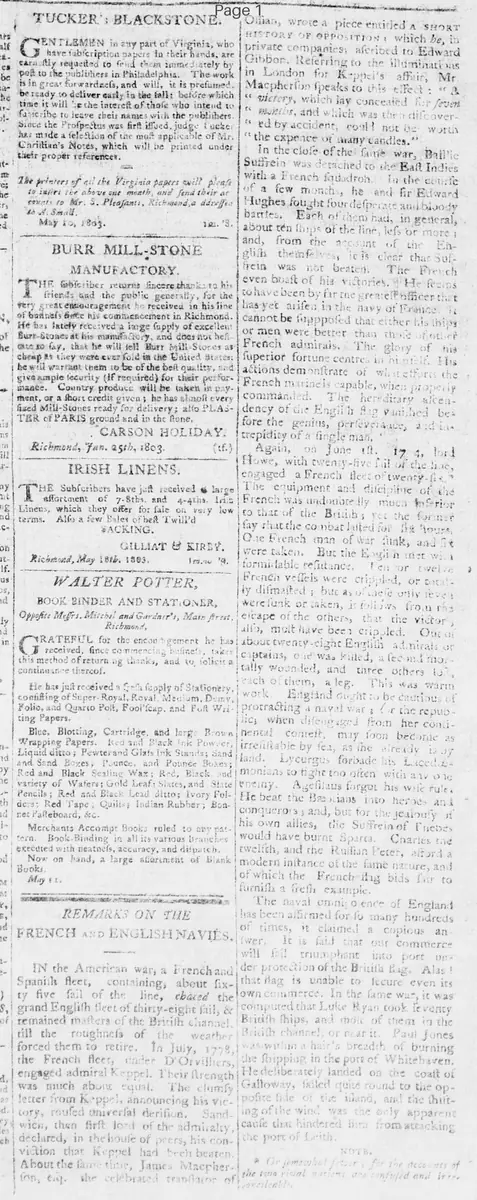
REMARKS ON THE FRENCH AND ENGLISH NAVIES.
In the American war, a French and Spanish fleet, containing about sixty-five sail of the line, chased the grand English fleet of thirty-eight sail, &c. remained masters of the British channel till the roughness of the weather forced them to retire. In July, 1778, the French fleet, under D'Orvilliers, engaged admiral Keppel. Their strength was much about equal. The clumsy letter from Keppel, announcing his victory, roused universal derision. Sandwich, then first Lord of the admiralty, declared, in the house of peers, his conviction that Keppel had been beaten.
About the same time, James Macpherson, Esq. the celebrated translator of Ossian, wrote a piece entitled a short HISTORY OF OPPOSITION: Which he, in private companies, ascribed to Edward Gibbon. Referring to the illuminati as in London for Keppel's affair, Mr. Macpherson speaks to this effect: "A victory, which lay concealed for seven months, and which was then discovered by accident, would not be worth the expense of many candles."
In the close of the same war, Baillie's Suffrein was detached to the East Indies with a French squadron. In the course of a few months, he and Sir Edward Hughes fought four desperate and bloody battles. Each of them had, in general, about ten ships of the line, less or more; and, from the account of the English themselves, it is clear that Suffrein was not beaten. The French even boast of his victories. He seems to have been by far the greatest officer that has yet arisen in the navy of France. It cannot be supposed that either his ships or men were better than those of other French admirals. The glory of his superior fortune centres in himself. His actions demonstrate of what efforts the French marine is capable, when properly commanded. The hereditary ascendency of the English flag vanished before the genius, perseverance, and intrepidity of a single man.
Again, on June 1, 1774, Lord Howe, with twenty-five sail of the line, engaged a French fleet of twenty-seven. The equipment and discipline of the French was undoubtedly much superior to that of the British: yet the former say that the combat lasted for six hours. One French man of war sunk, and six were taken. But the English met with formidable resistance. Ten or twelve French vessels were crippled, or otherwise damaged; but as only seven were sunk or taken, it follows from the escape of the others, that the victors must have been crippled. Out of twenty-eight English admirals or captains, one was killed, a second mortally wounded, and three others lost, each of them, a leg. This was war in earnest. England ought to be cautious of protracting a naval war; for the republic, when disengaged from her continental contest, may soon become as formidable by sea, as the ariel y by land. Lycurgus forbade his Lacedaemonians to fight too often with any one enemy. Agesilaus forgot his wise rule. He beat the Boiotians into heroic, and conquerors, and, but for the jealousy of his own allies, the Suffrein of Thebes would have burnt Sparta. Charles the Twelfth, and the Russian Peter, afford a modern instance of the same nature, and of which the French navy bids fair to furnish a fresh example.
The naval eminence of England has been affirmed for so many hundreds of times, to claim a copious answer. it is said that our commerce will still triumph under protection of the British flag. Alas! that flag is unable to secure even its own commerce. In the same way, it was computed that Luke Ryan took seventy British ships, and most of them in the British channel, or near it. Paul Jones was within a hair's breadth of burning the shipping in the port of Whitehaven. He deliberately landed on the coast of Galloway, sailed quite round to the opposite side of the island, and the shifting of the wind was the only apparent cause that hindered him from attacking the port of Leith.
Or some other fleet for account of the snow general wanted confused and ir.
In the American war, a French and Spanish fleet, containing about sixty-five sail of the line, chased the grand English fleet of thirty-eight sail, &c. remained masters of the British channel till the roughness of the weather forced them to retire. In July, 1778, the French fleet, under D'Orvilliers, engaged admiral Keppel. Their strength was much about equal. The clumsy letter from Keppel, announcing his victory, roused universal derision. Sandwich, then first Lord of the admiralty, declared, in the house of peers, his conviction that Keppel had been beaten.
About the same time, James Macpherson, Esq. the celebrated translator of Ossian, wrote a piece entitled a short HISTORY OF OPPOSITION: Which he, in private companies, ascribed to Edward Gibbon. Referring to the illuminati as in London for Keppel's affair, Mr. Macpherson speaks to this effect: "A victory, which lay concealed for seven months, and which was then discovered by accident, would not be worth the expense of many candles."
In the close of the same war, Baillie's Suffrein was detached to the East Indies with a French squadron. In the course of a few months, he and Sir Edward Hughes fought four desperate and bloody battles. Each of them had, in general, about ten ships of the line, less or more; and, from the account of the English themselves, it is clear that Suffrein was not beaten. The French even boast of his victories. He seems to have been by far the greatest officer that has yet arisen in the navy of France. It cannot be supposed that either his ships or men were better than those of other French admirals. The glory of his superior fortune centres in himself. His actions demonstrate of what efforts the French marine is capable, when properly commanded. The hereditary ascendency of the English flag vanished before the genius, perseverance, and intrepidity of a single man.
Again, on June 1, 1774, Lord Howe, with twenty-five sail of the line, engaged a French fleet of twenty-seven. The equipment and discipline of the French was undoubtedly much superior to that of the British: yet the former say that the combat lasted for six hours. One French man of war sunk, and six were taken. But the English met with formidable resistance. Ten or twelve French vessels were crippled, or otherwise damaged; but as only seven were sunk or taken, it follows from the escape of the others, that the victors must have been crippled. Out of twenty-eight English admirals or captains, one was killed, a second mortally wounded, and three others lost, each of them, a leg. This was war in earnest. England ought to be cautious of protracting a naval war; for the republic, when disengaged from her continental contest, may soon become as formidable by sea, as the ariel y by land. Lycurgus forbade his Lacedaemonians to fight too often with any one enemy. Agesilaus forgot his wise rule. He beat the Boiotians into heroic, and conquerors, and, but for the jealousy of his own allies, the Suffrein of Thebes would have burnt Sparta. Charles the Twelfth, and the Russian Peter, afford a modern instance of the same nature, and of which the French navy bids fair to furnish a fresh example.
The naval eminence of England has been affirmed for so many hundreds of times, to claim a copious answer. it is said that our commerce will still triumph under protection of the British flag. Alas! that flag is unable to secure even its own commerce. In the same way, it was computed that Luke Ryan took seventy British ships, and most of them in the British channel, or near it. Paul Jones was within a hair's breadth of burning the shipping in the port of Whitehaven. He deliberately landed on the coast of Galloway, sailed quite round to the opposite side of the island, and the shifting of the wind was the only apparent cause that hindered him from attacking the port of Leith.
Or some other fleet for account of the snow general wanted confused and ir.
What sub-type of article is it?
Military Affairs
War Or Peace
What keywords are associated?
French Navy
English Navy
American War
Naval Battles
Suffrein
Keppel
Lord Howe
What entities or persons were involved?
D'orvilliers
Keppel
Sandwich
James Macpherson
Edward Gibbon
Baillie's Suffrein
Sir Edward Hughes
Lord Howe
Paul Jones
Luke Ryan
Editorial Details
Primary Topic
Remarks On French And English Naval Strengths During The American War
Stance / Tone
Cautionary Against English Naval Overconfidence And Protracting Naval Wars
Key Figures
D'orvilliers
Keppel
Sandwich
James Macpherson
Edward Gibbon
Baillie's Suffrein
Sir Edward Hughes
Lord Howe
Paul Jones
Luke Ryan
Key Arguments
French And Spanish Fleet Mastered British Channel In American War
Keppel's Announced Victory Over D'orvilliers Was Dubious And Ridiculed
Suffrein Undefeated In Four Battles Against Hughes In East Indies
Suffrein's Success Shows French Navy's Potential Under Proper Command
Howe's Engagement With French Fleet Resulted In Heavy English Losses Despite Victory
English Naval Eminence Overstated As Commerce Remains Vulnerable
Historical Examples Warn Against Frequent Naval Conflicts With Capable Foes