Thank you for visiting SNEWPapers!
Sign up free
The New Hampshire Gazette And General Advertiser
Portsmouth, Rockingham County, New Hampshire
What is this article about?
Detailed account of the October 1789 riots in Paris leading to the Women's March on Versailles, forcing King Louis XVI to relocate to Paris, approve the constitution, and signaling the decline of aristocracy amid revolutionary fervor.
Merged-components note: Continuation of the article on recent riots and revolution in France across pages 1 and 2.
Clippings
1 of 2
OCR Quality
Full Text
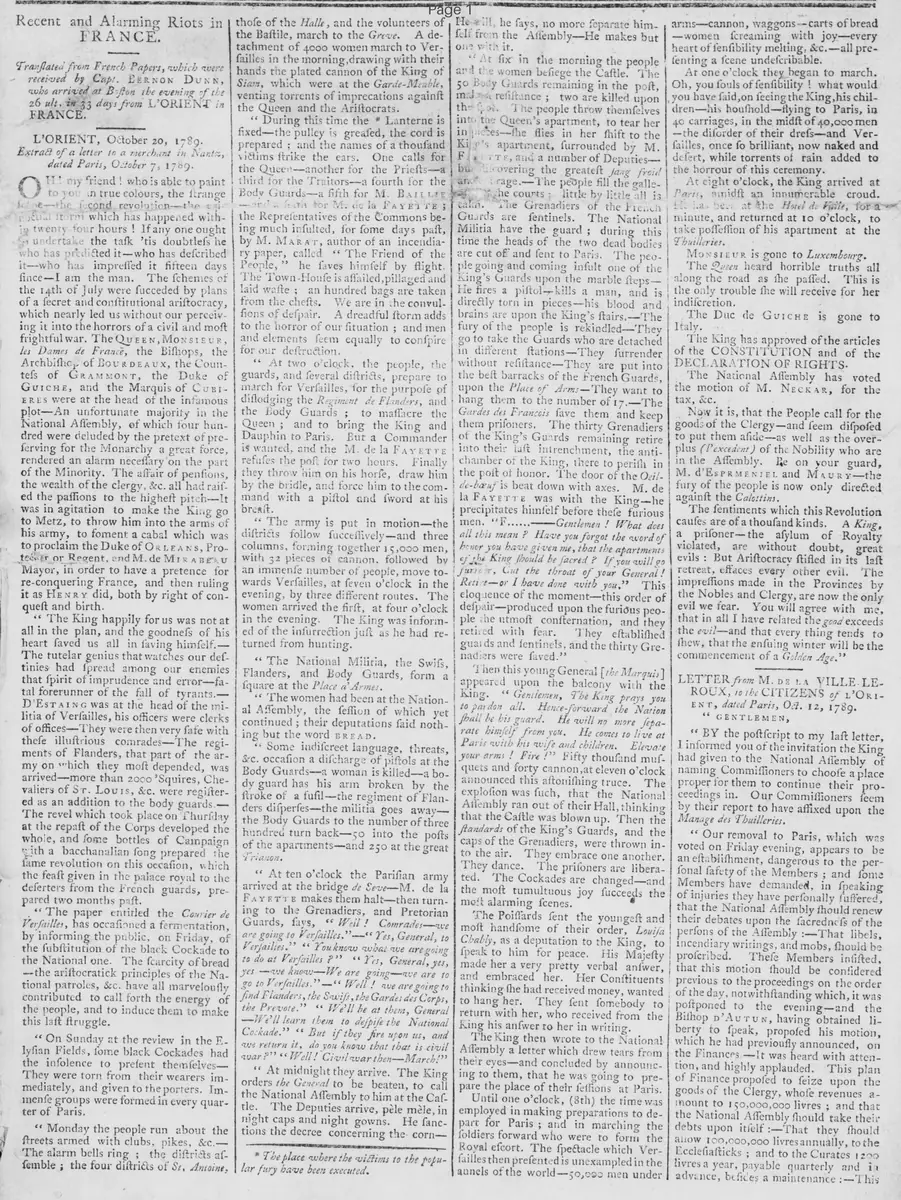
Translated from French Papers, which were received by Capt. Bernon Dunn, who arrived at Boston the evening of the 26 ult. in 33 days from L'Orient in FRANCE.
L'ORIENT, October 20, 1789.
Extract of a letter to a merchant in Nantes, dated Paris, October 7, 1789.
Ah! my friend! who is able to paint to you in true colours, the strange--the second revolution--the celestial storm which has happened within twenty four hours! If any one ought to undertake the task 'tis doubtless he who has predicted it--who has described it--who has impressed it fifteen days since--I am the man. The schemes of the 14th of July were succeeded by plans of a secret and constitutional aristocracy, which nearly led us without our perceiving it into the horrors of a civil and most frightful war. The Queen, Monsieur, the Dames de France, the Bishops, the Archbishop of Bourdeaux, the Countess of Gramont, the Duke of Guiche, and the Marquis of Cubieres were at the head of the infamous plot--An unfortunate majority in the National Assembly, of which four hundred were deluded by the pretext of preserving for the Monarchy a great force, rendered an alarm necessary on the part of the Minority. The affair of pensions, the wealth of the clergy, &c. all had raised the passions to the highest pitch--It was in agitation to make the King go to Metz, to throw him into the arms of his army, to foment a cabal which was to proclaim the Duke of Orleans, Protector or Regent, and M. de Mirabeau Mayor, in order to have a pretence for re-conquering France, and then ruling it as Henry did, both by right of conquest and birth.
The King happily for us was not at all in the plan, and the goodness of his heart saved us all in saving himself. The tutelar genius that watches our destinies had spread among our enemies that spirit of imprudence and error--fatal forerunner of the fall of tyrants. D'Estaing was at the head of the militia of Versailles, his officers were clerks of offices--They were then very safe with these illustrious comrades--The regiments of Flanders, that part of the army on which they most depended, was arrived--more than 2000 Squires, Chevaliers of St. Louis, &c. were registered as an addition to the body guards. The revel which took place on Thursday at the repast of the Corps developed the whole, and some bottles of Champagne with a bacchanalian song prepared the same revolution on this occasion, which the feast given in the palace royal to the deserters from the French guards, prepared two months past.
The paper entitled the Courier de Versailles, has occasioned a fermentation, by informing the public, on Friday, of the substitution of the black Cockade to the National one. The scarcity of bread the aristocratick principles of the National patrols, &c. have all marvellously contributed to call forth the energy of the people, and to induce them to make this last struggle.
On Sunday at the review in the Elysian Fields, some black Cockades had the insolence to present themselves--They were torn from their wearers immediately, and given to the porters. Immense groups were formed in every quarter of Paris.
Monday the people run about the streets armed with clubs, pikes, &c.--The alarm bells ring; the districts assemble; the four districts of St. Antoine, those of the Halle, and the volunteers of the Bastile, march to the Greve. A detachment of 4000 women march to Versailles in the morning, drawing with their hands the plated cannon of the King of Siam, which were at the Garde-Meuble, venting torrents of imprecations against the Queen and the Aristocrats.
During this time the Lanterne* is fixed--the pulley is greased, the cord is prepared: and the names of a thousand victims strike the ears. One calls for the Queen--another for the Priests--a third for the Traitors--a fourth for the Body Guards--a fifth for M. Bailly--and for M. de la Fayette; the Representatives of the Commons being much insulted, for some days past, by M. Marat, author of an incendiary paper, called "The Friend of the People," he saves himself by flight. The Town-House is assailed, pillaged and laid waste: an hundred bags are taken from the chests. We are in the convulsions of despair. A dreadful storm adds to the horror of our situation: and men and elements seem equally to conspire for our destruction.
At two o'clock, the people, the guards, and several districts, prepare to march for Versailles, for the purpose of dislodging the Regiment de Flanders, and the Body Guards; to massacre the Queen; and to bring the King and Dauphin to Paris. But a Commander is wanted, and M. de la Fayette refuses the post for two hours. Finally they throw him on his horse, draw him by the bridle, and force him to the command with a pistol and sword at his breast.
The army is put in motion--the districts follow successively--and three columns, forming together 15,000 men, with 32 pieces of cannon, followed by an immense number of people, move towards Versailles, at seven o'clock in the evening, by three different routes. The women arrived first, at four o'clock in the evening. The King was informed of the insurrection just as he had returned from hunting.
The National Militia, the Swiss, Flanders, and Body Guards, form a square at the Place d'Armes.
The women had been at the National Assembly, the session of which yet continued; their deputations said nothing but the word BREAD.
Some indiscreet language, threats, &c. occasion a discharge of pistols at the Body Guards--a woman is killed--a body guard has his arm broken by the stroke of a fusil--the regiment of Flanders disperses--the militia goes away--the Body Guards to the number of three hundred turn back--50 into the posts of the apartments--and 250 at the great Trianon.
At ten o'clock the Parisian army arrived at the bridge de Seve--M. de la Fayette makes them halt--then turning to the Grenadiers, and Pretorian Guards, says, "Well! Comrades--we are going to Versailles."--"Yes, General, to Versailles." "You know what we are going to do at Versailles?" "Yes, General, yes, yes--we know--we are going--we are to go to Versailles."--"Well! we are going to find Flanders, the Swiss, the Gardes des Corps, the Prevoté." "We'll be at them, General--We'll learn them to despise the National Cockade." "But if they fire upon us, and we return it, do you know that that is civil war?" "Well! Civil war then--March!"
At midnight they arrive. The King orders the General to be beaten, to call the National Assembly to him at the Castle. The Deputies arrive, pell-mell, in night caps and night gowns. He sanctions the decree concerning the corn--He will, he says, no more separate himself from the Assembly--He makes but one with it.
At six in the morning the people and the women besiege the Castle. The 50 Body Guards remaining in the post, make resistance; two are killed upon the spot. The people throw themselves into the Queen's apartment, to tear her in pieces--she flies in her shift to the King's apartment, surrounded by M. de la Fayette, and a number of Deputies--but covering the greatest sang froid and rage.--The people fill the galleries and the courts: little by little all is calm. The Grenadiers of the French Guards are sentinels. The National Militia have the guard; during this time the heads of the two dead bodies are cut off and sent to Paris. The people going and coming insult one of the King's Guards upon the marble steps--He fires a pistol--kills a man, and is directly torn in pieces--his blood and brains are upon the King's stairs.--The fury of the people is rekindled--They go to take the Guards who are detached in different stations--They surrender without resistance--They are put into the best barracks of the French Guards, upon the Place of Arms--They want to hang them to the number of 17.--The Gardes des Francois save them and keep them prisoners. The thirty Grenadiers of the King's Guards remaining retire into their last intrenchment, the anti-chamber of the King, there to perish in the post of honor. The door of the Oeil-de-boeuf is beat down with axes. M. de la Fayette was with the King--he precipitates himself before these furious men. "Gentlemen! What does all this mean? Have you forgot the word of honor you have given me, that the apartments of the King should be sacred? If you will go further, cut the throat of your General! Retire--or I have done with you." This eloquence of the moment---this order of despair--produced upon the furious people the utmost consternation, and they retired with fear. They established guards and sentinels, and the thirty Grenadiers were saved.
Then this young General [the Marquis] appeared upon the balcony with the King. "Gentlemen, The King prays you to pardon all. Hence-forward the Nation shall be his guard. He will no more separate himself from you. He comes to live at Paris with his wife and children. Elevate your arms! Fire!" Fifty thousand muskets and forty cannon, at eleven o'clock announced this astonishing truce. The explosion was such, that the National Assembly ran out of their Hall, thinking that the Castle was blown up. Then the standards of the King's Guards, and the caps of the Grenadiers, were thrown into the air. They embrace one another. They dance. The prisoners are liberated. The Cockades are changed--and the most tumultuous joy succeeds the most alarming scenes.
The Poissards sent the youngest and most handsome of their order, Louise Chabry, as a deputation to the King, to speak to him for peace. His Majesty made her a very pretty verbal answer, and embraced her. Her Constituents thinking she had received money, wanted to hang her. They sent somebody to return with her, who received from the King his answer to her in writing.
The King then wrote to the National Assembly a letter which drew tears from their eyes--and concluded by announcing to them, that he was going to prepare the place of their sessions at Paris.
Until one o'clock, (8th) the time was employed in making preparations to depart for Paris; and in marching the soldiers forward who were to form the Royal escort. The spectacle which Versailles then presented is unexampled in the annals of the world--50,000 men under arms--cannon, waggons--carts of bread--women screaming with joy--every heart of sensibility melting, &c.--all presenting a scene indescribable.
At one o'clock they began to march. Oh, you souls of sensibility! what would you have said, on seeing the King, his children--his household--flying to Paris, in 40 carriages, in the midst of 40,000 men--the disorder of their dress--and Versailles, once so brilliant, now naked and desert, while torrents of rain added to the horror of this ceremony.
At eight o'clock, the King arrived at Paris, amidst an innumerable crowd. He alighted at the Hotel de Ville, for a minute, and returned at 10 o'clock, to take possession of his apartment at the Thuilleries.
Monsieur is gone to Luxembourg.
The Queen heard horrible truths all along the road as she passed. This is the only trouble she will receive for her indiscretion.
The Duc de Guiche is gone to Italy.
The King has approved of the articles of the CONSTITUTION and of the DECLARATION OF RIGHTS.
The National Assembly has voted the motion of M. Necker, for the tax, &c.
Now it is, that the People call for the goods of the Clergy--and seem disposed to put them aside--as well as the overplus (l'excedent) of the Nobility who are in the Assembly. Be on your guard, M. d'Autun and Maury--the fury of the people is now only directed against the Calottins.
The sentiments which this Revolution causes are of a thousand kinds. A King, a prisoner--the asylum of Royalty violated, are without doubt, great evils: But Aristocracy stifled in its last retreat, effaces every other evil. The impressions made in the Provinces by the Nobles and Clergy, are now the only evil we fear. You will agree with me, that in all I have related the good exceeds the evil--and that every thing tends to show, that the ensuing winter will be the commencement of a Golden Age."
LETTER from M. DE LA VILLE-LE-ROUX, to the CITIZENS of L'ORIENT, dated Paris, Oct. 12, 1789.
GENTLEMEN,
"BY the postscript to my last letter, I informed you of the invitation the King had given to the National Assembly of naming Commissioners to choose a place proper for them to continue their proceedings in. Our Commissioners seem by their report to have fixed upon the Manage des Thuilleries.
Our removal to Paris, which was voted on Friday evening, appears to be an establishment, dangerous to the personal safety of the Members: and some Members have demanded, in speaking of injuries they have personally suffered, that the National Assembly should renew their debates upon the sacredness of the persons of the Assembly:--That libels, incendiary writings, and mobs, should be proscribed. These Members insisted, that this motion should be considered previous to the proceedings on the order of the day, notwithstanding which, it was postponed to the evening--and the Bishop d'Autun, having obtained liberty to speak, proposed his motion, which he had previously announced, on the Finances.--It was heard with attention, and highly applauded. This plan of Finance proposed to seize upon the goods of the Clergy, whose revenues amount to 150,000,000 livres: and that the National Assembly should take their debts upon itself:--That they should allow 100,000,000 livres annually, to the Ecclesiastics: and to the Curates 1200 livres a year, payable quarterly and in advance, besides a maintenance:--This
* The place where the victims to the popular fury have been executed.
appropriation to have preference to every other--and to be augmented every ten years, if necessary, according to the price of bread. In a few years the people benefitted by this motion will see, That the deficit will disappear : That great part of the rents and annuities will be extinguished : That the charges of Judicature and Finance will be reimbursed : That the tithes, which will be converted into cash, will be abolished, to the benefit of landholders : That the remains of the Salt Tax will be totally abolished : That there will remain, without that part of the annuities which will not be abolished, a revenue of 35,000,000 livres, to be appropriated to a sinking fund-- From which it results, that before many years France will not have occasion to raise more than 350, or 400,000,000 livres, per ann. A Bishop only could have struck his mighty stroke.
It has been decided, that there was no occasion to discuss the motion on the subject of sacredness of the persons of the National Assembly : This wise conduct has been justified by the address which the citizens of Paris have sent by their deputies, by which the city of Paris, in manifesting to the Assembly the joy which the Resolution of the Assembly to continue its sittings at Paris has occasioned, assures them of protection, respect and personal safety.
What sub-type of article is it?
What keywords are associated?
What entities or persons were involved?
Where did it happen?
Foreign News Details
Primary Location
Paris, Versailles, France
Event Date
October 7 12, 1789
Key Persons
Outcome
several killed including two body guards, one civilian, and one king's guard; king relocates to paris with family; approves constitution and declaration of rights; national assembly votes on clergy goods seizure and finances; aristocracy plot thwarted.
Event Details
Riots in Paris over bread scarcity and aristocratic plots lead to armed crowds and 4000 women marching to Versailles. They besiege the palace, clash with guards, force the King to sanction decrees, relocate to Paris under popular guard, and embrace revolutionary changes amid joy and violence.