Thank you for visiting SNEWPapers!
Sign up free
Letter to Editor
April 6, 1791
Gazette Of The United States
New York, New York County, New York
What is this article about?
A letter from Hartford critiques Edmund Burke's 'Philippic' against the French Revolution, faulting its style and inconsistency with his American support, while defending the revolution's necessity for reform and predicting liberty's success in France.
Clipping
OCR Quality
98%
Excellent
Full Text
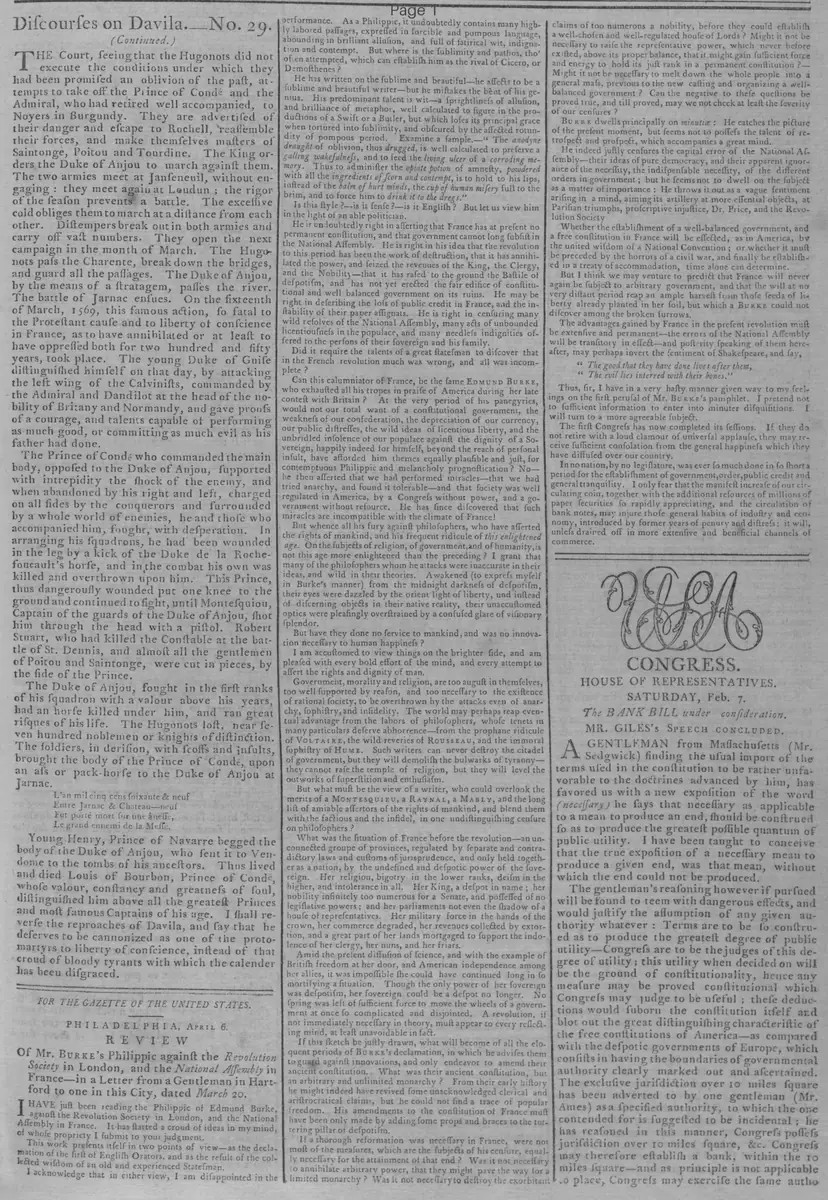
FOR THE GAZETTE OF THE UNITED STATES.
PHILADELPHIA, APRIL 6.
REVIEW
Of Mr. Burke's Philippic against the Revolution Society in London, and the National Assembly in France—in a Letter from a Gentleman in Hartford to one in this City, dated March 20.
I HAVE just been reading the Philippic of Edmund Burke, against the Revolution Society in London, and the National Assembly in France. It has started a crowd of ideas in my mind, of whose propriety I submit to your judgment.
This work presents itself in two points of view—as the declamation of the first of English Orators, and as the result of the collected wisdom of an old and experienced Statesman.
I acknowledge that in either view, I am disappointed in the performance. As a Philippic, it undoubtedly contains many highly labored passages, expressed in forcible and pompous language, abounding in brilliant allusion, and full of satirical wit, indignation and contempt. But where is the sublimity and pathos, tho' often attempted, which can establish him as the rival of Cicero, or Demosthenes?
He has written on the sublime and beautiful—he affects to be a sublime and beautiful writer—but he mistakes the bent of his genius. His predominant talent is wit—a sprightliness of allusion, and brilliance of metaphor, well calculated to figure in the productions of a Swift or a Butler, but which loses its principal grace when tortured into sublimity, and obscured by the affected rotundity of pompous period. Examine a sample.—"The anodyne draught of oblivion, thus drugged, is well calculated to preserve a galling wakefulness, and to feed the living ulcer of a corroding memory. Thus to administer the opiate potion of amnesty, powdered with all the ingredients of scorn and contempt, is to hold to his lips, instead of the balm of hurt minds, the cup of human misery full to the brim, and to force him to drink it to the dregs."
Is this style?—is it even?—is it English? But let us view him in the light of an able politician.
He is undoubtedly right in asserting that France has at present no permanent constitution, and that government cannot long subsist in the National Assembly. He is right in his idea that the revolution to this period has been the work of destruction, that it has annihilated the power, and seized the revenues of the King, the Clergy, and the Nobility—that it has razed to the ground the Bastile of despotism, and has not yet erected the fair edifice of constitutional and well balanced government on its ruins. He may be right in describing the loss of public credit in France, and the instability of their paper assignats. He is right in censuring many wild resolves of the National Assembly, many acts of unbounded licentiousness in the populace, and many needless indignities offered to the persons of their sovereign and his family.
Did it require the talents of a great statesman to discover that in the French revolution much was wrong, and all was incomplete?
Can this calumniator of France, be the same Edmund Burke, who exhausted all his tropes in praise of America during her late contest with Britain? At the very period of his panegyrics, would not our total want of a constitutional government, the weakness of our confederation, the depreciation of our currency, our public distresses, the wild ideas of licentious liberty, and the unbridled insolence of our populace against the dignity of a Sovereign, happily indeed for himself, beyond the reach of personal insult, have afforded him themes equally plausible and just, for contemptuous Philippic and melancholy prognostication? No—he then asserted that we had performed miracles—that we had tried anarchy, and found it tolerable—and that society was well regulated in America, by a Congress without power, and a government without resource. He has since discovered that such miracles are incompatible with the climate of France!
But whence all his fury against philosophers, who have asserted the rights of mankind, and his frequent ridicule of this enlightened age. On the subjects of religion, of government, and of humanity, is not this age more enlightened than the preceding? I grant that many of the philosophers whom he attacks were inaccurate in their ideas, and wild in their theories. Awakened (to express myself in Burke's manner) from the midnight darkness of despotism, their eyes were dazzled by the orient light of liberty, and instead of discerning objects in their native reality, their unaccustomed optics were pleasingly overstrained by a confused glare of visionary splendor.
But have they done no service to mankind, and was no innovation necessary to human happiness?
I am accustomed to view things on the brighter side, and am pleased with every bold effort of the mind, and every attempt to assert the rights and dignity of man.
Government, morality and religion, are too august in themselves, too well supported by reason, and too necessary to the existence of rational society, to be overthrown by the attacks even of anarchy, sophistry, and infidelity. The world may perhaps reap eventual advantage from the labors of philosophers, whose tenets in many particulars deserve abhorrence—from the profane ridicule of VOLTAIRE, the wild reveries of ROUSSEAU, and the immoral sophistry of HUME. Such writers can never destroy the citadel of government, but they will demolish the bulwarks of tyranny—they cannot raze the temple of religion, but they will level the outworks of superstition and enthusiasm.
But what must be the view of a writer, who could overlook the merits of a MONTESQUIEU, a RAYNAL, a MABLY, and the long list of amiable assertors of the rights of mankind, and blend them with the factious and the infidel, in one undistinguishing censure on philosophers?
What was the situation of France before the revolution—an unconnected groupe of provinces, regulated by separate and contradictory laws and customs of jurisprudence, and only held together as a nation, by the undefined and despotic power of the sovereign. Her religion, bigotry in the lower ranks, deism in the higher, and intolerance in all. Her King, a despot in name; her nobility infinitely too numerous for a Senate, and possessed of no legislative powers; and her parliaments not even the shadow of a house of representatives. Her military force in the hands of the crown, her commerce degraded, her revenues collected by extortion, and a great part of her lands mortgaged to support the indolence of her clergy, her nuns, and her friars.
Amid the present diffusion of science, and with the example of British freedom at her door, and American independence among her allies, it was impossible she could have continued long in so mortifying a situation. Though the only power of her sovereign was despotism, her sovereign could be a despot no longer. No spring was left of sufficient force to move the wheels of a government at once so complicated and disjointed. A revolution, if not immediately necessary in theory, must appear to every reflecting mind, at least unavoidable in fact.
If this sketch be justly drawn, what will become of all the eloquent periods of Burke's declamation, in which he advises them to guard against innovations, and only endeavor to amend their ancient constitution. What was their ancient constitution, but an arbitrary and unlimited monarchy? From their early history he might indeed have revived some unacknowledged clerical and aristocratical claims, but he could not find a trace of popular freedom. His amendments to the constitution of France must have been only made by adding some props and braces to the tottering pillar of despotism.
If a thorough reformation was necessary in France, were not most of the measures, which are the subjects of his censure, equally necessary for the attainment of that end? Was it not necessary to annihilate arbitrary power, that they might pave the way for a limited monarchy? Was it not necessary to destroy the exorbitant claims of too numerous a nobility, before they could establish a well-chosen and well-regulated house of Lords? Might it not be necessary to raise the representative power, which never before existed, above its proper balance, that it might gain sufficient force and energy to hold its just rank in a permanent constitution?—
Might it not be necessary to melt down the whole people into a general mass, previous to the new casting and organizing a well-balanced government? Can the negative to these questions be proved true, and till proved, may we not check at least the severity of our censures?
Burke dwells principally on minutiae: He catches the picture of the present moment, but seems not to possess the talent of retrospect and prospect, which accompanies a great mind.
He indeed justly censures the capital error of the National Assembly—their ideas of pure democracy, and their apparent ignorance of the necessity, the indispensable necessity, of the different orders in government; but he seems not to dwell on the subject as a matter of importance: He throws it out as a vague sentiment arising in a mind, aiming its artillery at more essential objects, at Parisian triumphs, proscriptive injustice, Dr. Price, and the Revolution Society.
Whether the establishment of a well-balanced government, and a free constitution in France will be effected, as in America, by the united wisdom of a National Convention; or whether it must be preceded by the horrors of a civil war, and finally be established in a treaty of accommodation, time alone can determine.
But I think we may venture to predict that France will never again be subject to arbitrary government, and that she will at no very distant period reap an ample harvest from those seeds of liberty already planted in her soil, but which a Burke could not discover among the broken furrows.
The advantages gained by France in the present revolution must be extensive and permanent—the errors of the National Assembly will be transitory in effect—and posterity speaking of them hereafter, may perhaps invert the sentiment of Shakespeare, and say,
"The good that they have done lives after them,
"The evil lies interred with their bones."
Thus, sir, I have in a very hasty manner given way to my feelings on the first perusal of Mr. Burke's pamphlet. I pretend not to sufficient information to enter into minuter disquisitions. I will turn to a more agreeable subject.
The first Congress has now completed its sessions. If they do not retire with a loud clamour of universal applause, they may receive sufficient consolation from the general happiness which they have diffused over our country.
In no nation, by no legislature, was ever so much done in so short a period for the establishment of government, order, public credit and general tranquility. I only fear that the manifest increase of our circulating coin, together with the additional resources of millions of paper securities so rapidly appreciating, and the circulation of bank notes, may injure those general habits of industry and economy, introduced by former years of penury and distress: it will, unless drained off in more extensive and beneficial channels of commerce.
PHILADELPHIA, APRIL 6.
REVIEW
Of Mr. Burke's Philippic against the Revolution Society in London, and the National Assembly in France—in a Letter from a Gentleman in Hartford to one in this City, dated March 20.
I HAVE just been reading the Philippic of Edmund Burke, against the Revolution Society in London, and the National Assembly in France. It has started a crowd of ideas in my mind, of whose propriety I submit to your judgment.
This work presents itself in two points of view—as the declamation of the first of English Orators, and as the result of the collected wisdom of an old and experienced Statesman.
I acknowledge that in either view, I am disappointed in the performance. As a Philippic, it undoubtedly contains many highly labored passages, expressed in forcible and pompous language, abounding in brilliant allusion, and full of satirical wit, indignation and contempt. But where is the sublimity and pathos, tho' often attempted, which can establish him as the rival of Cicero, or Demosthenes?
He has written on the sublime and beautiful—he affects to be a sublime and beautiful writer—but he mistakes the bent of his genius. His predominant talent is wit—a sprightliness of allusion, and brilliance of metaphor, well calculated to figure in the productions of a Swift or a Butler, but which loses its principal grace when tortured into sublimity, and obscured by the affected rotundity of pompous period. Examine a sample.—"The anodyne draught of oblivion, thus drugged, is well calculated to preserve a galling wakefulness, and to feed the living ulcer of a corroding memory. Thus to administer the opiate potion of amnesty, powdered with all the ingredients of scorn and contempt, is to hold to his lips, instead of the balm of hurt minds, the cup of human misery full to the brim, and to force him to drink it to the dregs."
Is this style?—is it even?—is it English? But let us view him in the light of an able politician.
He is undoubtedly right in asserting that France has at present no permanent constitution, and that government cannot long subsist in the National Assembly. He is right in his idea that the revolution to this period has been the work of destruction, that it has annihilated the power, and seized the revenues of the King, the Clergy, and the Nobility—that it has razed to the ground the Bastile of despotism, and has not yet erected the fair edifice of constitutional and well balanced government on its ruins. He may be right in describing the loss of public credit in France, and the instability of their paper assignats. He is right in censuring many wild resolves of the National Assembly, many acts of unbounded licentiousness in the populace, and many needless indignities offered to the persons of their sovereign and his family.
Did it require the talents of a great statesman to discover that in the French revolution much was wrong, and all was incomplete?
Can this calumniator of France, be the same Edmund Burke, who exhausted all his tropes in praise of America during her late contest with Britain? At the very period of his panegyrics, would not our total want of a constitutional government, the weakness of our confederation, the depreciation of our currency, our public distresses, the wild ideas of licentious liberty, and the unbridled insolence of our populace against the dignity of a Sovereign, happily indeed for himself, beyond the reach of personal insult, have afforded him themes equally plausible and just, for contemptuous Philippic and melancholy prognostication? No—he then asserted that we had performed miracles—that we had tried anarchy, and found it tolerable—and that society was well regulated in America, by a Congress without power, and a government without resource. He has since discovered that such miracles are incompatible with the climate of France!
But whence all his fury against philosophers, who have asserted the rights of mankind, and his frequent ridicule of this enlightened age. On the subjects of religion, of government, and of humanity, is not this age more enlightened than the preceding? I grant that many of the philosophers whom he attacks were inaccurate in their ideas, and wild in their theories. Awakened (to express myself in Burke's manner) from the midnight darkness of despotism, their eyes were dazzled by the orient light of liberty, and instead of discerning objects in their native reality, their unaccustomed optics were pleasingly overstrained by a confused glare of visionary splendor.
But have they done no service to mankind, and was no innovation necessary to human happiness?
I am accustomed to view things on the brighter side, and am pleased with every bold effort of the mind, and every attempt to assert the rights and dignity of man.
Government, morality and religion, are too august in themselves, too well supported by reason, and too necessary to the existence of rational society, to be overthrown by the attacks even of anarchy, sophistry, and infidelity. The world may perhaps reap eventual advantage from the labors of philosophers, whose tenets in many particulars deserve abhorrence—from the profane ridicule of VOLTAIRE, the wild reveries of ROUSSEAU, and the immoral sophistry of HUME. Such writers can never destroy the citadel of government, but they will demolish the bulwarks of tyranny—they cannot raze the temple of religion, but they will level the outworks of superstition and enthusiasm.
But what must be the view of a writer, who could overlook the merits of a MONTESQUIEU, a RAYNAL, a MABLY, and the long list of amiable assertors of the rights of mankind, and blend them with the factious and the infidel, in one undistinguishing censure on philosophers?
What was the situation of France before the revolution—an unconnected groupe of provinces, regulated by separate and contradictory laws and customs of jurisprudence, and only held together as a nation, by the undefined and despotic power of the sovereign. Her religion, bigotry in the lower ranks, deism in the higher, and intolerance in all. Her King, a despot in name; her nobility infinitely too numerous for a Senate, and possessed of no legislative powers; and her parliaments not even the shadow of a house of representatives. Her military force in the hands of the crown, her commerce degraded, her revenues collected by extortion, and a great part of her lands mortgaged to support the indolence of her clergy, her nuns, and her friars.
Amid the present diffusion of science, and with the example of British freedom at her door, and American independence among her allies, it was impossible she could have continued long in so mortifying a situation. Though the only power of her sovereign was despotism, her sovereign could be a despot no longer. No spring was left of sufficient force to move the wheels of a government at once so complicated and disjointed. A revolution, if not immediately necessary in theory, must appear to every reflecting mind, at least unavoidable in fact.
If this sketch be justly drawn, what will become of all the eloquent periods of Burke's declamation, in which he advises them to guard against innovations, and only endeavor to amend their ancient constitution. What was their ancient constitution, but an arbitrary and unlimited monarchy? From their early history he might indeed have revived some unacknowledged clerical and aristocratical claims, but he could not find a trace of popular freedom. His amendments to the constitution of France must have been only made by adding some props and braces to the tottering pillar of despotism.
If a thorough reformation was necessary in France, were not most of the measures, which are the subjects of his censure, equally necessary for the attainment of that end? Was it not necessary to annihilate arbitrary power, that they might pave the way for a limited monarchy? Was it not necessary to destroy the exorbitant claims of too numerous a nobility, before they could establish a well-chosen and well-regulated house of Lords? Might it not be necessary to raise the representative power, which never before existed, above its proper balance, that it might gain sufficient force and energy to hold its just rank in a permanent constitution?—
Might it not be necessary to melt down the whole people into a general mass, previous to the new casting and organizing a well-balanced government? Can the negative to these questions be proved true, and till proved, may we not check at least the severity of our censures?
Burke dwells principally on minutiae: He catches the picture of the present moment, but seems not to possess the talent of retrospect and prospect, which accompanies a great mind.
He indeed justly censures the capital error of the National Assembly—their ideas of pure democracy, and their apparent ignorance of the necessity, the indispensable necessity, of the different orders in government; but he seems not to dwell on the subject as a matter of importance: He throws it out as a vague sentiment arising in a mind, aiming its artillery at more essential objects, at Parisian triumphs, proscriptive injustice, Dr. Price, and the Revolution Society.
Whether the establishment of a well-balanced government, and a free constitution in France will be effected, as in America, by the united wisdom of a National Convention; or whether it must be preceded by the horrors of a civil war, and finally be established in a treaty of accommodation, time alone can determine.
But I think we may venture to predict that France will never again be subject to arbitrary government, and that she will at no very distant period reap an ample harvest from those seeds of liberty already planted in her soil, but which a Burke could not discover among the broken furrows.
The advantages gained by France in the present revolution must be extensive and permanent—the errors of the National Assembly will be transitory in effect—and posterity speaking of them hereafter, may perhaps invert the sentiment of Shakespeare, and say,
"The good that they have done lives after them,
"The evil lies interred with their bones."
Thus, sir, I have in a very hasty manner given way to my feelings on the first perusal of Mr. Burke's pamphlet. I pretend not to sufficient information to enter into minuter disquisitions. I will turn to a more agreeable subject.
The first Congress has now completed its sessions. If they do not retire with a loud clamour of universal applause, they may receive sufficient consolation from the general happiness which they have diffused over our country.
In no nation, by no legislature, was ever so much done in so short a period for the establishment of government, order, public credit and general tranquility. I only fear that the manifest increase of our circulating coin, together with the additional resources of millions of paper securities so rapidly appreciating, and the circulation of bank notes, may injure those general habits of industry and economy, introduced by former years of penury and distress: it will, unless drained off in more extensive and beneficial channels of commerce.
What sub-type of article is it?
Persuasive
Political
Reflective
What themes does it cover?
Politics
Constitutional Rights
What keywords are associated?
Edmund Burke
French Revolution
National Assembly
Constitutional Government
American Independence
Philosophers Rights
Despotism Reform
What entities or persons were involved?
A Gentleman In Hartford
One In This City
Letter to Editor Details
Author
A Gentleman In Hartford
Recipient
One In This City
Main Argument
critiques edmund burke's 'philippic' for lacking true sublimity in style and inconsistency with his praise of american independence, while defending the french revolution as a necessary response to despotism, acknowledging flaws but predicting ultimate success in establishing liberty and balanced government.
Notable Details
Quotes Burke's Passage On Amnesty
References Cicero, Demosthenes, Swift, Butler
Mentions Philosophers: Voltaire, Rousseau, Hume, Montesquieu, Raynal, Mably
Contrasts Pre Revolution French Despotism With Need For Reform
Quotes Shakespeare Inverted