Thank you for visiting SNEWPapers!
Sign up free
Madison County Democrat
London, Madison County, Ohio
What is this article about?
National Geographic reporters recount 1956 Operation Deepfreeze expedition to Antarctica with Admiral Byrd: establishing bases, aerial surveys beyond South Pole, ice-breaking, midnight sun fireworks, and a penguin umpiring softball. (187 characters)
Clipping
OCR Quality
Full Text
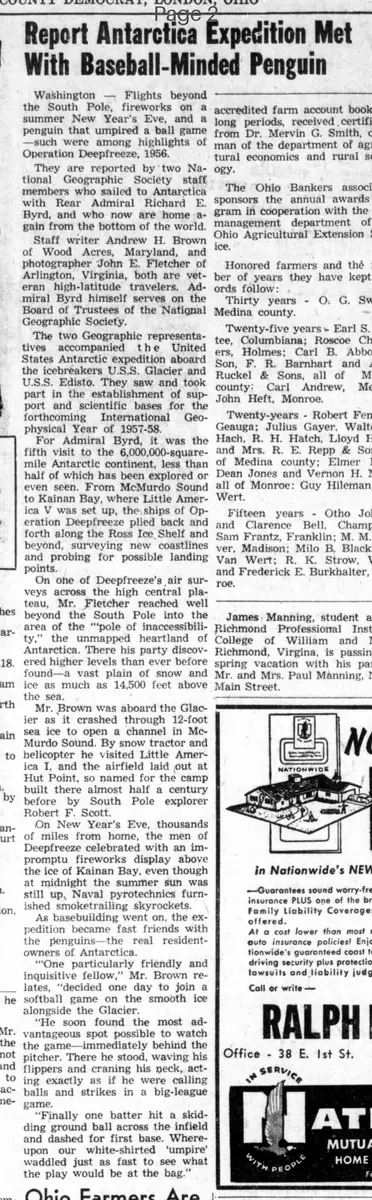
With Baseball-Minded Penguin
Washington—Flights beyond
the South Pole, fireworks on a
summer New Year's Eve, and a
penguin that umpired a ball game
such were among highlights of
Operation Deepfreeze, 1956.
They are reported by two Na-
tional Geographic Society staff
members who sailed to Antarctica
with Rear Admiral Richard E.
Byrd, and who now are home a-
gain from the bottom of the world.
Staff writer Andrew H. Brown
of Wood Acres, Maryland, and
photographer John E. Fletcher of
Arlington, Virginia, both are vet-
eran high-latitude travelers. Ad-
miral Byrd himself serves on the
Board of Trustees of the National
Geographic Society.
The two Geographic representa-
tives accompanied the United
States Antarctic expedition aboard
the icebreakers U.S.S. Glacier and
U.S.S. Edisto. They saw and took
part in the establishment of sup-
port and scientific bases for the
forthcoming International Geo-
physical Year of 1957-58.
For Admiral Byrd, it was the
fifth visit to the 6,000,000-square-
mile Antarctic continent, less than
half of which has been explored or
even seen. From McMurdo Sound
to Kainan Bay, where Little Amer-
ica V was set up, the ships of Op-
eration Deepfreeze plied back and
forth along the Ross Ice Shelf and
beyond, surveying new coastlines
and probing for possible landing
points.
On one of Deepfreeze's air sur-
veys across the high central pla-
teau, Mr. Fletcher reached well
beyond the South Pole into the
area of the "pole of inaccessibili-
ty," the unmapped heartland of
Antarctica. There his party discov-
ered higher levels than ever before
found—a vast plain of snow and
ice as much as 14,500 feet above
the sea.
Mr. Brown was aboard the Glac-
ier as it crashed through 12-foot
sea ice to open a channel in Mc-
Murdo Sound. By snow tractor and
helicopter he visited Little Amer-
ica I, and the airfield laid out at
Hut Point, so named for the camp
built there almost half a century
before by South Pole explorer
Robert F. Scott.
On New Year's Eve, thousands
of miles from home, the men of
Deepfreeze celebrated with an im-
promptu fireworks display above
the ice of Kainan Bay, even though
at midnight the summer sun was
still up. Naval pyrotechnics furn-
ished smoke-trailing skyrockets.
As base-building went on, the ex-
pedition became fast friends with
the penguins—the real resident-
owners of Antarctica.
"One particularly friendly and
inquisitive fellow," Mr. Brown re-
lates, "decided one day to join a
softball game on the smooth ice
alongside the Glacier.
"He soon found the most ad-
vantageous spot possible to watch
the game—immediately behind the
pitcher. There he stood, waving his
flippers and craning his neck, act-
ing exactly as if he were calling
balls and strikes in a big-league
game.
"Finally one batter hit a skid-
ding ground ball across the infield
and dashed for first base. Where-
upon our white-shirted 'umpire'
waddled just as fast to see what
the play would be at the bag."
What sub-type of article is it?
What themes does it cover?
What keywords are associated?
What entities or persons were involved?
Where did it happen?
Story Details
Key Persons
Location
Antarctica
Event Date
1956
Story Details
National Geographic staff members Andrew H. Brown and John E. Fletcher joined Rear Admiral Richard E. Byrd on Operation Deepfreeze, establishing bases for the International Geophysical Year. Highlights included flights beyond the South Pole discovering high plateaus, breaking through sea ice, New Year's Eve fireworks under the midnight sun, and a penguin acting as umpire in a softball game.