Thank you for visiting SNEWPapers!
Sign up free
Editorial
October 9, 1846
The Ottawa Free Trader
Ottawa, La Salle County County, Illinois
What is this article about?
Letter from the editor detailing the Illinois volunteers' arduous overland march from Camp Irvine near La Baca to Victoria, Texas, on August 10-11, 1846, amid rain, heat, and flooded terrain, leaving over 50 sick behind due to measles. Observations include poor conditions for new German immigrants in the sickly region.
Clipping
OCR Quality
88%
Good
Full Text
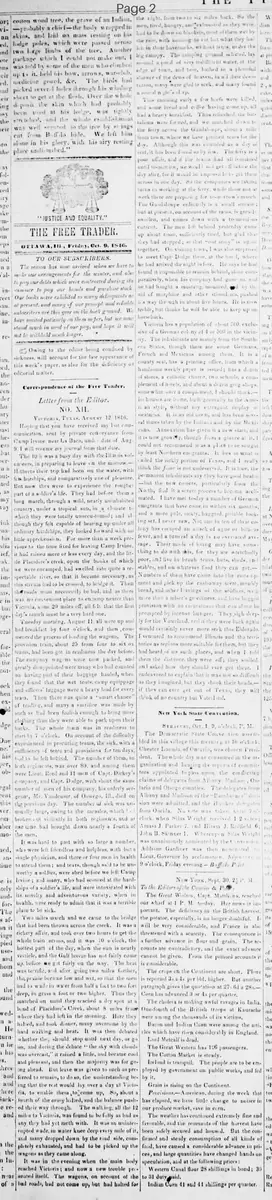
Correspondence of the Free Trader.
Letter from the Editor.
NO. XII.
VICTORIA, TEXAS, AUGUST 12, 1846.
Hoping that you have received my last communication, sent by private conveyance from Camp Irvine near La Baca, and date of Aug. 9. I will resume my journal from that date.
The 10th was a busy day with the Illinois volunteers, in preparing to leave on the morrow.—Hitherto their trip had been on the water, with few hardships, and comparatively one of pleasure. But now they were to experience the rougher part of a soldier's life. They had before them a long march, through a wild, nearly uninhabited country, under a tropical sun, in a climate to which they were totally unaccustomed; and although they felt capable of bearing up under all ordinary hardships, they looked forward with no little apprehension. For more than a week previous to the time fixed for leaving Camp Irvine, it had rained more or less every day, and the little Placidore's creek, upon the banks of which we were encamped, had swelled into quite a respectable river, so that it became necessary, as this stream had to be crossed, to bridge it. The roads must necessarily be bad, and as there was no convenient place to encamp nearer than Victoria, some 20 miles off, all felt that the first day's march must be a very hard one.
Tuesday morning, August 11, all were up and had breakfast by four o'clock, and then commenced the process of loading the wagons. The provision train, about 25 from four to six ox teams, had been got in readiness the day before. The company wagons were now packed, and greatly disappointed were many who had counted on having part of their baggage hauled, when they found that the wet tents, camp equipage and officers' luggage were a heavy load for every team. Then there was quite a "smart chance" of trading, and many a sacrifice was made by such as had been foolish enough to bring more clothing than they were able to pack upon their hacks. The whole train was in readiness to start by 7 o'clock. On account of the difficulty experienced in procuring teams, the sick, with a sufficiency of tents and provisions for ten days, had to be left behind. The number of them, in both regiments, was over 50, and among them were Lieut. Reed and 11 men of Capt. Dickey's company, and Capt. Dodge, with about the same number of men of his company, his orderly sergeant. Mr. Vandeuser, of Oswego, Ill., died on the previous day. The number of sick was unusually large, owing to the measles, which had broken out violently in both regiments, and at one time had brought down nearly a fourth of the men.
It was hard to part with so large a number, who were left friendless and helpless, with but a single physician, and three or four men in health to attend them; and tears, though said to be unworthy a soldier, were shed before we left Camp Irvine; and many, who had scoffed at the hardships of a soldier's life, and were intoxicated with its novelty and adventurous variety, when in health, were ready to admit that it was a terrible place to be sick.
Two miles march and we came to the bridge that had been thrown across the creek. It was a rickety affair, and took over two hours to get the whole train across, and it was 10 o'clock, the hottest part of the day, when the sun is nearly vertical, and the Gulf breeze has not fairly come up, before we got fairly on the way. The heat was terrific, and after going two miles further, the prairie became low and wet, so that the men had to wade in water from half a foot to two feet deep, in grass a foot or two higher. Thus they marched on until they reached a dry spot at a bend of Placidore's Creek, about 8 miles from where they had left in the morning. Here they halted, and took dinner, many overcome by the hard walking and heat. It was then debated whether they should stop until next day, or go on, and during the debate "the sky with clouds was overcast," it rained a little, and became cool and pleasant, and then the majority was for going ahead. But leave was given to such as preferred to remain, to do so, the understanding being that the rest would lay over a day at Victoria, to enable them to come up. So, about a fourth of the army halted, and the balance pushed their way through. The walking, all the 12 miles to Victoria, was found to be fully as bad as any they had yet met with. It was an uninterrupted wade, in water knee deep every mile of it, and many dropped down by the road side, completely exhausted, and had to be picked up by the wagons as they came along.
It was in the evening when the main body reached Victoria; and now a new trouble presented itself. The wagons, on account of the bad roads, had not come up, but had halted for the night, from two to six miles back. So the men, tired, hungry, and exhausted as they were, had to lie down on blankets, most of them wet by the rain, with nothing to eat but what they had in their haversacks, without tents, under the big canopy. The camping ground selected, lay around a pond of very putrid water, at the edge of town, and here, bathed to a plentiful shower of the dews of heaven, in a liberal destitution, many were glad to seek, and many found a sound night's sleep.
In the morning early a few beeves were killed, and some bread and coffee having come up, all had a hearty breakfast. Thus refreshed the battalions were formed, and we marched down to the ferry across the Guadalupe, about a mile from town, where we have pitched tents for the day. Although this was intended as a day of rest, it has been found so by few. The ferry is a poor affair, and had the trains had all remained until to-morrow, we would not get across in one day, for it would be impossible to get them across in one day. So the companies are taking turns in working at the ferry, while those not at work there are preparing for to-morrow's march.
The Guadalupe really is a small stream; but at present, on account of the rains, it is swollen, and comes down with a tremendous current. The men left behind yesterday came up about noon, sufficiently tired, but glad they had stopped, so that "all together" is once more the order. On visiting town, I was also surprised to meet Capt. Dodge there, at the hotel, where he had arrived the night before. He says he had found it impossible to remain behind alone comparatively, when his company had gone on, and he had bought a mustang, mounted, and by the aid of morphine and other stimulants, pushed his way through in about five hours. He is now feeble, but thinks he will be able to keep up on horseback.
Victoria has a population of about 500, exclusive of a German colony of 40 or 50 in the vicinity. The inhabitants are mainly from the Southern States, though there are some Germans, French and Mexicans among them. It is a county seat, has a printing office, from which a handsome weekly paper is issued; has a dozen of stores, a catholic church, two schools, a complement of hotels, and about a dozen grog shops—somewhat over a complement, I should think.—Its houses are frame, built generally to the American style, without any extravagant display of neatness. It is an old town, and has been several times taken by the Indians and by the Mexicans. Annexation has given it a new start, and it is now growing, though from appearances, I could not recommend it as a place to be sought by least Northern emigrants. It lies in what is called the sickly portion of Texas, and I really think the name is not undeserved. It is true, the permanent inhabitants say they have good health—but the new comers, particularly from the North, find it a severe process to become acclimated. I have met to-day a number of German emigrants that have come in within six months, and a more pale, sickly, haggard, pitiable looking set I never saw. Not one in ten of their colony has escaped an attack of ague or bilious fever, and a funeral a day is no exaggerated average. Their mode of living may have something to do with this, for they are wretchedly poor, and live in brush tents, huts, sheds, and stables, on whatever food they can get.—Numbers of them have come into the encampment and pick up the cast-away meat, mostly bread, and other leavings of the soldiers, with more than a miser's greediness, and have begged provisions with earnestness that could alone be prompted by intense hunger. They sigh deeply for the Vaterland, and if they were back again would certainly never more seek this Eldorado. I ventured to recommend Illinois and the territories as regions more suitable for them, but they had heard of no such places, and when I told them the distance, they were off; they smiled and only asked how they should ever get there. I endeavored to explain that it was not so difficult as they imagined, but they shook their heads,—if they can ever get out of Texas, they will think of no country but Vaterland.
Letter from the Editor.
NO. XII.
VICTORIA, TEXAS, AUGUST 12, 1846.
Hoping that you have received my last communication, sent by private conveyance from Camp Irvine near La Baca, and date of Aug. 9. I will resume my journal from that date.
The 10th was a busy day with the Illinois volunteers, in preparing to leave on the morrow.—Hitherto their trip had been on the water, with few hardships, and comparatively one of pleasure. But now they were to experience the rougher part of a soldier's life. They had before them a long march, through a wild, nearly uninhabited country, under a tropical sun, in a climate to which they were totally unaccustomed; and although they felt capable of bearing up under all ordinary hardships, they looked forward with no little apprehension. For more than a week previous to the time fixed for leaving Camp Irvine, it had rained more or less every day, and the little Placidore's creek, upon the banks of which we were encamped, had swelled into quite a respectable river, so that it became necessary, as this stream had to be crossed, to bridge it. The roads must necessarily be bad, and as there was no convenient place to encamp nearer than Victoria, some 20 miles off, all felt that the first day's march must be a very hard one.
Tuesday morning, August 11, all were up and had breakfast by four o'clock, and then commenced the process of loading the wagons. The provision train, about 25 from four to six ox teams, had been got in readiness the day before. The company wagons were now packed, and greatly disappointed were many who had counted on having part of their baggage hauled, when they found that the wet tents, camp equipage and officers' luggage were a heavy load for every team. Then there was quite a "smart chance" of trading, and many a sacrifice was made by such as had been foolish enough to bring more clothing than they were able to pack upon their hacks. The whole train was in readiness to start by 7 o'clock. On account of the difficulty experienced in procuring teams, the sick, with a sufficiency of tents and provisions for ten days, had to be left behind. The number of them, in both regiments, was over 50, and among them were Lieut. Reed and 11 men of Capt. Dickey's company, and Capt. Dodge, with about the same number of men of his company, his orderly sergeant. Mr. Vandeuser, of Oswego, Ill., died on the previous day. The number of sick was unusually large, owing to the measles, which had broken out violently in both regiments, and at one time had brought down nearly a fourth of the men.
It was hard to part with so large a number, who were left friendless and helpless, with but a single physician, and three or four men in health to attend them; and tears, though said to be unworthy a soldier, were shed before we left Camp Irvine; and many, who had scoffed at the hardships of a soldier's life, and were intoxicated with its novelty and adventurous variety, when in health, were ready to admit that it was a terrible place to be sick.
Two miles march and we came to the bridge that had been thrown across the creek. It was a rickety affair, and took over two hours to get the whole train across, and it was 10 o'clock, the hottest part of the day, when the sun is nearly vertical, and the Gulf breeze has not fairly come up, before we got fairly on the way. The heat was terrific, and after going two miles further, the prairie became low and wet, so that the men had to wade in water from half a foot to two feet deep, in grass a foot or two higher. Thus they marched on until they reached a dry spot at a bend of Placidore's Creek, about 8 miles from where they had left in the morning. Here they halted, and took dinner, many overcome by the hard walking and heat. It was then debated whether they should stop until next day, or go on, and during the debate "the sky with clouds was overcast," it rained a little, and became cool and pleasant, and then the majority was for going ahead. But leave was given to such as preferred to remain, to do so, the understanding being that the rest would lay over a day at Victoria, to enable them to come up. So, about a fourth of the army halted, and the balance pushed their way through. The walking, all the 12 miles to Victoria, was found to be fully as bad as any they had yet met with. It was an uninterrupted wade, in water knee deep every mile of it, and many dropped down by the road side, completely exhausted, and had to be picked up by the wagons as they came along.
It was in the evening when the main body reached Victoria; and now a new trouble presented itself. The wagons, on account of the bad roads, had not come up, but had halted for the night, from two to six miles back. So the men, tired, hungry, and exhausted as they were, had to lie down on blankets, most of them wet by the rain, with nothing to eat but what they had in their haversacks, without tents, under the big canopy. The camping ground selected, lay around a pond of very putrid water, at the edge of town, and here, bathed to a plentiful shower of the dews of heaven, in a liberal destitution, many were glad to seek, and many found a sound night's sleep.
In the morning early a few beeves were killed, and some bread and coffee having come up, all had a hearty breakfast. Thus refreshed the battalions were formed, and we marched down to the ferry across the Guadalupe, about a mile from town, where we have pitched tents for the day. Although this was intended as a day of rest, it has been found so by few. The ferry is a poor affair, and had the trains had all remained until to-morrow, we would not get across in one day, for it would be impossible to get them across in one day. So the companies are taking turns in working at the ferry, while those not at work there are preparing for to-morrow's march.
The Guadalupe really is a small stream; but at present, on account of the rains, it is swollen, and comes down with a tremendous current. The men left behind yesterday came up about noon, sufficiently tired, but glad they had stopped, so that "all together" is once more the order. On visiting town, I was also surprised to meet Capt. Dodge there, at the hotel, where he had arrived the night before. He says he had found it impossible to remain behind alone comparatively, when his company had gone on, and he had bought a mustang, mounted, and by the aid of morphine and other stimulants, pushed his way through in about five hours. He is now feeble, but thinks he will be able to keep up on horseback.
Victoria has a population of about 500, exclusive of a German colony of 40 or 50 in the vicinity. The inhabitants are mainly from the Southern States, though there are some Germans, French and Mexicans among them. It is a county seat, has a printing office, from which a handsome weekly paper is issued; has a dozen of stores, a catholic church, two schools, a complement of hotels, and about a dozen grog shops—somewhat over a complement, I should think.—Its houses are frame, built generally to the American style, without any extravagant display of neatness. It is an old town, and has been several times taken by the Indians and by the Mexicans. Annexation has given it a new start, and it is now growing, though from appearances, I could not recommend it as a place to be sought by least Northern emigrants. It lies in what is called the sickly portion of Texas, and I really think the name is not undeserved. It is true, the permanent inhabitants say they have good health—but the new comers, particularly from the North, find it a severe process to become acclimated. I have met to-day a number of German emigrants that have come in within six months, and a more pale, sickly, haggard, pitiable looking set I never saw. Not one in ten of their colony has escaped an attack of ague or bilious fever, and a funeral a day is no exaggerated average. Their mode of living may have something to do with this, for they are wretchedly poor, and live in brush tents, huts, sheds, and stables, on whatever food they can get.—Numbers of them have come into the encampment and pick up the cast-away meat, mostly bread, and other leavings of the soldiers, with more than a miser's greediness, and have begged provisions with earnestness that could alone be prompted by intense hunger. They sigh deeply for the Vaterland, and if they were back again would certainly never more seek this Eldorado. I ventured to recommend Illinois and the territories as regions more suitable for them, but they had heard of no such places, and when I told them the distance, they were off; they smiled and only asked how they should ever get there. I endeavored to explain that it was not so difficult as they imagined, but they shook their heads,—if they can ever get out of Texas, they will think of no country but Vaterland.
What sub-type of article is it?
Military Affairs
Immigration
What keywords are associated?
Illinois Volunteers
Mexican War March
Victoria Texas
Soldier Hardships
German Immigrants
Measles Outbreak
Texas Acclimation
What entities or persons were involved?
Illinois Volunteers
Capt. Dickey
Capt. Dodge
Lieut. Reed
German Emigrants
Victoria, Texas
Editorial Details
Primary Topic
March Of Illinois Volunteers To Victoria, Texas, And Observations On German Immigrants
Stance / Tone
Descriptive Account Of Hardships
Key Figures
Illinois Volunteers
Capt. Dickey
Capt. Dodge
Lieut. Reed
German Emigrants
Victoria, Texas
Key Arguments
Soldiers Faced Extreme Heat, Rain, And Flooded Terrain During The March
Over 50 Sick Left Behind Due To Measles Outbreak
Victoria Described As Sickly For Newcomers, Especially Northern And German Immigrants
German Colonists Suffer From Poverty, Disease, And Regret Emigrating