Thank you for visiting SNEWPapers!
Sign up free
The Alexandria Herald
Alexandria, Virginia
What is this article about?
In mid-winter near Aylesbury, a woodsman guides an elderly traveler across a ford, but the traveler vanishes, sparking murder suspicions against the guide, Hulburt. A blasted oak tree is linked to the crime, and bones found inside it years later lead to his trial. A lawyer reveals the bones were planted by a vengeful physician, exonerating Hulburt and highlighting dangers of superstition and circumstantial evidence.
Clipping
OCR Quality
Full Text
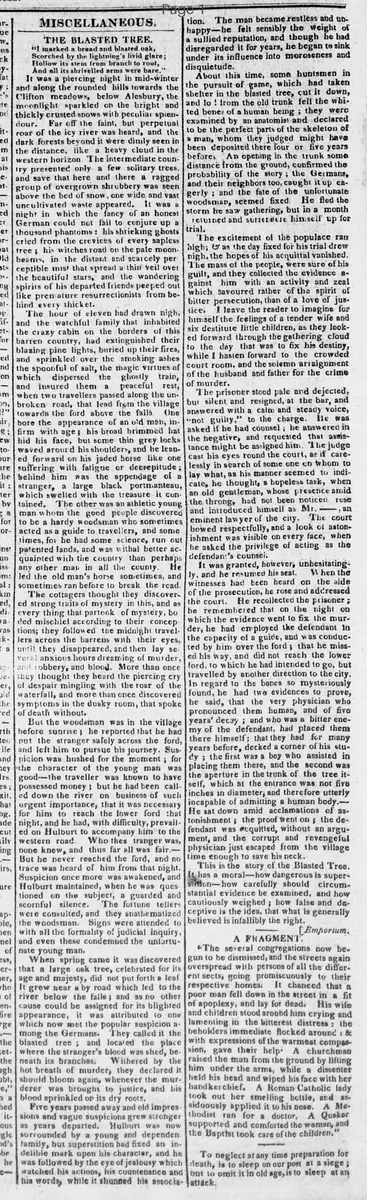
THE BLASTED TREE.
"I marked a broad and blasted oak,
Scorched by the lightning's livid glare;
Hollow its stem from branch to root,
And all its shrivelled arms were bare."
It was a piercing night in mid-winter and along the rounded hills towards the Clifton meadows, below Aylesbury, the moonlight sparkled on the bright and thickly crusted snows with peculiar splendour. Far off the faint, but perpetual roar of the icy river was heard, and the dark forests beyond it were dimly seen in the distance, like a heavy cloud in the western horizon. The intermediate country presented only a few solitary trees, and save that here and there a ragged group of overgrown shrubbery was seen above the bed of snow, one wide and vast uncultivated waste appeared. It was a night in which the fancy of an honest German could not fail to conjure up a thousand phantoms: his shrieking ghosts cried from the crevices of every sapless tree; his witches rode on the pale moon-beams, in the distant and scarcely perceptible mist that spread a thin veil over the beautiful stars, and the wandering spirits of his departed friends peeped out like premature resurrectionists from behind every thicket.
The hour of eleven had drawn nigh, and the watchful family that inhabited the crazy cabin on the borders of this barren country, had extinguished their blazing pine lights, buried up their fires, and sprinkled over the smoking ashes the spoonful of salt, the magic virtues of which dispersed the ghostly train, and insured them a peaceful rest, when two travellers passed along the unbroken road, that led from the village towards the ford above the falls. One bore the appearance of an old man, infirm with age: his broad brimmed hat hid his face, but some thin grey locks waved around his shoulders, and he leaned forward on his jaded horse like one suffering with fatigue or decrepitude; behind him was the appendage of a stranger, a large black portmanteau, which swelled with the treasure it contained. The other was an athletic young man whom the good people discovered to be a hardy woodsman who sometimes acted as a guide to travellers, and sometimes, for he had some science, run out patented lands, and was withal better acquainted with the country than perhaps any other man in all the county. He led the old man's horse sometimes, and sometimes ran before to break the road. The cottagers thought they discovered strong traits of mystery in this, and as every thing that partook of mystery, boded mischief according to their conceptions; they followed the midnight travellers across the barrens with their eyes, until they disappeared, and then lay several anxious hours dreaming of murder, and robbery, and blood. More than once they thought they heard the piercing cry of despair mingling with the roar of the waterfall, and more than once discovered symptoms in the dusky room, that spoke of death without.
But the woodsman was in the village before sunrise; he reported that he had put the stranger safely across the ford, and left him to pursue his journey. Suspicion was hushed for the moment; for the character of the young man was good—the traveller was known to have possessed money; but he had been called down the river on business of such urgent importance, that it was necessary for him to reach the lower ford that night, and he had, with difficulty, prevailed on Hulburt to accompany him to the western road. Who the stranger was, none knew, and thus far all was fair.—But he never reached the ford, and no trace was heard of him from that night. Suspicion once more was awakened, and Hulburt maintained, when he was questioned on the subject, a guarded and scornful silence. The fortune tellers were consulted, and they anathematized the woodsman. Signs were attended to with all the formality of judicial inquiry, and even these condemned the unfortunate young man.
When spring came it was discovered that a large oak tree, celebrated for its age and majesty, did not put forth a leaf. It grew near a by road which led to the river below the falls: and as no other cause could be assigned for its blighted appearance, it was attributed to one which now met the popular suspicion among the Germans. They called it the blasted tree; and located the place where the stranger's blood was shed, beneath its branches. Withered by the hot breath of murder, they declared it should bloom again, whenever the murderer was brought to justice, and his blood sprinkled on its dry roots.
Five years passed away and old impressions and vague suspicions grew stronger as years departed. Hulburt was now surrounded by a young and dependent family, but superstition had fixed an indelible mark upon his character, and he was followed by the eye of jealousy which watched his actions, his countenance and his words, while it shunned his association.
The man became restless and unhappy—he felt sensibly the weight of a sullied reputation, and though he had disregarded it for years, he began to sink under its influence into moroseness and disquietude.
About this time, some huntsmen in the pursuit of game, which had taken shelter in the blasted tree, cut it down, and lo! from the old trunk fell the whitened bones of a human being; they were examined by an anatomist and declared to be the perfect parts of the skeleton of a man, whom they judged might have been deposited there four or five years before: An opening in the trunk some distance from the ground, confirmed the probability of the story; the Germans, and their neighbors too, caught it up eagerly; and the fate of the unfortunate woodsman, seemed fixed. He fled the storm he saw gathering, but in a month returned and surrendered himself up for trial.
The excitement of the populace ran high; & as the day fixed for his trial drew nigh, the hopes of his acquittal vanished. The mass of the people, were sure of his guilt, and they collected the evidence against him with an activity and zeal which savoured rather of the spirit of bitter persecution, than of a love of justice. I leave the reader to imagine for himself the feelings of a tender wife and six destitute little children, as they looked forward through the gathering cloud to the day that was to fix his destiny, while I hasten forward to the crowded court room, and the solemn arraignment of the husband and father for the crime of murder.
The prisoner stood pale and dejected, but silent and resigned, at the bar, and answered with a calm and steady voice, "not guilty," to the charge. He was asked if he had counsel; he answered in the negative, and requested that assistance might be assigned him. The judge cast his eyes round the court, as if carelessly in search of some one on whom to lay what, as his manner seemed to indicate, he thought, a hopeless task, when an old gentleman, whose presence amid the throng, had not been noticed, rose and introduced himself as Mr. --, an eminent lawyer of the city. The court bowed respectfully, and a look of astonishment was visible on every face, when he asked the privilege of acting as the defendant's counsel.
It was granted, however; unhesitatingly, and he resumed his seat. When the witnesses had been heard on the side of the prosecution, he rose and addressed the court. He recollected the prisoner; he remembered that on the night on which the evidence went to fix the murder, he had employed the defendant in the capacity of a guide, and was conducted by him over the ford; that he missed his way, and did not reach the lower ford, to which he had intended to go, but travelled by another direction to the city. In regard to the bones so mysteriously found, he had two evidences to prove, he said, that the very physician who pronounced them human, and of five years' decay; and who was a bitter enemy of the defendant, had placed them there himself; that they had for many years before, decked a corner of his study; the first was a boy who assisted in placing them there, and the second was the aperture in the trunk of the tree itself, which at the entrance was not five inches in diameter; and therefore utterly incapable of admitting a human body.
He sat down amid acclamations of astonishment; the proof went on; the defendant was acquitted, without an argument, and the corrupt and revengeful physician just escaped from the village time enough to save his neck.
This is the story of the Blasted Tree. It has a moral how dangerous is superstition—how carefully should circumstantial evidence be examined, and how cautiously weighed; how false and deceptive is the idea, that what is generally believed is infallibly the right.
What sub-type of article is it?
What themes does it cover?
What keywords are associated?
What entities or persons were involved?
Where did it happen?
Story Details
Key Persons
Location
Near Aylesbury, Clifton Meadows, Below The Falls
Event Date
Mid Winter Night, Five Years Later
Story Details
A woodsman guides an elderly traveler across a ford on a winter night; the traveler disappears, leading to murder suspicions fueled by superstition and a blasted tree. Bones found in the tree five years later prompt Hulburt's trial, but the traveler, revealed as a lawyer, proves the bones were planted by a vengeful physician, securing acquittal.