Thank you for visiting SNEWPapers!
Sign up free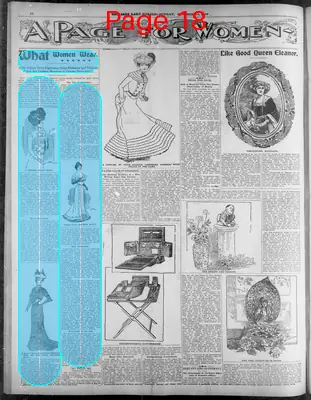
Story
October 14, 1900
The Salt Lake Herald
Salt Lake City, Salt Lake County, Utah
What is this article about?
New York fashion report from October 1900 highlights plain silk and wool fabrics like satin aiglon and Venetian panne, brown tones, braid trims, cashmere gowns, elaborate jacket waists, silver-handled umbrellas, and innovative fans with lace windows. (187 chars)
Clipping
OCR Quality
95%
Excellent
Full Text
WHAT WOMEN WEAR.
Satin Aiglon, Satin Algerienne, Crepe Nubienne and Venetian Panne Are Leading Novelties in October Dress Goods.
New York, October, 1900.—Figured goods, whether silk or wool, have all been ignominiously retired to the bargain counters. A stripe or dot is permitted, of course; indeed, they are never out of fashion, but all the cashmeres, winter voiles, flannels, etc., that are to be wrought into gowns show none but plain surfaces. The dots and stripes will do their duty in the field of shirt waist manufacture, and meanwhile to linger at a counter where the new silks are spread forth is to enjoy an artistic treat. Satin aiglon, crepe nubienne and Venetian panne are the richest and newest fabrics of them all. As to satin proper there is little or none of it called into use by the dressmakers this season, and the satin du jour, satin aiglon and satin Algerienne that we hear and see so much of are no more than very rich silks with a sheeny finish that sometimes is iridescent.
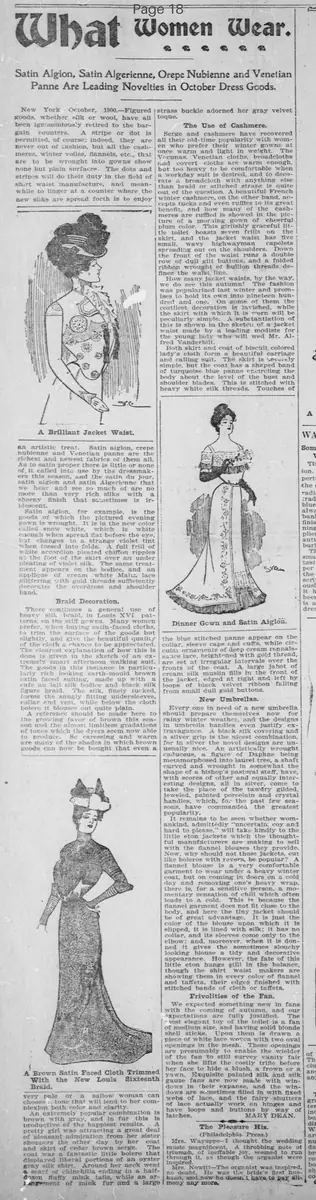
Satin aiglon, for example, is the goods of which the pictured evening gown is wrought. It is in the new color called snow white, which is white enough when spread flat before the eye, but changes to a strange violet tint when tossed into folds. A full frill of white accordion pleated chiffon ripples at the foot of the skirt over an under pleating of violet silk. The same treatment appears on the bodice, and an applique of cream white Malat lace glittering with gold threads sufficiently decorates the overdress and shoulder band.
Braid Decoration.
There continues a general use of heavy silk braid, in Louis XVI patterns on the stiff gowns. Many women prefer, when buying satin-faced cloths, to trim the surface of the goods but slightly, and give the beautiful quality of the cloth a chance to be appreciated. The clearest explanation of how this is done is given in the sketch of an extremely smart afternoon walking suit. The goods in this instance is particularly rich looking earth-mould brown satin faced suiting, made up with a cafe au lait silk bodice and black silk figure braid. The silk, finely tucked, forms the snugly fitting undersleeves, collar and vest, while below the cloth bolero it blouses out quite plain. A reference should be made here to the growing favor of brown this season and the almost limitless gradations of tones which the dyers seem now able to produce. So caressing and warm are many of the shades in which brown goods can now be bought that even a very pale or sallow woman can choose a tone that will lend to her complexion both color and clarity.
A Brown Satin Faced Cloth Trimmed with the New Louis Sixteenth Braid.
An extremely popular combination is brown with gray, and in fur this is productive of the happiest results. A pretty girl was attracting a great deal of pleasant admiration from her sister shoppers the other day by her coat and skirt of cedar brown serge. The coat was a fantastic little bolero that displayed liberal portions of an oyster gray silk shirt. Around her neck went a scarf of chinchilla ending in a half-dozen fluffy mink tails, while an arrangement of mink fur and a large...
Serge and cashmere have recovered all their old-time popularity with women who prefer their winter gowns at once warm and light in weight. The Venetians, Venetian cloths, broadcloths and covert cloths are warm enough, but too heavy to be comfortable when a workday suit is desired, and to decorate a broadcloth with anything else than braid or stitched straps is quite out of the question. A beautiful French winter cashmere, on the other hand, accepts tucks and even ruffles to its great benefit, and how many of the cashmeres are ruffled is showed in the picture of a morning gown of cheerful plum color. This girlishly graceful little toilet boasts seven frills on the skirt, and the jacket waist has five small, wavy highwayman capelets spreading out on the shoulders. Down the front of the waist runs a double row of dull gilt buttons, and a folded ribbon wrought of bullion threads defines the waist line.
How many jacket waists, by the way, we do see this autumn! The fashion was popularized last winter and promises to hold its own into nineteen hundred and one. On some of them the costliest decoration is lavished, while the skirt with which it is worn will be peculiarly simple. A substantiation of this is shown in the sketch of a jacket waist made by a leading modiste for the young lady who will wed Mr. Alfred Vanderbilt. Both skirt and coat of biscuit colored lady's cloth form a beautiful carriage and calling suit. The skirt is severely simple, but the coat has a shaped band of turquoise blue panne encircling the body about the level of the bust and shoulder blades. This is stitched with heavy white silk threads. Touches of the blue stitched panne appear on the collar, sleeve caps and cuffs, while circular ornaments of deep cream renaissance lace, brightened with gold thread, are set at irregular intervals over the fronts of the coat. A large jabot of cream silk muslin fills in the front of the jacket, edged at right and left by loops of black velvet ribbon falling from small dull gold buttons.
Dinner Gown and Satin Aiglon.
New Umbrellas.
Every one in need of a new umbrella should prepare themselves now for rainy winter weather, and the designs in umbrella handles even justify extravagance. A black silk covering and a silver grip is the nicest combination, for in silver the novel designs are unusually nice. An artistically wrought caduceus, a figure of Daphne being metamorphosed into laurel tree, a shaft curved and wrought in somewhat the shape of a bishop's pastoral staff, have, with scores of other and equally interesting designs, all in silver, come to take the place of the tawdry gilded, jeweled, painted porcelain and crystal handles, which, for the past few seasons, have commanded the greatest popularity. It remains to be seen whether womankind, admittedly 'uncertain, coy and hard to please,' will take kindly to the little eton jackets which the thoughtful manufacturers are making to sell with the flannel blouses they provide. Now, why should not those jackets, cut like boleros with revers, be popular? A flannel blouse is a very comfortable garment to wear under a heavy winter coat, but on coming in doors on a cold day and removing one's heavy wrap, there is, for a sensitive person, a momentary sensation of chill which often leads to a cold. This is because the flannel garment does not fit close to the body, and here the tiny jacket should be of great advantage. It is just the color of the blouse upon which it is slipped, it is lined with silk; it has no collar, and its sleeves come only to the elbow; and, moreover, when it is donned it gives the sometimes slouchy looking blouse a tidy and decorative appearance. However, the fate of this little eton hangs still in the balance, though the shirt waist makers are showing them in every color of flannel and taffeta, their edges finished with stitched bands of cloth or taffeta.
Frivolities of the Fan.
We expected something new in fans with the coming of autumn, and our expectations are fully justified. The most elegant toy of the toilet is a fan of medium size, and having solid blonde shell sticks. Upon them is drawn a piece of white lace woven with two oval openings in the mesh. These openings are presumably to enable the wielder of the fan to still survey vanity fair when she lifts the costly trifle before her face to hide a blush, a frown or a yawn. Exquisite painted silk and silk gauze fans are now made with windows in their expanse, and the windows are sometimes filled in with fixed webs of lace, and the fairy shutters of lace actually work on hinges and have loops and buttons by way of latches.
MARY DEAN.
Satin Aiglon, Satin Algerienne, Crepe Nubienne and Venetian Panne Are Leading Novelties in October Dress Goods.
New York, October, 1900.—Figured goods, whether silk or wool, have all been ignominiously retired to the bargain counters. A stripe or dot is permitted, of course; indeed, they are never out of fashion, but all the cashmeres, winter voiles, flannels, etc., that are to be wrought into gowns show none but plain surfaces. The dots and stripes will do their duty in the field of shirt waist manufacture, and meanwhile to linger at a counter where the new silks are spread forth is to enjoy an artistic treat. Satin aiglon, crepe nubienne and Venetian panne are the richest and newest fabrics of them all. As to satin proper there is little or none of it called into use by the dressmakers this season, and the satin du jour, satin aiglon and satin Algerienne that we hear and see so much of are no more than very rich silks with a sheeny finish that sometimes is iridescent.
Satin aiglon, for example, is the goods of which the pictured evening gown is wrought. It is in the new color called snow white, which is white enough when spread flat before the eye, but changes to a strange violet tint when tossed into folds. A full frill of white accordion pleated chiffon ripples at the foot of the skirt over an under pleating of violet silk. The same treatment appears on the bodice, and an applique of cream white Malat lace glittering with gold threads sufficiently decorates the overdress and shoulder band.
Braid Decoration.
There continues a general use of heavy silk braid, in Louis XVI patterns on the stiff gowns. Many women prefer, when buying satin-faced cloths, to trim the surface of the goods but slightly, and give the beautiful quality of the cloth a chance to be appreciated. The clearest explanation of how this is done is given in the sketch of an extremely smart afternoon walking suit. The goods in this instance is particularly rich looking earth-mould brown satin faced suiting, made up with a cafe au lait silk bodice and black silk figure braid. The silk, finely tucked, forms the snugly fitting undersleeves, collar and vest, while below the cloth bolero it blouses out quite plain. A reference should be made here to the growing favor of brown this season and the almost limitless gradations of tones which the dyers seem now able to produce. So caressing and warm are many of the shades in which brown goods can now be bought that even a very pale or sallow woman can choose a tone that will lend to her complexion both color and clarity.
A Brown Satin Faced Cloth Trimmed with the New Louis Sixteenth Braid.
An extremely popular combination is brown with gray, and in fur this is productive of the happiest results. A pretty girl was attracting a great deal of pleasant admiration from her sister shoppers the other day by her coat and skirt of cedar brown serge. The coat was a fantastic little bolero that displayed liberal portions of an oyster gray silk shirt. Around her neck went a scarf of chinchilla ending in a half-dozen fluffy mink tails, while an arrangement of mink fur and a large...
Serge and cashmere have recovered all their old-time popularity with women who prefer their winter gowns at once warm and light in weight. The Venetians, Venetian cloths, broadcloths and covert cloths are warm enough, but too heavy to be comfortable when a workday suit is desired, and to decorate a broadcloth with anything else than braid or stitched straps is quite out of the question. A beautiful French winter cashmere, on the other hand, accepts tucks and even ruffles to its great benefit, and how many of the cashmeres are ruffled is showed in the picture of a morning gown of cheerful plum color. This girlishly graceful little toilet boasts seven frills on the skirt, and the jacket waist has five small, wavy highwayman capelets spreading out on the shoulders. Down the front of the waist runs a double row of dull gilt buttons, and a folded ribbon wrought of bullion threads defines the waist line.
How many jacket waists, by the way, we do see this autumn! The fashion was popularized last winter and promises to hold its own into nineteen hundred and one. On some of them the costliest decoration is lavished, while the skirt with which it is worn will be peculiarly simple. A substantiation of this is shown in the sketch of a jacket waist made by a leading modiste for the young lady who will wed Mr. Alfred Vanderbilt. Both skirt and coat of biscuit colored lady's cloth form a beautiful carriage and calling suit. The skirt is severely simple, but the coat has a shaped band of turquoise blue panne encircling the body about the level of the bust and shoulder blades. This is stitched with heavy white silk threads. Touches of the blue stitched panne appear on the collar, sleeve caps and cuffs, while circular ornaments of deep cream renaissance lace, brightened with gold thread, are set at irregular intervals over the fronts of the coat. A large jabot of cream silk muslin fills in the front of the jacket, edged at right and left by loops of black velvet ribbon falling from small dull gold buttons.
Dinner Gown and Satin Aiglon.
New Umbrellas.
Every one in need of a new umbrella should prepare themselves now for rainy winter weather, and the designs in umbrella handles even justify extravagance. A black silk covering and a silver grip is the nicest combination, for in silver the novel designs are unusually nice. An artistically wrought caduceus, a figure of Daphne being metamorphosed into laurel tree, a shaft curved and wrought in somewhat the shape of a bishop's pastoral staff, have, with scores of other and equally interesting designs, all in silver, come to take the place of the tawdry gilded, jeweled, painted porcelain and crystal handles, which, for the past few seasons, have commanded the greatest popularity. It remains to be seen whether womankind, admittedly 'uncertain, coy and hard to please,' will take kindly to the little eton jackets which the thoughtful manufacturers are making to sell with the flannel blouses they provide. Now, why should not those jackets, cut like boleros with revers, be popular? A flannel blouse is a very comfortable garment to wear under a heavy winter coat, but on coming in doors on a cold day and removing one's heavy wrap, there is, for a sensitive person, a momentary sensation of chill which often leads to a cold. This is because the flannel garment does not fit close to the body, and here the tiny jacket should be of great advantage. It is just the color of the blouse upon which it is slipped, it is lined with silk; it has no collar, and its sleeves come only to the elbow; and, moreover, when it is donned it gives the sometimes slouchy looking blouse a tidy and decorative appearance. However, the fate of this little eton hangs still in the balance, though the shirt waist makers are showing them in every color of flannel and taffeta, their edges finished with stitched bands of cloth or taffeta.
Frivolities of the Fan.
We expected something new in fans with the coming of autumn, and our expectations are fully justified. The most elegant toy of the toilet is a fan of medium size, and having solid blonde shell sticks. Upon them is drawn a piece of white lace woven with two oval openings in the mesh. These openings are presumably to enable the wielder of the fan to still survey vanity fair when she lifts the costly trifle before her face to hide a blush, a frown or a yawn. Exquisite painted silk and silk gauze fans are now made with windows in their expanse, and the windows are sometimes filled in with fixed webs of lace, and the fairy shutters of lace actually work on hinges and have loops and buttons by way of latches.
MARY DEAN.
What sub-type of article is it?
Fashion Report
Trend Description
What themes does it cover?
Social Manners
What keywords are associated?
Satin Aiglon
Venetian Panne
Brown Fashion
Jacket Waists
Silver Umbrellas
Lace Fans
What entities or persons were involved?
Alfred Vanderbilt
Mary Dean
Where did it happen?
New York
Story Details
Key Persons
Alfred Vanderbilt
Mary Dean
Location
New York
Event Date
October 1900
Story Details
Article describes leading October 1900 dress goods like satin aiglon, satin Algerienne, crepe nubienne, and Venetian panne; trends in plain fabrics, brown shades, braid decorations, cashmere gowns, jacket waists, umbrellas with silver handles, and new fans with lace elements.