Thank you for visiting SNEWPapers!
Sign up free
Story
November 22, 1855
The Religious Herald
Hartford, Hartford County, Connecticut
What is this article about?
On Thanksgiving, elderly Deacon Wilson and his wife face poverty and grief over their deceased daughter and wayward son William. The reformed William returns from California with gold, reconciling with his parents and saving the family farm.
Clipping
OCR Quality
94%
Excellent
Full Text
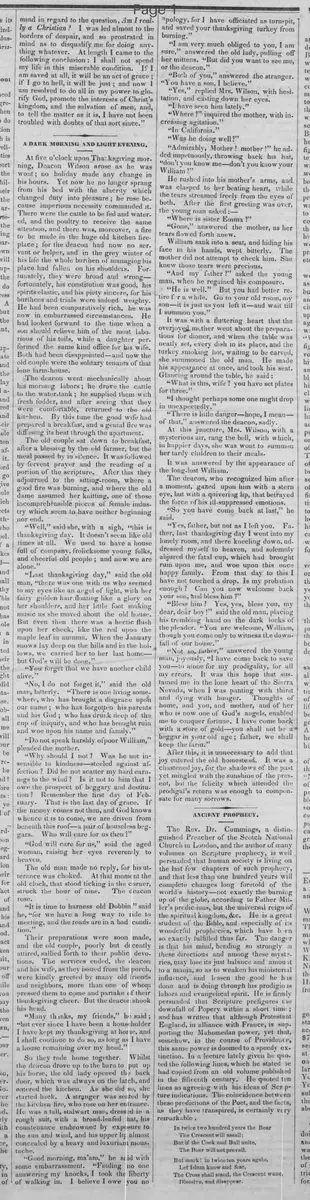
A DARK MORNING AND LIGHT EVENING.
At five o'clock upon Thanksgiving morning, Deacon Wilson arose as he was wont; no holiday made any change in his hours. Yet now he no longer sprang from his bed with the alacrity which changed duty into pleasure; he rose because imperious necessity commanded it. There were the cattle to be fed and watered, and the poultry to receive the same attention, and there was, moreover, a fire to be made in the huge old kitchen fireplace; for the deacon had now no servant or helper, and in the grey winter of his life the whole burden of managing his place had fallen on his shoulders. Fortunately, they were broad and strong—fortunately, his constitution was good, his spirits elastic, and his piety sincere, for his burdens and trials were indeed weighty.
He had been comparatively rich, he was now in embarrassed circumstances. He had looked forward to the time when a son should relieve him of the most laborious of his toils, while a daughter performed the same kind office for his wife. Both had been disappointed—and now the old couple were the solitary tenants of that large farm-house.
The deacon went mechanically about his morning labors; he drove the cattle to the water-tank; he supplied them with fresh fodder, and after seeing that they were comfortable, returned to the old kitchen. By this time the good wife had prepared a breakfast, and a genial fire was diffusing its heat through the apartment.
The old couple sat down to breakfast, after a blessing by the old farmer, but the meal passed by in silence. It was followed by fervent prayer and the reading of a portion of the scripture. After this they adjourned to the sitting-room, where a good fire was burning, and where the old dame assumed her knitting, one of those incomprehensible pieces of female industry which seem to have neither beginning nor end.
"Well," said she, with a sigh, "this is thanksgiving day. It doesn't seem like old times at all. We used to have a house full of company, frolicksome young folks and cheerful old people; and now we are alone."
"Last thanksgiving day," said the old man, "there was one with us who seemed to my eyes like an angel of light, with her fairy golden hair floating like a glory on her shoulders, and her little foot making music as she moved about the old house. But even then there was a hectic flush upon her cheek, like the red upon the maple leaf in autumn. When the January snows lay deep on the hills and in the hollows, we carried her to her last home—but God's will be done."
"You forget that we have another child alive."
"No, I do not forget it," said the old man, bitterly. "There is one living somewhere, who has brought a disgrace upon our name; who has forgotten his parents and his God; who has drunk deep of the cup of iniquity, and who has brought ruin and woe upon his name and family."
"Do not speak harshly of poor William," pleaded the mother.
"Why should I not? Was he not insensible to kindness—steeled against affection? Did he not scatter my hard earnings to the wind? Is it not to him that I owe the prospect of beggary and destitution? Remember the first day of February. That is the last day of grace. If the money comes not then, and God knows whence it is to come, we are driven from beneath this roof—a pair of houseless beggars. Who will care for us then?"
"God will care for us," said the aged woman, raising her eyes reverently to heaven.
The old man made no reply, for his utterance was choked. At that moment the old clock, that stood ticking in the corner, struck the hour of nine.
The deacon rose,
"It is time to harness old Dobbin," said he, "for we have a long way to ride to meeting, and the roads are in a bad condition."
Their preparations were soon made, and the old couple, poorly but decently attired, sallied forth to their public devotions. The services ended, the deacon and his wife, as they issued from the porch, were kindly greeted by many old friends and neighbors, more than one of whom pressed them to come and partake of their thanksgiving cheer. But the deacon shook his head.
"Many thanks, my friends," he said; "but ever since I have been a householder I have kept my thanksgiving at home, and I shall continue to do so, as long as I have a house remaining over my head."
So they rode home together. Whilst the deacon drove up to the barn to put up his horse, the old lady opened the back door, which was always on the latch, and entered the kitchen. As she did so, she started back. A stranger was seated by the kitchen fire, who rose on her entrance. He was a tall, stalwart man, dressed in a rough suit, with a broad-leafed hat, his countenance embrowned by exposure to the sun and wind, and his upper lip almost concealed by a heavy and luxuriant moustache.
"Good morning, ma'am," he said with some embarrassment. "Finding no one answering my knocks, I took the liberty of walking in. I believe I owe you no apology, for I have officiated as turnspit, and saved your thanksgiving turkey from burning."
"I am very much obliged to you, I am sure," answered the old lady, pulling off her mittens. "But did you want to see me, or the deacon."
"Both of you," answered the stranger. "You have a son, I believe."
"Yes," replied Mrs. Wilson, with hesitation, and casting down her eyes.
"I have seen him lately."
"Where?" inquired the mother, with increasing agitation.
"In California."
"Was he doing well?"
"Admirably, Mother! mother!" he added impetuously, throwing back his hat, "don't you know me—don't you know your William?"
He rushed into his mother's arms, and was clasped to her beating heart, while the tears streamed freely from the eyes of both. After the first greeting was over, the young man asked:-
"Where is sister Emma?"
"Gone," answered the mother, as her tears flowed forth anew.
William sank into a seat, and hiding his face in his hands, wept bitterly. The mother did not attempt to check him. She knew those tears were precious.
"And my father?" asked the young man, when he regained his composure.
"He is well." But you had better retire for a while. Go to your old room, my son—it is just as you left it—and wait till I summon you.
It was with a fluttering heart that the overjoyed mother went about the preparations for dinner, and when the table was neatly set, every dish in its place, and the turkey smoking hot, waiting to be carved, she summoned the old man. He made his appearance at once, and took his seat. Glancing around the table, he said:
"What is this, wife? you have set plates for three."
"I thought perhaps some one might drop in unexpectedly."
"There is little danger—hope, I mean— of that," answered the deacon, sadly.
At this juncture, Mrs. Wilson, with a mysterious air, rang the bell, with which, in happier days, she was wont to summon her tardy children to their meals.
It was answered by the appearance of the long-lost William.
The deacon, who recognized him after a moment, gazed upon him with a stern eye, but with a quivering lip, that betrayed the force of his ill-suppressed emotions.
"So you have come back at last," he said.
"Yes, father, but not as I left you. Father, last thanksgiving day I went into my lonely room, and there kneeling down, addressed myself to heaven, and solemnly abjured the fatal cup, which had brought ruin upon me, and woe upon this once happy family. From that day to this I have not touched a drop. Is my probation enough? Can you now welcome back your son, and bless him?"
"Bless him? Yes, yes, bless you, my dear, dear boy!" said the old man, placing his trembling hand on the dark locks of the pleader. "You are welcome, William, though you come only to witness the downfall of our house.'"
"Not so, father," answered the young man, joyously, "I have come back to save you—to atone for my prodigality, for all my errors. It was this hope that sustained me in the lone heart of the Sierra Nevada, when I was panting with thirst and dying with hunger. Thoughts of home, and you, and mother, and of her who is now one of God's angels, enabled me to conquer fortune. I have come back with a store of gold—you shall not be a beggar in your old age; father, we shall keep the farm."
After this, it is unnecessary to add that joy entered the old homestead. It was a chastened joy, for the shadows of the past yet mingled with the sunshine of the present, but the felicity which attended the prodigal's return was enough to compensate for many sorrows.
At five o'clock upon Thanksgiving morning, Deacon Wilson arose as he was wont; no holiday made any change in his hours. Yet now he no longer sprang from his bed with the alacrity which changed duty into pleasure; he rose because imperious necessity commanded it. There were the cattle to be fed and watered, and the poultry to receive the same attention, and there was, moreover, a fire to be made in the huge old kitchen fireplace; for the deacon had now no servant or helper, and in the grey winter of his life the whole burden of managing his place had fallen on his shoulders. Fortunately, they were broad and strong—fortunately, his constitution was good, his spirits elastic, and his piety sincere, for his burdens and trials were indeed weighty.
He had been comparatively rich, he was now in embarrassed circumstances. He had looked forward to the time when a son should relieve him of the most laborious of his toils, while a daughter performed the same kind office for his wife. Both had been disappointed—and now the old couple were the solitary tenants of that large farm-house.
The deacon went mechanically about his morning labors; he drove the cattle to the water-tank; he supplied them with fresh fodder, and after seeing that they were comfortable, returned to the old kitchen. By this time the good wife had prepared a breakfast, and a genial fire was diffusing its heat through the apartment.
The old couple sat down to breakfast, after a blessing by the old farmer, but the meal passed by in silence. It was followed by fervent prayer and the reading of a portion of the scripture. After this they adjourned to the sitting-room, where a good fire was burning, and where the old dame assumed her knitting, one of those incomprehensible pieces of female industry which seem to have neither beginning nor end.
"Well," said she, with a sigh, "this is thanksgiving day. It doesn't seem like old times at all. We used to have a house full of company, frolicksome young folks and cheerful old people; and now we are alone."
"Last thanksgiving day," said the old man, "there was one with us who seemed to my eyes like an angel of light, with her fairy golden hair floating like a glory on her shoulders, and her little foot making music as she moved about the old house. But even then there was a hectic flush upon her cheek, like the red upon the maple leaf in autumn. When the January snows lay deep on the hills and in the hollows, we carried her to her last home—but God's will be done."
"You forget that we have another child alive."
"No, I do not forget it," said the old man, bitterly. "There is one living somewhere, who has brought a disgrace upon our name; who has forgotten his parents and his God; who has drunk deep of the cup of iniquity, and who has brought ruin and woe upon his name and family."
"Do not speak harshly of poor William," pleaded the mother.
"Why should I not? Was he not insensible to kindness—steeled against affection? Did he not scatter my hard earnings to the wind? Is it not to him that I owe the prospect of beggary and destitution? Remember the first day of February. That is the last day of grace. If the money comes not then, and God knows whence it is to come, we are driven from beneath this roof—a pair of houseless beggars. Who will care for us then?"
"God will care for us," said the aged woman, raising her eyes reverently to heaven.
The old man made no reply, for his utterance was choked. At that moment the old clock, that stood ticking in the corner, struck the hour of nine.
The deacon rose,
"It is time to harness old Dobbin," said he, "for we have a long way to ride to meeting, and the roads are in a bad condition."
Their preparations were soon made, and the old couple, poorly but decently attired, sallied forth to their public devotions. The services ended, the deacon and his wife, as they issued from the porch, were kindly greeted by many old friends and neighbors, more than one of whom pressed them to come and partake of their thanksgiving cheer. But the deacon shook his head.
"Many thanks, my friends," he said; "but ever since I have been a householder I have kept my thanksgiving at home, and I shall continue to do so, as long as I have a house remaining over my head."
So they rode home together. Whilst the deacon drove up to the barn to put up his horse, the old lady opened the back door, which was always on the latch, and entered the kitchen. As she did so, she started back. A stranger was seated by the kitchen fire, who rose on her entrance. He was a tall, stalwart man, dressed in a rough suit, with a broad-leafed hat, his countenance embrowned by exposure to the sun and wind, and his upper lip almost concealed by a heavy and luxuriant moustache.
"Good morning, ma'am," he said with some embarrassment. "Finding no one answering my knocks, I took the liberty of walking in. I believe I owe you no apology, for I have officiated as turnspit, and saved your thanksgiving turkey from burning."
"I am very much obliged to you, I am sure," answered the old lady, pulling off her mittens. "But did you want to see me, or the deacon."
"Both of you," answered the stranger. "You have a son, I believe."
"Yes," replied Mrs. Wilson, with hesitation, and casting down her eyes.
"I have seen him lately."
"Where?" inquired the mother, with increasing agitation.
"In California."
"Was he doing well?"
"Admirably, Mother! mother!" he added impetuously, throwing back his hat, "don't you know me—don't you know your William?"
He rushed into his mother's arms, and was clasped to her beating heart, while the tears streamed freely from the eyes of both. After the first greeting was over, the young man asked:-
"Where is sister Emma?"
"Gone," answered the mother, as her tears flowed forth anew.
William sank into a seat, and hiding his face in his hands, wept bitterly. The mother did not attempt to check him. She knew those tears were precious.
"And my father?" asked the young man, when he regained his composure.
"He is well." But you had better retire for a while. Go to your old room, my son—it is just as you left it—and wait till I summon you.
It was with a fluttering heart that the overjoyed mother went about the preparations for dinner, and when the table was neatly set, every dish in its place, and the turkey smoking hot, waiting to be carved, she summoned the old man. He made his appearance at once, and took his seat. Glancing around the table, he said:
"What is this, wife? you have set plates for three."
"I thought perhaps some one might drop in unexpectedly."
"There is little danger—hope, I mean— of that," answered the deacon, sadly.
At this juncture, Mrs. Wilson, with a mysterious air, rang the bell, with which, in happier days, she was wont to summon her tardy children to their meals.
It was answered by the appearance of the long-lost William.
The deacon, who recognized him after a moment, gazed upon him with a stern eye, but with a quivering lip, that betrayed the force of his ill-suppressed emotions.
"So you have come back at last," he said.
"Yes, father, but not as I left you. Father, last thanksgiving day I went into my lonely room, and there kneeling down, addressed myself to heaven, and solemnly abjured the fatal cup, which had brought ruin upon me, and woe upon this once happy family. From that day to this I have not touched a drop. Is my probation enough? Can you now welcome back your son, and bless him?"
"Bless him? Yes, yes, bless you, my dear, dear boy!" said the old man, placing his trembling hand on the dark locks of the pleader. "You are welcome, William, though you come only to witness the downfall of our house.'"
"Not so, father," answered the young man, joyously, "I have come back to save you—to atone for my prodigality, for all my errors. It was this hope that sustained me in the lone heart of the Sierra Nevada, when I was panting with thirst and dying with hunger. Thoughts of home, and you, and mother, and of her who is now one of God's angels, enabled me to conquer fortune. I have come back with a store of gold—you shall not be a beggar in your old age; father, we shall keep the farm."
After this, it is unnecessary to add that joy entered the old homestead. It was a chastened joy, for the shadows of the past yet mingled with the sunshine of the present, but the felicity which attended the prodigal's return was enough to compensate for many sorrows.
What sub-type of article is it?
Family Drama
Personal Triumph
Tragedy
What themes does it cover?
Family
Moral Virtue
Triumph
What keywords are associated?
Thanksgiving
Family Reunion
Prodigal Son
Redemption
Farm Foreclosure
California Gold
What entities or persons were involved?
Deacon Wilson
Mrs. Wilson
William
Emma
Where did it happen?
The Wilson Family Farm
Story Details
Key Persons
Deacon Wilson
Mrs. Wilson
William
Emma
Location
The Wilson Family Farm
Event Date
Thanksgiving Day
Story Details
Elderly Deacon Wilson and his wife, impoverished after their daughter Emma's death and son William's disgraceful departure due to alcoholism, face losing their farm. On Thanksgiving, the reformed William returns from California with gold earned in the Sierra Nevada, reconciles with his parents, and saves the homestead.