Thank you for visiting SNEWPapers!
Sign up free
Story
May 20, 1932
The Coolidge Examiner
Coolidge, Pinal County, Arizona
What is this article about?
Prof. Clyde T. Morris of Ohio State University explains that stenographers in tall buildings may suffer sea-sickness-like illness from swaying fixtures, not the structure itself, based on experiments in Columbus, Ohio's American Insurance Union tower.
Clipping
OCR Quality
98%
Excellent
Full Text
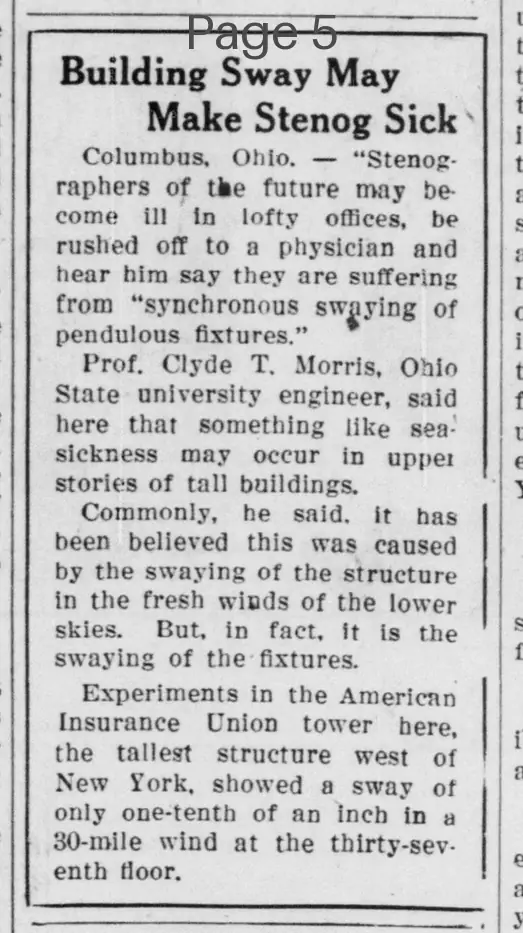
Building Sway May Make Stenog Sick
Columbus, Ohio. "Stenographers of the future may become ill in lofty offices, be rushed off to a physician and hear him say they are suffering from "synchronous swaying of pendulous fixtures. Prof. Clyde T. Morris, Ohio State university engineer, said here that something like sea-sickness may occur in upper stories of tall buildings. Commonly, he said, it has been believed this was caused by the swaying of the structure in the fresh winds of the lower skies. But, in fact, it is the swaying of the fixtures. Experiments in the American Insurance Union tower here, the tallest structure west of New York, showed a sway of only one-tenth of an inch in a 30-mile wind at the thirty-seventh floor.
Columbus, Ohio. "Stenographers of the future may become ill in lofty offices, be rushed off to a physician and hear him say they are suffering from "synchronous swaying of pendulous fixtures. Prof. Clyde T. Morris, Ohio State university engineer, said here that something like sea-sickness may occur in upper stories of tall buildings. Commonly, he said, it has been believed this was caused by the swaying of the structure in the fresh winds of the lower skies. But, in fact, it is the swaying of the fixtures. Experiments in the American Insurance Union tower here, the tallest structure west of New York, showed a sway of only one-tenth of an inch in a 30-mile wind at the thirty-seventh floor.
What sub-type of article is it?
Curiosity
Medical Curiosity
What themes does it cover?
Misfortune
What keywords are associated?
Building Sway
Sea Sickness
Tall Buildings
Stenographers
Fixtures
Experiments
What entities or persons were involved?
Prof. Clyde T. Morris
Where did it happen?
Columbus, Ohio; American Insurance Union Tower
Story Details
Key Persons
Prof. Clyde T. Morris
Location
Columbus, Ohio; American Insurance Union Tower
Story Details
Prof. Morris states that future stenographers in tall buildings may experience sea-sickness from swaying fixtures, not the building sway, as shown by minimal structural movement in experiments at the American Insurance Union tower.