Thank you for visiting SNEWPapers!
Sign up free
Literary
May 22, 1818
The Rhode Island American, And General Advertiser
Providence, Providence County, Rhode Island
What is this article about?
A fraternal letter reflecting on the author's renewed appreciation for agriculture after years in public service, praising farming's independence and profitability, and noting the current U.S. administration's policies supporting peace and avoiding direct taxation on the soil to benefit rural pursuits.
Clipping
OCR Quality
95%
Excellent
Full Text
Rural Economy.
For THE RHODE-ISLAND AMERICAN,
LETTERS ON AGRICULTURE.
NO. I.
DEAR BROTHER,
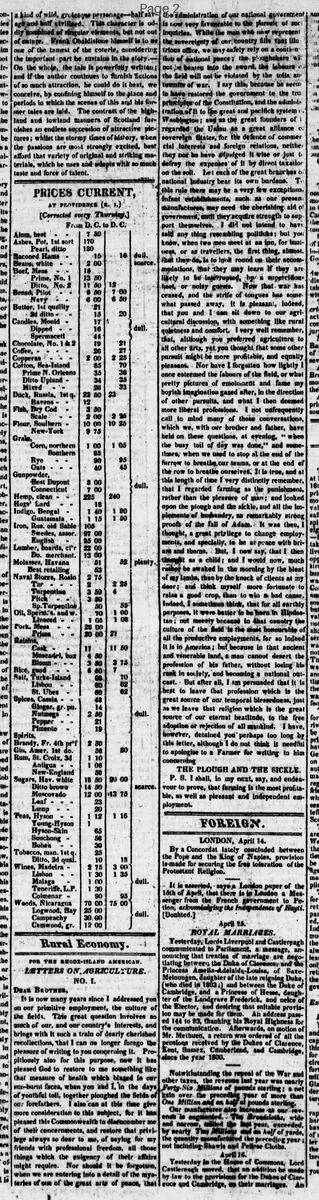
It is now many years since I addressed you on our primitive employment, the culture of the fields. This great question involves so much of our, and our country's interests, and brings with it such a train of dearly cherished recollections, that I can no longer forego the pleasure of writing to you concerning it. Propitiously also for this purpose, now it has pleased God to restore to me something like that measure of health which blazed in our sun-burnt faces, when you and I, in the days of youthful toil, together ploughed the fields of our forefathers. I also can at this time give more consideration to this subject, for it has pleased this Commonwealth to disencumber me of their concernments, and restore that privilege always so dear to me, of saying for my friends with professional freedom, all those things which the exigency of their affairs might require. Nor should it be forgotten, when we are entering into a detail of the mysteries of one of the great arts of peace, that the administration of our national government is now very favourable to the pursuit of such inquiries. While the man who now represents the sovereignty of our country fills that illustrious office, we may safely rely on a continuance of national peace; the ploughshare will not be beaten into the sword, the labours of the field will not be violated by the toils and tumult of war. I say this, because he seems to have restored the government to the true principles of the Constitution, and the administration of it to the great and pacifick system of Washington; and as the great founders of it regarded the Union, as a great alliance of sovereign States, for the defence of commercial interests and foreign relations, neither they nor he have adjudged it wise or just to defray the expenses of it by direct taxation on the soil. Let each of the great branches of national industry bear its own burdens. To this rule there may be a very few exceptions. Infant establishments, such as our present manufactures, may need the cherishing aid of government, until they acquire strength to support themselves. I did not intend to have said any thing resembling politicks; but you know, when two men meet at an inn, for business, or as travellers, the first thing, almost, that they do, is to look round on their accommodations, that they may learn if they are likely to be interrupted by a supercilious host, or noisy guests. Now that war has ceased, and the strife of tongues has somewhat passed away, it is pleasant, indeed, that you and I can sit down to our agricultural discussion, with something like rural quietness and comfort. I very well remember, that, although you preferred agriculture to all other arts, yet you thought that some other pursuit might be more profitable; and equally pleasant. Nor have I forgotten how lightly I once esteemed the labours of the field, or what pretty pictures of emolument and fame my boyish imagination gazed after, in the direction of other pursuits, and what I then deemed more liberal professions. I not unfrequently call to mind many of those conversations, which we, with our brother and father, have held on these questions, at evening, when the busy toil of day was done, and sometimes, when we used to stop at the end of the furrow to breathe our teams, or at the end of the row to breathe ourselves. It is true, and at this length of time I very distinctly remember, that I regarded farming as the punishment, rather than the pleasure of man; and looked upon the plough and the sickle, and all the implements of husbandry, as remarkably strong proofs of the fall of Adam. I was then, I thought, a great privilege to change employments, and specially to be at peace with briars and thorns. But, I now say, that I then thought as a child; and I would now, much rather be awaked in the morning by the bleat of my lambs, than by the knock of clients at my door; and think myself more fortunate to raise a good crop, than to win a bad cause. Indeed, I sometimes think, that for all earthly purposes, it were better to be born in Hindostan; not merely because in that country the culture of the field is the most honourable of all the productive employments, for so indeed it is in America; but because in that ancient and venerable land, a man cannot desert the profession of his father, without losing his rank in society, and becoming a national outcast. But after all, I am persuaded that it is best to leave that profession which is the great source of our temporal blessedness, just as we leave that religion which is the great source of our eternal beatitude, to the free adoption or rejection of all mankind. I have, however, detained you perhaps too long by this letter, although I do not think it needful to apologise to a Farmer for writing to him concerning
THE PLOUGH AND THE SICKLE.
P. S. I shall, in my next, say, and endeavour to prove, that farming is the most profitable, as well as pleasant and independent employment.
For THE RHODE-ISLAND AMERICAN,
LETTERS ON AGRICULTURE.
NO. I.
DEAR BROTHER,
It is now many years since I addressed you on our primitive employment, the culture of the fields. This great question involves so much of our, and our country's interests, and brings with it such a train of dearly cherished recollections, that I can no longer forego the pleasure of writing to you concerning it. Propitiously also for this purpose, now it has pleased God to restore to me something like that measure of health which blazed in our sun-burnt faces, when you and I, in the days of youthful toil, together ploughed the fields of our forefathers. I also can at this time give more consideration to this subject, for it has pleased this Commonwealth to disencumber me of their concernments, and restore that privilege always so dear to me, of saying for my friends with professional freedom, all those things which the exigency of their affairs might require. Nor should it be forgotten, when we are entering into a detail of the mysteries of one of the great arts of peace, that the administration of our national government is now very favourable to the pursuit of such inquiries. While the man who now represents the sovereignty of our country fills that illustrious office, we may safely rely on a continuance of national peace; the ploughshare will not be beaten into the sword, the labours of the field will not be violated by the toils and tumult of war. I say this, because he seems to have restored the government to the true principles of the Constitution, and the administration of it to the great and pacifick system of Washington; and as the great founders of it regarded the Union, as a great alliance of sovereign States, for the defence of commercial interests and foreign relations, neither they nor he have adjudged it wise or just to defray the expenses of it by direct taxation on the soil. Let each of the great branches of national industry bear its own burdens. To this rule there may be a very few exceptions. Infant establishments, such as our present manufactures, may need the cherishing aid of government, until they acquire strength to support themselves. I did not intend to have said any thing resembling politicks; but you know, when two men meet at an inn, for business, or as travellers, the first thing, almost, that they do, is to look round on their accommodations, that they may learn if they are likely to be interrupted by a supercilious host, or noisy guests. Now that war has ceased, and the strife of tongues has somewhat passed away, it is pleasant, indeed, that you and I can sit down to our agricultural discussion, with something like rural quietness and comfort. I very well remember, that, although you preferred agriculture to all other arts, yet you thought that some other pursuit might be more profitable; and equally pleasant. Nor have I forgotten how lightly I once esteemed the labours of the field, or what pretty pictures of emolument and fame my boyish imagination gazed after, in the direction of other pursuits, and what I then deemed more liberal professions. I not unfrequently call to mind many of those conversations, which we, with our brother and father, have held on these questions, at evening, when the busy toil of day was done, and sometimes, when we used to stop at the end of the furrow to breathe our teams, or at the end of the row to breathe ourselves. It is true, and at this length of time I very distinctly remember, that I regarded farming as the punishment, rather than the pleasure of man; and looked upon the plough and the sickle, and all the implements of husbandry, as remarkably strong proofs of the fall of Adam. I was then, I thought, a great privilege to change employments, and specially to be at peace with briars and thorns. But, I now say, that I then thought as a child; and I would now, much rather be awaked in the morning by the bleat of my lambs, than by the knock of clients at my door; and think myself more fortunate to raise a good crop, than to win a bad cause. Indeed, I sometimes think, that for all earthly purposes, it were better to be born in Hindostan; not merely because in that country the culture of the field is the most honourable of all the productive employments, for so indeed it is in America; but because in that ancient and venerable land, a man cannot desert the profession of his father, without losing his rank in society, and becoming a national outcast. But after all, I am persuaded that it is best to leave that profession which is the great source of our temporal blessedness, just as we leave that religion which is the great source of our eternal beatitude, to the free adoption or rejection of all mankind. I have, however, detained you perhaps too long by this letter, although I do not think it needful to apologise to a Farmer for writing to him concerning
THE PLOUGH AND THE SICKLE.
P. S. I shall, in my next, say, and endeavour to prove, that farming is the most profitable, as well as pleasant and independent employment.
What sub-type of article is it?
Epistolary
Essay
What themes does it cover?
Agriculture Rural
Political
What keywords are associated?
Agriculture
Farming
Rural Economy
Plough
Sickle
National Peace
Literary Details
Title
Letters On Agriculture. No. I.
Subject
Reflections On The Culture Of The Fields And Rural Economy
Form / Style
Prose Letter Discussing Farming's Pleasures And National Support
Key Lines
It Is Now Many Years Since I Addressed You On Our Primitive Employment, The Culture Of The Fields.
I Would Now, Much Rather Be Awaked In The Morning By The Bleat Of My Lambs, Than By The Knock Of Clients At My Door; And Think Myself More Fortunate To Raise A Good Crop, Than To Win A Bad Cause.
Let Each Of The Great Branches Of National Industry Bear Its Own Burdens.