Thank you for visiting SNEWPapers!
Sign up free
Constitutional Whig
Richmond, Virginia
What is this article about?
Proceedings of the Virginia House of Delegates on January 21 and 25, featuring debates and resolutions on internal improvements including abolishing the Board of Public Works (adopted), passage of a bill reforming bail in civil actions, elections of penitentiary superintendent and public store-keeper, various other bills passed, concurrence on a turnpike extension, and a divorce granted. Separate Convention committee debates led to amending and rejecting engrossment of a bill to take the sense of the people on calling a convention. A claim for Revolutionary War commutation pay for Capt. Thomas Ewell was denied.
Clipping
OCR Quality
Full Text
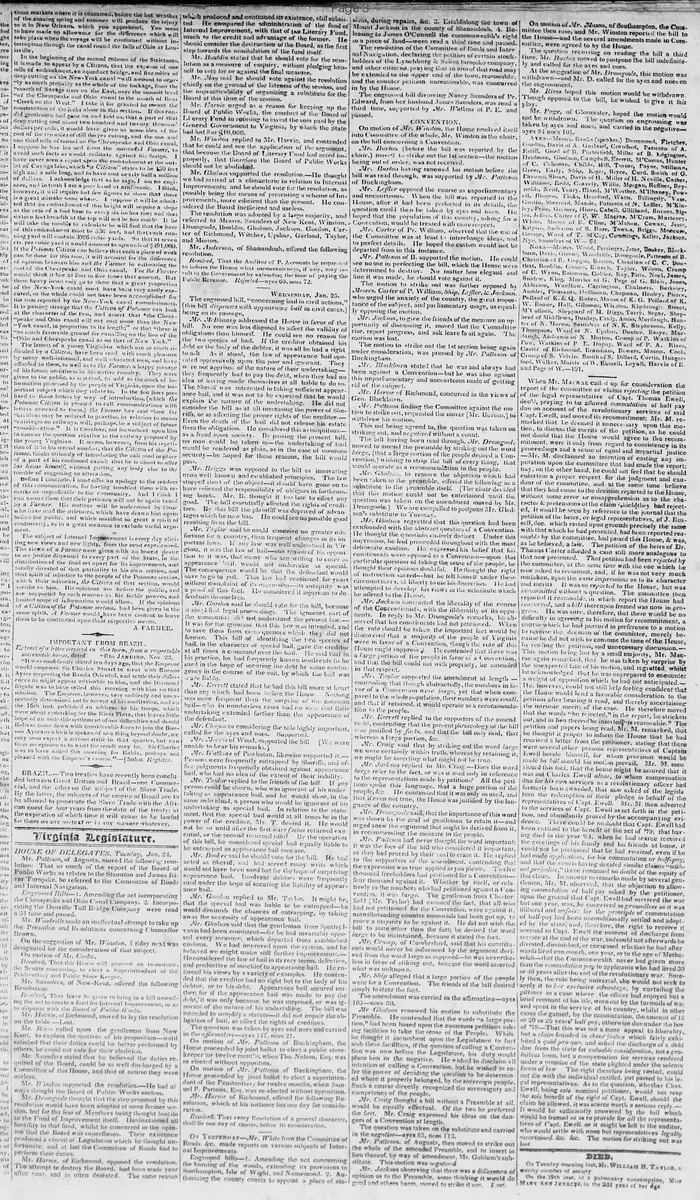
HOUSE OF DELEGATES. Tuesday, Jan. 21.
Mr. Patterson, of Augusta, moved the following: resolution: That so much of the report of the Board of Public Works as relates to the Staunton and James River Turnpike, be referred to the Committee of Roads and Internal Navigation.
Engrossed Bills—1. Amending the act incorporating the Chesapeake and Ohio Canal Company. 2. Incorporating the Danville Toll Bridge Company were read a 3d time and passed.
Mr. Woodville made an ineffectual attempt to take up the Preamble and Resolutions concerning Chancellor Brown.
On the suggestion of Mr. Winston, Friday next was designated for the consideration of that subject.
On motion of Mr. Cooke, Resolved, That this House will proceed on to-morrow, the Senate concurring, to elect a Superintendent of the Penitentiary and Public Store Keeper.
Mr. Saunders, of New-Kent, offered the following Resolution: Resolved, That leave be given to bring in a bill amending the act to create a fund for Internal Improvement, so as to dispense with the Board of Public Works.
Mr. Harris, of Richmond, moved to lay the resolution on the table—Lost.
Mr. Rives called upon the gentleman from New Kent, to explain the motives of his proposition—until satisfied that their duties could be better performed by others, he could not vote for their abolition.
Mr. Saunders stated that he believed the duties required of the Board, could be as well discharged by a Committee of this House, and that of course they were useless.
Mr. Winston supported the resolution.—He had always thought the Board of Public Works useless.
Mr. Dromgoole thought that the step proposed by this resolution would have been adopted at some former session, but for the fear of Members being thought hostile to the Fund of Improvement itself. He disclaimed all hostility to that fund, whilst he concurred in the opinion that the Board was superfluous. Their existence produced a circuit of Legislation which he thought unfortunate, and at last the Committee of Roads had to perform their duties.
Mr. Harvie, of Richmond, opposed the resolution. The attempt to destroy the Board, had been made year after year, and as often defeated. The same reason which produced and continued its existence, still subsisted. He compared the administration of the fund of Internal Improvement, with that of the Literary Fund, much to the credit and advantage of the former. He should consider the destruction of the Board, as the first step towards the annihilation of the fund itself.
Mr. Bouldin stated that he should vote for the resolution as a measure of enquiry, without pledging himself to vote for or against the final measure.
Mr. May said he should vote against the resolution chiefly on the ground of the lateness of the session, and the impracticability of organizing a substitute for the Board at this time of the session.
Mr. Harvie urged as a reason for keeping up the Board of Public Works, the conduct of the Board of Literary Fund in refusing to invest the sum paid by the General Government to Virginia, by which the State had lost 8 or $10,000.
Mr. Winston replied to Mr. Harvie, and contended that he could not see the application of the argument, that because the Board of Literary Fund had acted improperly, therefore the Board of Public Works should not be abolished.
Mr. Gholson supported the resolution.—He thought we had arrived at a climacteric in relation to Internal Improvements: and he should vote for the resolution, as possibly being the means of presenting a scheme of improvements, more efficient than the present. He considered the Board inefficient and useless.
The resolution was adopted by a large majority, and referred to Messrs. Saunders of New Kent, Winston, Dromgoole, Bouldin, Gholson, Jackson, Gordon, Carter of Richmond, Witcher, Upshur, Garland, Taylor, and Morton.
Mr. Anderson, of Shenandoah, offered the following resolution. Resolved, That the Auditor of P. Accounts be requested to inform the House what inconveniences, if any, may result to the Government by extending the time of paying the Public Revenue. Rejected—ayes 69, noes 72.
Wednesday, Jan. 25.
The engrossed bill, "concerning bail in civil actions," (this bill dispenses with appearance bail in civil cases.) being on its passage,
Mr. McIlhenny addressed the House in favor of the bill. No one was less disposed to affect the validity of obligations than himself. He could see no reason for the two species of bail. If the creditor obtained his debt or the body of the debtor, it was all he had a right to ask. As it stood, the law of appearance bail operated oppressively upon the poor and ignorant. They were not apprised of the nature of their undertaking—they frequently had to pay the debt, when they had no idea of having made themselves at all liable to do so. The Sheriff was interested in taking sufficient appearance bail, and it was not to be expected that he would explain the nature of the undertaking. He did not consider the bill as at all increasing the power of Sheriffs, or as affecting the proper rights of the creditor.—Even the death of the bail did not release his estate from the obligation. He considered this as iniquitous—as a fraud upon society. By passing the present bill, no man could be taken in—the undertaking of bail would be rendered as plain, as in the case of common security—he hoped for these reasons, the bill would pass.
Mr. Briggs was opposed to the bill as innovating upon well known and established principles. The law stopped short of the object—it should have gone on to have relieved the responsibility of obligors in forthcoming bonds. Mr. B. thought it too late to effect any good. The bill essentially affected the rights of creditors. By this bill the plaintiff was deprived of advantages which he now has. He could see no possible good resulting from the bill.
Mr. Taylor said he could conceive no greater misfortune for a country, than frequent changes in its important laws. If any law was well understood in Virginia, it was the law of bail—one reason of his opposition to it was, that many who are willing to enter as appearance bail, would not undertake as special. The consequence would be that the defendant would have to go to jail. This law had continued for years without complaint of its oppression—its antiquity was a proof of this fact. He considered it injurious to defendants themselves.
Mr. Gordon said he should vote for the bill, because it simplified legal proceedings. The ignorant part of the community did not understand the present law.—It was for the ignorant that this law was intended, and to save them from consequences which they did not foresee. This bill of identifying the two species of bail, in the character of special bail, gave the creditor at all times a command over the bail. He said that in his practice, he had frequently known insolvents to be sued in the hope of securing the debt by some contingency in the course of the suit, by which the bail was made liable.
Mr. Brodnax stated that he had this bill more at heart than any which had been before the House. Nothing was more frequent than the surprise of the common bail—who in numberless cases had no idea that their undertaking extended farther than the appearance of the defendant.
Mr. Chapman considering the title highly important, called for the ayes and noes. Supported.
Mr. Morris of Wood, supported the bill (We were unable to hear his remarks.)
Mr. Watkins of Powhatan, likewise supported it.—Persons were frequently entrapped by Sheriffs, and office judgments frequently obtained against appearance bail, who had no idea of the extent of their liability.
Mr. Taylor replied to the friends of the bill. If any person could be shown, who was ignorant of his undertaking as appearance bail, and he would show, in the same individual, a person who would be ignorant of his undertaking as special bail. In relation to the statement, that the special bail would at all times be in the power of the creditor, Mr. T. denied it. He would not be so until after the first scire facias returned executed, or the second returned nihil. By the operation of this bill, he considered special bail equally liable to be entrapped as appearance bail now are.
Mr. Booker said he should vote for the bill. He had acted as Sheriff, and had served many writs which would not have been sued but for the hope of surprising appearance bail. Insolvent debtors were frequently sued under the hope of securing the liability of appearance bail.
Mr. Gordon replied to Mr. Taylor. It might be, that the special bail was liable to be entrapped—he would diminish the chances of entrapping, by taking away the necessity of appearance bail.
Mr. Gholson said that the gentleman from Spotsylvania had been consistent—for he had invariably opposed every measure, which departed from established customs. We had improved upon the system, and he believed we might make still further improvements.—He considered the law of bail in its very terms, defective, and productive of mischief to appearance bail. He enforced his views by a variety of examples. He contended that the creditor had no right but to the body of his debtor, or to his debt. Appearance bail secured neither; for if the appearance bail was made to pay the debt, it was only because he was surprised, or was ignorant of the nature of his undertaking. The bill was intended to simplify a statute—it did not impair the obligation of bail, or affect the rights of creditors.
The question was taken by ayes and noes and carried in the affirmative—ayes 147, noes 21.
On motion of Mr. Patterson of Buckingham, the House proceeded by joint ballot to elect a public store-keeper for twelve months, when Tho. Nelson, Esq. was re-elected without opposition.
On motion of Mr. Patterson of Buckingham, the House proceeded by joint ballot to elect a superintendent of the Penitentiary; for twelve months, when Samuel P. Parsons, Esq. was re-elected without opposition.
Mr. Harvie of Richmond, offered the following Resolution, which at his instance lies one day for consideration. Resolved, That every Resolution of a general character, shall lie one day of course, before its consideration.
On Yesterday—Mr. White from the Committee of Roads, &c. made reports on various subjects of Internal Improvements
Engrossed bills—1. Amending the act concerning the burning of the woods, extending its provisions to Southampton, Isle of Wight, and Nansemond. 2. Authorizing the county courts to appoint a place of sessions, during repairs, &c. 3. Establishing the town of Mount Jackson in the county of Shenandoah. 4. Releasing to James O'Connell the commonwealth's right to a piece of land—were read a third time and passed.
The resolution of the Committee of Roads and Internal Navigation, declaring the petition of certain stock-holders of the Lynchburg & Salem turnpike company, and other citizens, praying that an arm of that road may be extended to the upper end of the town, reasonable, and the counter petition unreasonable, was concurred in by the House.
The engrossed bill divorcing Nancy Saunders of Pr. Edward, from her husband James Saunders, was read a third time, supported by Mr. Watkins of P. E. and passed.
CONVENTION.
On motion of Mr. Winston, the House resolved itself into Committee of the whole, Mr. Winston in the chair, on the bill concerning a Convention.
Mr. Burton (before the bill was reported by the chair.) moved to strike out the 1st section—the motion being out of order, was not received.
Mr. Burton having renewed his motion before the bill was read through, was supported by Mr. Patterson of Buckingham.
Mr. Leffler opposed the course as unparliamentary and uncourteous. When the bill was reported to the House, after it had been perfected in its details, the question could then be taken by ayes and noes. He hoped that the population of this country, asking for a Convention, would be treated with more respect.
Mr. Carter of Pr. William, observed that the use of the Committee was at least to interchange ideas, and to perfect details. He hoped the custom would not be departed from in this instance.
Mr. Patterson of B. supported the motion. He could see no use in perfecting the bill, which the House were determined to destroy. No matter how elegant and fine it was made, he should vote against it.
The motion to strike out was further opposed by Messrs. Carter of P. William, Ship, Leffler, & Jackson, who urged the anxiety of the country, the great importance of the subject, and parliamentary usage, as equally opposing the motion.
Mr. Jackson, to give the friends of the measure an opportunity of discussing it, moved that the Committee rise, report progress, and ask leave to sit again. The motion was lost.
The motion to strike out the 1st section being again under consideration, was pressed by Mr. Patterson of Buckingham.
Mr. Blackburn stated that he was and always had been against a Convention—but he was also against this unparliamentary and uncourteous mode of getting rid of the subject.
Mr. Harvie of Richmond, concurred in the views of Gen. Blackburn.
Mr. Patterson finding the Committee against the motion to strike out, requested the mover (Mr. Burton,) to withdraw his motion.
This not being agreed to, the question was taken on striking out, and negatived without a count.
The bill having been read through, Mr. Dromgoole moved to amend the preamble by striking out the word large, (that a large portion of the people desired a Convention,) wishing to strip the bill of every thing, that would operate as a recommendation to the people.
Mr. Gholson, to remove the objection which had been taken to the preamble, offered the following as a substitute to the preamble itself. (The chair decided that this motion could not be entertained until the question was taken on the amendment moved by Mr. Dromgoole.) We are compelled to postpone Mr. Gholson's substitute to Tuesday.
Mr. Gholson regretted that this question had been confounded with the abstract question of a Convention. He thought the questions entirely distinct. Under this impression, he had proceeded throughout with the most deliberate caution. He expressed his belief that his constituents were opposed to a Convention—upon this particular question of taking the sense of the people, he thought their opinions doubtful. He thought the right of instruction sacred—but he felt himself under these circumstances, at liberty to use his discretion. He had attempted to develop his views in the substitute which he offered to the House.
Mr. Jackson contrasted the liberality of the course of the Conventionists, with the illiberality of its opponents. In reply to Mr. Dromgoole's remarks, he observed that his constituents had not petitioned. When the vote should be taken the important fact would be discovered that a majority of the people of Virginia were in favor of a Convention, though the vote of this House might suppress it. He contended that there was a large portion of the people in favor of a Convention, and that the bill could not with propriety, be amended in that respect.
Mr. Taylor supported the amendment at length—contending that though abstractedly, the numbers in favor of a Convention were large, yet that when compared to the whole population, their numbers were small, and that if retained, it would operate as a recommendation to the people.
Mr. Everett replied to the supporters of the amendment, contending that the present phraseology of the bill was justified by facts, and that the bill only said, that whereas a large portion, &c.
Mr. Craig said that by striking out the word large we were certainly within truth, whereas by retaining it, we might be asserting what might not be true.
Mr. Jackson replied to Mr. Craig.—Does the word large refer to the fact, or was it used only in reference to the representations made by petitions? All the petitions spoke this language, that a large portion of the people, &c. He contended that it was only so used, and that if even not true, the House was justified by the language of the country.
Mr. Dromgoole said, that the importance of this word was shown by the zeal of gentlemen to retain it—and urged anew the argument that might be derived from it, in recommending the measure to the people.
Mr. Patterson had never thought the word important; it was the foes of the bill who considered it important, as they had proved by their zeal to erase it. He replied to the supporters of the amendment, contending that the expression was true applied as you please. Twelve thousand freeholders had petitioned for a Convention—four thousand against it. Whether by itself, or relatively to the numbers who had petitioned against a Convention, it was large. The gentleman from Chesterfield (Mr. Taylor) had assumed the fact, that all who had not petitioned for the Convention, were against it, notwithstanding counter memorials had been got up, to prove a majority to be against it. He did not wish the bill to state other than the fact: he desired the word large to be maintained, because it stated the fact.
Mr. Crump, of Cumberland, said that his constituents would never be influenced by the argument derived from the word large as supposed—he was nevertheless in favor of striking out, because the word asserted what was unknown.
Mr. Shin alleged that a large portion of the people were for a Convention. The friends of the bill desired simply to state the fact.
The amendment was carried in the affirmative—ayes 105, noes 80.
Mr. Gholson renewed his motion to substitute the Preamble. He contended that the words "a large portion," had been based upon the numerous petitions asking facilities to take the sense of the People. Whilst he thought it incumbent upon the Legislature to furnish these facilities, if the question of calling a Convention was now before the Legislature, his duty would place him in the negative. He wished to disclaim all intention of calling a Convention, but he wished to refer the power of deciding the question to be determined where it properly belonged, by the sovereign people. Such a course directly recognized the sovereignty and competency of the people.
Mr. Craig thought a bill without a Preamble at all, would be equally effectual. Of the two he preferred the first. Mr. Craig expressed his ideas on the dangers of a Convention at length.
The question was taken on the substitute and carried in the negative—ayes 83, noes 113.
Mr. Patterson, of Augusta, then moved to strike out the whole of the amended Preamble, and to insert in lieu thereof, by way of amendment, Mr. Gholson's substitute. This motion was negatived
Mr. Jackson observing that there was a difference of opinion as to the Preamble, some thinking it would do good and others harm, moved to strike it out. Lost.
On motion of Mr. Jason, of Southampton, the Committee then rose, and Mr. Winston reported the bill to the House—and the several amendments made in Committee, were agreed to by the House.
The question recurring on reading the bill a third time, Mr. Burton moved to postpone the bill indefinitely and called for the ayes and noes.
At the suggestion of Mr. Dromgoole, this motion was withdrawn—and Mr. D. called for the ayes and noes on the engrossment.
Mr. Rives hoped this motion would be withdrawn. Though opposed to the bill, he wished to give it fair play.
Mr. Page, of Gloucester, hoped the motion would not be withdrawn. The question on engrossing was taken by ayes and noes, and carried in the negative—ayes 94 noes 101.
Ayes—Messrs. Banks (speaker,) Drummond, Fletcher, Gordon, Davis of A. Garland, Crawford, Patterson of A. Estill, Goode of B. Porterfield, Miller of B. Edgington, Herndon, Gholson, Campbell, Everett, M'Comas, Hunter of C. Coleman, Childs, Hill, Turner, Payne, Stillman, Greer, Early, Ship, Kiger, Bryce, Curd, Smith of G. Parsons, Sloan, Davis of H. Miller of H. Neville, Cather, Williams, Redd, Gravely, Willis, Morgan, Ruffner, Reynolds, Neill, Yeary, Bland, M'Worther, M'Ilheney, Powell, Dingess, Finks, Hereford, Watts, Billingsly, Vass, (Gustin, Sherrard, Massie, Patterson of N. Leffler, M'Kinley, Penn, Gunner, Hiner, Cabell, Gilliland, Burner, Sigler, J. Peters, Carter of P. W. Macrae, M'Crumm, Marteney, White, Moore of R. Cline, M'Mahon, Cowan, Jesse, Kilgore, Anderson of S. Bare, Towles, Briggs, Measure, (George, Ward of T. M'Coy, Cummings, Keller, Jackson, Nye, Saunders of W.—94.
Noes—Messrs. Wood, Persinger, Jeter, Booker, Blackburn, Davis, Givens, Woodville, Dromgoole, Patterson of B. Christian of B. Goggin, Burton, Christian of C. C. Douglas, Bouldin, Gaines, Brannham, Taylor, Wilson, Crump of C. Wynn, Boisseau, Collier, Ray, Pitts, Noel, James, Snidow, King, Morris of G. Page of G. Blair, Jones, Alderson, Wardlaw, Carrington, Chalmers, Berkeley, Ambler, Pleasants, Holliman, Chapman, Henley, Pierce, Pollard of K.& Q. Baber, Mason of K. G. Pollard of K. W. Roane, Hall, Gilmour, Winston, Kimbrough, Street, M'Cullough, Sheppard of M. Diggs, Tarry, Segar, Shepherd of Middlesex, Dunlap, Craig, Amiss, Murdaugh, Hunter of N. Macon, Saunders of N. K. Stephenson, Kelly, Thompson, Ward of N. Upshur, Dufton, Basye, Murdaugh, Anderson of N. Morton, Crump of P. Watkins of Pow. Watkins of P E. Dupuy, Ward of P. A. Rives, Carter of Richmond, Brannham, Bowers, Mason, Cooke, Crump of S. Velvin, Smith of S. Dillard, Curtis, Hungerford, Walker, Morris of W. Russell, Loyall, Harvie of R. and Page of W.—101.
Which Mr. MacRae called up for consideration the report of the committee on claims rejecting the petition of the legal representative of Capt. Thomas Ewell, dec'd, praying to be allowed commutation of half pay due on account of the revolutionary services of said Capt. Ewell, and moved its recommittal; Mr. M. remarked that he deemed it unnecessary upon this motion, to discuss the merits of the petition, as he could not doubt that the House would agree to the recommittal, were it only from regard to consistency in its proceedings and a sense of equal and impartial justice —Mr. M. disclaimed an intention of casting any imputation upon the committee that had made the report; nay, on the other hand, he could not feel that he should entertain a proper respect for the judgment and candour of the committee, and at the same time believe that they had come to the decision reported to the House, without some error or misapprehension as to the character & pretensions of the claim which they had rejected, It would be seen by reference to the journal that the petition of the heirs, or legal representatives, of J. Russell, dec. which rested upon grounds precisely the same with that which he had presented, had been reported reasonable by the committee, had passed this House, & was, as he believed, a law. The petition of the heirs of Dr. Thomas Carter afforded a case still more analogous to that now presented. That petition had been rejected by the committee, at the same time with the one which he now asked to recommitted, and, if he was not very much mistaken, upon the same impressions as to its character and merits. It was so reported to the House, but was recommitted without a question. The committee then reported it reasonable, in which report the House had concurred, and a bill thereupon framed was now in progress. He was sure, therefore, that there would be no difficulty in agreeing to his motion for recommittal, a course which he had pursued in preference to a motion to reverse the decision of the committee, merely because he did not wish to consume the time of the House, by reading the petition, and unnecessary discussion.
This motion being lost by a small majority, Mr. Macrae again remarked, that he was taken by surprise By the unexpected fate of his motion, and regretted, whilst he acknowledged that he was unprepared to encounter a weight of opposition which he had not anticipated.— He however, could not still help feeling confident that the House would lend a favorable consideration to the petition after hearing it read, and thereby ascertaining the intrinsic merits of the case. He therefore moved that the words "be rejected," in the report, be stricken out, and in lieu thereof be inserted "is reasonable." The petition and papers being read, Mr. M. remarked, that he thought it proper to inform the House that he had received a letter from the petitioner, stating that there were several other persons representatives of Captain Ewell beside himself, for whom provision would be made by bill should his motion prevail. Mr. M. mentioned this fact, that the House might be assured that it was not Charles Ewell alone, to whom compensation due for his own services as a revolutionary officer had formerly been awarded, that now asked of the legislature the redemption of their pledge in behalf of the representatives of Capt. Ewell." Mr. M. then adverted to the services of Capt. Ewell as set forth in the petition, and abundantly proved by the accompanying evidence. There could be no doubt that Capt. Ewell had been entitled to the benefit of the act of '79; that having died in the year '84, when he had scarce received the greetings of his family and his friends at home, it could not be presumed that he had received, even if he had made application, for his commutation or half-pay; and that the courts having decided similar claims "without prejudice," there remained no doubt of the equity of this claim. In answer to remarks made by several gentlemen, Mr. M. observed, that the objection to allowing commutation of half pay asked by the petitioner, upon the ground that Capt. Ewell had survived the war but one year, was, he conceived as groundless as it was illiberal and unfair: for the principle of commutation of half-pay had been unconditionally settled and adopted by the state, and, therefore, the right to receive it accrued to Capt. Ewell the moment of discharge from service at the end of the war, and could not afterwards be divested, diminished, or increased whether he had afterwards lived one month, one year, or to the age of Methuselah—that the commonwealth never had given more than the commutation pay to applicants who had lived 30 or 40 years after the end of the revolutionary war. Surely then, the rule being universal, she would not seek to apply it to her exclusive advantage, by curtailing the allowance in a case where the officer had enjoyed but a brief remnant of his life, worn out by the turmoils of war and spent in the service of his country, whilst in other cases she gained, by the commutation, the amount of 15 or 20 or 25 years' half pay, otherwise due under the law of '79—That this was not a mere appeal to liberality, but a claim founded in sheer justice which fairly exhibited a quid pro quo, and asked the discharge of a debt due from the state for valuable consideration, not a gratuitous boon, but a compensation for services rendered under a promise of the state plighted under the solemn forms of law The right therefore being vested, could not die with the individual entitled, but passed to his legal representatives. As to the question, whether Chas. Ewell, being sole nominal petitioner, would not reap the sole benefit of the right of Capt. Ewell, should the claim be allowed, it was scarce worth a serious reply.— It would be sufficiently answered by the bill which would be framed so as to provide for all the representatives of Capt. Ewell, or it might be left to the auditor, who would settle with none but representatives legally ascertained, &c. &c. The motion for striking out was lost.
What sub-type of article is it?
What keywords are associated?
What entities or persons were involved?
Where did it happen?
Domestic News Details
Primary Location
Virginia
Event Date
Tuesday, Jan. 21 And Wednesday, Jan. 25
Key Persons
Outcome
resolution to amend internal improvement act and dispense with board of public works adopted by large majority; bill concerning bail in civil actions passed (ayes 147, noes 21); tho. nelson and samuel p. parsons re-elected without opposition; various engrossed bills passed including on woods burning, county courts, town establishment, land release, and divorce; lynchburg & salem turnpike petition deemed reasonable; convention bill engrossment rejected (ayes 94, noes 101); motions on capt. ewell's commutation claim lost.
Event Details
The Virginia House of Delegates on Jan. 21 referred a report on Staunton and James River Turnpike to committee, passed bills amending Chesapeake and Ohio Canal act and incorporating Danville Toll Bridge Company, postponed resolutions on Chancellor Brown to Friday, resolved to elect Penitentiary Superintendent and Public Store Keeper next day, debated and adopted resolution to introduce bill amending internal improvement fund act to abolish Board of Public Works (with speeches by Saunders, Rives, Winston, Dromgoole, Harvie, Bouldin, May, Gholson), rejected resolution on extending public revenue payment time (69-72). On Jan. 25, debated and passed bill on bail in civil actions dispensing with appearance bail (speeches by McIlhenny, Briggs, Taylor, Gordon, Brodnax, Chapman, Morris of Wood, Watkins of Powhatan, Booker, Gholson), elected Tho. Nelson as public store-keeper and Samuel P. Parsons as Penitentiary superintendent, offered resolution requiring general resolutions to lie one day, received reports on internal improvements, passed several engrossed bills, concurred in turnpike road extension resolution, passed divorce bill for Nancy Saunders. In Committee of the Whole on Convention bill, motions to strike sections rejected, amended preamble by striking 'large' portion desiring Convention (105-80), rejected substitute preamble (83-113), rejected striking amended preamble, reported bill with amendments agreed, but engrossment rejected (94-101) with listed ayes and noes. Mr. MacRae's motions to recommit and amend report rejecting Capt. Thomas Ewell's heirs' petition for Revolutionary War half-pay commutation lost.