Thank you for visiting SNEWPapers!
Sign up free
Litchfield Enquirer
Litchfield, Litchfield County, Connecticut
What is this article about?
Allegations of election fraud in New York City's 1838 election, where Whigs were accused of importing voters from Philadelphia. Affidavits from both sides presented, with denials claiming the men were sent to prevent illegal voting by opponents.
Clipping
OCR Quality
Full Text
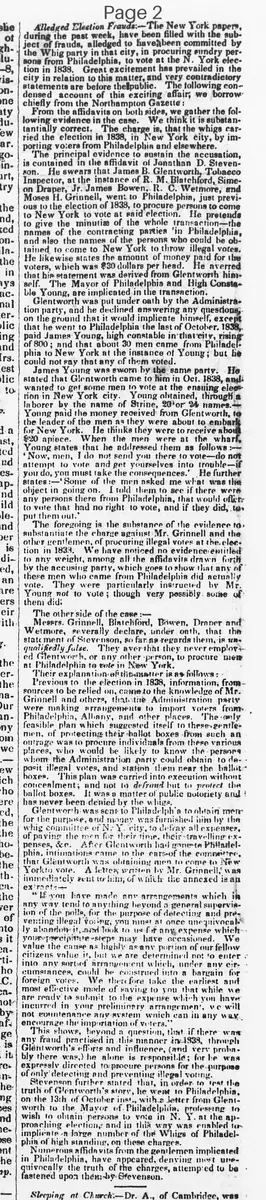
From the affidavits on both sides, we gather the following evidence in the case. We think it is substantially correct. The charge is, that the whigs carried the election in 1838, in New York city, by importing voters from Philadelphia and elsewhere.
The principal evidence to sustain the accusation, is contained in the affidavit of Jonathan D. Stevenson. He swears that James B. Glentworth, Tobacco Inspector, at the instance of R. M. Blatchford, Simeon Draper, Jr. James Bowen, R. C. Wetmore, and Moses H. Grinnell, went to Philadelphia, just previous to the election of 1838, to procure persons to come to New York to vote at said election. He pretends to give the minutiae of the whole transaction—the names of the contracting parties in Philadelphia, and also the names of the persons who could be obtained to come to New York to throw illegal votes. He likewise states the amount of money paid for the voters, which was $30 dollars per head. He averred that his statement was derived from Glentworth himself. The Mayor of Philadelphia and High Constable Young, are implicated in the transaction.
Glentworth was put under oath by the Administration party, and he declined answering any questions, on the ground that it would implicate himself, except that he went to Philadelphia the last of October, 1838, paid James Young, high constable in that city, rising of $800; and that about 30 men came from Philadelphia to New York at the instance of Young; but he could not say that any of them voted.
James Young was sworn by the same party. He stated that Glentworth came to him in Oct. 1838, and wanted to get some men to vote at the ensuing election in New York city. Young obtained, through a laborer by the name of Strine, 20 or 30 names. Young paid the money received from Glentworth, to the leader of the men as they were about to embark for New York. He thinks they were to receive about $20 apiece. When the men were at the wharf Young states that he addressed them as follows:—
"Now, men, I do not send you there to vote—do not attempt to vote and get yourselves into trouble—if you do, you must take the consequences." He further states:—"Some of the men asked me what was the object in going on. I told them to see if there were any persons there from Philadelphia, that would offer to vote that had no right to vote, and if they did, to put them out."
The foregoing is the substance of the evidence to substantiate the charge against Mr. Grinnell and the other gentlemen, of procuring illegal votes at the election in 1838. We have noticed no evidence entitled to any weight, among all the affidavits drawn forth by the accusing party, which goes to show that any of these men who came from Philadelphia did actually vote. They were particularly instructed by Mr. Young not to vote; though very possibly, some of them did:
The other side of the case:—
Messrs. Grinnell, Blatchford, Bowen, Draper and Wetmore, severally declare, under oath, that the statement of Stevenson, so far as regards them, is unqualifiedly false. They aver that they never employed Glentworth, or any other person, to procure men at Philadelphia to vote in New York.
Their explanation of the matter is as follows:
Previous to the election in 1838, information, from sources to be relied on, came to the knowledge of Mr. Grinnell and others, that the Administration party were making arrangements to import voters from Philadelphia, Albany, and other places. The only feasible plan which suggested itself to these gentlemen, of protecting their ballot boxes from such an outrage was to procure individuals from these various places, who would be likely to know the persons whom the Administration party could obtain to deposit illegal votes, and station them near the ballot boxes. This plan was carried into execution without concealment; and not to defraud but to protect the ballot boxes. It was a matter of public notoriety and has never been denied by the whigs.
Glentworth was sent to Philadelphia to obtain men for the purpose, and money was furnished him by the whig committee of N. Y. city, to defray all expenses, of paying the men for their time, their travelling expenses, &c. After Glentworth had gone to Philadelphia, intimations came to the ears of the committee, that Glentworth was obtaining men to come to New York to vote. A letter sent by Mr. Grinnell, was immediately sent for him; of which the annexed is an extract:—
"if you have made any arrangements which in any way tend to anything beyond a general supervision of the polls, for the purpose of detecting and preventing illegal voting, you must at once unequivocally abandon it, and look to us for any expense which your precipitate steps may have occasioned. We value the cause as highly as any portion of our fellow citizens value it, but we are determined not to enter into any sort of arrangement which, under any circumstances, could be construed into a bargain for foreign votes. We therefore take the earliest and most effective mode of saving to you that while we are ready to submit to the expense which you have incurred in your preliminary arrangements, we will not countenance any system which can in any way encourage the importation of voters."
This shows, beyond a question, that if there was any fraud practised in this manner in 1838, through Glentworth's efforts and influence, (and very probably there was,) he alone is responsible; for he was expressly directed to procure persons for the purpose of only 'detecting and preventing illegal voting.'
Stevenson further stated that, in order to test the truth of Glentworth's story, he went to Philadelphia, on the 13th of October inst., with a letter from Glentworth to the Mayor of Philadelphia, professing to wish to obtain persons to vote in N. Y. at the approaching election; and in this way was enabled to implicate a large number of the Whigs of Philadelphia of high standing, on these charges.
Numerous affidavits from the gentlemen implicated in Philadelphia, have appeared, denying most unequivocally the truth of the charges, attempted to be fastened upon them!—by Stevenson.
What sub-type of article is it?
What keywords are associated?
What entities or persons were involved?
Where did it happen?
Domestic News Details
Primary Location
New York City
Event Date
1838
Key Persons
Outcome
allegations of importing 20-30 voters from philadelphia for $20-30 each; involved parties deny intent to vote illegally, claiming men were to detect and prevent fraud by opponents; no evidence of actual voting confirmed; contradictory affidavits presented.
Event Details
Accusations that Whig party leaders sent Glentworth to Philadelphia in October 1838 to procure men to vote illegally in New York election. Stevenson affidavit details payments and involvement. Glentworth admits trip and payment to Young but denies voting. Young instructed men not to vote but to monitor polls. Whig leaders deny fraud, explain as countermeasure to opponent's imports; Grinnell letter warns against any voting arrangements. Stevenson later tested claims by posing in Philadelphia, implicating locals who denied charges.