Thank you for visiting SNEWPapers!
Sign up free
Imperial Valley Press
El Centro, Imperial County, California
What is this article about?
Washington report on the Burke-Wadsworth selective service bill for peacetime military training, committee preparations, public reactions including financial concerns for draftees, and revisions to M-Day mobilization plans to achieve 790,000 recruits by April 1941 without civilian recruiting drives.
Clipping
OCR Quality
Full Text
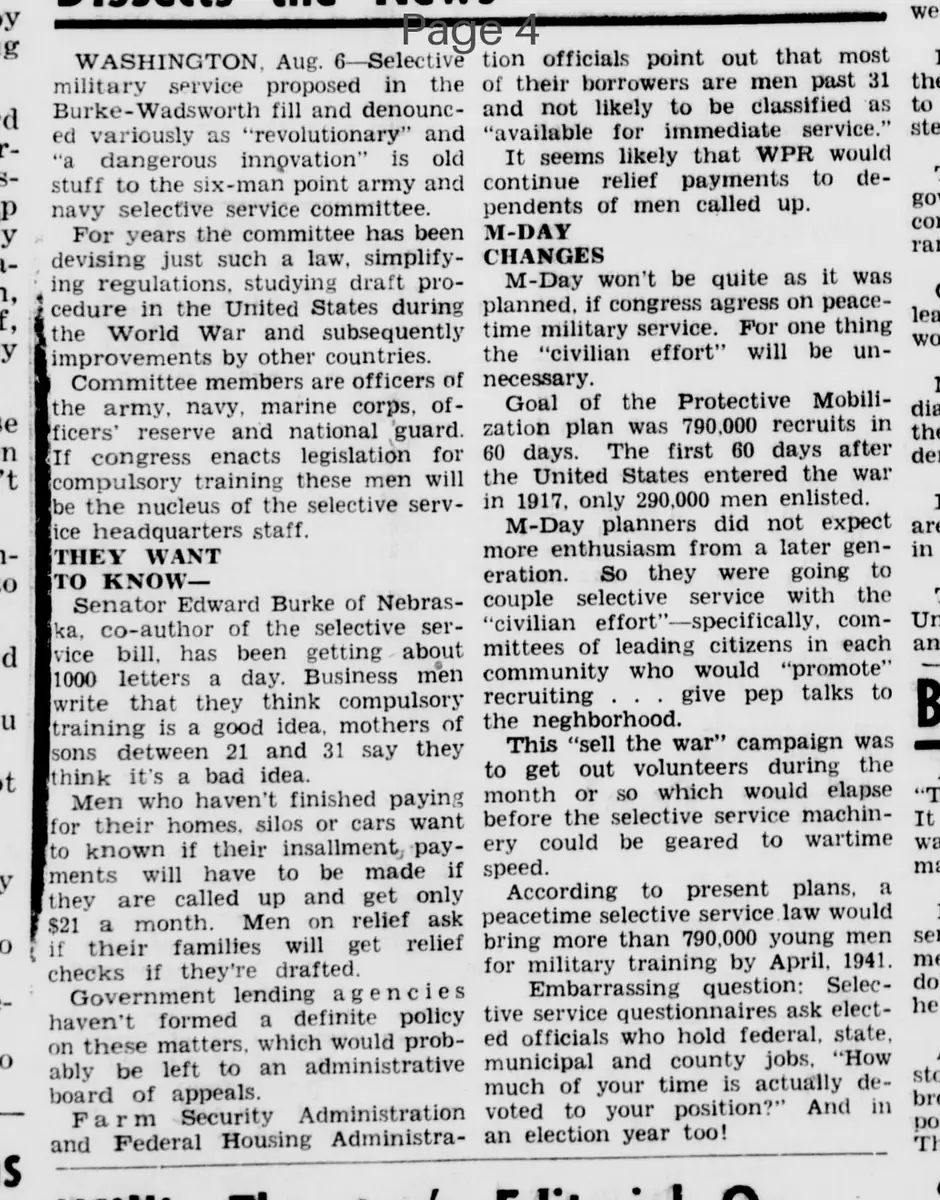
For years the committee has been devising just such a law, simplifying regulations, studying draft procedure in the United States during the World War and subsequent improvements by other countries. Committee members are officers of the army, navy, marine corps, officers' reserve and national guard.
If congress enacts legislation for compulsory training these men will be the nucleus of the selective service headquarters staff.
THEY WANT
TO KNOW—
Senator Edward Burke of Nebraska, co-author of the selective service bill, has been getting about 1000 letters a day. Business men write that they think compulsory training is a good idea. Mothers of sons between 21 and 31 say they think it's a bad idea.
Men who haven't finished paying for their homes, silos or cars want to know if their installment payments will have to be made if they are called up and get only $21 a month. Men on relief ask if their families will get relief checks if they're drafted.
Government lending agencies haven't formed a definite policy on these matters, which would probably be left to an administrative board of appeals. Farm Security Administration and Federal Housing Administration officials point out that most of their borrowers are men past 31 and not likely to be classified as "available for immediate service."
It seems likely that WPA would continue relief payments to dependents of men called up.
M-DAY
CHANGES
M-Day won't be quite as it was planned, if congress agrees on peace-time military service. For one thing the "civilian effort" will be unnecessary.
Goal of the Protective Mobilization plan was 790,000 recruits in 60 days. The first 60 days after the United States entered the war in 1917, only 290,000 men enlisted. M-Day planners did not expect more enthusiasm from a later generation.
So they were going to couple selective service with the "civilian effort"—specifically, committees of leading citizens in each community who would "promote" recruiting . . . give pep talks to the neighborhood.
This "sell the war" campaign was to get out volunteers during the month or so which would elapse before the selective service machinery could be geared to wartime speed.
According to present plans, a peacetime selective service law would bring more than 790,000 young men for military training by April, 1941.
Embarrassing question: Selective service questionnaires ask elected officials who hold federal, state, municipal and county jobs, "How much of your time is actually devoted to your position?" And in an election year too!
What sub-type of article is it?
What keywords are associated?
What entities or persons were involved?
Where did it happen?
Domestic News Details
Primary Location
Washington
Event Date
Aug. 6
Key Persons
Outcome
business men support compulsory training; mothers oppose it. questions on installment payments, relief for families, and continuation of wpa payments to dependents. most borrowers past 31 not likely affected. adjustments to m-day plans eliminate need for civilian recruiting effort; peacetime law to bring over 790,000 men by april, 1941.
Event Details
The Burke-Wadsworth bill proposes selective military service, which a six-man joint army and navy committee has been developing for years based on World War experiences and international improvements. Committee members from army, navy, marine corps, officers' reserve, and national guard would form the selective service headquarters staff if enacted. Senator Edward Burke receives 1000 letters daily with mixed opinions. Government agencies have no definite policy on financial matters for draftees, likely handled by appeals board. M-Day plans change without civilian effort, aiming for 790,000 recruits faster via peacetime selective service. Questionnaires ask elected officials about time devoted to positions.