Thank you for visiting SNEWPapers!
Sign up free
Madison County Democrat
London, Madison County, Ohio
What is this article about?
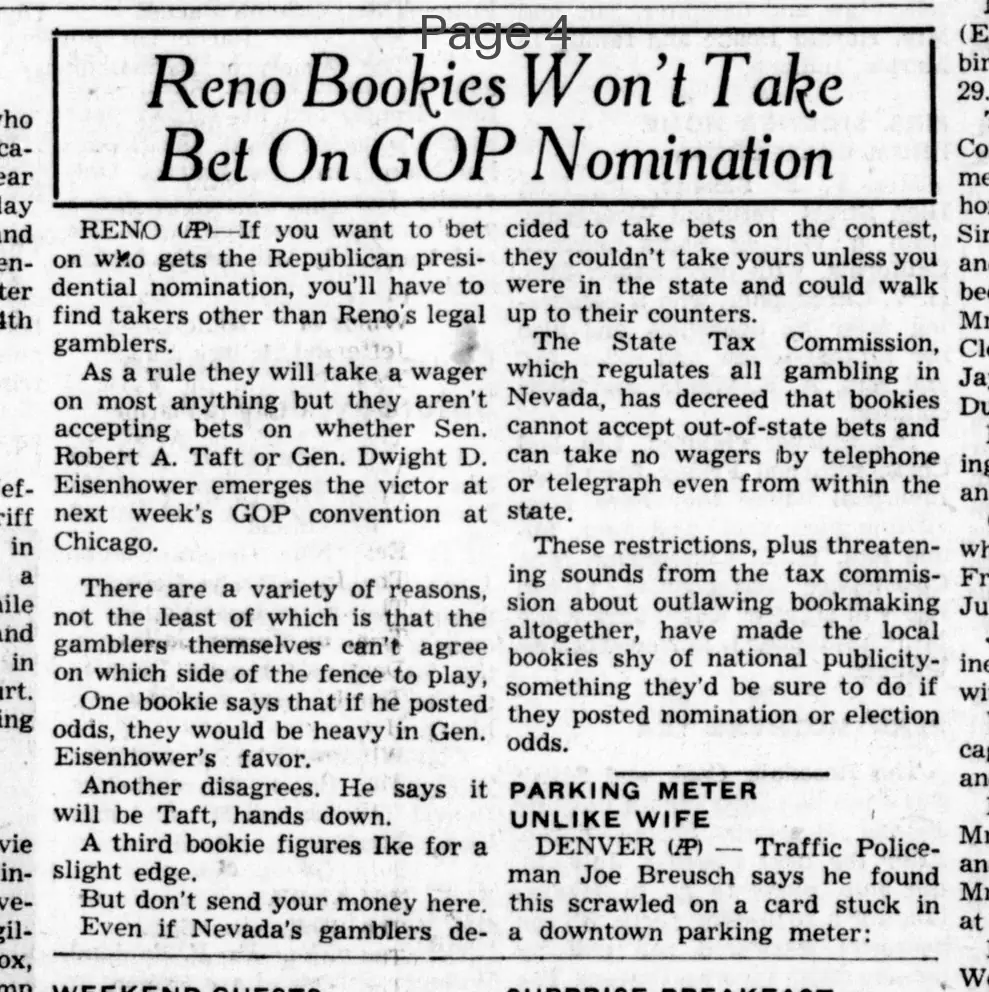
Reno's legal gamblers decline bets on the 1952 Republican presidential nomination between Sen. Taft and Gen. Eisenhower, citing internal disagreements and Nevada's strict rules against out-of-state and remote wagers, avoiding national attention amid threats to ban bookmaking.
Clipping
OCR Quality
Full Text
RENO (P)—If you want to bet on who gets the Republican presidential nomination, you'll have to find takers other than Reno's legal gamblers. As a rule they will take a wager on most anything but they aren't accepting bets on whether Sen. Robert A. Taft or Gen. Dwight D. Eisenhower emerges the victor at next week's GOP convention at Chicago. There are a variety of reasons, not the least of which is that the gamblers themselves can't agree on which side of the fence to play. One bookie says that if he posted odds, they would be heavy in Gen. Eisenhower's favor. Another disagrees. He says it will be Taft, hands down. A third bookie figures Ike for a slight edge. But don't send your money here. Even if Nevada's gamblers decided to take bets on the contest, they couldn't take yours unless you were in the state and could walk up to their counters. The State Tax Commission, which regulates all gambling in Nevada, has decreed that bookies cannot accept out-of-state bets and can take no wagers by telephone or telegraph even from within the state. These restrictions, plus threatening sounds from the tax commission about outlawing bookmaking altogether, have made the local bookies shy of national publicity—something they'd be sure to do if they posted nomination or election odds.
What sub-type of article is it?
What themes does it cover?
What keywords are associated?
What entities or persons were involved?
Where did it happen?
Story Details
Key Persons
Location
Reno, Nevada
Event Date
Next Week's Gop Convention At Chicago
Story Details
Reno's legal bookies refuse bets on the Republican presidential nomination between Sen. Robert A. Taft and Gen. Dwight D. Eisenhower due to their own disagreements on the outcome and state regulations prohibiting out-of-state wagers, telephone or telegraph bets, leading to avoidance of national publicity.