Thank you for visiting SNEWPapers!
Sign up free
The Liberator
Boston, Suffolk County, Massachusetts
What is this article about?
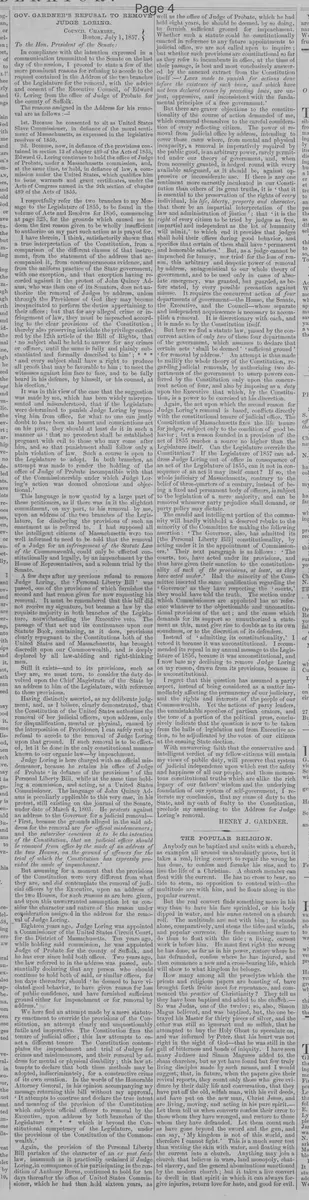
On July 1, 1857, Massachusetts Governor Henry J. Gardner refused the legislature's request to remove Judge Edward G. Loring from his position as Probate Judge for Suffolk County, citing constitutional protections for judicial independence and arguing that removal for his role as a U.S. Slave Commissioner required impeachment, not address, especially given the unconstitutional Personal Liberty Bill.
Clipping
OCR Quality
Full Text
COUNCIL CHAMBER,
Boston, July 1, 1857.
To the Hon. President of the Senate:
In compliance with the intention expressed in a communication transmitted to the Senate on the last day of the session, I proceed to state a few of the more prominent reasons for refusing to accede to the request contained in the Address of the two branches of the Legislature for the removal, with the advice and consent of the Executive Council, of Edward G. Loring from the office of Judge of Probate for the county of Suffolk.
The reasons assigned in the Address for his removal are as follows :-
1st. Because he consented to sit as United States Slave Commissioner, in defiance of the moral sentiment of Massachusetts, as expressed in the legislative resolves of 1850.
2d. Because, now, in defiance of the provisions contained in section 13 of chapter 489 of the Acts of 1855, Edward G. Loring continues to hold the office of Judge of Probate, under a Massachusetts commission, and, at the same time, to hold, in defiance of law, a commission under the United States, which qualifies him to issue warrants and grant certificates, under the Acts of Congress named in the 9th section of chapter 489 of the Acts of 1855.
I respectfully refer the two branches to my Message to the Legislature of 1855, to be found in the volume of Acts and Resolves for 1856, commencing at page 325, for the grounds which caused me to deem the first reason given to be wholly insufficient to authorize on my part such action as is prayed for. I have therein, I think, satisfactorily shown that a true interpretation of the Constitution, from a comparison of the different clauses of that instrument, from the statement of the address that accompanied it, from contemporaneous evidence, and from the uniform practice of the State government, with one exception, and that exception having recorded against it the protest of John Quincy Adams, who was then one of its Senators, does not authorize the removal of Judges by address, unless through the Providence of God they may become incapacitated to perform the duties appertaining to their offices; but that for any alleged crime or infringement of law, they must be impeached according to the clear provisions of the Constitution; thereby also preserving inviolate the privilege conferred by the 12th article of the Bill of Rights, that 'no subject shall be held to answer for any crimes or offence, until the same is fully and plainly substantiated and formally described to him':* * * 'and every subject shall have a right to produce all proofs that may be favorable to him; to meet the witnesses against him face to face, and to be fully heard in his defence, by himself, or his counsel, at his election.'
It was in this view of the case that the suggestion was made by me, which has been widely misrepresented and misunderstood, that if the Legislature were determined to punish Judge Loring by removing him from office, for what no one can justly doubt to have been an honest and conscientious act on his part, they should at least do it in such a manner as 'that no precedent shall be established pregnant with evil to those who may come after him, and so that punishment shall follow only a plain violation of law. Such a course is open to the Legislature to adopt. In both branches, an attempt was made to render the holding of the office of Judge of Probate incompatible with that of the Commissionership under which Judge Loring's action was deemed obnoxious and objectionable.
This language is now quoted by a large part of these petitioners, as if there was in it the slightest commitment, on my part, to his removal by me, upon an address of the two branches of the Legislature, for disobeying the provisions of such an enactment as is referred to. I had supposed all the intelligent citizens of Massachusetts were too well informed to need to be told that the removal of a Judge for an infringement of the Statute Law of the Commonwealth, could only be effected constitutionally and legally, by an impeachment by the House of Representatives, and a solemn trial by the Senate.
A few days after my previous refusal to remove Judge Loring, the · Personal Liberty Bill' was passed, one of the provisions of which furnishes the second and last reason given for now requesting his removal. It must be remembered that this bill did not receive my signature, but became a law by the requisite majority in both branches of the Legislature, notwithstanding the Executive veto. The passage of that act and its continuance upon our Statute Book, containing, as it does, provisions clearly repugnant to the Constitutions both of the United States and of Massachusetts, has brought discredit upon our Commonwealth, and is deeply deplored by all law-abiding and right-thinking men.
Still it exists—and to its provisions, such as they are, we must turn, to consider the duty devolved upon the Chief Magistrate of the State by an address to him of the Legislature, with reference to these provisions. Having distinctly asserted, as my deliberate judgment, and, as I believe, clearly demonstrated, that the Constitution of the United States authorizes the removal of her judicial officers, upon address, only for disqualification, mental or physical, caused by the interposition of Providence, I can safely rest my refusal to accede to the removal of Judge Loring upon that ground. If such removal is to be effected, let it be done in the only constitutional manner known to our organic law—by impeachment.
Judge Loring is here charged with an official misdemeanor, because he retains his office of Judge of Probate 'in defiance of the provisions' of the Personal Liberty Bill, while at the same time holding a commission, and acting, as a United States Commissioner. The language of John Quincy Adams is peculiarly applicable to this very case, in his protest, still existing on the journal of the Senate, under date of March 4, 1803.' He protests against an address to the Governor for a judicial removal— First, because the grounds alleged in the said address for the removal are for official misdemeanors; and the subscriber conceives it to be the intention of the Constitution, that no judicial officer should be removed from office by the mode of an address of the two Houses, on the ground of offences for the trial of which the Constitution has expressly provided the mode of impeachment.'
But assuming for a moment that the provisions of the Constitution were very different from what they are, and did contemplate the removal of judicial officers by the Executive, upon an address of the two Houses, for such reasons as are here given, and upon this unwarranted assumption let us consider the character and nature of the reason under consideration assigned in the address for the removal of Judge Loring.
Eighteen years ago, Judge Loring was appointed a Commissioner of the United States Circuit Court, for the District of Massachusetts. Ten years ago, while holding said commission, he was appointed Judge of Probate for the county of Suffolk, and he has ever since held both offices. Two years ago, the law referred to in the address was passed, substantially declaring that any person who should continue to hold both of said, or similar offices, for ten days thereafter, should be deemed to have violated good behavior, to have given reason for loss of public confidence, and have furnished sufficient ground either for impeachment or for removal by address.'
We here find an attempt made by a mere statutory enactment to override the provisions of the Constitution, an attempt clearly and unquestionably futile and inoperative. The Constitution fixes the tenure of judicial office; this law attempts to enact a different tenure. The Constitution contemplates the impeachment and trial of Judges for crimes and misdemeanors, and their removal by address for mental or physical disability; this law attempts to declare that both these methods may be adopted, indiscriminately, for a constructive crime of its own creation. In the words of the Honorable Attorney General, in his opinion accompanying my message returning this bill without my approval. It attempts to construe and declare the true intent and meaning of the provision of the Constitution which subjects official officers to removal by the Executive, upon address by both branches of the Legislature * which is beyond the Constitutional competency of the Legislature, under the provisions of the Constitution of the Commonwealth.'
Again, the provision of the Personal Liberty Bill partakes of the character of an ex post facto law, 'inasmuch as it practically ordained if Judge Loring, in consequence of his participating in the rendition of Anthony Burns, continued to hold for ten days thereafter the office of United States Commissioner, which he had then held sixteen years, as well as the office of Judge of Probate, which he had held eight years, he should be deemed, by so doing, to furnish sufficient ground for impeachment.
Whether such a statute could be constitutionally enacted in reference to any future appointments to judicial office, we are not called upon to inquire; but whether such provisions are constitutional so far as they refer to incumbents in office, at the time of their passage, is best and most conclusively answered by the annexed extract from the Constitution itself:—' Laws made to punish for actions done before the existence of such laws, and which have not been declared crimes by preceding laws, are unjust, oppressive, and inconsistent with the fundamental principles of a free government.'
But there are graver objections to the constitutionality of the course of action demanded of me, which commend themselves to the careful consideration of every reflecting citizen. The power of removal from judicial office by address, intending to cover those cases where, from mental and physical incapacity, a removal is imperatively required by the public good, is an arbitrary power, rarely permitted under our theory of government, and, when from necessity granted, is hedged round with every available safeguard, as it should be, against oppressive or inconsiderate use. If there is any one sentiment more earnestly inculcated in our Constitution than others of its great truths, it is ' that it is essential to the preservation of the rights of every individual, his life, liberty, property and character, that there be an impartial interpretation of the law and administration of justice '; that 'it is the right of every citizen to be tried by judges as free, impartial and independent as the lot of humanity will admit,' to which end it provides that judges shall hold their offices during good behavior, and specifies that certain of them shall have ' permanent and honorable salaries.' But, as a judge cannot be impeached for lunacy, nor tried for the loss of reason, this arbitrary and despotic power of removal by address, antagonistical to our whole theory of government, and to be used only in cases of absolute emergency, was granted, but guarded, as before stated, by every possible precaution against misuse. It requires the concurrent action of four departments of government—the House, the Senate, the Executive, and the Council—whose separate and independent acquiescence is necessary to accomplish a removal. It is discretionary with each, and it is made so by the Constitution itself.
But here we find a statute law, passed by the concurrent action of only two of these four departments of the government, which assumes to declare that certain acts 'shall be deemed' 'sufficient ground' 'for removal by address.' An attempt is thus made to nullify the whole theory of the Constitution, regarding judicial removals, by authorizing two departments of the government to usurp powers conferred by the Constitution only upon the concurrent action of four, and also by imposing as a duty upon the Executive that which, by the Constitution, is a power to be exercised at his discretion.
Again, the act upon which the second reason for Judge Loring's removal is based, conflicts directly with the constitutional tenure of judicial office. The Constitution of Massachusetts fixes the life tenure for judges, subject only to the condition of good behavior; but a reason founded in a provision of the act of 1855 reaches a source no higher than the Legislature itself. Can the Legislature override the Constitution? If the Legislature of 1857 can address Judge Loring out of office in consequence of an act of the Legislature of 1855, can it not in consequence of an act it may itself enact? If so, the whole judiciary of Massachusetts, contrary to the belief of three-quarters of a century, instead of being a fixed and permanent body of officers, is subject to the legislation of a mere majority, and can be removed whenever party prejudice shall demand, or party policy may dictate.
The candid and intelligent portion of the community will hardly withhold a deserved rebuke to the minority of the Committee for making the following assertion: The Governor, also, has admitted its [the Personal Liberty Bill] constitutionality, by acting under it in the appointment of Commissioners.' Their next paragraph is as follows: The courts, too, have acted under its provisions, and thus have given their sanction to the constitutionality of such of the provisions, at least, as they have acted under.' Had the minority of the Committee inserted the same qualification regarding the Governor' as they have respecting the courts, they would have told the truth. The section under which Commissioners are appointed has no reference whatever to the objectionable and unconstitutional provisions of the act; and the cause which demands for its support so unauthorized a statement as this, must give rise to doubts as to its own soundness, or to the discretion of its defenders.
Instead of admitting its constitutionality,' I vetoed it because it was unconstitutional. I recommended its repeal in my annual message to the Legislature of 1856, because it was unconstitutional, and I now base my declining to remove Judge Loring on my reason, drawn from its provisions, because it is unconstitutional.
I regret that this question has assumed a party aspect, instead of being considered as a matter immediately affecting the permanency of our judiciary, and the rights and interests of the people of our Commonwealth. Yet the actions of party leaders, the unmistakable speeches of partisan orators, and the tone of a portion of the political press, conclusively indicate that the question is now to be taken from the halls of legislation and from Executive action, to be adjudicated by the votes of our citizens at the ensuing State election.
With unwavering faith that the conservative and intelligent verdict of my fellow-citizens will sustain my views of public duty, will preserve that system of judicial independence upon which rest the safety and happiness of all our people, and those momentous constitutional truths which are alike the rich legacy of our fathers' wisdom and the underlying foundation of our system of self-government, I reiterate my conclusion, that my sense of duty to the State, and my oath of fealty to the Constitution, preclude my assenting to the Address for Judge Loring's removal.
HENRY J. GARDNER.
What sub-type of article is it?
What keywords are associated?
What entities or persons were involved?
Where did it happen?
Domestic News Details
Primary Location
Boston, Massachusetts
Event Date
July 1, 1857
Key Persons
Outcome
governor gardner refuses to remove judge loring, arguing the legislature's address is unconstitutional and that impeachment is the proper process; no removal occurs.
Event Details
Governor Henry J. Gardner issues a formal refusal to the Massachusetts Legislature's address requesting the removal of Judge Edward G. Loring from his Probate Court position in Suffolk County due to Loring's dual role as a U.S. Slave Commissioner, citing violations of the state constitution, the Personal Liberty Bill's unconstitutionality, and the need for impeachment rather than removal by address for official misdemeanors.