Thank you for visiting SNEWPapers!
Sign up free
Daily Kennebec Journal
Augusta, Kennebec County, Maine
What is this article about?
In 1908, President Theodore Roosevelt responds to Democratic candidate William J. Bryan's demand for proof of Gov. Haskell's Standard Oil ties, providing evidence from Oklahoma court records, condemning Haskell's fitness, and critiquing Bryan's trust policies as impractical. (214 characters)
Merged-components note: Headline merged with main story on page 1 (ro10 and ro11, spatially and textually related), continued to page 2 ro19 '(Continued from Page One.)', coherent Roosevelt statement topic.
Clippings
1 of 2
OCR Quality
Full Text
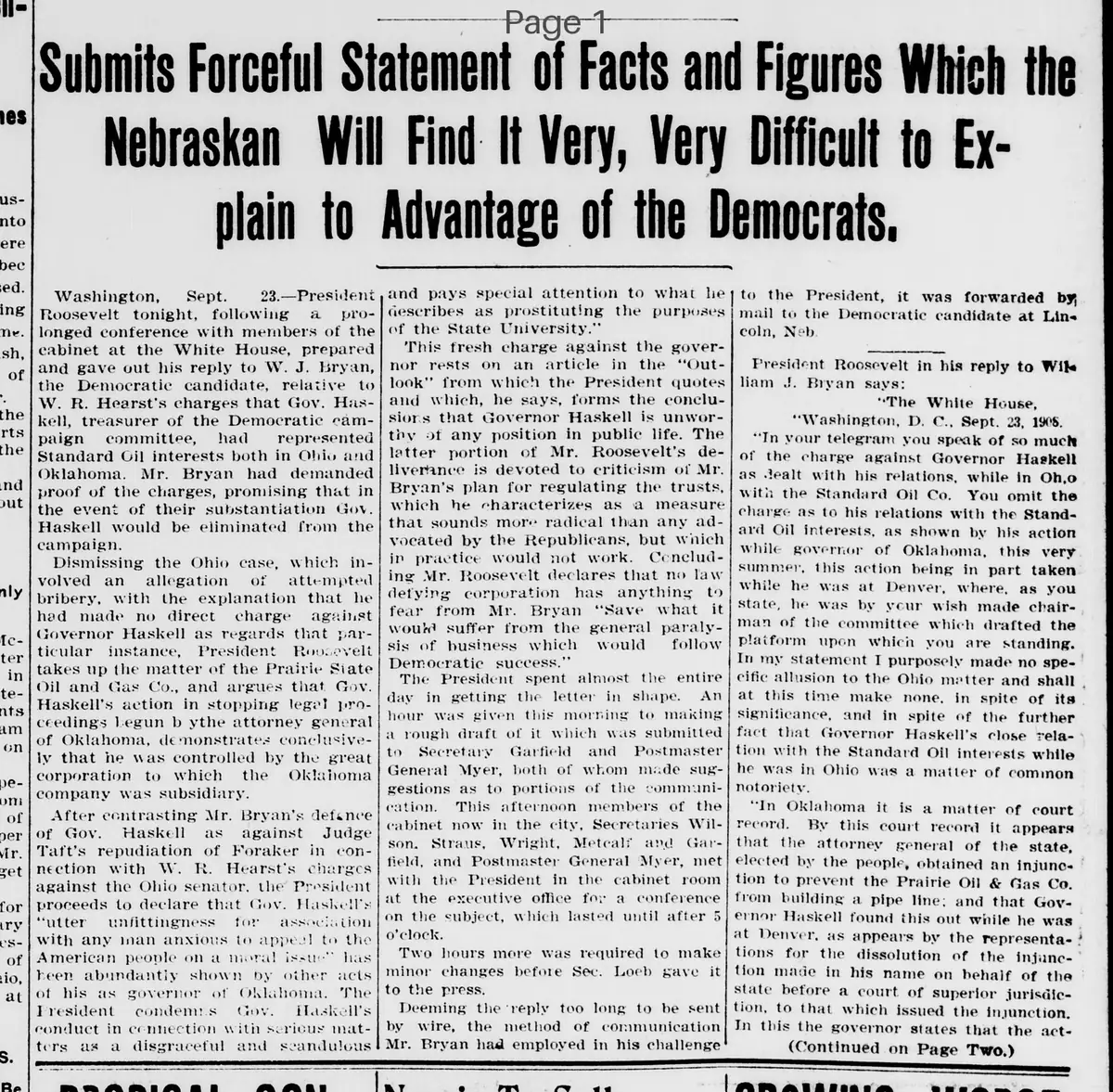
Washington, Sept. 23.--President Roosevelt tonight, following a prolonged conference with members of the cabinet at the White House, prepared and gave out his reply to W. J. Bryan, the Democratic candidate, relative to W. R. Hearst's charges that Gov. Haskell, treasurer of the Democratic campaign committee, had represented Standard Oil interests both in Ohio and Oklahoma. Mr. Bryan had demanded proof of the charges, promising that in the event of their substantiation Gov. Haskell would be eliminated from the campaign.
Dismissing the Ohio case, which involved an allegation of attempted bribery, with the explanation that he had made no direct charge against Governor Haskell as regards that particular instance, President Roosevelt takes up the matter of the Prairie State Oil and Gas Co., and argues that Gov. Haskell's action in stopping legal proceedings begun by the attorney general of Oklahoma, demonstrates conclusively that he was controlled by the great corporation to which the Oklahoma company was subsidiary.
After contrasting Mr. Bryan's defense of Gov. Haskell as against Judge Taft's repudiation of Foraker in connection with W. R. Hearst's charges against the Ohio senator, the President proceeds to declare that Gov. Haskell's "utter unfittingness for association with any man anxious to appeal to the American people on a moral issue" has been abundantly shown by other acts of his as governor of Oklahoma. The President condemns Gov. Haskell's conduct in connection with serious matters as a disgraceful and scandalous.
and pays special attention to what he describes as prostituting the purposes of the State University."
This fresh charge against the governor rests on an article in the "Outlook" from which the President quotes and which, he says, forms the conclusion that Governor Haskell is unworthy of any position in public life. The latter portion of Mr. Roosevelt's deliverance is devoted to criticism of Mr. Bryan's plan for regulating the trusts, which he characterizes as a measure that sounds more radical than any advocated by the Republicans, but which in practice would not work. Concluding Mr. Roosevelt declares that no law defying corporation has anything to fear from Mr. Bryan "Save what it would suffer from the general paralysis of business which would follow Democratic success."
The President spent almost the entire day in getting the letter in shape. An hour was given this morning to making a rough draft of it which was submitted to Secretary Garfield and Postmaster General Meyer, both of whom made suggestions as to portions of the communication. This afternoon members of the cabinet now in the city, Secretaries Wilson, Straus, Wright, Metcalf and Garfield, and Postmaster General Meyer, met with the President in the cabinet room at the executive office for a conference on the subject, which lasted until after 5 o'clock.
Two hours more was required to make minor changes before Sec. Loeb gave it to the press. Deeming the reply too long to be sent by wire, the method of communication Mr. Bryan had employed in his challenge to the President, it was forwarded by mail to the Democratic candidate at Lincoln, Neb.
President Roosevelt in his reply to William J. Bryan says:
The White House,
"Washington, D. C., Sept. 23, 1908.
"In your telegram you speak of so much of the charge against Governor Haskell as dealt with his relations, while in Ohio with the Standard Oil Co. You omit the charge as to his relations with the Standard Oil interests, as shown by his action while governor of Oklahoma, this very summer, this action being in part taken while he was at Denver, where, as you state, he was by your wish made chairman of the committee which drafted the platform upon which you are standing.
In my statement I purposely made no specific allusion to the Ohio matter and shall at this time make none, in spite of its significance, and in spite of the further fact that Governor Haskell's close relation with the Standard Oil interests while he was in Ohio was a matter of common notoriety.
"In Oklahoma it is a matter of court record. By this court record it appears that the attorney general of the state, elected by the people, obtained an injunction to prevent the Prairie Oil & Gas Co. from building a pipe line; and that Governor Haskell found this out while he was at Denver, as appears by the representations for the dissolution of the injunction made in his name on behalf of the state before a court of superior jurisdiction to that which issued the injunction. In this the governor states that the act-
(Continued on Page Two.)
PRES. ANSWERS MR. BRYAN.
(Continued from Page One.)
Acting governor, in his absence, had asked that the hearing be postponed until next, the governor might return and have an opportunity to investigate the controversy. The governor sets forth in his petition that he is the sole authority to determine such matters, and that the attorney general and the judge of the lower court had no right in the matter and that the action of the judge of the lower court represented an encroachment by the judiciary.
"The attorney general opposed the dissolution of the injunction, stating that the Prairie Oil & Gas Co. was a foreign corporation which had not accepted the provisions of the constitution applicable to such corporations, and that without authority of law it was employing a great force of men and teams to dig up, across and into various highways of the state for the purpose of laying its pipe lines. The governor prevailed, the injunction was suspended, and the pipe line was permitted to continue its work, to use the words of the attorney general, 'without any color of law.' I call your attention to the fact that the question is not whether or not the judge erred, or whether the injunction was proper. The point is that the governor was alert to take out of the hands of the attorney general what the attorney general felt was his sworn duty to prevent, an alleged instance of the breaking of the laws by this particular great corporation.
"As far as I have seen, Governor Haskell has not even attempted anything which can be called a defense of this action of his. It thus appears that his action was as inexcusable as it was wanton, except on the theory that in defiance of the attorney general of the state and at all hazards he intended for some reasons of his own to protect the interests of a great corporation against the law. It has been suggested on his behalf that after all he did not favor the Standard Oil Co., but merely the Prairie Oil & Gas Co. This claim is disposed of by the testimony of the Standard Oil Co. itself, taken in the latter part of 1907 in the suit now pending before the United States court at St. Louis against the Standard Oil Co. In this testimony the Standard Oil Co., upon being required by the government to put in a list of all the companies in which it held stock, or in which its subsidiary companies held stock, reported among others the Prairie Oil & Gas Co., total capital $10,000,000, of which the National Transit Co.'s portion was $9,959,500; and, furthermore, it appears that the National Transit Co. had a capital stock of $25,455,200, of which the Standard Oil Co. owned $25,451,650. In other words, the Prairie Oil Co. was owned, all except $500, by the National Transit Co., and this National Transit Co. was owned, all except about $3,550, by the Standard Oil Co.
"Now contrast your action in the case of Governor Haskell with Mr. Taft's action as regards Senator Foraker, as set forth in his letter of July 20, 1907, which I quoted in my statement. It was a matter of common notoriety about Senator Foraker as it has long been a matter of common notoriety about Governor Haskell, that he was the defender and supporter of certain great corporate interests and therefore hostile to the policies for which the administration has stood. There was no such convincing proof against Senator Foraker at that time, however, as there was against Governor Haskell, when, as you say, he was with your approval made treasurer of your campaign committee.
"But Mr. Taft refused to be a party to the renomination of Senator Foraker, even though it was represented that only thus could he advance his own interests, showing by actual deeds that his words were true when he said: 'I do not care for the Presidency if it has to come by compromise with anyone on a matter of principle.' With a hundred fold clearer evidence before you as to the connection of Governor Haskell with the Standard Oil than Mr. Taft then had as to the connection of Senator Foraker with any corporation, you nevertheless having secured Gov. Haskell as chairman of the committee to write the platform on which you stand put him in as treasurer of your campaign committee.
"Let me add that Gov. Haskell's utter unfitness for any public position of trust, or for association with any man anxious to make an appeal on a moral issue to the American people has been abundantly shown wholly irrespective of this action of his in connection with the Standard Oil interests. As an American citizen who prizes his Americanism and his citizenship far above any question of partisanship, I regard it as a scandal and a disgrace that Governor Haskell should be connected with the management of any national campaign.
"I have not the space in this letter to discuss Governor Haskell's conduct, for instance, in vetoing the child labor bill, or the fact that his name appears as one of the defendants in various suits brought by the government to prevent the Creek Indians from having certain of their lands fraudulently taken; or his connection with various other matters of the kind: but let me call your attention to his conduct in prostituting to base purposes the State University as set forth in an article in The Outlook of Sept. 5, last, under the heading 'Shall the People Rule in Oklahoma?' In this article you will see that Governor Haskell was given full opportunity to make every explanation, and that he made none. After setting forth the facts as to Governor Haskell's conduct, The Outlook article concludes as follows:
"On this state of affairs we have two comments to make and two questions to ask.
"The people of Oklahoma are taxed to support their educational institutions from the primary schools to the university. They pay their money to have their children educated. When the politicians use their money to promote the interests of a political machine or a church sect they are guilty of a breach of trust. What do the taxpayers of Oklahoma think of the use which their public servants are making of the public funds? What do they think about this financial policy - the taking of the money due their sons and daughters and diverting it for the benefit of politicians, ecclesiastical and civil.
"Governor Haskell was one of Mr. Bryan's right-hand men in the Democratic convention, and at Mr. Bryan's instance has been made treasurer of the Democratic national committee. It is appalling to think what would be the results in the educational systems of the Philippines and Porto Rico, in the digging of the Panama canal, in the work of irrigation and reforestation, in the administration of the postoffice, the interior and agricultural departments, in the appointments of foreign ministers and consuls, if the spirit which has actuated the Democratic authorities in the state of Oklahoma should be permitted to take control of the federal government at Washington.
Governor Haskell, by actions which speak louder than words, has declared his disbelief in Grover Cleveland's motto, 'A Public Office is a Public Trust.' And Mr. Haskell is a representative leader in the Bryan Democracy. What does Mr. Bryan think of Mr. Cleveland's principle? What do the American people think of Mr. Haskell's contemptuous reversal of it?'
"You close your telegram by saying that you expect and will demand fair and honorable treatment from those who are in charge of the Republican campaign. I am not in charge of the campaign, but am greatly interested in it. I have shown you above fairly and honorably that Governor Haskell is a man who, on every account I have named, is unworthy of any position in our public life. No further investigation of these facts is required. They are spread on the record before you, and they were available before Mr. Haskell was chosen for his position as treasurer. You also say that you will not permit any responsible member of the Republican organization to misrepresent the attitude of your party in the present campaign. You will have no difficulty in getting me to represent it aright, for my sole anxiety is that the people of the country shall understand this attitude clearly, and shall then condemn it as it should be condemned. You say that you have advocates more radical measures against private monopolies than either I or my party associates have been willing to undertake. You have indeed advocated measures that sound more radical, but they have the prime defect that in practice they would not work. I should not in this letter to you discuss your attitude on this question if you did not yourself bring it up; but as you have brought it up, I answer you that in my judgement, the measures you advocate would be wholly ineffective in curing a single evil, and so far as they had any effect at all, would merely throw the entire business of the country into hopeless and utter confusion.
"I put Mr. Taft's deeds against your words. I ask that Mr. Taft be judged by all his deeds, for he wishes none of them forgotten. I ask that you be judged both by the words you wish remembered, and by the words that seemingly you and your party now desire to have forgotten. I ask that your present plan for regulating the trusts be judged in connection with your past utterances that you did not believe in their regulation but in their destruction; and again in connection with your past utterances to the effect that only government ownership by a complicated national and state system of railroads would avail; and again by your utterances when you proposed to remedy all the sufferings of our people by a depreciated currency. For several years now I have been steadfastly fighting to secure thorough going and far-reaching control in the interest of the public over the great business combinations which do an interstate business. In this effort I have been as much hampered by the extremists, well-meaning or otherwise who demanded visionary and impracticable radicalism, and by those other extremists, no less dangerous, who stand for the reactionary refusal to remedy any grievance. One side, the side on which I am obliged to say you have placed yourself, has shown itself to be just as much the enemy of progress as the other. I hold it entirely natural for any great law-defying corporation to wish to see you placed in the Presidency rather than Mr. Taft. Your plans to put a stop to the abuses of these corporations are wholly chimerical: how chimerical your last plan is you will yourself see in Gov. Hughes' speech in Youngstown, O. To recall to your mind what Governor Hughes said, I quote as follows:
"'When we consider those (proposed) remedies (of Mr. Bryan against the trust) we find ourselves journeying in a land of dreams. Again the magician of 1896 waves his hand. At a stroke difficulties disappear and the complex problems of modern business are forgotten in the fascination of the simple panacea. The most important proposal of Mr. Bryan is, That any manufacturing or trading corporation engaged in interstate commerce shall be required to take out a federal license before it shall be permitted to control as much as 25 per cent. of the product in which it deals' and no corporation shall be permitted to control 'more than 50 per cent. of the total amount of any production consumed in the United States.'
"It might be interesting to inquire what is the meaning of product consumed in the United States. Does it refer to a class of commodities? And if so how shall the classes be defined? Or does it refer to such separate articles of commerce? and if so, what account does this proposal take of the skill and initiative of manufacturers who have built up a more or less exclusive trade in particular articles often protected by trade-marks, although in most active competition with other articles designed for the same general purpose and seeking the same market? In a desire to correct the evils of business are we to place an embargo upon honest men whose activity present none of the abuses requiring remedies? And, if not, what statutory definitions shall found to be adequate and just if we lay down our prohibition in terms of volume. Or ratio of business and not in terms of right and wrong? If we adopt Mr. Bryan's proposal to what period of production is the prohibition to apply? Is the excess for a day or for a month to be considered? And what system shall be devised by which suitable information may be furnished in the nature of danger signals along the routes of trade so that the manufacturer may know when he is about to exceed the prescribed ration? He may justly be required to governor his own conduct, but how shall he be apprised of the conduct of others upon which is to depend his guilt or innocence?
"Let me repeat that no law-defying corporation has anything to fear from you save what it will suffer in the general paralysis of business which any attempt on your part to reduce to practice what you have advocated would bring. This paralysis would affect the wage worker, the farmer, the small business man, more than it would affect the great business man. But it would affect the latter, too. Therefore I hope and believe that all far-sighted citizens who wish to see this country prosperous will support Mr. Taft. But above all, I ask for support for him because he stands for the moral uplift of the nation, because his deeds have made good his words, and because the policies to which he is committed are of immeasurable consequence alike to the honor and to the interest of the whole American people.
"Very truly yours,
"THEODORE ROOSEVELT.
"HON. WILLIAM JENNINGS BRYAN, Lincoln, Neb."
What sub-type of article is it?
What themes does it cover?
What keywords are associated?
What entities or persons were involved?
Where did it happen?
Story Details
Key Persons
Location
Washington, D.C.
Event Date
1908 09 23
Story Details
President Roosevelt issues a detailed reply to Bryan defending charges against Gov. Haskell's ties to Standard Oil interests in Oklahoma, contrasting it with Taft's stance on Foraker, condemning Haskell's other actions including misuse of state university funds, and criticizing Bryan's trust regulation proposals as ineffective.