Thank you for visiting SNEWPapers!
Sign up free
Virginia Argus
Richmond, Virginia
What is this article about?
Thomas Paine analyzes the October 1806 Prussian defeat by French forces under Bonaparte, critiques English coalitions and peace negotiations, and comments on ongoing European military situation involving Russia, Sweden, and Austria, based on recent reports.
Clipping
OCR Quality
Full Text
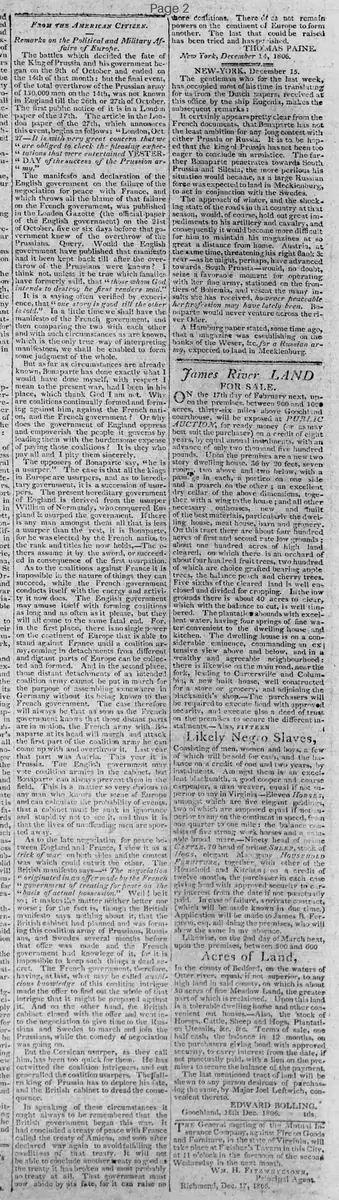
The battles which decided the fate of the King of Prussia and his government began on the 9th of October and ended on the 14th of that month: but the final event, of the total overthrow of the Prussian army of 150,000 men on the 14th, was not known in England till the 26th or 27th of October.
The first public notice of it is in a London paper of the 27th. The article in the London paper of the 27th, which announces this event, begins as follows: "London, Oct. 27—It is with very great concern that we are obliged to check the pleasing expectations that were entertained YESTERDAY of the success of the Prussian army."
The manifesto and declaration of the English government on the failure of the negociation for peace with France, and which throws all the blame of that failure on the French government, was published in the London Gazette (the official paper of the English government) on the 21st of October, five or six days before that government knew of the overthrow of the Prussians. Query. Would the English government have published that manifesto had it been kept back till after the overthrow of the Prussians were known? I think not, unless it be true which fanatics have formerly said, that "those whom God intends to destroy he first renders mad."
It is a saying often verified by experience, that "one story is good till the other is told." In a little time we shall have the manifesto of the French government, and then comparing the two with each other and with such circumstances as are known, which is the only true way of interpreting manifestoes, we shall be enabled to form some judgment of the whole.
But as far as circumstances are already known, Bonaparte has done exactly what I would have done myself, with respect I mean to the present war, had I been in his place, which thank God I am not. Why are coalitions continually formed and forming against him, against the French nation, and the French government? Or why does the government of England oppress and impoverish the people it governs by loading them with the burdensome expense of paying those coalitions? It is they who pay all and I pity them sincerely.
The opposers of Bonaparte say, "he is a usurper." The case is that all the kings in Europe are usurpers, and as to hereditary government, it is a succession of usurpers. The present hereditary government of England is derived from the usurper William of Normandy, who conquered England & usurped the government. If there is any man amongst them all that is less a usurper than the rest, it is Bonaparte. For he was elected by the French nation to the rank and titles he now holds.—The others assume it by the sword, or succeeded in consequence of the first usurpation.
As to the coalitions against France it is impossible in the nature of things they can succeed, while the French government conducts itself with the energy and activity it now does. The English government may amuse itself with forming coalitions as long and as often as it please, but they will all come to the same fatal end. For, in the first place, there is no single power on the continent of Europe that is able to stand against France until a coalition army, coming in detachments from different and distant parts of Europe can be collected and formed. And in the second place, those distant detachments of an intended coalition army cannot be put in march for the purpose of assembling somewhere in Germany without its being known to the French government. The case therefore will always be that as soon as the French government knows that those distant parts are in motion, the French army with Bonaparte at its head will march and attack the first part of the coalition army he can come up with and overthrow it. Last year that part was Austria. This year it is Prussia. The English government may vote coalition armies in the cabinet, but Bonaparte can always prevent them in the field. This is a matter so very obvious to any man who knows the scene of Europe and can calculate the probability of events, that a cabinet must be sunk in ignorance and stupidity not to see it. And thus it is that the lives of unoffending men are sported away.
As to the late negociation for peace between England and France, I view it as a trick of war on both sides and the contest was which could outwit the other. The British manifesto says—"The negociation originated in an offer made by the French government of treating for peace on the basis of actual possession." Well! be it so: it makes the matter neither better nor worse; for the fact is, though the British manifesto says nothing about it, that the British cabinet had planned and was forming this coalition army of Prussians, Russians, and Swedes several months before that offer was made and the French government had knowledge of it, for it is impossible to keep such things a dead secret. The French government, therefore, having, at last, what may be called suspicious knowledge of this coalition intrigue made the offer to find out the whole of that intrigue that it might be prepared against it. And on the other hand, the British cabinet closed with the offer and went into the negociation to give time to the Russians and Swedes to march and join the Prussians, while the comedy of negociation was going on.
But the Corsican usurper, as they call him, has been too quick for them. He has outwitted the coalition intriguers, and out generalled the coalition usurpers. The fallen king of Prussia has to deplore his fate, and the British cabinet to dread the consequence.
In speaking of these circumstances it ought always to be remembered that the British government began this war. It had concluded a treaty of peace with France called the treaty of Amiens, and soon after declared war again to avoid fulfilling the conditions of that treaty. It will not be able to conclude another treaty so good as the treaty it has broken and most probably no treaty at all. That government must now abide by its fate, for it can raise no more coalitions. There does not remain powers on the continent of Europe to form another. The last that could be raised has been tried and has perished.
THOMAS PAINE.
New York, December 14, 1806.
NEW-YORK. December 15.
The gentleman who for the last week, has occupied most of his time in translating for us from the Dutch papers, received at this office by the ship Eugenia, makes the subsequent remarks:
It certainly appears pretty clear from the French documents, that Bonaparte has not the least ambition for any long contest with either Prussia or Russia. It is to be hoped that the king of Prussia has not been too eager to conclude an armistice. The further Bonaparte penetrates towards South Prussia and Silesia, the more perilous his situation would become, as a large Russian force was expected to land in Mecklenburg, to act in conjunction with the Swedes.
The approach of winter, and the shocking state of the roads in that country at that season, would, of course, hold out great impediments to his artillery and cavalry, and consequently it would become more difficult for him to maintain his magazines at so great a distance from home. Austria, at the same time, threatening his right flank & rear—as he might, perhaps, have advanced towards South Prussia—would, no doubt, seize a favorable moment for operating with her fine army, stationed on the frontiers of Bohemia, and resent the many insults she has received, however peaceable her profession may have lately been. Bonaparte would never venture across the river Oder.
A Hamburg paper stated, some time ago, that a magazine was establishing on the banks of the Weser, &c. for a Russian army, expected to land in Mecklenburg.
What sub-type of article is it?
What keywords are associated?
What entities or persons were involved?
Where did it happen?
Foreign News Details
Primary Location
Prussia
Event Date
9th To 14th October 1806
Key Persons
Outcome
total overthrow of the prussian army of 150,000 men on the 14th
Event Details
Battles decided the fate of the King of Prussia, beginning 9th October and ending 14th with overthrow of Prussian army; English manifesto on failed peace negotiations published 21st October; analysis of coalitions against France, with Bonaparte defeating detachments; ongoing concerns of Russian and Swedish forces in Mecklenburg, Austrian threats from Bohemia.