Thank you for visiting SNEWPapers!
Sign up free
Alexandria Gazette
Alexandria, Alexandria County, District Of Columbia
What is this article about?
President Polk's 1845 annual message to Congress highlights national prosperity, Texas annexation process and its completion, tensions with Mexico over independence and claims, and stalled Oregon boundary talks with Britain, urging legislative action on admission, protection, and territorial rights.
Clipping
OCR Quality
Full Text
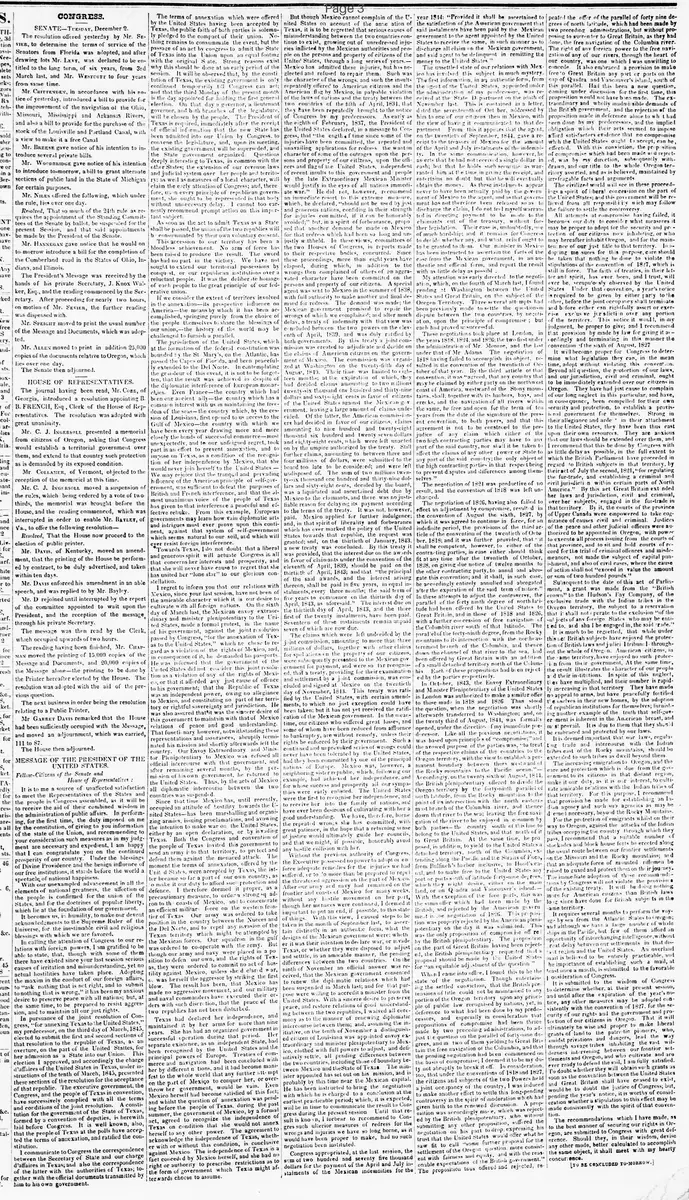
Fellow-Citizens of the Senate and House of Representatives :
It is to me a source of unaffected satisfaction to meet the Representatives of the States and the people in Congress assembled, as it will be to receive the aid of their combined wisdom in the administration of public affairs. In performing, for the first time, the duty imposed on me by the constitution, of giving to you information of the state of the Union, and recommending to your consideration such measures as in my judgment are necessary and expedient, I am happy that I can congratulate you on the continued prosperity of our country. Under the blessings of Divine Providence and the benign influence of our free institutions, it stands before the world a spectacle of national happiness.
With our unexampled advancement in all the elements of national greatness, the affection of the people is confirmed for the union of the States, and for the doctrines of popular liberty, which lie at the foundation of our government.
It becomes us, in humility, to make our devout acknowledgments to the Supreme Ruler of the Universe, for the inestimable civil and religious blessings with which we are favored,
In calling the attention of Congress to our relations with foreign powers, I am gratified to be able to state, that, though with some of them there have existed since your last session serious causes of irritation and misunderstanding, yet no actual hostilities have taken place. Adopting the maxim in the conduct of our foreign affairs, to "ask nothing that is not right, and to submit to nothing that is wrong," it has been my anxious desire to preserve peace with all nations; but, at the same time, to be prepared to resist aggression, and to maintain all our just rights.
In pursuance of the joint resolution of Congress, "for annexing Texas to the United States," passed on the third day of March, 1845, my predecessor, elected to submit the first and second sections of that resolution to the republic of Texas, as an overture, on the part of the United States, for her admission as a State into our Union. This election I approved, and accordingly the charge d'affaires of the United States in Texas, under instructions of the tenth of March, 1845, presented these sections of the resolution for the acceptance of that republic. The executive government, the Congress, and the people of Texas in convention, have successively complied with all the terms and conditions of the joint resolution. A constitution for the government of the State of Texas, formed by a convention of deputies, is herewith laid before Congress. It is well known, also, that the people of Texas at the polls have accepted the terms of annexation, and ratified the constitution.
I communicate to Congress the correspondence between the Secretary of State and our charge d'affaires in Texas; and also the correspondence of the latter with the authorities of Texas; together with the official documents transmitted by him to his own government.
The terms of annexation which were offered by the United States having been accepted by Texas, the public faith of both parties is solemnly pledged to the compact of their union. Nothing remains to consummate the event, but the passage of an act by congress to admit the State of Texas into the Union upon an equal footing with the original States. Strong reasons exist why this should be done at an early period of the session. It will be observed that, by the constitution of Texas, the existing government is only continued temporarily till Congress can act; and that the third Monday of the present month is the day appointed for holding the first general election. On that day a governor, a lieutenant governor, and both branches of the legislature, will be chosen by the people. The President of Texas is required, immediately after the receipt of official information that the new State has been admitted into our Union by Congress, to convene the legislature, and, upon its meeting, the existing government will be superseded, and the State government organized. Questions deeply interesting to Texas, in common with the other States; the extension of our revenue laws and judicial system over her people and territory; as well as measures of a local character, will claim the early attention of Congress; and, therefore, upon every principle of republican government, she ought to be represented in that body without unnecessary delay. I cannot too earnestly recommend prompt action on this important subject.
As soon as the act to admit Texas as a State shall be passed, the union of the two republics will be consummated by their own voluntary consent.
This accession to our territory has been a bloodless achievement. No arm of force has been raised to produce the result. The sword has had no part in the victory. We have not sought to extend our territorial possessions by conquest, or our republican institutions over a reluctant people. It was the deliberate homage of each people to the great principle of our federative union.
If we consider the extent of territory involved in the annexation-its prospective influence on America--the means by which it has been accomplished, springing purely from the choice of the people themselves to share the blessings of our union,-the history of the world may be challenged to furnish a parallel.
The jurisdiction of the United States, which at the formation of the federal constitution was bounded by the St Mary's, on the Atlantic, has passed the Capes of Florida, and been peacefully extended to the Del Norte. In contemplating the grandeur of this event, it is not to be forgotten, that the result was achieved in despite of the diplomatic interference of European monarchies. Even France-the country which had been our ancient ally-the country which has a common interest with us in maintaining the freedom of the seas-the country which, by the cession of Louisiana, first opened to us access to the Gulf of Mexico-the country with which we have been every year drawing more and more closely the bonds of successful commerce-most unexpectedly, and to our unfeigned regret, took part in an effort to prevent annexation, and to impose on Texas, as a condition of the recognition of her independence by Mexico, that she would never join herself to the United States -
We may rejoice that the tranquil and pervading influence of the American principle of self-government, was sufficient to defeat the purposes of British and French interference, and that the almost unanimous voice of the people of Texas has given to that interference a peaceful and effective rebuke. From this example, European governments may learn how vain diplomatic arts and intrigues must ever prove upon this continent, against that system of self-government which seems natural to our soil, and which will ever resist foreign interference.
Towards Texas, I do not doubt that a liberal and generous spirit will actuate Congress in all that concerns her interests and prosperity, and that she will never have cause to regret that she has united her "lone star" to our glorious constellation.
I regret to inform you that our relations with Mexico, since your last session, have not been of the amicable character which it is our desire to cultivate with all foreign nations. On the sixth day of March last, the Mexican envoy extraordinary and minister plenipotentiary to the United States, made a formal protest, in the name of his government, against the joint resolution passed by Congress, "for the annexation of Texas to the United States," which he chose to regard as a violation of the rights of Mexico, and, in consequence of it, he demanded his passports. He was informed that the government of the United States did not consider this joint resolution as a violation of any of the rights of Mexico, or that it afforded any just cause of offence to his government; that the Republic of Texas was an independent power, owing no allegiance to Mexico, and constituting no part of her territory or rightful sovereignty and jurisdiction. He was also assured that it was the sincere desire of this government to maintain with that of Mexico relations of peace and good understanding. That functionary however, notwithstanding these representations and assurances, abruptly terminated his mission and shortly afterwards left the country. Our Envoy Extraordinary and Minister Plenipotentiary to Mexico was refused all official intercourse with that government, and after remaining several months, by the permission of his own government, he returned to the United States. Thus, by the acts of Mexico all diplomatic intercourse between the two countries was suspended.
Since that time Mexico has, until recently, occupied an attitude of hostility towards the United States-has been marshalling and organizing armies, issuing proclamations, and avowing the intention to make war on the United States, either by an open declaration, or by invading Texas. Both the Congress and convention of the people of Texas invited this government to send an army into that territory, to protect and defend them against the menaced attack. The moment the terms of annexation, offered by the United States, were accepted by Texas, the latter became so far a part of our own country, as to make it our duty to afford such protection and defence. I therefore deemed it proper, as a precautionary measure, to order a strong squadron to the coasts of Mexico, and to concentrate an efficient military force on the western frontier of Texas. Our army was ordered to take position in the country between the Nueces and the Del Norte, and to repel any invasion of the Texan territory which might be attempted by the Mexican forces. Our squadron in the gulf was ordered to co-operate with the army. But though our army and navy were placed in a position to defend our own, and the rights of Texas, they were ordered to commit no act of hostility against Mexico, unless she declared war, or was herself the aggressor by striking the first blow. The result has been, that Mexico has made no aggressive movement, and our military and naval commanders have executed their orders with such discretion, that the peace of the two republics has not been disturbed.
Texas had declared her independence, and maintained it by her arms for more than nine years. She has had an organized government in successful operation during that period. Her separate existence, as an independent State, had been recognised by the United States and the principal powers of Europe. Treaties of commerce and navigation had been concluded with her by different nations, and it had become manifest to the whole world that any further attempt on the part of Mexico to conquer her, or overthrow her government, would be vain. Even Mexico herself had become satisfied of this fact; and whilst the question of annexation was pending before the people of Texas. during the past summer, the government of Mexico, by a formal act, agreed to recognize the independence of Texas on condition that she would not annex herself to any other power. The agreement to acknowledge the independence of Texas, whether with or without this condition, is conclusive against Mexico. The independence of Texas is a fact conceded by Mexico herself, and she had no right or authority to prescribe restrictions as to the form of government which Texas might afterwards choose to assume.
But though Mexico cannot complain of the United States on account of the annexation of Texas, it is to be regretted that serious causes of misunderstanding between the two countries continue to exist. growing out of unredressed injuries inflicted by the Mexican authorities and people on the persons and property of citizens of the United States, through a long series of years.- Mexico has admitted these injuries, but has neglected and refused to repair them. Such was the character of the wrongs. and such the insults repeatedly offered to American citizens and the American flag by Mexico, in palpable violation of the laws of nations and the treaty between the two countries of the fifth of April. 1831. that they have been repeatedly brought to the notice of Congress by my predecessors. As early as the eighth of February, 1837, the President of the United States declared. in a message to Congress, that "the length of time since some of the injuries have been committed, the repeated and unavailing applications for redress the wanton character of some of the outrages upon the persons and property of our citizens, upon the officers and flag of the United States. independent of recent insults to this government and people by the late Extraordinary Mexican Minister would justify in the eyes of all nations immediate war." He did not, however. recommend an immediate resort to this extreme measure, which. he declared, "should not be used by just and generous nations, confiding in their strength for injuries committed, if it can be honorably avoided;" but, in a spirit of forbearance, proposed that another demand be made on Mexico for that redress which had been so long and unjustly withheld. In these views, committees of the two Houses of Congress, in reports made to their respective bodies, concurred. Since these proceedings, more than eight years have elapsed, during which, in addition to the wrongs then complained of others of an aggravated character have been committed on the persons and property of our citizens. A special agent was sent to Mexico in the summer of 1838. with full authority to make another and final demand for redress." The demand was made; the Mexican government promised to repair the wrongs of which we complained; and after much delay, a treaty of indemnity with that view was concluded between the two powers on the eleventh of April, 1839, and was duly ratified by both governments. By this treaty a joint commission was created to adjudicate and decide on the claims of American citizens on the government of Mexico. The commission was organized at Washington on the twenty-fifth day of August, 1840. Their time was limited to eighteen months; at the expiration of which, they had decided claims amounting to two millions twenty-six thousand one hundred and thirty-nine dollars and sixty-eight cents in favor of citizens of the United States against the Mexican government. leaving a large amount of claims undecided. Of the latter, the American commissioners had decided in favor of our citizens, claims amounting to nine hundred and twenty-eight thousand six hundred and twenty seven dollars and eighty-eight cents, which were left unacted on by the umpire authorized by the treaty. Still further claims, amounting to between three and four millions of dollars, were submitted to the board too late to be considered; and were left undisposed of. The sum of two millions twenty-six thousand one hundred and thirty-nine dollars and sixty-eight cents, decided by the board, was a liquidated and ascertained debt due by Mexico to the claimants, and there was no justifiable reason for delaying its payment according to the terms of the treaty. It was not, however. paid. Mexico applied for further indulgence; and, in that spirit of liberality and forbearance which has ever marked the policy of the United States towards that republic, the request was granted; and, on the thirtieth of January, 1843, a new treaty was concluded. By this treaty it was provided, that the interest due on the awards in favor of claimants under the convention of the eleventh of April, 1839, should be paid on the thirtieth of April, 1843; and that "the principal of the said awards, and the interest arising thereon, shall be paid in five years, in equal instalments, every three months; the said term of five years to commence on the thirtieth day of April, 1843, as aforesaid." The interest due on the thirtieth day of April, 1843, and the three first of the twenty instalments, have been paid. Seventeen of these instalments remain unpaid seven of which are now due.
The claims which were left undecided by the joint commission, amounting to more than three millions of dollars, together with other claims for spoliations on the property of our citizens, were subsequently presented to the Mexican government for payment, and were so far recognized, that a treaty, providing for their examination and settlement by a joint commission, was concluded and signed at Mexico on the twentieth day of November, 1843. This treaty was ratified by the United States, with certain amendments, to which no just exception could have been taken: but it has not yet received the ratification of the Mexican government. In the meantime, our citizens who suffered great losses, and some of whom have been reduced from affluence to bankruptcy, are without remedy, unless their rights be enforced by their government. Such a continued and unprovoked series of wrongs could never have been tolerated by the United States, had they been committed by one of the principal nations of Europe. Mexico was, however, a neighboring sister republic, which, following our example, had achieved her independence, and for whose success and prosperity all our sympathies were early enlisted." The United States were the first to recognise her independence, and to receive her into the family of nations, and have ever been desirous of cultivating with her a good understanding. We have, therefore, borne the repeated wrongs she has committed, with great patience, in the hope that a returning sense of justice would ultimately guide her councils. and that we might, if possible, honorably avoid any hostile collision with her.
Without the previous authority of Congress. the Executive possessed no power to adopt or enforce adequate remedies for the injuries we had suffered, or to do more than be prepared to repel the threatened aggression on the part of Mexico. After our army and navy had remained on the frontier and coasts of Mexico for many weeks. without any hostile movement on her part, though her menaces were continued, I deemed it important to put an end, if possible, to this state of things. With this view, I caused steps to be taken in the month of September last, to ascertain distinctly in an authentic form, what the designs of the Mexican government were: whether it was their intention to declare war, or invade Texas, or whether they were disposed to adjust and settle, in an amicable manner, the pending differences between the two countries. On the ninth of November an official answer was received, that the Mexican government consented to renew the diplomatic relations which had been suspended in March last; and for that purpose were willing to accredit a minister from the United States. With a sincere desire to preserve peace, and restore relations of good understanding between the two republics, I waived all ceremony as to the manner of renewing diplomatic intercourse between them; and, assuming the initiative, on the tenth of November a distinguished citizen of Louisiana was appointed envoy extraordinary and minister plenipotentiary to Mexico, clothed with full powers to adjust, and definitively settle, all pending differences between the two countries, including those of boundary between Mexico and the State of Texas. The minister appointed has set out on his mission, and is probably by this time near the Mexican capital. He has been instructed to bring the negotiation with which he is charged to a conclusion at the earliest practicable period; which, it is expected, will be in time to communicate the result to Congress during the present session Until that result is known, I forbear to recommend to Congress such ulterior measures of redress for the wrongs and injuries we have so long borne, as it would have been proper to make, had no such negotiation been instituted.
Congress appropriated, at the last session, the sum of two hundred and seventy five thousand dollars for the payment of the April and July instalments of the Mexican indemnities for the year 1844: "Provided it shall be ascertained to the satisfaction of the American government that said instalments have been paid by the Mexican government to the agent appointed by the United States to receive the same, in such manner as to discharge all claim on the Mexican government. and said agent to be delinquent in remitting the money to the United States"
The unsettled state of our relations with Mexico has involved this subject in much mystery. The first information, in an authentic form, from the agent of the United States. appointed under the administration of my predecessor, was received at the State Department on the ninth of November last. This is contained in a letter dated the seventeenth of October. addressed by him to one of our citizens then in Mexico, with the view of having it communicated to that department. From this it appears that the agent. on the twentieth of September. 1844. gave a receipt to the treasury of Mexico for the amount of the April and July instalments of the indemnity. In the same communication, however, he asserts that he had not received a single dollar in cash: but that he holds such securities as warranted him at the time in giving the receipt, and entertains no doubt but that he will eventually obtain the money. As these instalments appear never to have been actually paid by the government of Mexico to the agent, and as that government has not therefore been released so as to discharge the claim, I do not feel myself warranted in directing payment to be made to the claimants out of the treasury. without further legislation. Their case is, undoubtedly, one of much hardship; and it remains for Congress to decide whether any, and what. relief ought to be granted to them. Our minister in Mexico has been instructed to ascertain the facts of the case from the Mexican government, in an authentic and official form, and report the result with as little delay as possible.
My attention was early directed to the negotiation, which, on the fourth of March last, I found rending at Washington between the United States and Great Britain, on the subject of the Oregon Territory. Three several attempts had been previously made to settle the questions in dispute between the two countries. by negotiation, upon the principle of compromise ; but each had proved unsuccessful. These negotiations took place at London, in the years 1818, 1824, and 1826: the two first under the administration of Mr. Monroe, and the last under that of Mr Adams The negotiation of 1818 having failed to accomplish its object. resulted in the convention of the twentieth of October of that year. By the third article of that convention. it was "agreed, that any country that may be claimed by either party on the northwest coast of America, westward of the Stony mountains, shall, together with its harbors. bays, and creeks, and the navigation of all rivers within. the same, be free and open for the term of ten years from the date of the signature of the present convention, to both powers, and that this agreement is not to be construed to the prejudice of any claim which either of the two high contracting parties may have to any part of the said country, nor shall it be taken to affect the claims of any other power or State to any part of the said country; the only object of the high contracting parties in that respect being to prevent disputes and differences among themselves."
The negotiation of 1824 was productive of no result, and the convention of 1818 was left unchanged.
The negotiation of 1826, having also failed to effect an adjustment by compromise, resulted in the convention of August the sixth, 1827, by which it was agreed to continue in force, for an indefinite period, the provisions of the third article of the convention of the twentieth of October. 1818; and it was further provided, that it shall be competent, however, to either of the contracting parties, in case either should think fit at any time after the twentieth of October, 1828, on giving due notice of twelve months to the other contracting party, to annul and abrogate this convention; and it shall, in such case, be accordingly entirely annulled and abrogated after the expiration of the said term of notice.
In these attempts to adjust the controversy, the parallel of the forty ninth degree of north latitude had been offered by the United States to Great Britain, and in those of 1818 and 1826. with a further concession of free navigation of the Columbia river south of that latitude. The parallel of the forty-ninth degree, from the Rocky mountains to its intersection with the northeasternmost branch of the Columbia, and thence down the channel of that river to the sea. had been offered by Great Britain with an addition of a small detached territory north of the Columbia. Each. of these propositions had been rejected by the parties respectively.
In October, 1843, the Envoy Extraordinary and Minister Plenipotentiary of the United States in London was authorized to make a similar offer to those made in 1818 and 1826 Thus stood the question, when the negotiation was shortly afterwards transferred to Washington; and, on the twenty third of August, 1844, was formally opened, under the direction of my immediate predecessor. Like all the previous negotiations, it was based upon principles of "compromise;"and the avowed purpose of the parties was, "to treat of the respective claims of the countries to the Oregon territory, with the view to establish a permanent boundary between them westward of the Rocky mountains to the Pacific ocean."- Accordingly, on the twenty sixth of August, 1844. the British plenipotentiary offered to divide the Oregon territory by the forty-ninth parallel of north latitude, from the Rocky mountains to the point of its intersection with the north easternmost branch of the Columbia river, and thence down that river to the sea; leaving the free navigation of the river to be enjoyed in common by both parties-the country south of this line to belong to the United States, and that north of it to Great Britain. At the same time, he proposed, in addition, to yield to the United States a detached territory, north of the Columbia, extending along the Pacific and the Straits of Fuca. from Bulfinch's harbor inclusive, to Hoods canal, and to make free to the United States any port or ports south of latitude forty-nine degrees. which they might desire, either on the mainland, or on Quadra and Vancouver's island.- With the exception of the free ports, this was the same offer which had been made by the British, and rejected by the American government in the negotiation of 1826. This proposition was properly rejected by the American plenipotentiary on the day it was submitted. This was the only proposition of compromise offered on the part of Great Britain having been rejected by the American plenipotentiary, the British plenipotentiary requested that a proposal should be made by the United States for "an equitable adjustment of the question"
When I came into office, I found this to be the state of the negotiation. Though entertaining the settled conviction, that the British pretensions of title could not be maintained to any portion of the Oregon territory upon any principle of public law recognized by nations, yet, in deference to what had been done by my predecessors, and especially in consideration that propositions of compromise had been thrice made by two preceding administrations, to adjust the question on the parallel of forty-nine degrees, and in two of them yielding to Great Britain the free navigation of the Columbia, and that the pending negotiation had been commenced on the basis of compromise; I deemed it to be my duty not abruptly to break it off. In consideration. too, that under the conventions of 1818 and 1827, the citizens and subjects of the two Powers held a joint occupancy of the country, I was induced to make another effort to settle this long-pending controversy in the spirit of moderation which had given birth to the renewed discussion. A proposition was accordingly made, which was rejected by the British plenipotentiary, who without submitting any other proposition, suffered the negotiation on his part to drop, expressing his trust that the United States would offer what he saw fit to call "some further proposal for the settlement of the Oregon question more consistent with fairness and equity, and with the reasonable expectations of the British government."
The proposition thus offered and rejected, repeated the offer of the parallel of forty nine degrees of north latitude, which had been made by two preceding administrations, but without proposing to surrender to Great Britain, as they had done, the free navigation of the Columbia river. The right of any foreign power to the free navigation of any of our rivers. through the heart of our country, was one which I was unwilling to concede It also embraced a provision to make free to Great Britain any port or ports on the cap of Quadra and Vancouver's island, south of this parallel. Had this been a new question, coming under discussion for the first time, this proposition would not have been made. The extraordinary and wholly inadmissible demands of the British government, and the rejection of the proposition made in deference alone to what had been done by my predecessors, and the implied obligation which their acts seemed to impose aford satisfactory evidence that no compromise which the United States ought to accept, can be effected. With this conviction, the proposition of compromise which had been made and rejected, was by my direction, subsequently withdrawn, and our title to the whole Oregon territory asserted, and as is believed, maintained by irrefragable facts and arguments
The civilized world will see in these proceedings a spirit of liberal concession on the part of the United States; and this government will be relieved from all responsibility which may follow the failure to settle the controversy
All attempts at compromise having failed, it becomes our duty to consider what measures it may be proper to adopt for the security and protection of our citizens now inhabiting, or who may hereafter inhabit Oregon, and for the maintenance of our just title to that territory. In adopting measures for this purpose, care should be taken that nothing be done to violate the stipulations of the convention of 1827, which is still in force. The faith of treaties, in their letter and spirit, has ever been, and I trust, will ever be, scrupulously observed by the United States Under that convention, a year's notice is required to be given by either party to the other, before the joint occupancy shall terminate and before either can rightfully assert or exercise exclusive jurisdiction over any portion of the territory." This notice it would, in my judgment, be proper to give; and I recommend that provision be made by law for giving it accordingly and terminating in this manner the convention of the sixth of August. 1827
It will become proper for Congress to determine what legislation they can, in the mean time, adopt without violating this convention. Beyond all question, the protection of our laws, and our jurisdiction, civil and criminal, ought to be immediately extended over our citizens in Oregon. They have had just cause to complain of our long neglect in this particular, and have, in consequence, been compelled for their own security and protection, to establish a provisional government for themselves. Strong in their allegiance and ardent in their attachment to the United States, they have been thus cast upon their own resources. They are anxious that our laws should be extended over them, and I recommend that this be done by Congress with as little delay as possible, in the full extent to which the British Parliament have proceeded in regard to British subjects in that territory, by their act of July the second, 1821, "for regulating the fur-trade, and establishing a criminal and civil jurisdiction within certain parts of North America." By this act Great Britain extended her laws and jurisdiction, civil and criminal, over her subjects, engaged in the fur-trade in that territory. By it, the courts of the province of Upper Canada were empowered to take cognizance of causes civil and criminal. Justices of the peace and other judicial officers were authorized to be appointed in Oregon, with power to execute all process issuing from the courts of that province, and to sit and hold courts of record for the trial of criminal offences and misdemeanors, not made the subject of capital punishment, and also of civil cases, where the cause of action shall not "exceed in value the amount or sum of two hundred pounds."
Subsequent to the date of this act of Parliament, a grant was made from the "British crown" to the Hudsons Bay Company, of the exclusive trade with the Indian tribes in the Oregon territory, the subject to a reservation that it shall not operate to the exclusion "of the subjects of any foreign States who may be entitled to, and shall be engaged in, the said trade."
It is much to be regretted, that while under this act British subjects have enjoyed the protection of British laws and judicial tribunals. throughout the whole of Oregon. American citizens, in the same territory, have enjoyed no such protection from their government. At the same time, the result illustrates the character of our people and their institutions. In spite of this neglect, they have multiplied, and their number is rapidly increasing in that territory They have made no appeal to arms, but have peacefully fortified themselves in their new homes, by the adoption of republican institutions for themselves; furnishing another example of the truth that self-government is inherent in the American breast, and must prevail. It is due to them that they should be embraced and protected by our laws.
It is deemed important that our laws, regulating trade and intercourse with the Indian tribes east of the Rocky mountains, should be extended to such tribes as dwell beyond them The increasing emigration to Oregon, and the care and protection which is due from the government to its citizens in that distant region, make it our duty, as it is our interest, to cultivate amicable relations with the Indian tribes of that territory. For this purpose, I recommend that provision be made for establishing an Indian agency and such sub agencies as may be deemed necessary, beyond the Rocky Mountains.
For the protection of emigrants whilst on their way to Oregon, against the attacks of the Indian tribes occupying the country through which they pass, I recommend that a suitable number of stockades and block house forts be erected along the usual route between our frontier settlements on the Missouri and the Rocky mountains; and that an adequate force of mounted riflemen be raised to guard and protect them on their journey.
The immediate adoption of these recommendations by Congress will not violate the provisions of the existing treaty. It will be doing nothing more for American citizens than British laws long since have done for British subjects in the same territory.
It requires several months to perform the voyage by sea from the Atlantic States to Oregon; and although we have a large number of whale ships in the Pacific, but few of them afford an opportunity of interchanging intelligence, without great delay between our settlements in that distant region and the United States. An overland mail is believed to be entirely practicable, and a.t region and the United States. The importance of establishing such a mail, at least once a month, is submitted to the favorable consideration of Congress.
It is submitted to the wisdom of Congress to determine whether, at their present session, and until after the expiration of the year's notice, any other measures may be adopted consistently with the convention of 1827, for the security of our rights and the government and protection of our citizens in Oregon. That it will ultimately be wise and proper to make liberal grants of land to the patriotic pioneers, who, amidst privations and dangers, lead the way through savage tribes inhabiting the vast wilderness intervening between our frontier settlements and Oregon, and who cultivate and are ever ready to defend the soil, I am fully satisfied. To doubt whether they will obtain such grants as would be to doubt the justice of Congress; but, pending the year's notice, it is worthy of consideration whether a stipulation to this effect may be made consistently with the spirit of that convention.
The recommendations which I have made, as to the best manner of securing our rights in Oregon, are submitted to Congress with great deference. Should they, in their wisdom, devise any other mode, better calculated to accomplish the same object, it shall meet with my hearty concurrence.
TO BE CONCLUDED TO-MORROW.
What sub-type of article is it?
What themes does it cover?
What keywords are associated?
What entities or persons were involved?
Where did it happen?
Story Details
Key Persons
Location
United States, Texas, Mexico, Oregon Territory
Event Date
1845
Story Details
The President reports on the prosperous state of the Union, the annexation of Texas, strained relations with Mexico including unresolved claims and military preparations, and ongoing negotiations with Great Britain over the Oregon Territory, recommending actions to protect American interests.