Thank you for visiting SNEWPapers!
Sign up free
The New Hampshire Gazette
Portsmouth, Rockingham County, New Hampshire
What is this article about?
Advices from London up to June 10, 1759, detail King George's message to Parliament on French invasion preparations, unanimous Commons' addresses supporting defense and militia embodiment, prorogation speech praising war efforts, naval updates including Boscawen's Mediterranean blockade, observations of French flat-bottomed boats at Havre, reports of French troop movements, trade distress, and allied forces against Prussia.
Clipping
OCR Quality
Full Text
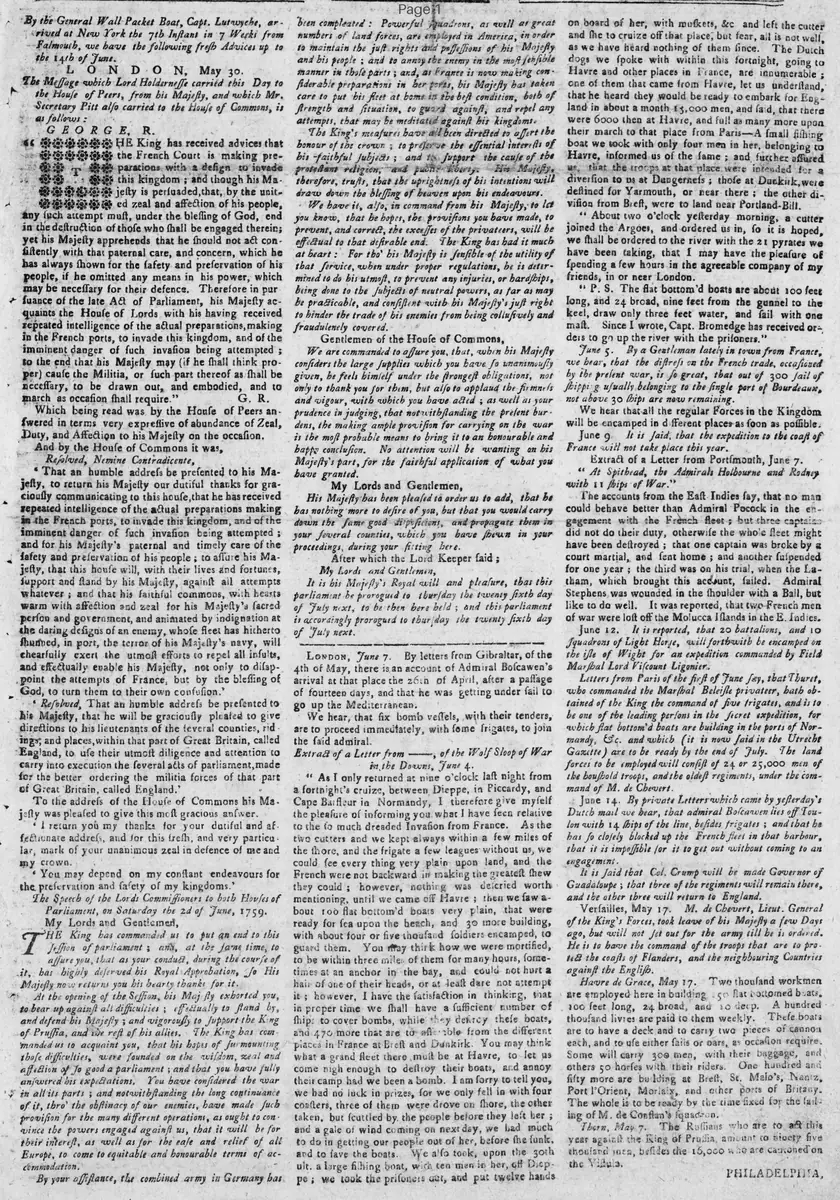
LONDON, May 30.
The Message which Lord Holdernesse carried this Day to the House of Peers, from his Majesty, and which Mr. Secretary Pitt also carried to the House of Commons, is as follows:
GEORGE. R.
Our Gracious Sovereign the King has received advice that from the French Court is making preparations with a design to invade this kingdom; and though his Majesty is persuaded, that by the united zeal and affection of his people, any such attempt must, under the blessing of God, end in the destruction of those who shall be engaged therein; yet his Majesty apprehends that he should not act consistently with that paternal care, and concern, which he has always shown for the safety and preservation of his people, if he omitted any means in his power, which may be necessary for their defence. Therefore in pursuance of the late Act of Parliament, his Majesty acquaints the House of Lords with his having received repeated intelligence of the actual preparations, making in the French ports, to invade this kingdom, and of the imminent danger of such invasion being attempted; to the end that his Majesty may (if he shall think proper) cause the Militia, or such part thereof as shall be necessary, to be drawn out, and embodied, and to march as occasion shall require.
G. R.
Which being read was by the House of Peers answered in terms very expressive of abundance of Zeal, Duty, and Affection to his Majesty on the occasion. And by the House of Commons it was,
Resolved, Nemine Contradicente,
That an humble address be presented to his Majesty, to return his Majesty our dutiful thanks for graciously communicating to this house, that he has received repeated intelligence of the actual preparations making in the French ports, to invade this kingdom, and of the imminent danger of such invasion being attempted; and for his Majesty's paternal and timely care of the safety and preservation of his people: to assure his Majesty, that this house will, with their lives and fortunes, support and stand by his Majesty, against all attempts whatever; and that his faithful commons, with hearts warm with affection and zeal for his Majesty's sacred person and government, and animated by indignation at the daring designs of an enemy, whose fleet has hitherto shunned, in port, the terror of his Majesty's navy, will cheerfully exert the utmost efforts to repel all insults, and effectually enable his Majesty, not only to disappoint the attempts of France, but by the blessing of God, to turn them to their own confusion.
Resolved, That an humble address be presented to his Majesty, that he will be graciously pleased to give directions to his lieutenants of the several counties, ridings, and places, within that part of Great Britain, called England, to use their utmost diligence and attention to carry into execution the several acts of parliament made for the better ordering the militia forces of that part of Great Britain, called England.
To the address of the House of Commons his Majesty was pleased to give this most gracious answer.
I return you my thanks for your dutiful and affectionate address, and for this fresh, and very particular, mark of your unanimous zeal in defence of me and my crown.
You may depend on my constant endeavours for the preservation and safety of my kingdoms.
The Speech of the Lords Commissioner to both Houses of Parliament, on Saturday the 2d of June, 1759.
My Lords and Gentlemen,
The King has commanded us to put an end to this Session of parliament; and, at the same time, to assure you, that as your conduct, during the course of it, has highly deserved his Royal Approbation, so His Majesty now returns you his hearty thanks for it. At the opening of the Session, his Majesty exhorted you, to bear up against all difficulties; effectually to stand by, and defend his Majesty; and vigorously to support the King of Prussia, and the rest of his allies. The King has commanded us to acquaint you, that his hopes of surmounting those difficulties, were founded on the wisdom, zeal and affection of so good a parliament; and that you have fully answered his expectations. You have considered the war in all its parts; and notwithstanding the long continuance of it, thro' the obstinacy of our enemies, have made such provision for the many different operations, as ought to convince the powers engaged against us, that it will be for their interest, as well as for the ease and relief of all Europe, to come to equitable and honourable terms of accommodation.
By your assistance, the combined army in Germany has been completed: Powerful squadrons, as well as great numbers of land forces, are employed in America, in order to maintain the just rights and possessions of his Majesty and his people: and to annoy the enemy in the most sensible manner in those parts; and, as France is now making considerable preparations in her ports, his Majesty has taken care to put his fleet at home in the best condition, both of strength and situation, to guard against and repel any attempts, that may be meditated against his kingdoms.
The King's measures have all been directed to assert the honour of the crown: to preserve the essential interests of his faithful subjects: and to support the cause of the protestant religion, and public liberty. His Majesty, therefore, trusts, that the uprightness of his intentions will draw down the blessing of heaven upon his endeavours.
We have it also in command from his Majesty, to let you know, that he hopes, the provisions you have made, to prevent, and correct, the excesses of the privateers, will be effectual to that desirable end. The King has had it much at heart: For tho' his Majesty is sensible of the utility of that service, when under proper regulations, he is determined to do his utmost, to prevent any injuries, or hardships, being done to the subjects of neutral powers, as far as may be practicable, and consistent with his Majesty's just right to hinder the trade of his enemies from being collusively and fraudulently covered.
Gentlemen of the House of Commons,
We are commanded to assure you, that, when his Majesty considers the large supplies which you have so unanimously given, he feels himself under the strongest obligations, not only to thank you for them, but also to applaud the firmness and vigour, with which you have acted; as well as your prudence in judging, that notwithstanding the present burdens, the making ample provision for carrying on the war is the most probable means to bring it to an honourable and happy conclusion. No attention will be wanting on his Majesty's part, for the faithful application of what you have granted.
My Lords and Gentlemen,
His Majesty has been pleased to order us to add, that he has nothing more to desire of you, but that you would carry down the same good dispositions, and propagate them in your several counties, which you have shewn in your proceedings, during your sitting here.
After which the Lord Keeper said;
My Lords and Gentlemen,
It is his Majesty's Royal will and pleasure, that this parliament be prorogued to Thursday the twenty sixth day of July next, to be then here held; and this parliament is accordingly prorogued to Thursday the twenty sixth day of July next.
London, June 7. By letters from Gibraltar, of the 4th of May, there is an account of Admiral Boscawen's arrival at that place the 20th of April, after a passage of fourteen days, and that he was getting under sail to go up the Mediterranean.
We hear, that six bomb vessels, with their tenders, are to proceed immediately, with some frigates, to join the said admiral.
Extract of a Letter from on board of the Wolf Sloop of War in the Downs. June 4.
As I only returned at nine o'clock last night from a fortnight's cruize, between Dieppe, in Piccardy, and Cape Barfleur in Normandy. I therefore give myself the pleasure of informing you what I have seen relative to the so much dreaded Invasion from France. As the two cutters and we kept always within a few miles of the shore, and the frigate a few leagues without us, we could see every thing very plain upon land, and the French were not backward in making the greatest show they could; however, nothing was descried worth mentioning, until we came off Havre; then we saw about 100 flat bottom'd boats very plain, that were ready for sea upon the beach, and 30 more building, with about four or five thousand soldiers encamped, to guard them. You may think how we were mortified, to be within three miles of them for many hours, sometimes at an anchor in the bay, and could not hurt a hair of one of their heads, or at least dare not attempt it; however, I have the satisfaction in thinking, that in proper time we shall have a sufficient number of ships to cover bombs, while they destroy these boats, and 470 more that are to sail from the different places in France at Brest and Dunkirk. You may think what a grand fleet there must be at Havre, to let us come nigh enough to destroy their boats, and annoy their camp had we been a bomb. I am sorry to tell you, we had no luck in prizes, for we only fell in with four coasters, three of them were drove on shore, the other taken, but scuttled by the people before they left her; and a gale of wind coming on next day, we had much to do in getting our people out of her, before she sunk, and to save the boats. We also took, upon the 30th ult. a large fishing boat, with ten men in her, off Dieppe; we took the prisoners out, and put twelve hands on board of her, with muskets, &c. and left the cutter and she to cruize off that place, but fear, all is not well, as we have heard nothing of them since. The Dutch dogs we spoke with within this fortnight, going to Havre and other places in France, are innumerable; one of them that came from Havre, let us understand, that he heard they would be ready to embark for England in about a month 12,000 men, and said, that there were 6000 then at Havre, and full as many more upon their march to that place from Paris--A small fishing boat we took with only four men in her, belonging to Havre, informed us of the same; and further assured us, that the troops at that place were intended for a diversion to us at Dungeness; those at Dunkirk, were destined for Yarmouth, or near there; the other division from Brest, were to land near Portland-Bill.
About two o'clock yesterday morning, a cutter joined the Argus, and ordered us in, so it is hoped, we shall be ordered to the river with the 21 pyrates we have been taking, that I may have the pleasure of spending a few hours in the agreeable company of my friends, in or near London.
P. S. The flat bottom'd boats are about 100 feet long, and 24 broad, nine feet from the gunnel to the keel, draw only three feet water, and sail with one mast. Since I wrote, Capt. Bromedge has received orders to go up the river with the prisoners.
June 5. By a Gentleman lately in town from France, we hear, that the distress on the French trade, occasioned by the present war, is so great, that out of 200 sail of shipping usually belonging to the single port of Bourdeaux, not above 20 ships are now remaining.
We hear that all the regular Forces in the Kingdom will be encamped in different places as soon as possible.
June 9. It is said, that the expedition to the coast of France will not take place this year.
Extract of a Letter from Portsmouth. June 7.
At Spithead, the Admirals Holbourne and Rodney with 21 ships of War.
The accounts from the East Indies say, that no man could behave better than Admiral Pocock in the engagement with the French fleet; but three captains did not do their duty, otherwise the whole fleet might have been destroyed; that one captain was broke by a court martial, and sent home; and another suspended for one year; the third was on his trial, when the Latham, which brought this account, sailed. Admiral Stephens was wounded in the shoulder with a Ball, but like to do well. It was reported, that two French men of war were lost off the Molucca Islands in the E. Indies.
June 12. It is reported, that 20 battalions, and 10 squadrons of Light Horse, will forthwith be encamped on the Isle of Wight for an expedition commanded by Field Marshal Lord Viscount Ligonier.
Letters from Paris of the first of June say, that Thuret, who commanded the Marshal Belleisle privateer, hath obtained of the King the command of five frigates, and is to be one of the leading persons in the secret expedition, for which flat bottom'd boats are building in the ports of Normandy, &c. and which (it is now said in the Utrecht Gazette) are to be ready by the end of July. The land forces to be employed will consist of 24 or 25,000 men of the household troops, and the oldest regiments, under the command of M. de Chevert.
June 14. By private Letters which came by yesterday's Dutch mail we hear, that admiral Boscawen lies off Toulon with 18 ships of the line, besides frigates; and that he has so closely blocked up the French fleet in that harbour, that it is impossible for it to get out without coming to an engagement.
It is said that Col. Crump will be made Governor of Guadaloupe; that three of the regiments will remain there, and the other three will return to England.
Versailles, May 17. M. de Chevert, Lieut. General of the King's Forces, took leave of his Majesty a few Days ago, but will not set out for the army till he is ordered. He is to have the command of the troops that are to protect the coasts of Flanders, and the neighbouring Countries against the English.
Havre de Grace, May 17. Two thousand workmen are employed here in building 60 flat bottomed boats, 100 feet long, 24 broad, and 9 deep. A hundred thousand livres are paid to them weekly. These boats are to have a deck and to carry two pieces of cannon each, and to use either sails or oar, as occasion require. Some will carry 200 men, with their baggage, and others 20 horses with their riders. One hundred and fifty more are building at Brest, St. Malo's, Nantz, Port l'Orient, Morlaix, and other ports of Brittany. The whole is to be ready by the time fixed for the sailing of M. de Conflans's squadron.
Thorn, May 7. The Russians who are to act this year against the King of Prussia, amount to ninety five thousand men, besides the 16,000 that are cantoned on the Vistula.
PHILADELPHIA
What sub-type of article is it?
What keywords are associated?
What entities or persons were involved?
Where did it happen?
Foreign News Details
Primary Location
London
Event Date
Up To The 10th Of June 1759
Key Persons
Outcome
british parliament resolves unanimous support for king, embodiment of militia, and defense against french invasion; prorogation praises war provisions; french preparations observed including flat-bottomed boats and 24-25,000 troops; boscawen blockades toulon; reports of french trade distress with only 20 ships left at bordeaux; east indies engagement with french fleet where three captains disciplined; russians 95,000 men against prussia; expedition to french coast canceled; 20 battalions and 10 squadrons to encamp on isle of wight.
Event Details
King George communicates intelligence of French invasion preparations to Parliament on May 30; Lords and Commons respond with zealous addresses assuring support and requesting militia activation; King thanks them; prorogation speech on June 2 reviews session, war efforts in Germany, America, home fleet against French ports, privateer regulations; letters report Boscawen's arrival Gibraltar April 20, proceeding to Mediterranean with bomb vessels; Wolf Sloop observes 100 flat-bottomed boats and 5,000 soldiers at Havre June 4, rumors of 12,000 men embarking for England; French trade distressed; regular forces to encamp; expedition to France not this year; 21 ships at Spithead; Pocock's engagement in East Indies with captain disciplines; two French ships lost; encampment on Isle of Wight under Ligonier; Paris letters on Thuret commanding frigates for secret expedition with Chevert's 24-25,000 men by July end; Boscawen blockades Toulon June 14; Chevert to command coastal troops Versailles May 17; 60 boats building at Havre with 150 more in Brittany by Conflans's squadron time; Russians 95,000 against Prussia Thorn May 7.