Thank you for visiting SNEWPapers!
Sign up free
Literary
September 20, 1788
The Daily Advertiser
New York, New York County, New York
What is this article about?
A collection of aphoristic reflections by Montesquieu on worldly knowledge, admiration for ancients, study as remedy, social observations, patriotism, travel attachments, storytelling, trust, emotion, and forgiveness, extracted and translated from his manuscripts.
Clipping
OCR Quality
95%
Excellent
Full Text
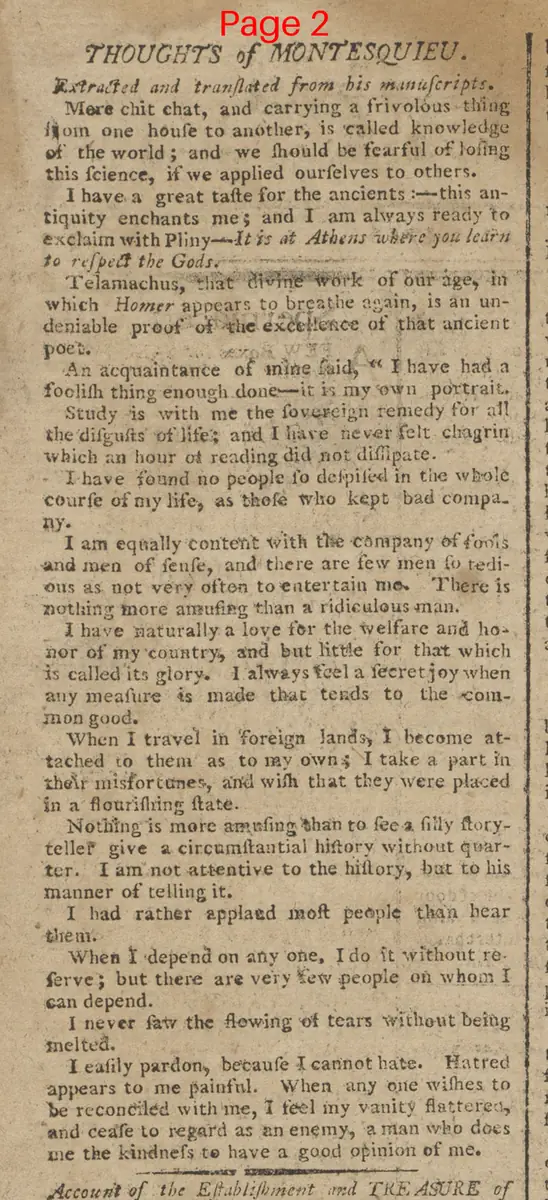
THOUGHTS of MONTESQUIEU.
Extracted and translated from his manuscripts.
Mere chit chat, and carrying a frivolous thing from one house to another, is called knowledge of the world; and we should be fearful of losing this science, if we applied ourselves to others.
I have a great taste for the ancients: this antiquity enchants me; and I am always ready to exclaim with Pliny—It is at Athens where you learn to respect the Gods.
Telamachus, that divine work of our age, in which Homer appears to breathe again, is an undeniable proof of the excellence of that ancient poet.
An acquaintance of mine said, I have had a foolish thing enough done—it is my own portrait.
Study is with me the sovereign remedy for all the disquiets of life: and I have never felt chagrin which an hour of reading did not dissipate.
I have found no people so despised in the whole course of my life, as those who kept bad company.
I am equally content with the company of fools and men of sense, and there are few men so tedious as not very often to entertain me. There is nothing more amusing than a ridiculous man.
I have naturally a love for the welfare and honor of my country, and but little for that which is called its glory. I always feel a secret joy when any measure is made that tends to the common good.
When I travel in foreign lands, I become attached to them as to my own; I take a part in their misfortunes, and wish that they were placed in a flourishing state.
Nothing is more amusing than to see a silly story-teller give a circumstantial history without quarter. I am not attentive to the history, but to his manner of telling it.
I had rather applauded most people than hear them.
When I depend on any one, I do it without reserve; but there are very few people on whom I can depend.
I never saw the flowing of tears without being melted.
I easily pardon, because I cannot hate. Hatred appears to me painful. When any one wishes to be reconciled with me, I feel my vanity flattered, and cease to regard as an enemy, a man who does me the kindness to have a good opinion of me.
Extracted and translated from his manuscripts.
Mere chit chat, and carrying a frivolous thing from one house to another, is called knowledge of the world; and we should be fearful of losing this science, if we applied ourselves to others.
I have a great taste for the ancients: this antiquity enchants me; and I am always ready to exclaim with Pliny—It is at Athens where you learn to respect the Gods.
Telamachus, that divine work of our age, in which Homer appears to breathe again, is an undeniable proof of the excellence of that ancient poet.
An acquaintance of mine said, I have had a foolish thing enough done—it is my own portrait.
Study is with me the sovereign remedy for all the disquiets of life: and I have never felt chagrin which an hour of reading did not dissipate.
I have found no people so despised in the whole course of my life, as those who kept bad company.
I am equally content with the company of fools and men of sense, and there are few men so tedious as not very often to entertain me. There is nothing more amusing than a ridiculous man.
I have naturally a love for the welfare and honor of my country, and but little for that which is called its glory. I always feel a secret joy when any measure is made that tends to the common good.
When I travel in foreign lands, I become attached to them as to my own; I take a part in their misfortunes, and wish that they were placed in a flourishing state.
Nothing is more amusing than to see a silly story-teller give a circumstantial history without quarter. I am not attentive to the history, but to his manner of telling it.
I had rather applauded most people than hear them.
When I depend on any one, I do it without reserve; but there are very few people on whom I can depend.
I never saw the flowing of tears without being melted.
I easily pardon, because I cannot hate. Hatred appears to me painful. When any one wishes to be reconciled with me, I feel my vanity flattered, and cease to regard as an enemy, a man who does me the kindness to have a good opinion of me.
What sub-type of article is it?
Essay
What themes does it cover?
Moral Virtue
Social Manners
Patriotism
What keywords are associated?
Montesquieu Thoughts
Personal Reflections
Social Observations
Patriotism
Study Remedy
Forgiveness
Ancients Admiration
What entities or persons were involved?
Montesquieu
Literary Details
Title
Thoughts Of Montesquieu.
Author
Montesquieu
Key Lines
Study Is With Me The Sovereign Remedy For All The Disquiets Of Life: And I Have Never Felt Chagrin Which An Hour Of Reading Did Not Dissipate.
I Have Naturally A Love For The Welfare And Honor Of My Country, And But Little For That Which Is Called Its Glory.
I Easily Pardon, Because I Cannot Hate. Hatred Appears To Me Painful.