Thank you for visiting SNEWPapers!
Sign up free
The New York Journal, And Daily Patriotic Register
New York, New York County, New York
What is this article about?
A historical account of the rise of the Ottoman Empire, tracing from Mahomet's 7th-century foundations through Saracen conquests, key sultans like Ottoman and Solyman, territorial expansions, governing principles including Janizaries, and factors contributing to later decline.
Clipping
OCR Quality
Full Text
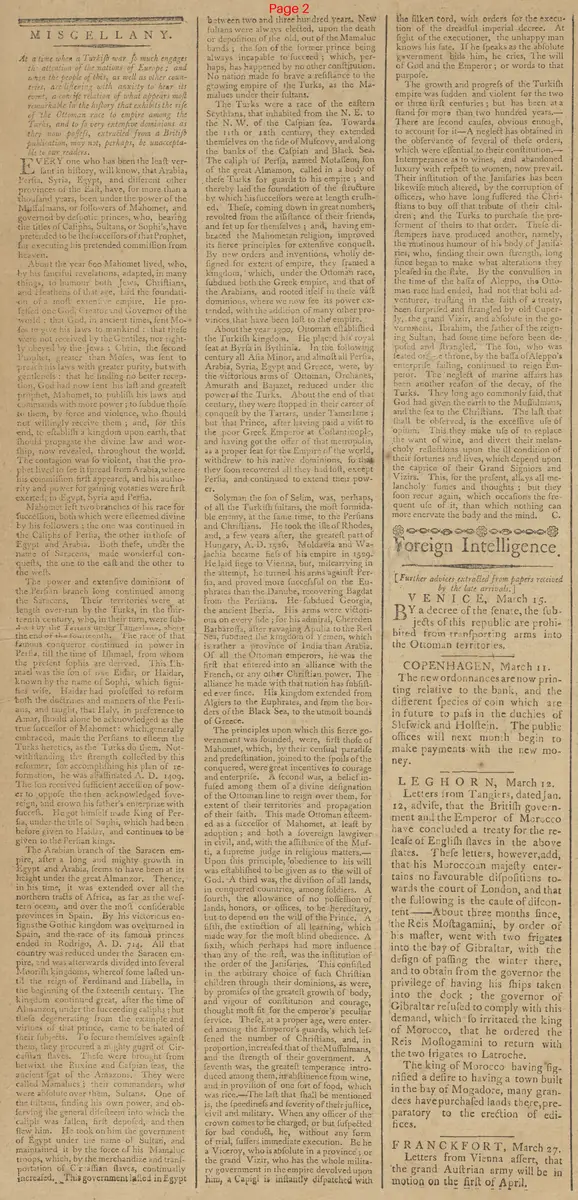
At a time when a Turkish war so much engages the attention of the nations of Europe; and when the people of this, as well as other countries, are listening with anxiety to hear its event, a concise relation of what appears most remarkable in the history that exhibits the rise of the Ottoman race to empire among the Turks, and to so very extensive dominions as they now possess, extracted from a British publication, may not, perhaps, be unacceptable to our readers.
Every one who has been the least versed in history, will know, that Arabia, Persia, Syria, Egypt, and sundry other provinces of the East, have, for more than a thousand years, been under the power of the Musulmans, or followers of Mahomet, and governed by despotic princes, who, bearing the titles of Caliphs, Sultans, or Sophis, have pretended to be the successors of that Prophet, for executing his pretended commission from heaven.
About the year 600 Mahomet lived, who, by his fanciful revelations, adapted, in many things, to humour both Jews, Christians, and Heathens of that age, laid the foundation of a most extensive empire. He professed one God, Creator and Governor of the world: that God, in ancient times, sent Moses to give his laws to mankind: that these were not received by the Gentiles, nor rightly obeyed by the Jews; Christ, the second Prophet, greater than Moses, was sent to preach his laws with greater purity, but with gentleness: that he finding no better reception, God had now sent his last and greatest prophet, Mahomet, to publish his laws and commands with more power; to subdue those to them, by force and violence, who should not willingly receive them; and, for this end, to establish a kingdom upon earth, that should propagate the divine law and worship, now revealed, throughout the world.
The contagion was so violent, that the prophet lived to see it spread from Arabia, where his commission first appeared, and his authority and power for gaining votaries were first exerted, into Egypt, Syria and Persia.
Mahomet left two branches of his race for succession, both which were esteemed divine by his followers: the one was continued in the Caliphs of Persia, the other in those of Egypt and Arabia. Both these, under the name of Saracens, made wonderful conquests, the one to the east and the other to the west.
The power and extensive dominions of the Persian branch long continued among the Saracens. Their territories were at length over-run by the Turks, in the thirteenth century, who, in their turn, were subdued by the Tartars under Tamerlane, about the end of the fourteenth. The race of that famous conqueror continued in power in Persia, till the time of Ishmael, from whom the present Sophis are derived. This Ishmael was the son of one Hyder, or Haidar, known by the name of Sophi, which signifies wise. Haidar had professed to reform both the doctrines and manners of the Persians, and taught, that Ali, in preference to Omar, should alone be acknowledged as the true successor of Mahomet: which, generally embraced, made the Persians to esteem the Turks heretics, as the Turks do them. Notwithstanding the strength collected by this reformer, for accomplishing his plan of reformation, he was assassinated A. D. 1409.
The son received sufficient accession of power to oppose the then acknowledged sovereign, and crown his father's enterprize with success. He got himself made King of Persia, under the title of Sophi, which had been before given to Haidar, and continues to be given to the Persian kings.
The Arabian branch of the Saracen empire, after a long and mighty growth in Egypt and Arabia, seems to have been at its height under the great Almanzor. Thence, in his time, it was extended over all the northern tracts of Africa, as far as the western ocean, and over the most considerable provinces in Spain. By his victorious ensigns the Gothic kingdom was overturned in Spain, and the race of its famous princes ended in Rodrigo, A. D. 714. All that country was reduced under the Saracen empire, and was afterwards divided into several Moorish kingdoms, whereof some lasted until the reign of Ferdinand and Isabella, in the beginning of the sixteenth century. The kingdom continued great, after the time of Almanzor, under the succeeding caliphs; but these degenerating from the example and virtues of that prince, came to be hated of their subjects. To secure themselves against them, they procured a mighty guard of Circassian slaves. These were brought from betwixt the Euxine and Caspian seas, the ancient seat of the Amazons. They were called Mamelucs; their commanders, who were absolute over them, Sultans. One of the sultans, finding his own power, and observing the general disesteem into which the caliph was fallen, first deposed, and then slew him. He took on him the government of Egypt under the name of Sultan, and maintained it by the force of his Mameluc troops, which, by the merchandize and transportation of Circassian slaves, continually increased. This government lasted in Egypt between two and three hundred years. New sultans were always elected, upon the death or deposition of the old, out of the Mameluc bands; the son of the former prince being always incapable to succeed; which, perhaps, has happened by no other constitution.
No nation made so brave a resistance to the growing empire of the Turks, as the Mamelucs under their sultans.
The Turks were a race of the eastern Scythians, that inhabited from the N. E. to the N. W. of the Caspian sea. Towards the 11th or 12th century, they extended themselves on the side of Muscovy, and along the banks of the Caspian and Black Sea. The caliph of Persia, named Motassem, son of the great Almanmon, called in a body of these Turks for guards to his empire; and thereby laid the foundation of the structure by which his successors were at length crushed. These, coming down in great numbers, revolted from the assistance of their friends, and set up for themselves: and, having embraced the Mahometan religion, improved its fierce principles for extensive conquest. By new orders and inventions, wholly designed for extent of empire, they framed a kingdom, which, under the Ottoman race, subdued both the Greek empire, and that of the Arabians, and rooted itself in these vast dominions, where we now see its power extended, with the addition of many other provinces that have been lost to the empire.
About the year 1300, Ottoman established the Turkish kingdom. He placed his royal seat at Prusa in Bythinia. In the following century all Asia Minor, and almost all Persia, Arabia, Syria, Egypt and Greece, were, by the victorious arms of Ottoman, Orchanes, Amurath and Bajazet, reduced under the power of the Turks. About the end of that century, they were stopped in their career of conquest by the Tartars, under Tamerlane; but that Prince, after having paid a visit to the poor Greek Emperor at Constantinople, and having got the offer of that metropolis, as a proper seat for the Empire of the world, withdrew to his native dominions, so that they soon recovered all they had lost, except Persia, and continued to extend their power.
Solyman the son of Selim, was, perhaps, of all the Turkish sultans, the most formidable enemy, at the same time, to the Persians and Christians. He took the isle of Rhodes, and, a few years after, the greatest part of Hungary, A. D. 1526, Moldavia and Wallachia became fiefs of his empire in 1529. He laid siege to Vienna, but, miscarrying in the attempt, he turned his arms against Persia, and proved more successful on the Euphrates than the Danube, recovering Bagdad from the Persians. He subdued Georgia, the ancient Iberia. His arms were victorious on every side; for his admiral, Cheredin Barbarossa, after ravaging Apulia to the Red Sea, subdued the kingdom of Yemen, which is rather a province of India than Arabia. Of all the Ottoman emperors, he was the first that entered into an alliance with the French, or any other Christian power. The alliance he made with that nation has subsisted ever since. His kingdom extended from Algiers to the Euphrates, and from the borders of the Black Sea, to the utmost bounds of Greece.
The principles upon which this fierce government was founded, were, first those of Mahomet, which, by their sensual paradise and predestination, joined to the spoils of the conquered, were great incentives to courage and enterprise. A second was, a belief infused among them of a divine destination of the Ottoman line to reign over them, for extent of their territories and propagation of their faith. This made Ottoman esteemed as a successor of Mahomet, at least by adoption; and both a sovereign lawgiver in civil, and, with the assistance of the Mufti, a supreme judge in religious matters. Upon this principle, obedience to his will was established to be given as to the will of God. A third was, the division of all lands, in conquered countries, among soldiers. A fourth, the allowance of no possession of lands, honors, or offices, to be hereditary, but to depend on the will of the Prince. A fifth, the extinction of all learning, which made way for the most blind obedience. A sixth, which perhaps had more influence than any of the rest, was the institution of the order of the Janizaries. This consisted in the arbitrary choice of such Christian children through their dominions, as were, by promises of the greatest growth of body, and vigour of constitution and courage, thought most fit for the emperor's peculiar service. These, at a proper age, were entered among the Emperor's guards, which lessened the number of Christians, and, in proportion, increased that of the Musulmans, and the strength of their government. A seventh was, the greatest temperance introduced among them, in abstinence from wine, and in provision of one sort of food, which was rice. The last that shall be mentioned is, the speediness and severity of their justice, civil and military. When any officer of the crown comes to be charged, or but suspected for bad conduct, he, without any form of trial, suffers immediate execution. Be he a Viceroy, who is absolute in a province; or the grand Vizir, who has the whole military government in the empire devolved upon him, a Capigi is instantly dispatched with the silken cord, with orders for the execution of the dreadful imperial decree. At sight of the executioner, the unhappy man knows his fate. If he speaks as the absolute government bids him, he cries, The will of God and the Emperor; or words to that purpose.
The growth and progress of the Turkish empire was sudden and violent for the two or three first centuries; but has been at a stand for more than two hundred years. There are second causes, obvious enough, to account for it. A neglect has obtained in the observance of several of these orders, which were essential to their constitution. Intemperance as to wines, and abandoned luxury with respect to women, now prevail. Their institution of the Janizaries has been likewise much altered, by the corruption of officers, who have long suffered the Christians to buy off that tribute of their children; and the Turks to purchase the preference of theirs to that order. These disorders have produced another, namely, the mutinous humour of this body of Janizaries, who, finding their own strength, long since began to make what alterations they pleased in the state. By the convulsion in the time of the Pasha of Aleppo, the Ottoman race had ended, had not that bold adventurer, trusting in the faith of a treaty, been surprised and strangled by old Kuprily, the grand Vizir, and absolute in the government. Ibrahim, the father of the reigning Sultan, had some time before been deposed and strangled. The son, who was seated on the throne, by the Pasha of Aleppo's enterprize failing, continued to reign Emperor. The neglect of marine affairs has been another reason of the decay, of the Turks. They long ago commonly said, that God had given the earth to the Musulmans, and the sea to the Christians. The last that shall be observed, is the excessive use of opium. This they make use of to replace the want of wine, and divert their melancholy reflections upon the ill condition of their fortunes and lives, which depend upon the caprice of their Grand Signiors and Vizirs. This, for the present, allays all melancholy fumes and thoughts; but they soon recur again, which occasions the frequent use of it, than which nothing can more enervate the body and the mind. C.
What sub-type of article is it?
What themes does it cover?
What keywords are associated?
What entities or persons were involved?
Where did it happen?
Story Details
Key Persons
Location
Arabia, Persia, Syria, Egypt, Asia Minor, And Surrounding Regions
Event Date
From About The Year 600 To The 16th Century
Story Details
Account of Mahomet's founding of Islam and its spread; Saracen branches in Persia and Arabia; Turkish origins and conquests under Ottoman and successors; expansions by Solyman; governing principles like Janizaries; and later decline due to corruption and neglect.