Thank you for visiting SNEWPapers!
Sign up free
Editorial
October 24, 1814
Portland Gazette, And Maine Advertiser
Portland, Cumberland County, Maine
What is this article about?
Editorial 'No. 2' discusses what Great Britain does not demand in peace negotiations with the US, critiquing American commissioners' proposals on maritime rights, blockades, and fisheries, while defending British positions on Indian peace, boundaries, and uti possidetis. Signed by PACIFICUS.
Clipping
OCR Quality
95%
Excellent
Full Text
The first No of a series of Plays on the subject of the pending negotiation will be found in the last page of this day's Gazette. It is hoped they will receive an attentive perusal.
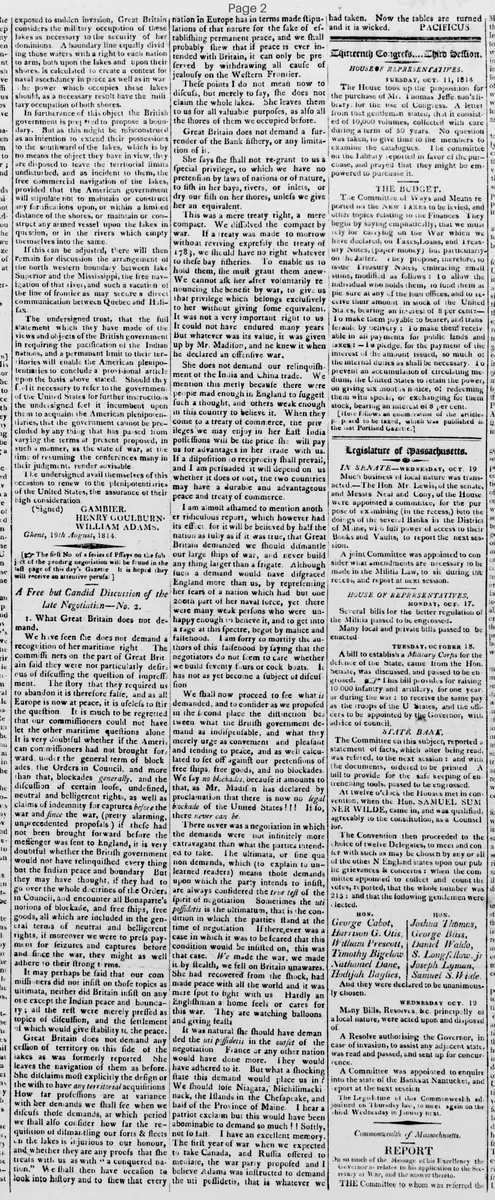
A Free but Candid Discussion of the late Negotiation--No. 2.
1. What Great Britain does not demand.
We have seen she does not demand a recognition of her maritime rights. The commissioners on the part of Great Britain said they were not particularly desirous of discussing the question of impressment. The story that they required us to abandon it is therefore false, and as all Europe is now at peace, it is useless to stir the question. It is much to be regretted that our commissioners could not have let the other maritime questions alone. It is very doubtful whether if the American commissioners had not brought forward, under the general term of blockades, the Orders in Council, and more than that, blockades generally, and the discussion of certain loose, undefined, neutral and belligerent rights, as well as claims of indemnity for captures before the war and since the war, (pretty alarming, unprecedented proposals) if these had not been brought forward before the messenger was sent to England, it is very doubtful whether the British government would not have relinquished every thing but the Indian peace and boundary. But they may have thought, if they had to go over the whole doctrines of the Orders in Council, and encounter all Bonaparte's notions of blockade, and free ships, free goods, all which are included in the general terms of neutral and belligerent rights, if moreover we were to press payment for seizures and captures before and since the war, they might as well adhere to their strong terms.
It may perhaps be said that our commissioners did not insist on those topics as ultimata, neither did Britain insist on any one except the Indian peace and boundary; all the rest were merely pressed as topics of discussion, and the settlement of which would give stability to the peace.
Great Britain does not demand any cession of territory on this side of the lakes as was formerly reported. She leaves the navigation of them as before. She disclaims most explicitly the design or the wish to have any territorial acquisitions. How far professions are at variance with her demands we shall see when we discuss those demands, at which period we shall also consider how far the requisition of dismantling our forts & fleets on the lakes is injurious to our honour, and whether they are any proofs that she treats with us as with "a conquered nation." We shall then have occasion to look into history and to show that every nation in Europe has in terms made stipulations of that nature for the sake of establishing permanent peace, and we shall probably show that if peace is ever intended with Britain, it can only be preserved by withdrawing all cause of jealousy on the Western Frontier.
These points I do not mean now to discuss, but merely to say, she does not claim the whole lakes. She leaves them to us for all valuable purposes, as also all the shores of them we occupied before.
Great Britain does not demand a surrender of the Bank fishery, or any limitation of it. She says she shall not re-grant to us a special privilege, to which we have no pretension by laws of nations or of nature, to fish in her bays, rivers, or inlets, or dry our fish on her shores, unless we give her an equivalent.
This was a mere treaty right, a mere compact. We dissolved the compact by war. If a treaty was made to morrow without reviving expressly the treaty of 1783, we should have no right whatever to these bay fisheries. To enable us to hold them, she must grant them anew. We cannot ask her after voluntarily renouncing the benefit by war, to give us that privilege which belongs exclusively to her without giving some equivalent.
It was not a very important right to us. It could not have endured many years. But whatever was its value, it was given up by Mr. Madison, and he knew it when he declared an offensive war.
She does not demand our relinquishment of the India and China trade. We mention this merely because there were people mad enough in England to suggest such a thought, and others weak enough in this country to believe it. When they come to a treaty of commerce, the privileges we may enjoy in her East India possessions will be the price she will pay us for advantages in her trade with us. If a disposition to reciprocity shall prevail, and I am persuaded it will depend on us whether it does or not, the two countries may have a durable and advantageous peace and treaty of commerce.
I am almost ashamed to mention another ridiculous report, which however had its effect, for it will be believed by half the nation as fully as if it was true, that Great Britain demanded we should dismantle our large ships of war, and never build any thing larger than a frigate. Although such a demand would have disgraced England more than us, by representing her fears of a nation which had but one 20oth part of her naval force, yet there were many weak persons who were unhappy enough to believe it, and to get into a rage at this spectre, begot by malice and falsehood. I am sorry to mortify the authors of this falsehood by saying that the negotiators do not seem to care whether we build seventy fours or cock boats. It has not as yet become a subject of discussion.
We shall now proceed to see what is demanded, and to consider as we proposed in the second place the distinction between what the British government demand as indispensable, and what they merely urge as convenient and pleasant and tending to peace, and as well calculated to set off against our pretensions of free ships, free goods, and no blockades. We say no blockades, because it amounts to that, as Mr. Madison has declared by proclamation that there is now no legal blockade of the United States!!! If so, there never can be.
There never was a negotiation in which the demands were not infinitely more extravagant than what the parties intended to take. The ultimata, or Sine qua non demands, which (to explain to unlearned readers) means those demands upon which the party intends to insist, are always considered the true test of the spirit of negotiation. Sometimes the uti possidetis is the ultimatum, that is the condition in which the parties stand at the time of negotiation. If there ever was a case in which it was to be feared that this condition would be insisted on, this was that case. We made the war. we made it by stealth, we fell on Britain unawares. She had recovered from the shock, had made peace with all the world and it was mere pot to fight with us. Hardly an Englishman at home feels or cares for this war. They are watching balloons and giving feasts.
It was natural she should have demanded the uti possidetis in the outset of the negotiation. France or any other nation would have done more. They would have adhered to it. But what a shocking state this demand would place us in? We should lose Niagara, Michilimackinac, the Islands in the Chesapeake, and half of the Province of Maine. I hear a patriot exclaim but this would have been abominable to demand so much!! Softly. not so fast. I have an excellent memory. The first year of war when we expected to take Canada, and Russia offered to mediate, the war party proposed and I believe Adams was instructed to demand the uti possidetis, that is whatever we had taken. Now the tables are turned and it is wicked.
PACIFICUS.
A Free but Candid Discussion of the late Negotiation--No. 2.
1. What Great Britain does not demand.
We have seen she does not demand a recognition of her maritime rights. The commissioners on the part of Great Britain said they were not particularly desirous of discussing the question of impressment. The story that they required us to abandon it is therefore false, and as all Europe is now at peace, it is useless to stir the question. It is much to be regretted that our commissioners could not have let the other maritime questions alone. It is very doubtful whether if the American commissioners had not brought forward, under the general term of blockades, the Orders in Council, and more than that, blockades generally, and the discussion of certain loose, undefined, neutral and belligerent rights, as well as claims of indemnity for captures before the war and since the war, (pretty alarming, unprecedented proposals) if these had not been brought forward before the messenger was sent to England, it is very doubtful whether the British government would not have relinquished every thing but the Indian peace and boundary. But they may have thought, if they had to go over the whole doctrines of the Orders in Council, and encounter all Bonaparte's notions of blockade, and free ships, free goods, all which are included in the general terms of neutral and belligerent rights, if moreover we were to press payment for seizures and captures before and since the war, they might as well adhere to their strong terms.
It may perhaps be said that our commissioners did not insist on those topics as ultimata, neither did Britain insist on any one except the Indian peace and boundary; all the rest were merely pressed as topics of discussion, and the settlement of which would give stability to the peace.
Great Britain does not demand any cession of territory on this side of the lakes as was formerly reported. She leaves the navigation of them as before. She disclaims most explicitly the design or the wish to have any territorial acquisitions. How far professions are at variance with her demands we shall see when we discuss those demands, at which period we shall also consider how far the requisition of dismantling our forts & fleets on the lakes is injurious to our honour, and whether they are any proofs that she treats with us as with "a conquered nation." We shall then have occasion to look into history and to show that every nation in Europe has in terms made stipulations of that nature for the sake of establishing permanent peace, and we shall probably show that if peace is ever intended with Britain, it can only be preserved by withdrawing all cause of jealousy on the Western Frontier.
These points I do not mean now to discuss, but merely to say, she does not claim the whole lakes. She leaves them to us for all valuable purposes, as also all the shores of them we occupied before.
Great Britain does not demand a surrender of the Bank fishery, or any limitation of it. She says she shall not re-grant to us a special privilege, to which we have no pretension by laws of nations or of nature, to fish in her bays, rivers, or inlets, or dry our fish on her shores, unless we give her an equivalent.
This was a mere treaty right, a mere compact. We dissolved the compact by war. If a treaty was made to morrow without reviving expressly the treaty of 1783, we should have no right whatever to these bay fisheries. To enable us to hold them, she must grant them anew. We cannot ask her after voluntarily renouncing the benefit by war, to give us that privilege which belongs exclusively to her without giving some equivalent.
It was not a very important right to us. It could not have endured many years. But whatever was its value, it was given up by Mr. Madison, and he knew it when he declared an offensive war.
She does not demand our relinquishment of the India and China trade. We mention this merely because there were people mad enough in England to suggest such a thought, and others weak enough in this country to believe it. When they come to a treaty of commerce, the privileges we may enjoy in her East India possessions will be the price she will pay us for advantages in her trade with us. If a disposition to reciprocity shall prevail, and I am persuaded it will depend on us whether it does or not, the two countries may have a durable and advantageous peace and treaty of commerce.
I am almost ashamed to mention another ridiculous report, which however had its effect, for it will be believed by half the nation as fully as if it was true, that Great Britain demanded we should dismantle our large ships of war, and never build any thing larger than a frigate. Although such a demand would have disgraced England more than us, by representing her fears of a nation which had but one 20oth part of her naval force, yet there were many weak persons who were unhappy enough to believe it, and to get into a rage at this spectre, begot by malice and falsehood. I am sorry to mortify the authors of this falsehood by saying that the negotiators do not seem to care whether we build seventy fours or cock boats. It has not as yet become a subject of discussion.
We shall now proceed to see what is demanded, and to consider as we proposed in the second place the distinction between what the British government demand as indispensable, and what they merely urge as convenient and pleasant and tending to peace, and as well calculated to set off against our pretensions of free ships, free goods, and no blockades. We say no blockades, because it amounts to that, as Mr. Madison has declared by proclamation that there is now no legal blockade of the United States!!! If so, there never can be.
There never was a negotiation in which the demands were not infinitely more extravagant than what the parties intended to take. The ultimata, or Sine qua non demands, which (to explain to unlearned readers) means those demands upon which the party intends to insist, are always considered the true test of the spirit of negotiation. Sometimes the uti possidetis is the ultimatum, that is the condition in which the parties stand at the time of negotiation. If there ever was a case in which it was to be feared that this condition would be insisted on, this was that case. We made the war. we made it by stealth, we fell on Britain unawares. She had recovered from the shock, had made peace with all the world and it was mere pot to fight with us. Hardly an Englishman at home feels or cares for this war. They are watching balloons and giving feasts.
It was natural she should have demanded the uti possidetis in the outset of the negotiation. France or any other nation would have done more. They would have adhered to it. But what a shocking state this demand would place us in? We should lose Niagara, Michilimackinac, the Islands in the Chesapeake, and half of the Province of Maine. I hear a patriot exclaim but this would have been abominable to demand so much!! Softly. not so fast. I have an excellent memory. The first year of war when we expected to take Canada, and Russia offered to mediate, the war party proposed and I believe Adams was instructed to demand the uti possidetis, that is whatever we had taken. Now the tables are turned and it is wicked.
PACIFICUS.
What sub-type of article is it?
War Or Peace
Foreign Affairs
Partisan Politics
What keywords are associated?
Peace Negotiations
British Demands
American Commissioners
Maritime Rights
Indian Boundary
Bank Fishery
Uti Possidetis
Mr Madison
War Of 1812
What entities or persons were involved?
Great Britain
American Commissioners
Mr. Madison
Bonaparte
Pacificus
Editorial Details
Primary Topic
What Great Britain Does Not Demand In Peace Negotiations
Stance / Tone
Defensive Of British Positions, Critical Of American War Policy And Commissioners
Key Figures
Great Britain
American Commissioners
Mr. Madison
Bonaparte
Pacificus
Key Arguments
Britain Does Not Demand Recognition Of Maritime Rights Or Discussion Of Impressment
American Commissioners Unnecessarily Raised Blockades, Orders In Council, And Indemnity Claims
Britain Insists Only On Indian Peace And Boundary As Ultimata
No Demand For Cession Of Territory Or Control Of Lakes
No Surrender Of Bank Fishery Required, But No Special Privileges Without Equivalent
Fishery Rights Were Treaty Based And Dissolved By War
No Demand To Relinquish India And China Trade
Ridiculous Report Of Demanding Dismantling Of Large Ships Is False
Distinction Between Indispensable Demands And Discussion Topics
Uti Possidetis Was A Natural Initial Demand But Not Adhered To By Britain
Hypocrisy Of American War Party In Previously Proposing Uti Possidetis