Thank you for visiting SNEWPapers!
Sign up free
Southern Christian Advocate
Charleston, Charleston County, South Carolina
What is this article about?
In 1849, Mr. Kendall describes Catholic religious practices in Brussels, including the Assumption fete and a unique annual procession commemorating a 14th-century miracle where Jews allegedly desecrated wafers that bled, leading to their persecution and execution.
Clipping
OCR Quality
Full Text
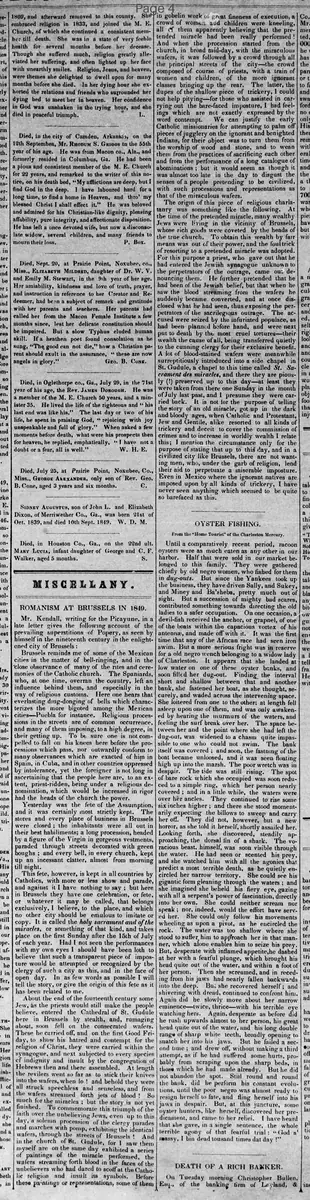
ROMANISM AT BRUSSELS IN 1849.
Mr. Kendall, writing for the Picayune, in a late letter gives the following account of the prevailing superstitions of Popery, as seen by himself in the nineteenth century in the enlightened city of Brussels:
Brussels reminds me of some of the Mexican cities in the matter of bell-ringing, and in the close observance of many of the rites and ceremonies of the Catholic church. The Spaniards, who, at one time, overran the country, let an influence behind them, and especially in the way of religious customs. Here one hears that everlasting ding-donging of bells which characterizes the more bigoted among the Mexican cities—Puebla for instance. Religious processions in the streets are of common occurrence, and many of them imposing, to a high degree, in their getting up. To be sure one is not compelled to fall on his knees here before the processions which pass, nor outwardly conform to many observances which are exacted of him in Spain, in Cuba, and in other countries oppressed by intolerance, yet the foreigner is not long in ascertaining that the people here are, to an extent, priest-ridden, being under a religious denomination, which would be increased in rigor had the heads of the church the power.
Yesterday was the fete of the Assumption, and it was certainly most strictly kept. The stores and every place of business in Brussels were closed; the inhabitants were all out in their best habiliments; a long procession, headed by a figure of the Virgin in gorgeous vestments, paraded through streets decorated with green boughs; and every bell, in every church, kept up an incessant clatter, almost from morning till night.
This fete, however, is kept in all countries by Catholics, with more or less show and parade, and against it I have nothing to say; but here in Brussels they have one celebration, or fete, or whatever it may be called, that belongs exclusively, I believe, to the place, and which no other city should be emulous to imitate or copy. It is called the holy sacrament and of the miracles, or something of that kind, and takes place on the first Sunday after the 15th of July of each year. Had I not seen the performances with my own eyes I should have been loth to believe that such a transparent piece of imposture would be attempted or recognized by the clergy of such a city as this, and in the face of open day. In as few words as possible I will tell the story, or give the origin of this fete as it has been related to me.
About the end of the fourteenth century some Jew, as the priests would still make the people believe, entered the Cathedral of St. Gudule here in Brussels by stealth, and, rummaging about, soon fell on the consecrated wafers. These he carried off, and on the first Good Friday, to show his hatred and contempt for the religion of Christ, they were carried within the synagogue, and next subjected to every species of indignity and insult by the congregation of Hebrews then and there assembled. At length the revilers went so far as to stick their knives into the wafers, when lo! and behold they were all struck speechless and senseless, and from the wafers streamed forth jets of blood! So much for the miracles; but the story is not yet finished. To commemorate this triumph of the faith over the unbelieving Jews, even up to this day, a solemn procession of the clergy parades and marches with pomp, exhibiting the identical wafers, through the streets of Brussels! And in the church of St. Gudule, for I saw them myself are on the same day exhibited a series of paintings of the miracle performed, the wafers streaming forth blood in the faces of the unbelievers who had dared to scoff at the Catholic religion and insult its symbols. Before these paintings or representations, some of them in gobelin work of great fineness of execution, a crowd of women and children were kneeling, all of them apparently believing that the pretended miracle had been really performed.
And when the procession started from the church, in broad mid-day, with the miraculous wafers, it was followed by a crowd through all the principal streets of the city—the crowd composed of course of priests, with a train of women and children, of the more ignorant classes bringing up the rear. The latter, the dupes of the shallow piece of trickery, I could not help pitying—for those who assisted in carrying out the bare-faced imposture, I had feelings which are not exactly expressed by the word contempt. We can justify the early Catholic missionaries for attempting to palm off pieces of jugglery on the ignorant and benighted Indians, for their object was to turn them from the worship of wood and stone, and to wean them from the practices of sacrificing each other and from the performance of a long catalogue of abominations; but it would seem as though it was almost too late in the day to disgust the senses of a people pretending to be civilized, with such processions and representations as that of the miraculous wafers.
The origin of this piece of religious charlatanry was something like the following. At the time of the pretended miracle, many wealthy Jews were living in the vicinity of Brussels, whose rich goods were coveted by the heads of the true church. To obtain this wealth by fair means was out of their power, and the foul trick of resorting to a pretended miracle was adopted. For this purpose a priest, who gave out that he had entered the Jewish synagogue unknown to the perpetrators of the outrage, came out denouncing them. He further pretended that he had been of the Jewish belief, but that when he saw the blood streaming from the wafers he suddenly became converted, and at once disclosed what he had seen, thus exposing the perpetrators of the sacrilegious outrage. The accused were seized by the infuriated populace, as had been planned before hand, and were next put to death by the most cruel tortures—their wealth the cause of all, being transferred quietly to the cunning clergy for their exclusive benefit. A lot of blood-stained wafers were meanwhile surreptitiously introduced into a side chapel in St. Gudule, a chapel to this time called St. Sacrament des miracles, and there they are piously (!) preserved up to this day—at least they were taken from there one Sunday in the month of July last past, and I presume they were carried back. It is not for the purpose of telling the story of an old miracle, got up in the dark and bloody ages, when Catholic and Protestant, Jew and Gentile, alike resorted to all kinds of trickery and deceit to cover the commission of crimes and to increase in worldly wealth I relate this; I mention the circumstance only for the purpose of stating that up to this day, and in a civilized city like Brussels, there are not wanting men, who, under the garb of religion, lend their aid to perpetuate a miserable imposture. Even in Mexico where the ignorant natives are imposed upon by all kinds of trickery, I have never seen anything which seemed to be quite so barefaced as this.
What sub-type of article is it?
What keywords are associated?
Where did it happen?
Foreign News Details
Primary Location
Brussels
Event Date
1849
Outcome
in the 14th-century story, accused jews were seized, tortured, and put to death, with their wealth transferred to the clergy.
Event Details
Mr. Kendall reports on Catholic rites in Brussels, including bell-ringing, processions, and strict observance of the Assumption fete on August 15, 1849. He details a local annual celebration on the first Sunday after July 15, commemorating a supposed miracle where Jews desecrated consecrated wafers in a synagogue, causing them to bleed; the perpetrators were converted or punished, and the event is reenacted with processions and displays in St. Gudule Cathedral.