Thank you for visiting SNEWPapers!
Sign up free
Editorial
September 20, 1860
Wilmington Journal
Wilmington, New Hanover County, North Carolina
What is this article about?
Editorial argues that President Buchanan did not endorse Stephen Douglas's squatter sovereignty doctrine, using 1850 and 1860 correspondence to prove Buchanan's consistent view that territorial legislatures lack power to exclude slavery, countering Democratic Party claims.
Clipping
OCR Quality
98%
Excellent
Full Text
Territorial Question.
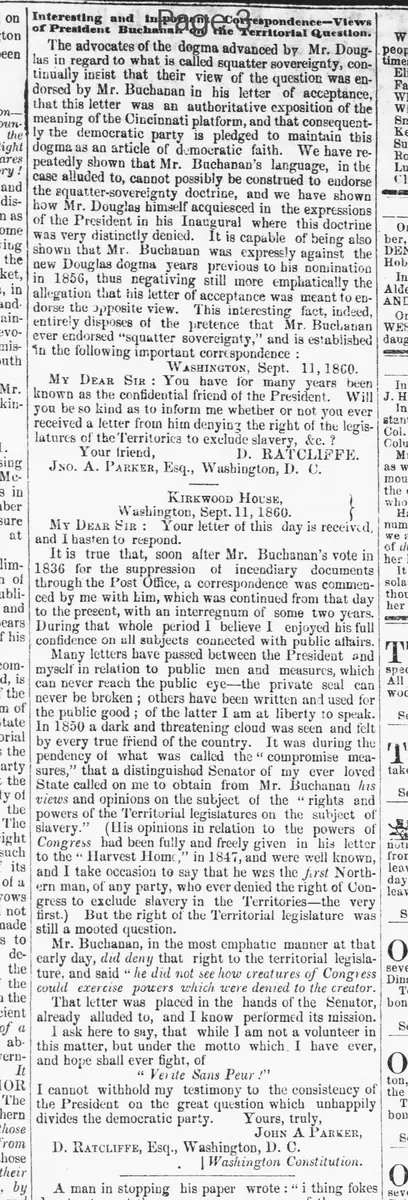
The advocates of the dogma advanced by Mr. Douglas in regard to what is called squatter sovereignty, continually insist that their view of the question was endorsed by Mr. Buchanan in his letter of acceptance, that this letter was an authoritative exposition of the meaning of the Cincinnati platform, and that consequently the democratic party is pledged to maintain this dogma as an article of democratic faith. We have repeatedly shown that Mr. Buchanan's language, in the case alluded to, cannot possibly be construed to endorse the squatter-sovereignty doctrine, and we have shown how Mr. Douglas himself acquiesced in the expressions of the President in his Inaugural where this doctrine was very distinctly denied. It is capable of being also shown that Mr. Buchanan was expressly against the new Douglas dogma years previous to his nomination in 1856, thus negativing still more emphatically the allegation that his letter of acceptance was meant to endorse the opposite view. This interesting fact, indeed, entirely disposes of the pretence that Mr. Buchanan ever endorsed "squatter sovereignty," and is established in the following important correspondence:
WASHINGTON, Sept. 11, 1860.
My Dear Sir: You have for many years been known as the confidential friend of the President. Will you be so kind as to inform me whether or not you ever received a letter from him denying the right of the legislatures of the Territories to exclude slavery, &c.?
Your friend,
D. RATCLIFFE.
Jno. A. Parker, Esq., Washington, D. C.
KIRKWOOD HOUSE, Washington, Sept. 11, 1860.
My Dear Sir: Your letter of this day is received, and I hasten to respond.
It is true that, soon after Mr. Buchanan's vote in 1836 for the suppression of incendiary documents through the Post Office, a correspondence was commenced by me with him, which was continued from that day to the present, with an interregnum of some two years.
During that whole period I believe I enjoyed his full confidence on all subjects connected with public affairs.
Many letters have passed between the President and myself in relation to public men and measures, which can never reach the public eye—the private seal can never be broken; others have been written and used for the public good; of the latter I am at liberty to speak.
In 1850 a dark and threatening cloud was seen and felt by every true friend of the country. It was during the pendency of what was called the "compromise measures," that a distinguished Senator of my ever loved State called on me to obtain from Mr. Buchanan his views and opinions on the subject of the "rights and powers of the Territorial legislatures on the subject of slavery." (His opinions in relation to the powers of Congress had been fully and freely given in his letter to the "Harvest Home," in 1847, and were well known, and I take occasion to say that he was the first Northern man, of any party, who ever denied the right of Congress to exclude slavery in the Territories—the very first.) But the right of the Territorial legislature was still a mooted question.
Mr. Buchanan, in the most emphatic manner at that early day, did deny that right to the territorial legislature, and said "he did not see how creatures of Congress could exercise powers which were denied to the creator."
That letter was placed in the hands of the Senator already alluded to, and I know performed its mission.
I ask here to say, that while I am not a volunteer in this matter, but under the motto which I have ever, and hope shall ever fight, of "Veite Sans Peur!" I cannot withhold my testimony to the consistency of the President on the great question which unhappily divides the democratic party.
Yours, truly,
JOHN A. PARKER,
D. Ratcliffe, Esq., Washington, D. C.
Washington Constitution.
The advocates of the dogma advanced by Mr. Douglas in regard to what is called squatter sovereignty, continually insist that their view of the question was endorsed by Mr. Buchanan in his letter of acceptance, that this letter was an authoritative exposition of the meaning of the Cincinnati platform, and that consequently the democratic party is pledged to maintain this dogma as an article of democratic faith. We have repeatedly shown that Mr. Buchanan's language, in the case alluded to, cannot possibly be construed to endorse the squatter-sovereignty doctrine, and we have shown how Mr. Douglas himself acquiesced in the expressions of the President in his Inaugural where this doctrine was very distinctly denied. It is capable of being also shown that Mr. Buchanan was expressly against the new Douglas dogma years previous to his nomination in 1856, thus negativing still more emphatically the allegation that his letter of acceptance was meant to endorse the opposite view. This interesting fact, indeed, entirely disposes of the pretence that Mr. Buchanan ever endorsed "squatter sovereignty," and is established in the following important correspondence:
WASHINGTON, Sept. 11, 1860.
My Dear Sir: You have for many years been known as the confidential friend of the President. Will you be so kind as to inform me whether or not you ever received a letter from him denying the right of the legislatures of the Territories to exclude slavery, &c.?
Your friend,
D. RATCLIFFE.
Jno. A. Parker, Esq., Washington, D. C.
KIRKWOOD HOUSE, Washington, Sept. 11, 1860.
My Dear Sir: Your letter of this day is received, and I hasten to respond.
It is true that, soon after Mr. Buchanan's vote in 1836 for the suppression of incendiary documents through the Post Office, a correspondence was commenced by me with him, which was continued from that day to the present, with an interregnum of some two years.
During that whole period I believe I enjoyed his full confidence on all subjects connected with public affairs.
Many letters have passed between the President and myself in relation to public men and measures, which can never reach the public eye—the private seal can never be broken; others have been written and used for the public good; of the latter I am at liberty to speak.
In 1850 a dark and threatening cloud was seen and felt by every true friend of the country. It was during the pendency of what was called the "compromise measures," that a distinguished Senator of my ever loved State called on me to obtain from Mr. Buchanan his views and opinions on the subject of the "rights and powers of the Territorial legislatures on the subject of slavery." (His opinions in relation to the powers of Congress had been fully and freely given in his letter to the "Harvest Home," in 1847, and were well known, and I take occasion to say that he was the first Northern man, of any party, who ever denied the right of Congress to exclude slavery in the Territories—the very first.) But the right of the Territorial legislature was still a mooted question.
Mr. Buchanan, in the most emphatic manner at that early day, did deny that right to the territorial legislature, and said "he did not see how creatures of Congress could exercise powers which were denied to the creator."
That letter was placed in the hands of the Senator already alluded to, and I know performed its mission.
I ask here to say, that while I am not a volunteer in this matter, but under the motto which I have ever, and hope shall ever fight, of "Veite Sans Peur!" I cannot withhold my testimony to the consistency of the President on the great question which unhappily divides the democratic party.
Yours, truly,
JOHN A. PARKER,
D. Ratcliffe, Esq., Washington, D. C.
Washington Constitution.
What sub-type of article is it?
Partisan Politics
Constitutional
Slavery Abolition
What keywords are associated?
Squatter Sovereignty
Territorial Question
Buchanan
Douglas
Democratic Party
Slavery Territories
What entities or persons were involved?
Mr. Buchanan
Mr. Douglas
Democratic Party
John A. Parker
D. Ratcliffe
Editorial Details
Primary Topic
Buchanan's Opposition To Squatter Sovereignty
Stance / Tone
Defense Of Buchanan Against Douglas Doctrine
Key Figures
Mr. Buchanan
Mr. Douglas
Democratic Party
John A. Parker
D. Ratcliffe
Key Arguments
Buchanan's Letter Of Acceptance Does Not Endorse Squatter Sovereignty
Buchanan Denied Territorial Legislatures' Right To Exclude Slavery In 1850
Correspondence Confirms Buchanan's Consistent Opposition
Douglas Acquiesced In Buchanan's Inaugural Denial Of The Doctrine