Thank you for visiting SNEWPapers!
Sign up free
Editorial
July 26, 1878
Springfield Weekly Republican
Springfield, Hampden County, Massachusetts
What is this article about?
This editorial discusses relations between labor and capital, praising public provisions for the poor in England and America, urging prompt wage payments by employers, critiquing Gen. Butler's 'rich tramp' rhetoric, and advocating mutual cooperation amid economic hardships.
Clipping
OCR Quality
98%
Excellent
Full Text
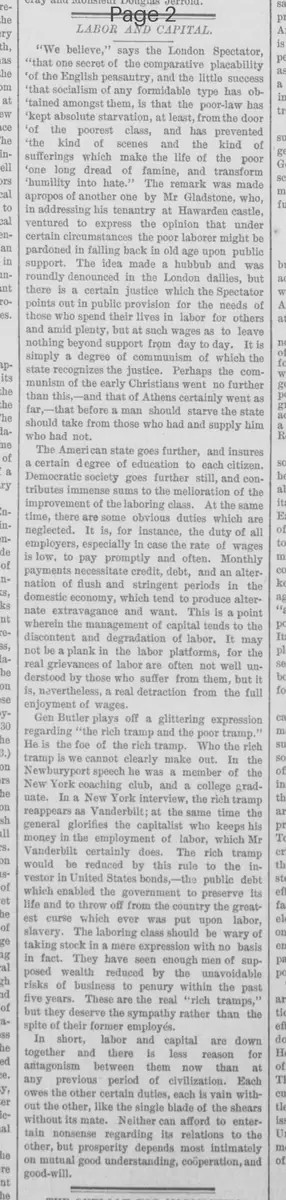
LABOR AND CAPITAL.
"We believe," says the London Spectator, "that one secret of the comparative placability of the English peasantry, and the little success that socialism of any formidable type has obtained amongst them, is that the poor-law has kept absolute starvation, at least, from the door of the poorest class, and has prevented the kind of scenes and the kind of sufferings which make the life of the poor one long dread of famine, and transform humility into hate." The remark was made apropos of another one by Mr. Gladstone, who, in addressing his tenantry at Hawarden castle, ventured to express the opinion that under certain circumstances the poor laborer might be pardoned in falling back in old age upon public support. The idea made a hubbub and was roundly denounced in the London dailies, but there is a certain justice which the Spectator points out in public provision for the needs of those who spend their lives in labor for others and amid plenty, but at such wages as to leave nothing beyond support from day to day. It is simply a degree of communism of which the state recognizes the justice. Perhaps the communism of the early Christians went no further than this,—and that of Athens certainly went as far.—that before a man should starve the state should take from those who had and supply him who had not.
The American state goes further, and insures a certain degree of education to each citizen. Democratic society goes further still, and contributes immense sums to the melioration of the improvement of the laboring class. At the same time, there are some obvious duties which are neglected. It is, for instance, the duty of all employers, especially in case the rate of wages is low, to pay promptly and often. Monthly payments necessitate credit, debt, and an alternation of flush and stringent periods in the domestic economy, which tend to produce alternate extravagance and want. This is a point wherein the management of capital tends to the discontent and degradation of labor. It may not be a plank in the labor platforms, for the real grievances of labor are often not well understood by those who suffer from them, but it is, nevertheless, a real detraction from the full enjoyment of wages.
Gen. Butler plays off a glittering expression regarding "the rich tramp and the poor tramp." He is the foe of the rich tramp. Who the rich tramp is we cannot clearly make out. In the Newburyport speech he was a member of the New York coaching club, and a college graduate. In a New York interview, the rich tramp reappears as Vanderbilt; at the same time the general glorifies the capitalist who keeps his money in the employment of labor, which Mr. Vanderbilt certainly does. The rich tramp would be reduced by this rule to the investor in United States bonds,—the public debt which enabled the government to preserve its life and to throw off from the country the greatest curse which ever was put upon labor, slavery. The laboring class should be wary of taking stock in a mere expression with no basis in fact. They have seen enough men of supposed wealth reduced by the unavoidable risks of business to penury within the past five years. These are the real "rich tramps," but they deserve the sympathy rather than the spite of their former employes.
In short, labor and capital are down together and there is less reason for antagonism between them now than at any previous period of civilization. Each owes the other certain duties, each is vain without the other, like the single blade of the shears without its mate. Neither can afford to entertain nonsense regarding its relations to the other, but prosperity depends most intimately on mutual good understanding, co-operation, and good-will.
"We believe," says the London Spectator, "that one secret of the comparative placability of the English peasantry, and the little success that socialism of any formidable type has obtained amongst them, is that the poor-law has kept absolute starvation, at least, from the door of the poorest class, and has prevented the kind of scenes and the kind of sufferings which make the life of the poor one long dread of famine, and transform humility into hate." The remark was made apropos of another one by Mr. Gladstone, who, in addressing his tenantry at Hawarden castle, ventured to express the opinion that under certain circumstances the poor laborer might be pardoned in falling back in old age upon public support. The idea made a hubbub and was roundly denounced in the London dailies, but there is a certain justice which the Spectator points out in public provision for the needs of those who spend their lives in labor for others and amid plenty, but at such wages as to leave nothing beyond support from day to day. It is simply a degree of communism of which the state recognizes the justice. Perhaps the communism of the early Christians went no further than this,—and that of Athens certainly went as far.—that before a man should starve the state should take from those who had and supply him who had not.
The American state goes further, and insures a certain degree of education to each citizen. Democratic society goes further still, and contributes immense sums to the melioration of the improvement of the laboring class. At the same time, there are some obvious duties which are neglected. It is, for instance, the duty of all employers, especially in case the rate of wages is low, to pay promptly and often. Monthly payments necessitate credit, debt, and an alternation of flush and stringent periods in the domestic economy, which tend to produce alternate extravagance and want. This is a point wherein the management of capital tends to the discontent and degradation of labor. It may not be a plank in the labor platforms, for the real grievances of labor are often not well understood by those who suffer from them, but it is, nevertheless, a real detraction from the full enjoyment of wages.
Gen. Butler plays off a glittering expression regarding "the rich tramp and the poor tramp." He is the foe of the rich tramp. Who the rich tramp is we cannot clearly make out. In the Newburyport speech he was a member of the New York coaching club, and a college graduate. In a New York interview, the rich tramp reappears as Vanderbilt; at the same time the general glorifies the capitalist who keeps his money in the employment of labor, which Mr. Vanderbilt certainly does. The rich tramp would be reduced by this rule to the investor in United States bonds,—the public debt which enabled the government to preserve its life and to throw off from the country the greatest curse which ever was put upon labor, slavery. The laboring class should be wary of taking stock in a mere expression with no basis in fact. They have seen enough men of supposed wealth reduced by the unavoidable risks of business to penury within the past five years. These are the real "rich tramps," but they deserve the sympathy rather than the spite of their former employes.
In short, labor and capital are down together and there is less reason for antagonism between them now than at any previous period of civilization. Each owes the other certain duties, each is vain without the other, like the single blade of the shears without its mate. Neither can afford to entertain nonsense regarding its relations to the other, but prosperity depends most intimately on mutual good understanding, co-operation, and good-will.
What sub-type of article is it?
Labor
Economic Policy
Social Reform
What keywords are associated?
Labor Capital Relations
Public Support Poor
Employer Duties
Wage Payments
Rich Tramp
Mutual Cooperation
What entities or persons were involved?
London Spectator
Mr. Gladstone
Gen. Butler
Vanderbilt
Editorial Details
Primary Topic
Relations Between Labor And Capital
Stance / Tone
Advocating Mutual Cooperation And Good Will
Key Figures
London Spectator
Mr. Gladstone
Gen. Butler
Vanderbilt
Key Arguments
Public Provision Prevents Starvation And Socialism Among The Poor
State Support For Laborers In Old Age Is Just
Employers Should Pay Wages Promptly To Avoid Debt And Discontent
Critique Of 'Rich Tramp' Rhetoric As Baseless
Labor And Capital Are Interdependent And Should Cooperate