Thank you for visiting SNEWPapers!
Sign up free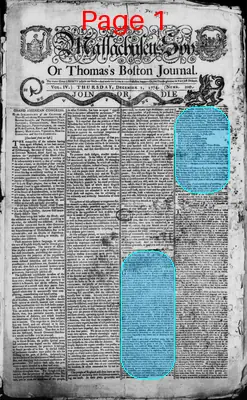
Story
December 1, 1774
The Massachusetts Spy, Or, Thomas's Boston Journal
Boston, Suffolk County, Massachusetts
What is this article about?
Character sketch of General Gage from Pennsylvania Packet, praising his private virtues while condemning his court education and the corrupt British influence that led him to an unpopular military role in the colonies.
Clipping
OCR Quality
95%
Excellent
Full Text
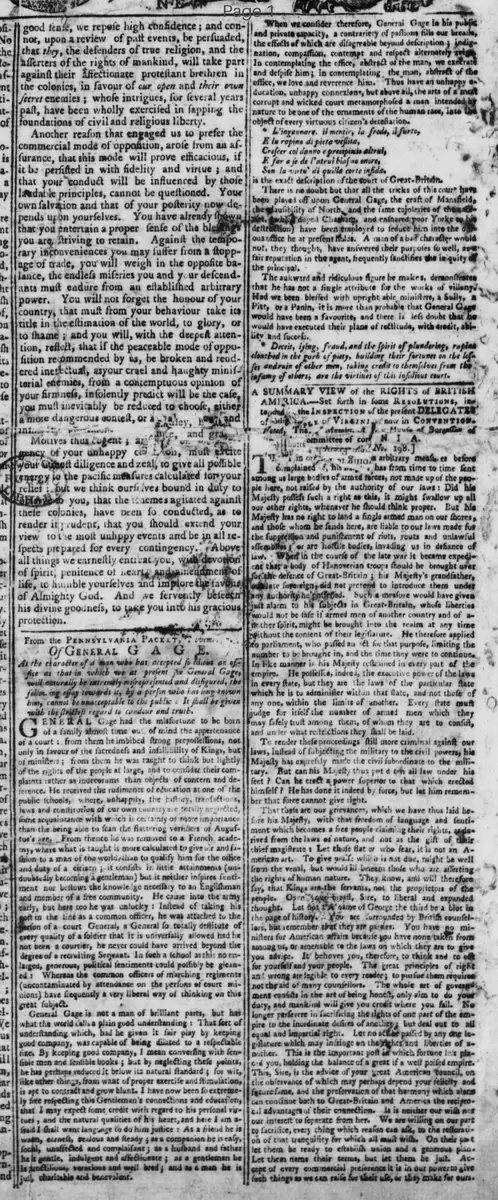
From the PENNSYLVANIA PACKET.
Of GENERAL GAGE.
As the character of a man who has accepted so odious an office as that in which we at present see General Gage, will naturally be extremely misrepresented and disfigured, the following essay towards it, by a person who has long known him, cannot be unacceptable to the public: It shall be given with the strictest regard to candour and truth.
GENERAL Gage had the misfortune to be born of a family almost time out of mind the appendage of a court: from them he imbibed strong prepossessions, not only in favour of the sacredness and infallibility of Kings, but of ministers; from them he was taught to think but lightly of the rights of the people at large, and to consider their complaints rather as indecorum than objects of concern and deference. He received the rudiments of education at one of the public schools, where, unhappily, the history, transactions, laws and constitution of our own country are totally neglected, some acquaintance with which is certainly of more importance than the being able to scan the flattering versifiers of Augustus's age. From thence he was removed to a French academy, where what is taught is more calculated to give air and fashion to a man of the world, than to qualify him for the office and duty of a citizen;—it consists in little attainments (undoubtedly becoming a gentleman) but it neither inspires sentiment nor bestows the knowledge necessary to an Englishman and member of a free community. He came into the army early, but here too he was unlucky: Instead of taking his most in the line as a common officer, he was attached to the train of a court General, a General so totally destitute of every quality of a soldier that it is universally allowed had he not been a courtier, he never could have arrived beyond the degree of a recruiting Serjeant. In such a school as this no enlarged, generous, political sentiments could possibly be gleaned: Whereas the common officers of marching regiments (uncontaminated by attendance on the persons of court minions) have frequently a very liberal way of thinking on this great subject.
General Gage is not a man of brilliant parts, but has what the world calls a plain good understanding: That sort of understanding which, had he given it fair play by keeping good company, was capable of being dilated to a respectable size. By keeping good company, I mean conversing with sensible men and sensible books; but by neglecting these points, he has perhaps reduced it below its natural standard; for wit, like other things, from want of proper exercise and stimulation, is apt to contract and grow blunt. I have now been so extremely free respecting this Gentleman's connections and education, that I may expect some credit with regard to his personal virtues, and the natural qualities of his heart, and here I am afraid I shall want language to do him justice: As a friend he is warm, earnest, zealous and steady; as a companion he is easy, social, unaffected and complaisant; as a husband and father he is gentle, indulgent and affectionate; as a gentleman he is punctilious, veracious and well bred; and as a man he is just, charitable and benevolent.
When we consider therefore, General Gage in his public and private capacity, a contrariety of passions fills our breast, the effects of which are disagreeable beyond description: indignation, compassion, contempt and respect alternately reign. In contemplating the office, abstract of the man, we execrate and despise him; in contemplating the man, abstract of the office, we love, and reverence him. Thus have an unhappy education, unhappy connexions, but above all, the arts of a most corrupt and wicked court metamorphosed a man intended by nature to be one of the ornaments of the human race, into the object of every virtuous citizen's detestation.
L'ingannare. il mentir, la frode, il furto,
E la rapina di pieta vestita,
Crescer col danno e precipizio altrui,
E far a se de l'altrui biasmo onore,
Son la vertu di quella corte infida
is the exact description of the court of Great-Britain.
There is no doubt but that all the tricks of this court have been played off upon General Gage, the craft of Mansfield, the plausibility of North, and the same cajoleries of Thurlow (which duped Chatham, and ensnared poor Yorke to his destruction) have been employed to seduce him into the odious office he at present holds. A man of a bad character would not, they thought, have answered their purposes so well, as fair reputation in the agent, frequently sanctifies the iniquity of the principal.
The awkward and ridiculous figure he makes, demonstrates that he has not a single attribute for the work of villainy. Had we been blessed with upright able ministers, a Sully, a Pitt, or a Pancirol, it is more than probable that General Gage would have been a favourite, and there is less doubt that he would have executed their plans of rectitude, with credit, ability and success.
Deceit, lying, fraud, and the spirit of plundering, rapine cloathed in the garb of piety, building their fortunes on the losses and ruin of other men, taking credit to themselves from the infamy of others; are the virtues of this insidious court.
Of GENERAL GAGE.
As the character of a man who has accepted so odious an office as that in which we at present see General Gage, will naturally be extremely misrepresented and disfigured, the following essay towards it, by a person who has long known him, cannot be unacceptable to the public: It shall be given with the strictest regard to candour and truth.
GENERAL Gage had the misfortune to be born of a family almost time out of mind the appendage of a court: from them he imbibed strong prepossessions, not only in favour of the sacredness and infallibility of Kings, but of ministers; from them he was taught to think but lightly of the rights of the people at large, and to consider their complaints rather as indecorum than objects of concern and deference. He received the rudiments of education at one of the public schools, where, unhappily, the history, transactions, laws and constitution of our own country are totally neglected, some acquaintance with which is certainly of more importance than the being able to scan the flattering versifiers of Augustus's age. From thence he was removed to a French academy, where what is taught is more calculated to give air and fashion to a man of the world, than to qualify him for the office and duty of a citizen;—it consists in little attainments (undoubtedly becoming a gentleman) but it neither inspires sentiment nor bestows the knowledge necessary to an Englishman and member of a free community. He came into the army early, but here too he was unlucky: Instead of taking his most in the line as a common officer, he was attached to the train of a court General, a General so totally destitute of every quality of a soldier that it is universally allowed had he not been a courtier, he never could have arrived beyond the degree of a recruiting Serjeant. In such a school as this no enlarged, generous, political sentiments could possibly be gleaned: Whereas the common officers of marching regiments (uncontaminated by attendance on the persons of court minions) have frequently a very liberal way of thinking on this great subject.
General Gage is not a man of brilliant parts, but has what the world calls a plain good understanding: That sort of understanding which, had he given it fair play by keeping good company, was capable of being dilated to a respectable size. By keeping good company, I mean conversing with sensible men and sensible books; but by neglecting these points, he has perhaps reduced it below its natural standard; for wit, like other things, from want of proper exercise and stimulation, is apt to contract and grow blunt. I have now been so extremely free respecting this Gentleman's connections and education, that I may expect some credit with regard to his personal virtues, and the natural qualities of his heart, and here I am afraid I shall want language to do him justice: As a friend he is warm, earnest, zealous and steady; as a companion he is easy, social, unaffected and complaisant; as a husband and father he is gentle, indulgent and affectionate; as a gentleman he is punctilious, veracious and well bred; and as a man he is just, charitable and benevolent.
When we consider therefore, General Gage in his public and private capacity, a contrariety of passions fills our breast, the effects of which are disagreeable beyond description: indignation, compassion, contempt and respect alternately reign. In contemplating the office, abstract of the man, we execrate and despise him; in contemplating the man, abstract of the office, we love, and reverence him. Thus have an unhappy education, unhappy connexions, but above all, the arts of a most corrupt and wicked court metamorphosed a man intended by nature to be one of the ornaments of the human race, into the object of every virtuous citizen's detestation.
L'ingannare. il mentir, la frode, il furto,
E la rapina di pieta vestita,
Crescer col danno e precipizio altrui,
E far a se de l'altrui biasmo onore,
Son la vertu di quella corte infida
is the exact description of the court of Great-Britain.
There is no doubt but that all the tricks of this court have been played off upon General Gage, the craft of Mansfield, the plausibility of North, and the same cajoleries of Thurlow (which duped Chatham, and ensnared poor Yorke to his destruction) have been employed to seduce him into the odious office he at present holds. A man of a bad character would not, they thought, have answered their purposes so well, as fair reputation in the agent, frequently sanctifies the iniquity of the principal.
The awkward and ridiculous figure he makes, demonstrates that he has not a single attribute for the work of villainy. Had we been blessed with upright able ministers, a Sully, a Pitt, or a Pancirol, it is more than probable that General Gage would have been a favourite, and there is less doubt that he would have executed their plans of rectitude, with credit, ability and success.
Deceit, lying, fraud, and the spirit of plundering, rapine cloathed in the garb of piety, building their fortunes on the losses and ruin of other men, taking credit to themselves from the infamy of others; are the virtues of this insidious court.
What sub-type of article is it?
Biography
Historical Event
What themes does it cover?
Deception
Misfortune
Moral Virtue
What keywords are associated?
General Gage
Character Sketch
British Court
Personal Virtues
Political Corruption
What entities or persons were involved?
General Gage
Story Details
Key Persons
General Gage
Story Details
An essay sketching General Gage's character, highlighting his noble personal virtues contrasted with his unfortunate court-influenced education and prejudices, leading him to accept an odious office; criticizes the corrupt British court for seducing him into villainy despite his natural goodness.