Thank you for visiting SNEWPapers!
Sign up free
The Western Democrat
Charlotte, Mecklenburg County, North Carolina
What is this article about?
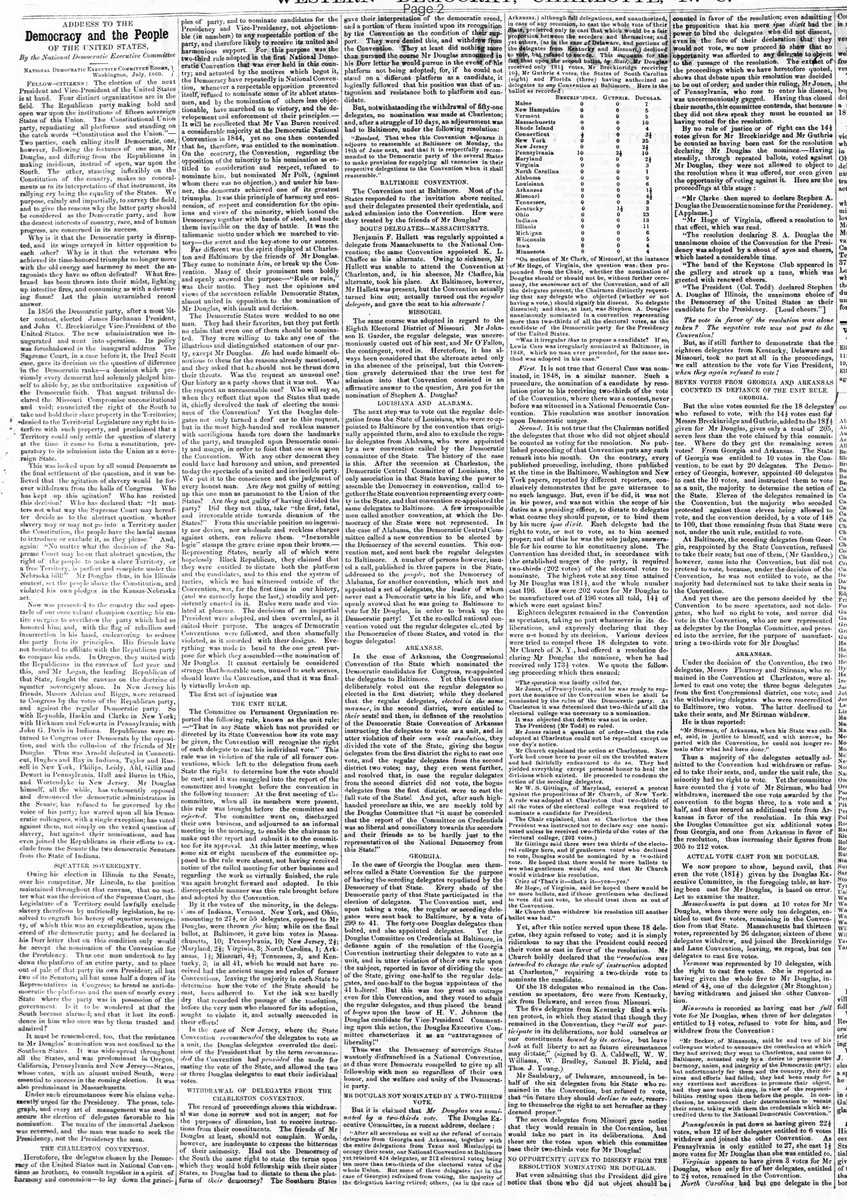
In July 1860, the National Democratic Executive Committee addresses the public, defending the southern Democratic faction against Stephen A. Douglas's supporters. It criticizes Douglas's 'squatter sovereignty' doctrine, details procedural irregularities and secessions at the Charleston and Baltimore conventions, and argues Douglas was not nominated by a two-thirds vote, urging support for the true Democratic party to preserve Union and southern rights.
Merged-components note: The table at reading_order 39 provides vote counts that are integral to the editorial address at reading_order 38, forming a single logical component.
Clipping
OCR Quality
Full Text
Democracy and the People
OF THE UNITED STATES,
By the National Democratic Executive Committee.
National Democratic Executive Committee Rooms,
Washington, July, 1860.
Fellow-Citizens: The election of the next President and Vice-President of the United States is at hand. Four distinct organizations are in the field. The Republican party making bold and open war upon the institutions of fifteen sovereign States of this Union. The Constitutional Union party, repudiating all platforms and standing on the catch words "Constitution and the Union." Two parties, each calling itself Democratic, one, however, following the fortunes of one man. Mr. Douglas, and differing from the Republicans in making insidious, instead of open, war upon the South. The other, standing inflexibly on the Constitution of the country, makes no concealments as to its interpretation of that instrument, its rallying cry being the equality of the States. We purpose, calmly and impartially, to survey the field, and to give the reasons why the latter party should be considered as the Democratic party, and how the dearest interests of country, race, and of human progress, are concerned in its success.
Why is it that the Democratic party is disrupted, and its wings arrayed in bitter opposition to each other? Why is it that the veterans who achieved its time-honored triumphs no longer move with the old energy and harmony to meet the antagonists they have so often defeated? What firebrand has been thrown into their midst, lighting up intestine fires, and consuming as with a devouring flame? Let the plain unvarnished record answer.
In 1856 the Democratic party, after a most bitter contest, elected James Buchanan President, and John C. Breckinridge Vice-President of the United States. The new administration was inaugurated and went into operation. Its policy was foreshadowed in the inaugural address. The Supreme Court, in a case before it, the Dred Scott case, gave its decision on the question of difference in the Democratic ranks—a decision which previously every Democrat had solemnly pledged himself to abide by, as the authoritative exposition of the Democratic faith. That august tribunal declared the Missouri Compromise unconstitutional and void; enunciated the right of the South to take and hold their slave property in the Territories; denied to the Territorial Legislature any right to interfere with such property, and proclaimed that a Territory could only settle the question of slavery at the time it came to form a constitution, preparatory to its admission into the Union as a sovereign State.
This was looked upon by all sound Democrats as the final settlement of the question, and it was believed that the agitation of slavery would be forever withdrawn from the halls of Congress. Who has kept up this agitation? Who has resisted this decision? Who has declared that: "It matters not what way the Supreme Court may hereafter decide as to the abstract question, whether slavery may or may not go into a Territory under the Constitution, the people have the lawful means to introduce or exclude it, as they please." And, again: "No matter what the decision of the Supreme Court may be on that abstract question, the right of the people to make a slave Territory, or a free Territory, is perfect and complete under the Nebraska bill?" Mr. Douglas thus, in his Illinois contest, set the people above the Constitution, and violated his own pledges in the Kansas-Nebraska act.
Now was presented to the country the sad spectacle of our once valiant champion exerting his entire energies to overthrow the party which had so honored him; and, with the flag of rebellion and insurrection in his hand, endeavoring to seduce the party from its principles. His friends have not hesitated to affiliate with the Republican party to compass his ends. In Oregon, they united with the Republicans in the canvass of last year and this, and Mr. Logan, the leading Republican of that State, fought the canvass on the doctrine of squatter sovereignty alone. In New Jersey his friends, Messrs. Adrian and Riggs, were returned to Congress by the votes of the Republican party, and against the regular Democratic party. So with Reynolds, Haskin and Clarke in New York; with Hickman and Schwartz in Pennsylvania; with John G. Davis in Indiana. Republicans were returned to Congress over Democrats by the opposition, and with the collusion of the friends of Mr. Douglas. Thus was Arnold defeated in Connecticut, Hughes and Ray in Indiana, Taylor and Russell in New York, Philips, Leidy, Ahl, Gillis and Dewart in Pennsylvania, Hall and Burns in Ohio, and Wortendyke in New Jersey. Mr. Douglas himself, all the while, has vehemently opposed and denounced the Democratic administration in the Senate; has refused to be governed by the voice of his party; has warred upon all his Democratic colleagues, with a single exception; has voted against them, not simply on the vexed question of slavery, but against their nominations, and has even joined the Republicans in their efforts to exclude from the Senate the two Democratic Senators from the State of Indiana.
SQUATTER SOVEREIGNTY.
Owing his election in Illinois to the Senate over his competitor, Mr. Lincoln, to the position maintained throughout that canvass, that no matter what was the decision of the Supreme Court, the Legislature of a Territory could lawfully exclude slavery therefrom by unfriendly legislation, he resolved to engraft his heresy of squatter sovereignty, of which this was an exemplification, upon the creed of the Democratic party: and he declared in his Dorr letter that on this condition only would he accept the nomination of the Convention for the Presidency. Thus one man undertook to lay down the platform of an entire party, and to place out of pale of that party its own President; all but two of its Senators; all but some half a dozen of its Representatives in Congress; to brand as anti-Democratic the platforms and the men of nearly every State where the party was in possession of the government. Is it to be wondered at that the South became alarmed; and that it lost its confidence in him who once was by them trusted and admired?
It must be remembered, too, that the resistance to Mr. Douglas' nomination was not confined to the Southern States. It was wide-spread throughout all the States, and was predominant in Oregon, California, Pennsylvania and New Jersey—States, whose votes, with an almost united South, were essential to success in the coming election. It was also predominant in Massachusetts.
Under such circumstances were his claims vehemently urged for the Presidency. The press, telegraph, and every art of management was used to secure the election of delegates favorable to his nomination. The maxim of the immortal Jackson was reversed, and the man was made to seek the Presidency, not the Presidency the man.
THE CHARLESTON CONVENTION.
Heretofore, the delegates chosen by the Democracy of the United States met in National Conventions as brothers, to consult together in a spirit of harmony and concession—to lay down the principles of party, and to nominate candidates for the Presidency and Vice-Presidency, not objectionable (in numbers) to any respectable portion of the party, and therefore likely to receive its united and harmonious support. For this purpose was the two-third rule adopted in the first National Democratic Convention that was ever held in this country; and actuated by the motives which begot it, the Democracy have repeatedly in National Convention, whenever a respectable opposition presented itself, refused to nominate some of its ablest statesmen, and by the nomination of others less objectionable, have marched on to victory, and the development and enforcement of their principles.
It will be recollected that Mr. Van Buren received a considerable majority at the Democratic National Convention in 1844, yet no one then contended that he, therefore, was entitled to the nomination. On the contrary, the Convention, regarding the opposition of the minority to his nomination as entitled to consideration and respect, refused to nominate him, but nominated Mr. Polk, (against whom there was no objection,) and under his banner, the Democrats achieved one of its greatest triumphs. It was this principle of harmony and concession, of respect and consideration for the opinions and views of the minority, which bound the Democracy together with bands of steel, and made them invincible on the day of battle. It was the talismanic motto under which we marched to victory—the secret and the key-stone to our success.
Far different was the spirit displayed at Charleston and Baltimore by the friends of Mr. Douglas. They came to nominate him, or break up the Convention. Many of their prominent men boldly and openly avowed the purpose—"Rule or ruin." was their motto. They met the opinions and views of the seventeen reliable Democratic States, almost united in opposition to the nomination of Mr. Douglas, with insult and derision.
The Democratic States were wedded to no one man. They had their favorites, but they put forth no claim that even one of them should be nominated. They were willing to take any one of the illustrious and distinguished statesmen of our party, except Mr. Douglas. He had made himself obnoxious to them for the reasons already mentioned, and they asked that he should not be thrust down their throats. Was the request an unusual one? Our history as a party shows that it was not. Was the request an unreasonable one? Who will say so, when they reflect that upon the States that made it, chiefly devolved the task of electing the nominees of the Convention? Yet the Douglas delegates not only turned a deaf ear to this request but in the most high-handed and reckless manner with sacrilegious hands tore down the landmarks of the party, and trampled upon Democratic comity and usages, in order to foist that one man upon the Convention. With any other Democrat they could have had harmony and union, and presented to-day the spectacle of a united and invincible party.
We put it to the conscience and the judgment of every honest man. Are they not guilty of setting up this one man as paramount to the Union of the States? Are they not guilty of having divided the party? Did they not thus, take the first, fatal, and irrevocable stride towards disunion of the States? From this unenviable position no ingenuity nor device, nor wholesale and reckless charges against others, can relieve them. "Inexorable logic" stamps the grave crime upon their brows.
Representing States, nearly all of which were hopelessly Black Republican, they claimed that they were entitled to dictate both the platform and the candidates, and to this end the system of tactics, which we had witnessed outside of the Convention, was, for the first time in our history (and we earnestly hope the last,) steadily and persistently enacted in it. Rules were made and violated at pleasure. The decisions of an impartial President were adopted, and then overruled, as it suited their purpose. The usages of Democratic Conventions were followed, and then shamefully violated, as it accorded with their designs. Everything was made to bend to the one great purpose for which they assembled—the nomination of Mr. Douglas. It cannot certainly be considered strange that honorable men, unused to such scenes should leave the Convention, and that it was finally virtually broken up.
The first act of injustice was
THE UNIT RULE
The Committee on Permanent Organization reported the following rule, known as the unit rule:
"That in any State which has not provided or directed by its State Convention how its vote may be given, the Convention will recognize the right of each delegate to cast his individual vote." This rule was in violation of the rule of all former conventions, which left to the delegation from each State the right to determine how the vote should be cast; and it was smuggled into the report of the committee and brought before the convention in the following manner: At the first meeting of the committee, when all its members were present this rule was brought before the committee and rejected. The committee went on, discharged their own business, and adjourned to an informal meeting in the morning, to enable the chairman to make out the report and submit it to the committee for its approval. At this latter meeting, when some six or eight members of the committee opposed to the rule were absent, not having received notice of the called meeting for other business and regarding the work as virtually finished, the rule was again brought forward and adopted. In this disrespectable manner was this rule brought before and adopted by the Convention.
By it the votes of the minority, in the delegations of Indiana, Vermont, New York, and Ohio, amounting to 27, or 55 delegates, opposed to Mr. Douglas, were thrown for him; while on the final ballot, at Baltimore, it gave him votes in Massachusetts, 10; Pennsylvania, 10; New Jersey, 2; Maryland, 24; Virginia, 3; North Carolina, 1; Arkansas, 1; Missouri, 4; Tennessee, 3, and Kentucky, 3; in all 41, which he would not have received had the ancient usages and rules of former Conventions, leaving the majority in each State to determine how the vote of the State should be cast, been adhered to. Yet the ink was hardly dry that recorded the passage of the resolution, before the very men who clamored for its adoption, sought to violate it, and actually succeeded in their efforts!
In the case of New Jersey, where the State Convention recommended the delegates to vote as a unit, the Douglas delegates overruled the decision of the President that by the term recommended the Convention had provided the mode for casting the vote of the State, and allowed the two or three Douglas delegates to cast their individual votes.
WITHDRAWAL OF DELEGATES FROM THE CHARLESTON CONVENTION
The record of proceedings shows this withdrawal was done in sorrow and not in anger; not for the purposes of disunion, but to receive instructions from their constituents. The friends of Mr. Douglas at least, should not complain. Words, however, are inadequate to express the bitterness of their animosity. "Had not the Democracy of the South the same right to state the terms upon which they would hold fellowship with their sister States, as Douglas had to dictate to them the platform of their democracy? The Southern States gave their interpretation of the Democratic creed, and a portion of them insisted upon its recognition by the Convention as the condition of their support. They were denied this, and withdrew from the Convention. They at least did nothing more than pursued the course Mr. Douglas announced in his Dorr letter he would pursue in the event of his platform not being adopted; for, if he could not stand on a different platform as a candidate, it logically followed that his position was that of antagonism and resistance both to platform and candidate.
But, notwithstanding the withdrawal of fifty-one delegates, no nomination was made at Charleston; and, after a struggle of 10 days, an adjournment was had to Baltimore, under the following resolution:
"Resolved, That when this Convention adjourns it adjourn to reassemble at Baltimore on Monday, the 18th of June next, and that it is respectfully recommended to the Democratic party of the several States to make provision for supplying all vacancies in their respective delegations to the Convention when it shall reassemble."
BALTIMORE CONVENTION.
The Convention met at Baltimore. Most of the States responded to the invitation above recited, and their delegates presented their credentials, and asked admission into the Convention. How were they treated by the friends of Mr. Douglas?
BOGUS DELEGATES—MASSACHUSETTS.
Benjamin F. Hallett was regularly appointed a delegate from Massachusetts to the National Convention; the same Convention appointed K. L. Chaffee as his alternate. Owing to sickness, Mr. Hallett was unable to attend the Convention at Charleston, and, in his absence, Mr. Chaffee, his alternate, took his place. At Baltimore, however Mr. Hallett was present, but the Convention actually turned him out; actually turned out the regular delegate, and gave the seat to his alternate!
MISSOURI.
The same course was adopted in regard to the Eighth Electoral District of Missouri. Mr. Johnson B. Garden, the regular delegate, was unceremoniously ousted out of his seat, and Mr. O'Fallon, the contingent, voted in. Heretofore, it has always been considered that the alternate acted only in the absence of the principal, but this Convention gravely determined that the true test for admission into that Convention consisted in an affirmative answer to the question, Are you for the nomination of Stephen A. Douglas?
LOUISIANA AND ALABAMA.
The next step was to vote out the regular delegation from the State of Louisiana, who were re-appointed to Baltimore by the convention that originally appointed them, and also to exclude the regular delegates from Alabama, who were appointed by a new convention called by the Democratic committee of the State. The history of the case is this. After the secession at Charleston, the Democratic Central Committee of Louisiana, the only association in that State having the power to assemble the Democracy in convention, called together the State convention representing every county in the State, and that convention re-appointed the same delegates to Baltimore. A few irresponsible men called another convention, at which the Democracy of the State were not represented. In the case of Alabama, the Democratic Central Committee called a new convention to be elected by the Democracy of the several counties. This convention met, and sent back the regular delegates to Baltimore. A number of persons however, issued a call, published in three papers in the State, addressed to the people, not the Democracy of Alabama, for another convention, which met and appointed a set of delegates, the leader of whom never cast a Democratic vote in his life, and who openly avowed that he was going to Baltimore to vote for Mr. Douglas, in order to break up the Democratic party! Yet the so-called national convention voted out the regular delegates elected by the Democracies of these States, and voted in the bogus delegates!
ARKANSAS.
In the case of Arkansas, the Congressional Convention of the State which nominated the Democratic candidates for Congress, re-appointed the delegates to Baltimore. Yet this Convention deliberately voted out the regular delegates so elected in the first district; while they declared that the regular delegates, elected in the same manner, in the second district, were entitled to their seats! and then, in defiance of the resolution of the Democratic State Convention of Arkansas instructing the delegates to vote as a unit, and in utter violation of their own unit resolution, they divided the vote of the State, giving the bogus delegates from the first district the right to cast one vote, and the regular delegates from the second district two votes; nay, they even went further, and resolved that, in case the regular delegates from the second district did not vote, the bogus delegates from the first district, were to cast the full vote of the State! And yet, after such high-handed procedure as this, we are meekly told by the Douglas Committee that "it must be conceded that the report of the Committee on Credentials was so liberal and conciliatory towards the seceders and their friends as to be hardly just to the representatives of the National Democracy from this State!"
GEORGIA.
In the case of Georgia the Douglas men themselves called a State Convention for the purpose of having the seceding delegates repudiated by the Democracy of that State. Every shade of the Democratic party of that State participated in the election of delegates. The Convention met, and upon taking a vote, the regular or seceding delegates were sent back to Baltimore, by a vote of 299 to 41. The forty-one Douglas delegates then bolted, and also appointed delegates. Yet the Douglas Committee on Credentials at Baltimore, in defiance again of the resolution of the Georgia Convention instructing their delegates to vote as a unit, and in utter violation of their own rule upon the subject, reported in favor of dividing the vote of the State, giving one-half to the regular delegates, and one-half to the bogus appointees of the 41 bolters! But this was too great an outrage even for this Convention, and they voted to admit the regular delegates, and thus placed the brand of bogus upon the brow of H. V. Johnson the Douglas candidate for Vice-President! Commenting upon this action, the Douglas Executive Committee characterizes it as an extravagance of liberality!
Thus was the Democracy of sovereign States wantonly disfranchised in a National Convention, and thus were Democrats compelled to give up all fellowship with men so regardless of their own honor, and the welfare and unity of the Democratic party.
MR. DOUGLAS NOT NOMINATED BY A TWO-THIRDS VOTE.
But it is claimed that Mr. Douglas was nominated by a two-thirds vote. The Douglas Executive Committee, in a recent address, declare:
"—After all secessions as well as the refusal of certain delegates from Georgia and Arkansas, together with the entire delegations from Texas and Mississippi to occupy their seats, our National Convention at Baltimore yet retained 424 delegates, or 212 electoral votes; being ten more than two-thirds of the electoral votes of the whole Union. But some of these delegates (as in the case of Georgia) refrained from voting, the majority of the delegation having retired; others, (as in the case of Arkansas,) although full delegations, and unauthorized, in case of any secession, to cast the whole vote of their State, preferred only to cast that which would be a fair proportion between the seceders and themselves; and yet others, (as in the case of Delaware, and portions of the delegates from Kentucky and Missouri.) declined to vote, but refused to secede. This accounts for the fact that upon the second ballot, by State, Mr. Douglas received only 181 votes, Mr. Breckinridge receiving 104, Mr. Guthrie 4 votes, the States of South Carolina (eight) and Florida (three) having authorized no delegates to any Convention at Baltimore. Here is the ballot as recorded:
"On motion of Mr. Clark, of Missouri, at the instance of Mr. Hoge, of Virginia, the question was then propounded from the Chair, whether the nomination of Douglas should or should not be, without further ceremony, the unanimous act of the Convention, and of all the delegates present; the Chairman distinctly requesting that any delegate who objected (whether or not having a vote,) should signify his dissent. No delegate dissented; and thus, at last, was Stephen A. Douglas unanimously nominated in a convention representing more than two-thirds of all the electoral votes, as the candidate of the Democratic party for the Presidency of the United States.
"Was it irregular thus to propose a candidate? If so, Lewis Cass was irregularly nominated at Baltimore, in 1848, which no man ever pretended, for the same method was adopted in his case."
First. It is not true that General Cass was nominated, in 1848, in a similar manner. Such a procedure, the nomination of a candidate by resolution prior to his receiving two-thirds of the vote of the Convention, where there was a contest, never before was witnessed in a National Democratic Convention. This resolution was another innovation upon Democratic usages.
Second. It is not true that the Chairman notified the delegates that those who did not object should be counted as voting for the resolution. No published proceeding of that Convention puts any such remark into his mouth. On the contrary, every published proceeding, including those published at the time in the Baltimore, Washington and New York papers, reported by different reporters, conclusively demonstrates that he gave utterance to no such language. But, even if he did, it was not in his power, and was not within the scope of his duties as a presiding officer, to dictate to delegates what course they should pursue, or to bind them by his mere ipse dixit. Each delegate had the right to vote, or not to vote, as to him seemed proper; and of this he was the sole judge, answerable for his course to his constituency alone. The Convention has decided that, in accordance with the established usages of the party, it required two-thirds (202 votes) of the electoral votes to nominate. The highest vote at any time attained by Mr. Douglas was 181, and the whole number cast 196. How were 202 votes for Mr. Douglas to be manufactured out of 196 votes all told, 14 of which were cast against him?
Eighteen delegates remained in the Convention as spectators, taking no part whatsoever in its deliberations, and expressly declaring that they were not bound by its decision. Various devices were tried to compel these 18 delegates to vote. Mr. Church of N. Y., had offered a resolution declaring Mr. Douglas the nominee, when he had received only 173 votes. We quote the following proceeding which then ensued:
"The question was loudly called for.
Mr. Jones, of Pennsylvania, said he was ready to support the nominee of the Convention when he shall be nominated by the rules of the Democratic party. At Charleston it was determined that two-thirds of all the electoral college was necessary to a nomination.
It was objected that debate was not in order.
The President (Mr. Todd) so ruled.
Mr. Jones raised a question of order—that the rule adopted at Charleston could not be repealed except on one day's notice.
Mr. Church explained the action at Charleston. New York had come here to pour oil on the troubled waters and had faithfully endeavored to do so. They had yielded everything except personal honor to heal the divisions which existed. He proceeded to condemn the action of the seceding delegates.
Mr. W. S. Gittings, of Maryland, entered a protest against the propositions of Mr. Church, of New York.
A rule was adopted at Charleston that two-thirds of all the votes of the electoral college was required to nominate a candidate for President.
The Chair explained, that at Charleston the then President was instructed not to declare any one nominated unless he received two-thirds of the votes of the electoral college, (202 votes.)
Mr. Gittings said there were two thirds of the electoral college here, and if gentlemen voted who declined to vote, Douglas would be nominated by a two-third vote. He hoped that there would be more ballots to see what gentlemen would do, and that Mr. Church would withdraw his resolution.
Cries of 'That's it—that's it—yes—yes.'
Mr. Hoge, of Virginia, said he hoped there would be no more ballots, and if those gentlemen who declined to vote did not vote, he should treat them as out of the Convention.
Mr. Church then withdrew his resolution till another ballot was had."
Yet, after this notice served upon these 18 delegates, they again refused to vote; and it is simply ridiculous to say that the President could record their votes as cast in favor of the resolution. Mr. Church boldly declared that the resolution was intended to change the rule of instruction adopted at Charleston, requiring a two-thirds vote to nominate the candidate.
Of the 18 delegates who remained in the Convention as spectators, five were from Kentucky, six from Delaware, and seven from Missouri.
The five delegates from Kentucky filed a written protest, in which they stated that though they remained in the Convention, they "will not participate in its deliberations, nor hold ourselves or our constituents bound by its action, but leave both at full liberty to act as future circumstances may dictate;" (signed by G. A. Caldwell, W. W. Williams, W. Bradley, Samuel B. Field, and Thos. J. Young.)
Mr. Saulsbury, of Delaware, announced, in behalf of the six delegates from his State who remained in the Convention, but refused to vote, that "in future they should decline to vote, reserving to themselves the right to act hereafter as they deemed proper."
The seven delegates from Missouri gave notice that they would remain in the Convention, but would take no part in its deliberations. And these are the votes upon which this committee base their two-thirds vote for Mr. Douglas!
NO OPPORTUNITY GIVEN TO DISSENT FROM THE RESOLUTION NOMINATING MR. DOUGLAS.
But even admitting that the President did give notice that those who did not object should be counted in favor of the resolution; even admitting the proposition that his mere ipse dixit had the power to bind the delegates who did not dissent, even in the face of their declaration that they would not vote, we now proceed to show that no opportunity was afforded to any delegate to object to the passage of the resolution. The extract of the proceedings which we have heretofore quoted, shows that debate upon this resolution was decided to be out of order; and under this ruling, Mr. Jones, of Pennsylvania, who rose to enter his dissent, was unceremoniously gagged. Having thus closed their mouths, this committee contends, that because they did not then speak they must be counted as having voted for the resolution.
By no rule of justice or of right can the 14 votes given for Mr. Breckinridge and Mr. Guthrie be counted as having been cast for the resolution declaring Mr. Douglas the nominee.—Having steadily, through repeated ballots, voted against Mr. Douglas, they were not allowed to object to the resolution when it was offered, nor even given the opportunity of voting against it. Here are the proceedings at this stage:
"Mr. Clarke then moved to declare Stephen A. Douglas the Democratic nominee for the Presidency [Applause.]
"Mr. Hoge of Virginia, offered a resolution to that effect, which was read.
"The resolution declaring S. A. Douglas the unanimous choice of the Convention for the Presidency was adopted by a shout of ayes and cheers, which lasted a considerable time.
"The band of the Keystone Club appeared in the gallery and struck up a tune, which was greeted with renewed cheers.
"The President (Col. Todd) declared Stephen A. Douglas of Illinois, the unanimous choice of the Democracy of the United States as their candidate for the Presidency. [Loud cheers.]"
The vote in favor of the resolution was alone taken? The negative vote was not put to the Convention!
But, as if still further to demonstrate that the eighteen delegates from Kentucky, Delaware and Missouri, took no part at all in the proceedings, we call attention to the vote for Vice President, when they again refused to vote!
SEVEN VOTES FROM GEORGIA AND ARKANSAS COUNTED IN DEFIANCE OF THE UNIT RULE.
GEORGIA.
But the nine votes counted for the 18 delegates who refused to vote, with the 14 votes cast for Messrs. Breckinridge and Guthrie, added to the 181 given for Mr. Douglas, gives only a total of 205—seven less than the vote claimed by this committee. Where do they get the remaining seven votes? From Georgia and Arkansas. The State of Georgia was entitled to 10 votes in the Convention, to be cast by 20 delegates. The Democracy of Georgia, however, appointed 40 delegates to cast the 10 votes, and instructed them to vote as a unit, the majority to determine the action of the State. Eleven of the delegates remained in the Convention, but the majority who seceded protested against these eleven being allowed to vote, and the convention decided, by a vote of 148 to 100, that those remaining from that State were not, under the unit rule, entitled to vote.
At Baltimore, the seceding delegates from Georgia, reappointed by the State Convention, refused to take their seats; but one of them, (Mr. Gaulden,) however, came into the Convention, but did not pretend to vote, because, under the decision of the Convention, he was not entitled to vote, as the majority had determined not to take their seats in the Convention.
And yet these are the persons decided by the Convention to be mere spectators, and not delegates, who had no right to vote, and never did vote in the Convention, who are now represented as delegates by the Douglas Committee, and pressed into the service, for the purpose of manufacturing a two-thirds vote for Mr. Douglas!
ARKANSAS.
Under the decision of the Convention, the two delegates, Messrs. Flournoy and Stirman, who remained in the Convention at Charleston, were allowed to cast one vote; the three bogus delegates from the first Congressional district, one vote; and the withdrawing delegates who were reaccredited to Baltimore, two votes. The latter declined to take their seats, and Mr. Stirman withdrew.
He is thus reported:
"Mr. Stirman, of Arkansas, when his State was called, said, in justice to himself, and with sorrow, he parted with the Convention, he could not longer remain after what had been done."
Thus a majority of the delegates actually admitted to the Convention had withdrawn or refused to take their seats, and, under the unit rule, the minority had no right to vote. Yet the committee have counted the vote of Mr. Stirman, who had withdrawn, increased the one vote awarded by the convention to the bogus three, to a vote and a half, and thus secured an additional vote from Arkansas in favor of the resolution. In this way the Douglas Committee got six additional votes from Georgia, and one from Arkansas in favor of the resolution, thus increasing their figures from 205 to 212 votes.
ACTUAL VOTE CAST FOR MR. DOUGLAS.
We now propose to show, beyond cavil, that even the vote (181) given by the Douglas Executive Committee, in the foregoing table, as having been cast for Mr. Douglas, is based on error.
Let us examine the matter.
Massachusetts is put down at 10 votes for Mr. Douglas, when there were only ten delegates, entitled to cast five votes, remaining in the Convention from that State. Massachusetts had thirteen votes, represented by 26 delegates; sixteen of these delegates withdrew, and joined the Breckinridge and Lane Convention, leaving, we repeat, but ten delegates to cast five votes.
Vermont was represented by 10 delegates, with the right to cast five votes. She is reported as having given the whole five to Mr. Douglas, instead of 4, one of the delegates (Mr. Stoughton) having withdrawn and joined the other Convention.
Minnesota is recorded as having cast her full vote for Mr. Douglas, when three of her delegates entitled to 1½ votes, refused to vote for him, and withdrew from the Convention:
"Mr. Becker, of Minnesota, said he and two of his colleagues wished to announce the conclusion at which they had arrived; they went to Charleston, and came to Baltimore, actuated only by a desire to promote the harmony, union, and integrity of the Democratic party; but unfortunately for them and the country, their desires and efforts had failed; they had been ready for any exertions and sacrifices, to promote their object, and they now took this step, in view of the responsibilities resting upon them before the people. In conclusion, he announced their determination to vacate their seats, taking with them the credentials which accredited them to the National Democratic Convention."
Pennsylvania is put down as having given 22 votes, when 12 of her delegates entitled to 6 votes withdrew and joined the other Convention. As Pennsylvania is only entitled to 27, she cast 1 more votes for Mr. Douglas than she was entitled to.
Virginia appears to have given 3 votes for Mr. Douglas, when only five of her delegates, entitled to 2 votes, remained in the Convention.
North Carolina had but one delegate in the Convention, entitled to cast one-half a vote, yet he is recorded as having cast one vote.
Tennessee, with only five delegates in the Convention, is put down at 3, instead of 2½.
New York is put down at 35 votes, when it is well known that two of her delegates withdrew from the Convention and joined the other convention.
These make a total of 11 votes, which added to the 18 bogus delegates from Alabama, the 12 bogus delegates from Louisiana, and the 3 bogus delegates from Arkansas, counting 16 votes, make a total of 27 votes to be subtracted from the 181, leaving the vote of Mr. Douglas at only 154!
FORCED VOTES.
But even this was a forced vote—forced by a violation of the usages of the Democratic party, by which the votes of 31 delegates from New York, in addition to the two above alluded to, 12 from Ohio and 9 from Indiana, making a total of 52 delegates, entitled to 26 votes, hostile to the nomination of Mr. Douglas, were voted for him. Subtract these from 154, and it leaves 128, as the actual strength of Mr. Douglas in the Convention!
Had the rules and usages of former Conventions whereby the vote of each State was to be determined by the majority of the delegates, been followed Mr. Douglas would have gained 1 vote in Maine, 2 votes in Connecticut, and lost 10 in Massachusetts, 2 in New Jersey, 10 in Pennsylvania, 2 in Maryland, 3 in Virginia, 1 in North Carolina, 1 in Arkansas, 4 in Missouri, 3 in Tennessee, 3 in Kentucky, making a net loss of 37, to which add the votes of Alabama 9, and Louisiana 6, represented by the bogus delegates, who would not then have gained admission into the Convention, and we have 52 votes to be deducted from 181, leaving 129 as the true vote under the rule of former Conventions, really cast for Mr. Douglas in the Convention.
CONTINUED NEXT WEEK.
| Maine | 0 | 0 | 7 |
| New Hampshire | 0 | 0 | 5 |
| Vermont | 0 | 0 | 5 |
| Massachusetts | 0 | 0 | 10 |
| Rhode Island | 0 | 0 | 4 |
| Connecticut | 1/2 | 0 | 3 1/2 |
| New York | 0 | 0 | 35 |
| New Jersey | 0 | 0 | 2 1/2 |
| Pennsylvania | 10 | 2 1/2 | 10 |
| Maryland | 0 | 0 | 2 1/2 |
| Virginia | 0 | 0 | 3 |
| North Carolina | 0 | 0 | 1 |
| Alabama | 0 | 0 | 9 |
| Louisiana | 0 | 0 | 6 |
| Arkansas | 0 | 0 | 1 1/2 |
| Missouri | 0 | 0 | 4 1/2 |
| Tennessee, | 0 | 0 | 3 |
| Kentucky | 0 | 1 1/2 | 3 |
| Ohio | 0 | 0 | 23 |
| Indiana | 0 | 0 | 13 |
| Illinois | 0 | 0 | 11 |
| Michigan | 0 | 0 | 6 |
| Wisconsin | 0 | 0 | 5 |
| Iowa | 0 | 0 | 4 |
| Minnesota | 0 | 0 | 4 |
What sub-type of article is it?
What keywords are associated?
What entities or persons were involved?
Editorial Details
Primary Topic
Defense Of Southern Democratic Faction Against Douglas Nomination
Stance / Tone
Strongly Anti Douglas, Pro Southern Democrats, Accusatory Of Convention Irregularities
Key Figures
Key Arguments