Thank you for visiting SNEWPapers!
Sign up free
The New Hampshire Gazette
Portsmouth, Rockingham County, New Hampshire
What is this article about?
The U.S. Supreme Court summonsed the State of Georgia over the execution of Indian George Tassels for murdering a white man, but Georgia proceeded with the hanging on October 24 despite Chief Justice Marshall's order to defer, leading to jurisdictional conflict and debates on state sovereignty.
Clipping
OCR Quality
Full Text
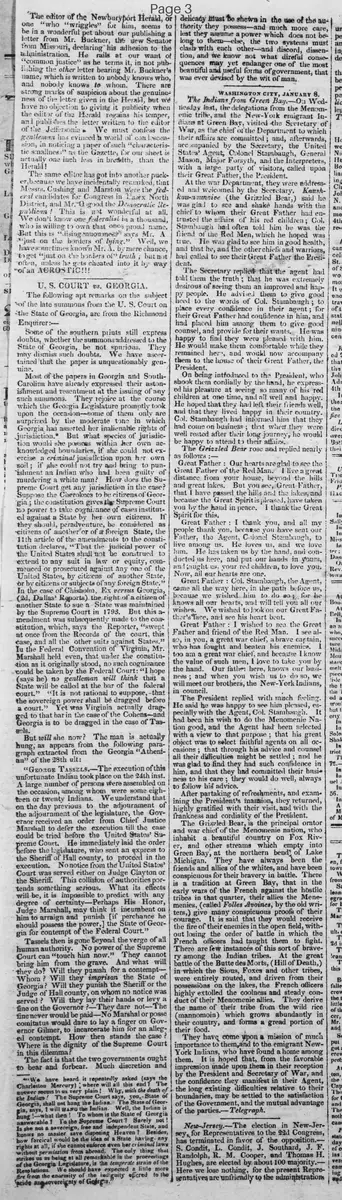
The following apt remarks on the subject of the late summons from the U. S. Court on the State of Georgia, are from the Richmond Enquirer:-
Some of the southern prints still express doubts, whether the summons addressed to the State of Georgia, be not spurious. They may dismiss such doubts. We have ascertained that the paper is unquestionably genuine.
Most of the papers in Georgia and South-Carolina have already expressed their astonishment and resentment at the issuing of any such summons. They rejoice at the course which the Georgia Legislature promptly took upon the occasion--some of them only are surprized by the moderate tone in which Georgia has asserted her inalienable rights of jurisdiction. But what species of jurisdiction would she possess within her own acknowledged boundaries, if she could not exercise a criminal jurisdiction upon her own soil: if she could not try and bring to punishment an Indian who had been guilty of murdering a white man? How does the Supreme Court get any jurisdiction in the case? Suppose the Cherokees to be citizens of Georgia; the constitution gives the Supreme Court no power to take cognizance of cases instituted against a State by her own citizens. If they should, peradventure, be considered as citizens of another or of a foreign State, the 11th article of the amendments to the constitution declares, "That the judicial power of the United States shall not be construed to extend to any suit in law or equity, commenced or prosecuted against one of the United States, by citizens of another State, or by citizens or subjects of any foreign State."
In the case of Chisholm, Ex versus Georgia, (2d, Dallas' Reports) the right of a citizen of another State to sue a State was maintained by the Supreme Court in 1793. But this amendment was subsequently made to the constitution, which, says the Reporter, "swept at once from the Records of the court, this case, and all the other suits against States."
In the Federal Convention of Virginia, Mr. Marshall held even, that under the constitution as it originally stood, no such cognizance could be taken by the Federal Court: "I hope (says he) no gentleman will think that a State will be called at the bar of the federal court." "It is not rational to suppose, that the sovereign power shall be dragged before a court." Yet was Virginia actually dragged to that bar in the case of the Cohens--and Georgia is to be dragged in the case of Tassels.
But will she now? The man is actually hung, as appears from the following paragraph extracted from the Georgia "Athenian" of the 28th ult:
"George Tassels.--The execution of this unfortunate Indian took place on the 24th inst. A large number of persons were assembled on the occasion, among whom were some eighteen or twenty Indians. We understand that on the day previous to the adjournment of the legislature, the Governor received an order from Chief Justice Marshall to defer the execution till the case could be tried before the United States' Supreme Court. He immediately laid the order before the legislature, who sent an express to the Sheriff of Hall county, to proceed in the execution. No notice from the United States' Court was served either on Judge Clayton or the Sheriff. This collision of authorities portends something serious. What its effects will be, it is impossible to predict with any degree of certainty--Perhaps His Honor, Judge Marshall, may think it incumbent on him to arraign and punish [if perchance he should possess the power,] the State of Georgia for contempt of the Federal Court."
Tassels then is gone beyond the verge of all human authority. No power of the Supreme Court can "touch him now." They cannot bring him from the grave. And what will they do? Will they punish for a contempt-- Whom? Will they imprison the State of Georgia? Will they punish the Sheriff or the Judge of Hall county, on whom no notice was served? Will they lay their hands or levy a fine on the Governor? They dare not--The fine never would be paid--No Marshal or posse comitatus would dare to lay a finger on Governor Gilmer, to incarcerate him for an alleged contempt. How then stands the case? Where is the dignity of the Supreme Court in this dilemma?
The fact is that the two governments ought to bear and forbear. Much discretion and delicacy must be shewn in the use of the authority they possess--and much more care, lest they assume a power which does not belong to them--else, the two systems must clash with each other--and discord, dissention, and we know not what direful consequences may yet endanger one of the most beautiful and useful orrhs of government, that was ever devised by the wit of man.
We have heard it repeatedly asked (says the Charleston Mercury) where will all this end? The State of Georgia, says, I will hang the Indian. Well, the Indian is hung!--what then! To whom is the State of Georgia answerable? To the Supreme Court? Surely not! Is she not a sovereign, free and independent State, and knows no master save disposing Heaven? Besides, how ridiculous would be the idea of a State having any rights at all, if she cannot enforce even her criminal laws without permission from abroad. The only thing that strikes us as being at all remarkable in the proceedings of the Georgia Legislature, is the temperate strain of the Resolutions. We should have expected a little more fire from the enormity of the indignity offered to the pride and sovereignty of Georgia.
What sub-type of article is it?
What keywords are associated?
What entities or persons were involved?
Where did it happen?
Domestic News Details
Primary Location
Georgia
Event Date
24th Inst.
Key Persons
Outcome
execution of george tassels by hanging on the 24th inst.
Event Details
The U.S. Supreme Court issued a summons to Georgia to defer the execution of Indian George Tassels for murdering a white man, but the Georgia Legislature ordered the Sheriff of Hall County to proceed without serving notice on officials, resulting in the execution despite the federal order.