Thank you for visiting SNEWPapers!
Sign up free
Story
July 5, 1877
The Rock Island Argus
Rock Island, Rock Island County County, Illinois
What is this article about?
Editorial critiquing U.S. Indian policy under Hayes administration, highlighting chronic frontier wars, corruption in Indian affairs, failures of conciliation efforts, and calling for civil service reform to address abuses by agents and traders.
Clipping
OCR Quality
98%
Excellent
Full Text
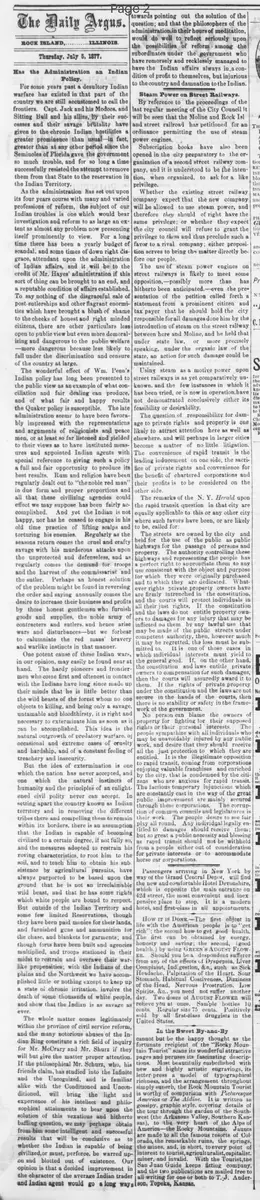
Has the Administration an Indian Policy.
For some years past a desultory Indian warfare has existed in that part of the country we are still accustomed to call the frontiers. Capt. Jack and his Modocs, and Sitting Bull and his allies, by their successes and their savage brutality have given to the chronic Indian hostilities a greater prominence than usual—in fact, greater than at any other period since the Seminoles of Florida gave the government so much trouble, and for so long a time successfully resisted the attempt to remove them from that State to the reservation in the Indian Territory.
As the administration has set out upon its four years course with many and varied professions of reform, the subject of our Indian troubles is one which would bear investigation and reform to as large an extent as almost any problem now presenting itself prominently to view. For a long time there has been a yearly budget of scandal, and sometimes of downright disgrace, attendant upon the administration of Indian affairs, and it will be to the credit of Mr. Hayes' administration if this sort of thing can be brought to an end, and a reputable condition of affairs established. To say nothing of the disgraceful sale of post-sutlerships and other flagrant enormities which have brought a blush of shame to the cheeks of honest and right minded citizens, there are other particulars less open to public view but even more demoralizing and dangerous to the public welfare—more dangerous because less likely to fall under the discrimination and censure of the country at large.
The wonderful effect of Wm. Penn's Indian policy has long been presented to the public view as an example of what conciliation and fair dealing can produce, and of what fair and happy results the Quaker policy is susceptible. The late administration seems to have been favorably impressed with the representations and arguments of religionists and peace men, or at least so far listened and yielded to their views as to have instituted measures and appointed Indian agents with special reference to giving such a policy a full and fair opportunity to produce its best results. Rum and religion have been regularly dealt out to 'the noble red man' in due form and proper proportions and all that these civilizing agencies could effect we may suppose has been fairly accomplished. And yet the Indian is not happy, nor has he ceased to engage in his old time practice of lifting scalps and torturing his enemies. Regularly as the seasons return comes the cruel and crafty savage with his murderous attacks upon the unprotected and defenseless, and as regularly comes the demand for troops and the harvest of the commissariat and the sutler. Perhaps an honest solution of the problem might be found in reversing the order and saying annually comes the desire to increase their business and profits by those honest gentlemen who furnish goods and supplies, the noble army of contractors and sutlers, and hence arise wars and disturbances—but we forbear to calumniate the red man's bravery and warlike instincts in that manner.
One potent cause of these Indian wars, in our opinion, may easily be found near at hand. The hardy pioneers and frontier men who come first and oftenest in contact with the Indians have long since made up their minds that he is little better than the wild beasts of the forest whom no one objects to killing, and being only a savage, untamable and bloodthirsty, it is right and necessary to exterminate him as soon as it can be accomplished. This idea is the natural outgrowth of predatory warfare, of occasional and extreme cases of cruelty and hardship, and of a constant feeling of treachery and insecurity. But the idea of extermination is one which the nation has never accepted, and one which the natural instincts of humanity and the principles of an enlightened civil polity never can accept. In setting apart the country known as Indian territory and in removing the different tribes there and compelling them to remain within its borders, there is an assumption that the Indian is capable of becoming civilized to a certain degree, if not fully so, and the measures adopted to restrain his roving characteristics, to root him to the soil, and to teach him to obtain his subsistence by agricultural pursuits, have always purported to be based upon the ground that he is not an irreclaimable wild beast, and that he has some rights which white people are bound to respect. But outside of the Indian Territory and some few limited Reservations, though they have been paid moneys for their lands, and furnished guns and ammunition for the chase, and blankets for garments; and though forts have been built and agencies multiplied, and troops stationed in their midst to restrain and overawe their warlike propensities; with the Indians of the plains and the Northwest we have accomplished little or nothing except to keep up a state of chronic irritation, involve the death of some thousands of white people and show that the Indian is as savage as ever.
The whole matter comes legitimately within the province of civil service reform, and the many notorious abuses of the Indian Ring constitute a rich field of inquiry for Mr. McCrary and Mr. Schurz if they will but give the matter proper attention. If the philosophical Mr. Schurz, who, his friends claim, has studied into the Infinite and the Unrecognized, and is familiar alike with the Conditioned and Unconditioned, will bring the light and experience of his intellect and philosophical attainments to bear upon the solution of this vexatious and hitherto baffling question, we may perhaps obtain from him some intelligent and successful results that will be conclusive as to whether the Indian is capable of being civilized, or must, perforce, be warred upon and blotted out of existence. Our opinion is that a decided improvement in the character of the average Indian trader and Indian agent would go a long ways towards pointing out the solution of the question; and that the philosophers of the administration, in their hours of meditation, would do well to reflect seriously upon the possibilities of reform among the subordinates under the government who have remorselessly and recklessly managed to have the Indian affairs always in a condition of profit to themselves, but injurious to the country and damnation to the Indian.
For some years past a desultory Indian warfare has existed in that part of the country we are still accustomed to call the frontiers. Capt. Jack and his Modocs, and Sitting Bull and his allies, by their successes and their savage brutality have given to the chronic Indian hostilities a greater prominence than usual—in fact, greater than at any other period since the Seminoles of Florida gave the government so much trouble, and for so long a time successfully resisted the attempt to remove them from that State to the reservation in the Indian Territory.
As the administration has set out upon its four years course with many and varied professions of reform, the subject of our Indian troubles is one which would bear investigation and reform to as large an extent as almost any problem now presenting itself prominently to view. For a long time there has been a yearly budget of scandal, and sometimes of downright disgrace, attendant upon the administration of Indian affairs, and it will be to the credit of Mr. Hayes' administration if this sort of thing can be brought to an end, and a reputable condition of affairs established. To say nothing of the disgraceful sale of post-sutlerships and other flagrant enormities which have brought a blush of shame to the cheeks of honest and right minded citizens, there are other particulars less open to public view but even more demoralizing and dangerous to the public welfare—more dangerous because less likely to fall under the discrimination and censure of the country at large.
The wonderful effect of Wm. Penn's Indian policy has long been presented to the public view as an example of what conciliation and fair dealing can produce, and of what fair and happy results the Quaker policy is susceptible. The late administration seems to have been favorably impressed with the representations and arguments of religionists and peace men, or at least so far listened and yielded to their views as to have instituted measures and appointed Indian agents with special reference to giving such a policy a full and fair opportunity to produce its best results. Rum and religion have been regularly dealt out to 'the noble red man' in due form and proper proportions and all that these civilizing agencies could effect we may suppose has been fairly accomplished. And yet the Indian is not happy, nor has he ceased to engage in his old time practice of lifting scalps and torturing his enemies. Regularly as the seasons return comes the cruel and crafty savage with his murderous attacks upon the unprotected and defenseless, and as regularly comes the demand for troops and the harvest of the commissariat and the sutler. Perhaps an honest solution of the problem might be found in reversing the order and saying annually comes the desire to increase their business and profits by those honest gentlemen who furnish goods and supplies, the noble army of contractors and sutlers, and hence arise wars and disturbances—but we forbear to calumniate the red man's bravery and warlike instincts in that manner.
One potent cause of these Indian wars, in our opinion, may easily be found near at hand. The hardy pioneers and frontier men who come first and oftenest in contact with the Indians have long since made up their minds that he is little better than the wild beasts of the forest whom no one objects to killing, and being only a savage, untamable and bloodthirsty, it is right and necessary to exterminate him as soon as it can be accomplished. This idea is the natural outgrowth of predatory warfare, of occasional and extreme cases of cruelty and hardship, and of a constant feeling of treachery and insecurity. But the idea of extermination is one which the nation has never accepted, and one which the natural instincts of humanity and the principles of an enlightened civil polity never can accept. In setting apart the country known as Indian territory and in removing the different tribes there and compelling them to remain within its borders, there is an assumption that the Indian is capable of becoming civilized to a certain degree, if not fully so, and the measures adopted to restrain his roving characteristics, to root him to the soil, and to teach him to obtain his subsistence by agricultural pursuits, have always purported to be based upon the ground that he is not an irreclaimable wild beast, and that he has some rights which white people are bound to respect. But outside of the Indian Territory and some few limited Reservations, though they have been paid moneys for their lands, and furnished guns and ammunition for the chase, and blankets for garments; and though forts have been built and agencies multiplied, and troops stationed in their midst to restrain and overawe their warlike propensities; with the Indians of the plains and the Northwest we have accomplished little or nothing except to keep up a state of chronic irritation, involve the death of some thousands of white people and show that the Indian is as savage as ever.
The whole matter comes legitimately within the province of civil service reform, and the many notorious abuses of the Indian Ring constitute a rich field of inquiry for Mr. McCrary and Mr. Schurz if they will but give the matter proper attention. If the philosophical Mr. Schurz, who, his friends claim, has studied into the Infinite and the Unrecognized, and is familiar alike with the Conditioned and Unconditioned, will bring the light and experience of his intellect and philosophical attainments to bear upon the solution of this vexatious and hitherto baffling question, we may perhaps obtain from him some intelligent and successful results that will be conclusive as to whether the Indian is capable of being civilized, or must, perforce, be warred upon and blotted out of existence. Our opinion is that a decided improvement in the character of the average Indian trader and Indian agent would go a long ways towards pointing out the solution of the question; and that the philosophers of the administration, in their hours of meditation, would do well to reflect seriously upon the possibilities of reform among the subordinates under the government who have remorselessly and recklessly managed to have the Indian affairs always in a condition of profit to themselves, but injurious to the country and damnation to the Indian.
What sub-type of article is it?
Historical Event
What themes does it cover?
Justice
Misfortune
Moral Virtue
What keywords are associated?
Indian Policy
Frontier Wars
Corruption
Civil Service Reform
Hayes Administration
Indian Agents
Extermination
What entities or persons were involved?
Capt. Jack
Modocs
Sitting Bull
Wm. Penn
Mr. Hayes
Mr. Mccrary
Mr. Schurz
Where did it happen?
Frontiers, Indian Territory, Florida, Plains And Northwest
Story Details
Key Persons
Capt. Jack
Modocs
Sitting Bull
Wm. Penn
Mr. Hayes
Mr. Mccrary
Mr. Schurz
Location
Frontiers, Indian Territory, Florida, Plains And Northwest
Event Date
For Some Years Past
Story Details
Critique of U.S. Indian policy, highlighting chronic wars, corruption in agencies, failures of conciliation, pioneer attitudes favoring extermination, and need for reform through better agents and civil service to civilize or manage Indians humanely.