Thank you for visiting SNEWPapers!
Sign up free
The Bryan Daily Eagle
Bryan, Brazos County, Texas
What is this article about?
Article explains Japanese soshis: turbulent Samurai descendants acting as political agitators, involved in assassinations like the Korean queen's murder and attack on Li Hung Chang. They often commit honorable hari-kari suicide afterward.
Merged-components note: Merging article title/dateline, text, and multiple overlapping images into single foreign_news story on Japanese soshis.
Clipping
OCR Quality
Full Text
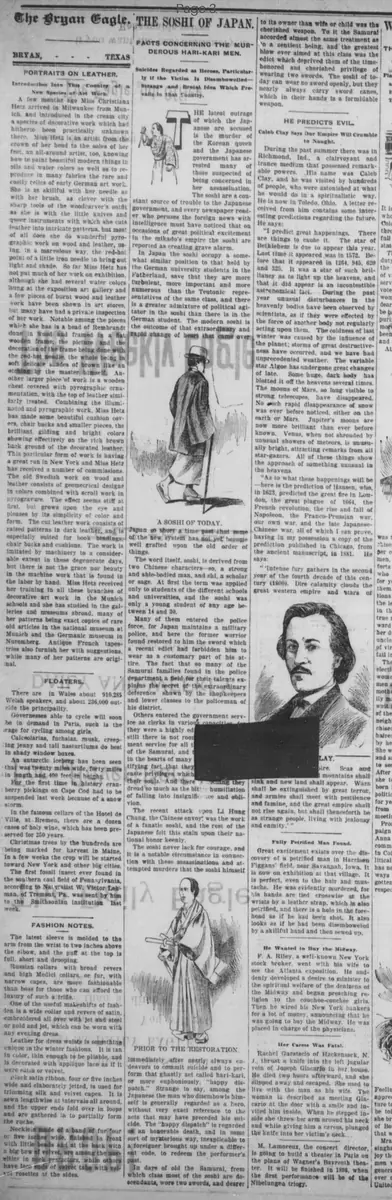
THE SOSHI OF JAPAN.
MY FACTS CONCERNING THE
MURDEROUS HARI-KARI MEN.
BRYAN, TEXAS.
Suicides Regarded as Heroes, Particularly If the Victim Is Disembowelled—Strange and Brutal Idea Which Prevails In that Country.
The latest outrage of which the Japanese are accused is the murder of the Korean queen and the Japanese government has arrested many of those suspected of being concerned in her assassination.
The soshis are a constant source of trouble to the Japanese government, and every newspaper reader who peruses the foreign news with intelligence must have noticed that on occasions of great political excitement in the mikado's empire the soshis are reported as creating grave alarm.
In Japan the soshis occupy somewhat similar position to that held by the German university students in the Fatherland, save that they are more turbulent, more important and more numerous than the Teutonic representatives of the same class, and there is a greater admixture of political agitator in the soshi than there is in the German student.
The modern soshi is the outcome of that extraordinary and rapid change of heart that a soshi of today, Japan so short a time past that some of the new system has not yet become well grafted upon the old order of things.
The word itself, soshi, is derived from two Chinese characters—so, a strong and able-bodied man, and shi, a scholar or sage.
At first the term was applied only to students of the different schools and universities, and the soshi was only a young student of any age between 14 and 30.
Many of them entered the police force, for Japan maintains a military police, and here the former warrior found restored to him the sword which a recent edict had forbidden him to wear as a customary part of his attire.
The fact that so many of the Samurai families found in the police department a field for their talents explains the secret of the extraordinary deference shown by the shopkeepers and lower classes to the policeman of his district.
Others entered the government service as clerks in various capacities they were highly educated still there is not room in the government service for all of the Samurai, and in the hearts of many a humiliating fact that they lost their caste privileges which their souls. And there is nothing they dread so much as the bitter humiliation of falling into insignificance and oblivion.
The recent attack upon Li Hung Chang, the Chinese envoy was the work of a fanatic soshi, and the rest of the Japanese felt this stain upon their national honor keenly.
The soshi never lack for courage, and it is a notable circumstance in connection with these assassinations and attempted murders that the soshi himself immediately after nearly always endeavors to commit suicide and to perform that ghastly act called hari-kari, or more euphemiously, "happy dispatch." Strange to say, among the Japanese the man who disembowels himself is generally regarded as a hero, without very exact reference to the acts that may have preceded his suicide. The "happy dispatch" is regarded as an honorable death, and in some sort of mysterious way, inexplicable to a foreigner brought up under a different code, to redeem the performer's past.
In days of old the Samurai, from which class most of the soshis are descendants, wore two swords, and dearer to its owner than wife or child was the cherished weapon. To it the Samurai accorded almost the same treatment as to a sentient being, and the greatest blow ever aimed at this class was the edict which deprived them of the time-honored and cherished privilege of wearing two swords.
The soshi of today can wear no sword openly, but they nearly always carry sword canes, which in their hands is a formidable weapon.
What sub-type of article is it?
What keywords are associated?
What entities or persons were involved?
Where did it happen?
Foreign News Details
Primary Location
Japan
Key Persons
Outcome
the japanese government has arrested many suspected in the murder of the korean queen. the attack on li hung chang was by a fanatic soshi.
Event Details
The article discusses the soshis in Japan, a class of turbulent young men descended from Samurai, who act as political agitators and are involved in assassinations. They are compared to German students but more numerous and politically active. The term soshi means strong scholar. Many entered police or government service but resent loss of privileges. Soshis often commit hari-kari after acts, seen as honorable. Historical context includes Samurai sword privileges revoked.