Thank you for visiting SNEWPapers!
Sign up free
Story
August 30, 1853
The Sumter Banner
Sumter, Sumter County, South Carolina
What is this article about?
An advisory article from the Southern Patriot outlining the mutual duties of lawyers and clients, emphasizing full disclosure, honest judgment, avoiding unnecessary litigation, and efficient communication to benefit both parties.
Clipping
OCR Quality
95%
Excellent
Full Text
From the Southern Patriot.
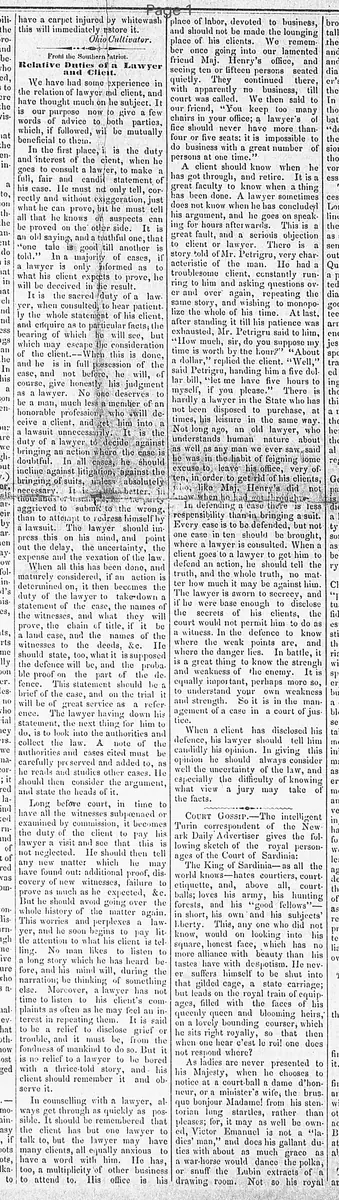
Relative Duties of a Lawyer and Client.
We have had some experience in the relation of lawyer and client, and have thought much on the subject. It is our purpose now to give a few words of advice to both parties, which, if followed, will be mutually beneficial to them.
In the first place, it is the duty and interest of the client, when he goes to consult a lawyer, to make a full, fair and candid statement of his case. He must not only tell, correctly and without exaggeration, just what he can prove, but he must tell all that he knows or suspects can be proved on the other side. It is an old saying, and a truthful one, that "one tale is good till another is told." In a majority of cases, if a lawyer is only informed as to what his client expects to prove, he will be deceived in the result.
It is the sacred duty of a lawyer, when consulted to hear patiently the whole statement of his client. and enquire as to particular facts; the bearing of which he will see, but which may escape the consideration of the client.--When this is done, and he is in full possession of the case, and not before, he will, of course, give honestly. his judgment as a lawyer. No one deserves- to be a man, much less a member of an honorable profession who will deceive a client. and get him into. a lawsuit unnecessarily. It is the duty of a lawyer to decide against bringing an action where the case is doubtful. In all cases. he. should incline against litigation against the bringing of suits, unless absolutely necessary.. It is a thousand times better. in most instances. he wrongly aggrieved to submit to the wrong, than to attempt to redress himself by a lawsuit. The lawyer should impress this on his mind, and point out the delay, the uncertainty, the expense and the vexation of the law.
When all this has been done, and maturely considered, if an action is determined on. it then becomes the duty of the lawyer to take-down a statement of the case, the names of the witnesses, and what they will prove, the chain of title. if it be a land case, and the names of the witnesses to the deeds, &c. He should state, too, what it is supposed the defence will be, and the probable proof on the part of the defence. This statement should be a brief of the case, and on the trial it will be of great service as a reference. The lawyer having down his statement, the next thing for him to do. is to look into the authorities and collect the law. A note of the authorities and cases cited must be carefully preserved and added to, as he reads and studies other cases. He should then consider the argument, and state the heads of it.
Long before court, in time to have all the witnesses subpoenaed or examined by commission, it becomes the duty of the client to pay his lawyer a visit and see that this is not neglected. He should then tell any new matter which he may have found out: additional proof, discovery of new witnesses, failure to prove as much as he expected, &c. But he should avoid going over the whole history of the matter again. This worries and perplexes a lawyer, and he soon begins to pay little attention to what his client is telling. No man likes to listen to a long story which he has heard before, and his mind will, during the narration; be thinking of something else. Moreover, a lawyer has not time to listen to his client's complaints as often as he may feel an interest in repeating them. It is said to be a relief to disclose grief or trouble, and it must be, from the fondness of mankind to do so. But it is no relief to a lawyer to be bored with a thrice-told story, and- his client should remember it and observe it.
In counselling with a lawyer, always get through as quickly as possible. It should be remembered that the client has but one lawyer to talk to, but the lawyer may. have many clients, all equally anxious to have a word with him. He has, too, a multiplicity of other business to attend to. His office is his place of labor, devoted to business, and should not be made the lounging place of his clients. We remember once going into our lamented friend Maj. Henry's office, and seeing ten or fifteen persons seated quietly. They continued there. with apparently no business, till court was called. We then said to our friend, "You keep too many chairs in your office; a lawyer's office should never have more than- four or five seats; it is impossible to do business with a great number of persons at one time."
A client should know when he has got through, and retire. It is a great faculty to know when a thing has been done. A lawyer sometimes does not know when he has concluded his argument, and he goes on speaking for hours afterwards. This is a great fault, and a serious objection to client or lawyer. There is a story told of Mr. Petigru, very characteristic of the man. He had a troublesome client, constantly running to him and asking questions over and over" again, repeating the same story, and wishing to monopolize the whole of his time. At last, after standing it till his patience was exhausted, Mr. Petigru said to him, "How much, sir, do you suppose my time is worth by the hour?" "About a dollar," replied the client. "Well," said Petigru, handing him a five dollar bill, "let me have five hours to myself, if you please." There is hardly a lawyer in the State who has not been disposed to purchase, at times, his leisure in the same way.
Not long ago, an old lawyer, who understands human nature about as well as any man we ever saw. said he was in the habit of feigning some excuse to leave his office, very often, in order to get rid of his clients, who, like Maj. Henry's did not know when he had got through..
In defending a case there is less responsibility than in bringing a suit. Every case is to be defended, but not one case in ten should be brought, where a lawyer is consulted. When a client goes' to a lawyer to get him to defend an action, he should tell the truth, and the whole truth, no matter how much it may be against him. The lawyer is sworn to secrecy, and if he were base enough to disclose the secrets of his clients, the court would not permit him to do as a witness. In the defence to know where the weak points are, and where the danger lies. In battle, it is a great thing to know the strength and weakness of the enemy. It is equally important, perhaps more so, to understand your own weakness and strength. So it is in the management of a case in a court of justice.
Relative Duties of a Lawyer and Client.
We have had some experience in the relation of lawyer and client, and have thought much on the subject. It is our purpose now to give a few words of advice to both parties, which, if followed, will be mutually beneficial to them.
In the first place, it is the duty and interest of the client, when he goes to consult a lawyer, to make a full, fair and candid statement of his case. He must not only tell, correctly and without exaggeration, just what he can prove, but he must tell all that he knows or suspects can be proved on the other side. It is an old saying, and a truthful one, that "one tale is good till another is told." In a majority of cases, if a lawyer is only informed as to what his client expects to prove, he will be deceived in the result.
It is the sacred duty of a lawyer, when consulted to hear patiently the whole statement of his client. and enquire as to particular facts; the bearing of which he will see, but which may escape the consideration of the client.--When this is done, and he is in full possession of the case, and not before, he will, of course, give honestly. his judgment as a lawyer. No one deserves- to be a man, much less a member of an honorable profession who will deceive a client. and get him into. a lawsuit unnecessarily. It is the duty of a lawyer to decide against bringing an action where the case is doubtful. In all cases. he. should incline against litigation against the bringing of suits, unless absolutely necessary.. It is a thousand times better. in most instances. he wrongly aggrieved to submit to the wrong, than to attempt to redress himself by a lawsuit. The lawyer should impress this on his mind, and point out the delay, the uncertainty, the expense and the vexation of the law.
When all this has been done, and maturely considered, if an action is determined on. it then becomes the duty of the lawyer to take-down a statement of the case, the names of the witnesses, and what they will prove, the chain of title. if it be a land case, and the names of the witnesses to the deeds, &c. He should state, too, what it is supposed the defence will be, and the probable proof on the part of the defence. This statement should be a brief of the case, and on the trial it will be of great service as a reference. The lawyer having down his statement, the next thing for him to do. is to look into the authorities and collect the law. A note of the authorities and cases cited must be carefully preserved and added to, as he reads and studies other cases. He should then consider the argument, and state the heads of it.
Long before court, in time to have all the witnesses subpoenaed or examined by commission, it becomes the duty of the client to pay his lawyer a visit and see that this is not neglected. He should then tell any new matter which he may have found out: additional proof, discovery of new witnesses, failure to prove as much as he expected, &c. But he should avoid going over the whole history of the matter again. This worries and perplexes a lawyer, and he soon begins to pay little attention to what his client is telling. No man likes to listen to a long story which he has heard before, and his mind will, during the narration; be thinking of something else. Moreover, a lawyer has not time to listen to his client's complaints as often as he may feel an interest in repeating them. It is said to be a relief to disclose grief or trouble, and it must be, from the fondness of mankind to do so. But it is no relief to a lawyer to be bored with a thrice-told story, and- his client should remember it and observe it.
In counselling with a lawyer, always get through as quickly as possible. It should be remembered that the client has but one lawyer to talk to, but the lawyer may. have many clients, all equally anxious to have a word with him. He has, too, a multiplicity of other business to attend to. His office is his place of labor, devoted to business, and should not be made the lounging place of his clients. We remember once going into our lamented friend Maj. Henry's office, and seeing ten or fifteen persons seated quietly. They continued there. with apparently no business, till court was called. We then said to our friend, "You keep too many chairs in your office; a lawyer's office should never have more than- four or five seats; it is impossible to do business with a great number of persons at one time."
A client should know when he has got through, and retire. It is a great faculty to know when a thing has been done. A lawyer sometimes does not know when he has concluded his argument, and he goes on speaking for hours afterwards. This is a great fault, and a serious objection to client or lawyer. There is a story told of Mr. Petigru, very characteristic of the man. He had a troublesome client, constantly running to him and asking questions over and over" again, repeating the same story, and wishing to monopolize the whole of his time. At last, after standing it till his patience was exhausted, Mr. Petigru said to him, "How much, sir, do you suppose my time is worth by the hour?" "About a dollar," replied the client. "Well," said Petigru, handing him a five dollar bill, "let me have five hours to myself, if you please." There is hardly a lawyer in the State who has not been disposed to purchase, at times, his leisure in the same way.
Not long ago, an old lawyer, who understands human nature about as well as any man we ever saw. said he was in the habit of feigning some excuse to leave his office, very often, in order to get rid of his clients, who, like Maj. Henry's did not know when he had got through..
In defending a case there is less responsibility than in bringing a suit. Every case is to be defended, but not one case in ten should be brought, where a lawyer is consulted. When a client goes' to a lawyer to get him to defend an action, he should tell the truth, and the whole truth, no matter how much it may be against him. The lawyer is sworn to secrecy, and if he were base enough to disclose the secrets of his clients, the court would not permit him to do as a witness. In the defence to know where the weak points are, and where the danger lies. In battle, it is a great thing to know the strength and weakness of the enemy. It is equally important, perhaps more so, to understand your own weakness and strength. So it is in the management of a case in a court of justice.
What sub-type of article is it?
Legal Advice
Professional Ethics
What themes does it cover?
Moral Virtue
Justice
Social Manners
What keywords are associated?
Lawyer Duties
Client Responsibilities
Legal Consultation
Avoiding Litigation
Professional Ethics
What entities or persons were involved?
Maj. Henry
Mr. Petigru
Story Details
Key Persons
Maj. Henry
Mr. Petigru
Story Details
The article provides guidance on the responsibilities of clients to disclose fully and lawyers to advise honestly against unnecessary suits, prepare thoroughly, and manage consultations efficiently, illustrated with anecdotes about troublesome clients.