Thank you for visiting SNEWPapers!
Sign up free
Imperial Valley Press
El Centro, Imperial County, California
What is this article about?
Five operating railway brotherhoods drafted a counterproposal to President Roosevelt's wage settlement offer, demanding an eight-cent hourly raise, overtime pay, and vacation benefits, amid planned strikes on Dec. 30. Negotiations in Washington involved union leaders and addressed stabilization program limits.
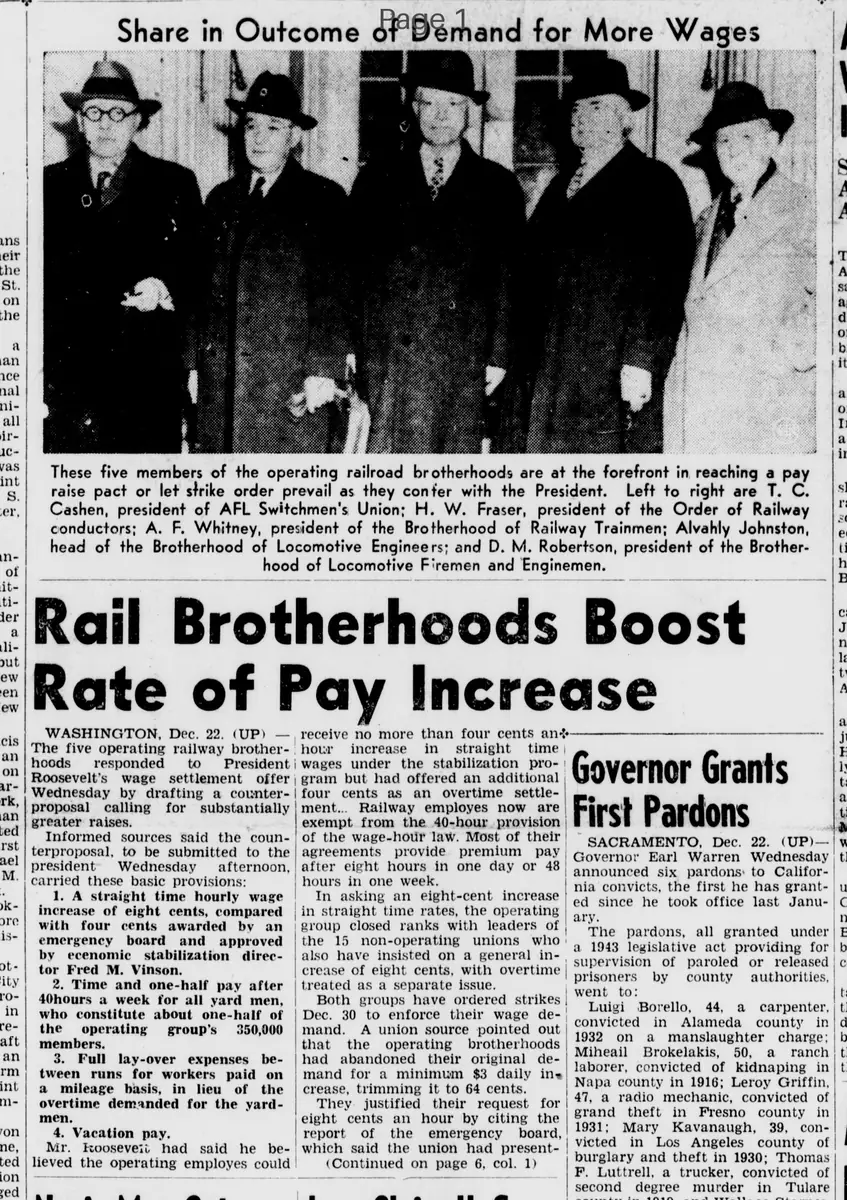
Merged-components note: Image and caption directly relate to the railway brotherhoods story; merge with the story and its continuation on page 6.
Clippings
1 of 2
OCR Quality
Full Text
WASHINGTON, Dec. 22. (UP) The five operating railway brotherhoods responded to President Roosevelt's wage settlement offer Wednesday by drafting a counterproposal calling for substantially greater raises.
Informed sources said the counterproposal, to be submitted to the president Wednesday afternoon, carried these basic provisions:
1. A straight time hourly wage increase of eight cents, compared with four cents awarded by an emergency board and approved by economic stabilization director Fred M. Vinson.
2. Time and one-half pay after 40 hours a week for all yard men, who constitute about one-half of the operating group's 350,000 members.
3. Full lay-over expenses between runs for workers paid on a mileage basis, in lieu of the overtime demanded for the yardmen.
4. Vacation pay.
Mr. Roosevelt had said he believed the operating employees could receive no more than four cents an hour increase in straight time wages under the stabilization program but had offered an additional four cents as an overtime settlement... Railway employees now are exempt from the 40-hour provision of the wage-hour law. Most of their agreements provide premium pay after eight hours in one day or 48 hours in one week.
In asking an eight-cent increase in straight time rates, the operating group closed ranks with leaders of the 15 non-operating unions who also have insisted on a general increase of eight cents, with overtime treated as a separate issue.
Both groups have ordered strikes Dec. 30 to enforce their wage demands. A union source pointed out that the operating brotherhoods had abandoned their original demand for a minimum $3 daily increase, trimming it to 64 cents.
They justified their request for eight cents an hour by citing the report of the emergency board, which said the union had presented— (Continued on page 6, col. 1)
Rail Men Boost Raise Rates
(Continued from page 1)
made a strong case, based on gross inequities, for a greater increase than the four cents recommended by the board.
The board had limited its award to four cents because of Vinson's decisions affecting the 1,100,000 non-operating employes.
The operating group's counter-proposal was approved by the executive committees of the unions shortly before noon. The committees then stood by for a possible call to the White House.
Mr. Roosevelt has met for three consecutive days with officials of the "big five" operating brotherhoods in an attempt to settle their dispute within limits of the wage stabilization program. But new complications were added last night when the 15 non-operating unions announced a strike for Dec. 30, the same date fixed earlier by the operating groups.
Since the president already has intervened in the case of the big five, it was believed he would take similar steps in response to the non-operating strike call. Up to this time, the two cases have been handled separately under procedure set up by the railway labor act, but officials now assumed a final settlement would be based on a single formula.
Mr. Roosevelt disclosed Tuesday that he had proposed a compromise settlement in the operating case, allowing a four cent hourly raise as payment for overtime. This would be in addition to the four cents already approved by stabilization director Fred M. Vinson as the maximum allowable under the little steel formula.
What sub-type of article is it?
What keywords are associated?
What entities or persons were involved?
Where did it happen?
Domestic News Details
Primary Location
Washington
Event Date
Dec. 22
Key Persons
Outcome
counterproposal drafted and submitted calling for eight-cent hourly raise, overtime pay, lay-over expenses, and vacation pay; strikes ordered for dec. 30 by operating and non-operating unions unless demands met.
Event Details
The five operating railway brotherhoods drafted a counterproposal to President Roosevelt's wage offer, seeking greater raises including eight cents per hour, time-and-a-half after 40 hours for yard men, full lay-over expenses, and vacation pay. This aligns with non-operating unions' demands. Roosevelt had offered four cents straight time plus four cents overtime, limited by stabilization program. Meetings occurred over three days; strikes planned for Dec. 30.