Thank you for visiting SNEWPapers!
Sign up free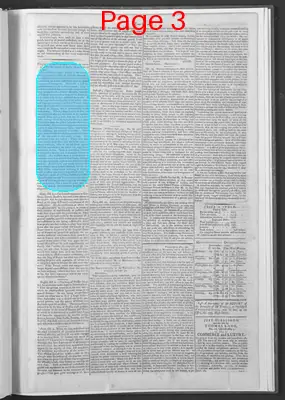
National Gazette
Philadelphia, Philadelphia County, Pennsylvania
What is this article about?
Paris, Oct. 8: Complaints in France about delays, intrigue, and corruption in the constitutional election method. Comparison to elective assemblies in Poland, Venice, and Genoa, highlighting Venice's complex balloting to prevent fraud.
Clipping
OCR Quality
Full Text
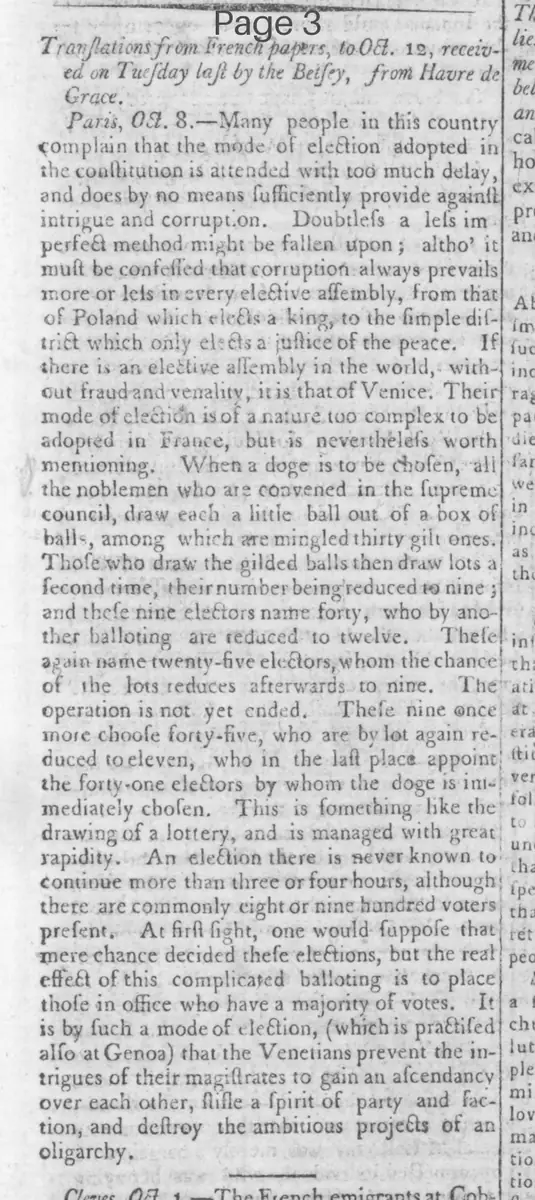
Paris, Oct. 8.—Many people in this country complain that the mode of election adopted in the constitution is attended with too much delay, and does by no means sufficiently provide against intrigue and corruption. Doubtless a less imperfect method might be fallen upon; although it must be confessed that corruption always prevails more or less in every elective assembly, from that of Poland which elects a king, to the simple district which only elects a justice of the peace. If there is an elective assembly in the world, without fraud and venality, it is that of Venice. Their mode of election is of a nature too complex to be adopted in France, but is nevertheless worth mentioning. When a doge is to be chosen, all the noblemen who are convened in the supreme council, draw each a little ball out of a box of balls, among which are mingled thirty gilt ones. Those who draw the gilded balls then draw lots a second time, their number being reduced to nine; and these nine electors name forty, who by another balloting are reduced to twelve. These again name twenty-five electors, whom the chance of the lots reduces afterwards to nine. The operation is not yet ended. These nine once more choose forty-five, who are by lot again reduced to eleven, who in the last place appoint the forty-one electors by whom the doge is immediately chosen. This is something like the drawing of a lottery, and is managed with great rapidity. An election there is never known to continue more than three or four hours, although there are commonly eight or nine hundred voters present. At first sight, one would suppose that mere chance decided these elections, but the real effect of this complicated balloting is to place those in office who have a majority of votes. It is by such a mode of election (which is practiced also at Genoa) that the Venetians prevent the intrigues of their magistrates to gain an ascendancy over each other, stifle a spirit of party and faction, and destroy the ambitious projects of an oligarchy.
What sub-type of article is it?
What keywords are associated?
Where did it happen?
Foreign News Details
Primary Location
Paris
Event Date
Oct. 8
Event Details
Many people in this country complain that the mode of election adopted in the constitution is attended with too much delay, and does by no means sufficiently provide against intrigue and corruption. Doubtless a less imperfect method might be fallen upon; although it must be confessed that corruption always prevails more or less in every elective assembly, from that of Poland which elects a king, to the simple district which only elects a justice of the peace. If there is an elective assembly in the world, without fraud and venality, it is that of Venice. Their mode of election is of a nature too complex to be adopted in France, but is nevertheless worth mentioning. When a doge is to be chosen, all the noblemen who are convened in the supreme council, draw each a little ball out of a box of balls, among which are mingled thirty gilt ones. Those who draw the gilded balls then draw lots a second time, their number being reduced to nine; and these nine electors name forty, who by another balloting are reduced to twelve. These again name twenty-five electors, whom the chance of the lots reduces afterwards to nine. The operation is not yet ended. These nine once more choose forty-five, who are by lot again reduced to eleven, who in the last place appoint the forty-one electors by whom the doge is immediately chosen. This is something like the drawing of a lottery, and is managed with great rapidity. An election there is never known to continue more than three or four hours, although there are commonly eight or nine hundred voters present. At first sight, one would suppose that mere chance decided these elections, but the real effect of this complicated balloting is to place those in office who have a majority of votes. It is by such a mode of election (which is practiced also at Genoa) that the Venetians prevent the intrigues of their magistrates to gain an ascendancy over each other, stifle a spirit of party and faction, and destroy the ambitious projects of an oligarchy.