Thank you for visiting SNEWPapers!
Sign up free
The Sumter Watchman
Sumter, Sumter County, South Carolina
What is this article about?
The Reform Convention in Columbia, South Carolina, on June 15-16, united white and Black delegates to form the Union Reform Party, adopt a platform recognizing civil rights and Reconstruction changes, and nominate R.B. Carpenter for governor and M.C. Butler for lieutenant governor to reform state government.
Clipping
OCR Quality
Full Text
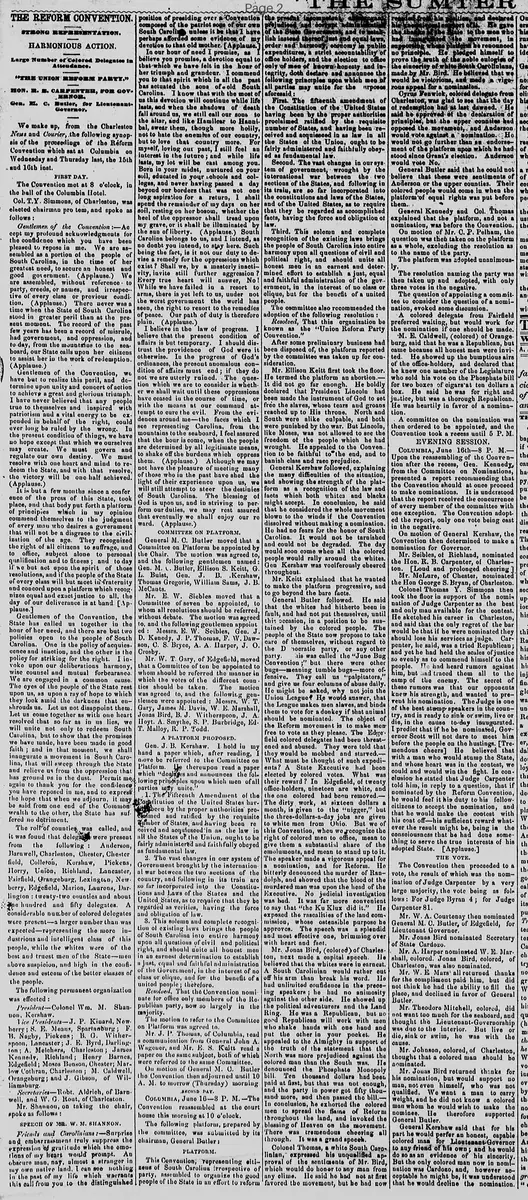
HARMONIOUS ACTION.
Large Number of Colored Delegates in Attendance.
"THE UNION REFORM PARTY."
HON. R. B. CARPENTER, FOR GOV.
Gen. B. O. Butler, for Lieutenant-Governor,
We make up, from the Charleston News and Courier, the following synopsis of the proceedings of the Reform Convention which sat at Columbia on Wednesday and Thursday last, the 15th and 16th inst.
FIRST DAY.
The Convention met at 8 o'clock, in the hall of the Columbia Hotel.
Col. T. Y. Simmons, of Charleston, was elected chairman pro tem, and spoke as follows:
Gentlemen of the Convention:--Accept my profound acknowledgments for the confidence which you have been pleased to repose in me. We are assembled as a portion of the people of South Carolina, in the time of her greatest need, to secure an honest and good government. (Applause.)
We are assembled, without reference to party, creeds, or paucs, and irrespective of every class or previous condition, (Applause.) There never was a time when the State of South Carolina stood in greater peril than at the present moment. The record of the past few years has been a record of misrule, bad government, and oppression, and to-day, from the mountains to the seaboard, our State calls upon her citizens to assist her in the work of redemption. (Applause.)
Gentlemen of the Convention, we have but to realize this peril, and determine upon unity and concert of action to achieve a great and glorious triumph.
I have never believed that any people true to themselves and inspired with patriotism and a vital energy to be expended in behalf of the right, could ever long be ruled by the wrong. In the present condition of things, we have no hope except that which we ourselves may create. We must govern and regulate our own destiny. We must resolve with one heart and mind to redeem the State, and with that resolve, the victory will be one-half achieved. (Applause.)
It is but a few months since a conference of the press of this State, took place, and that body put forth a platform of principles which in my opinion commend themselves to the judgment of every man who desires a government that will not be a disgrace to the civilization of the age. They recognized the right of all citizens to suffrage, and to office, subject alone to personal qualification and to fitness; and to-day if we but act upon the spirit of those resolutions, and if the people of the State of every class will but meet in fraternity and concord upon a platform which recognizes equal and exact justice to all, the day of our deliverance is at hand. [Applause.]
Gentlemen of the Convention, the State has called us together in the hour of her need, and there are but two policies open to the people of South Carolina. One is the policy of acquiescence and inaction, and the other is the policy of striking for the right. I invoke upon our deliberations harmony, wise counsel and mutual forbearance.
We are engaged in a common cause. The eyes of the people of the State rest upon us, as upon a ray of hope to which they look amid the darkness that enshrouds us. Let us not disappoint them.
Let us come together as with one heart resolved that so far as in us lies, we will unite not only to redeem South Carolina, but to show that the promises we have made, have been made in good faith ; and in that moment, we shall inaugurate a movement in South Carolina, that will sweep through the State and relieve us from the oppression that has ground us in the dust. Permit me again to thank you for the confidence you have reposed in me, and to express the hope that when we adjourn, it may be said from one end of the Commonwealth to the other, the State has suffered no detriment.
The roll of counties, was called, and it was found that delegates were present from the following : Anderson, Barnwell, Charleston, Chester, Chester field, Colleton, Kershaw, Pickens, Laurens, Union, Richland, Lancaster, Fairfield, Orangeburg, Lexington, Newberry, Edgefield, Marion, Laurens, Darlington : twenty-two counties and about one hundred and fifty delegates. A considerable number of colored delegates were present--a larger number than was expected--representing the more industrious and intelligent class of this people, while the whites were of the best and truest men of the State--men above suspicion, and high in the confidence and esteem of the better classes of the people.
The following permanent organization was effected:
President--Colonel Wm. M. Shannon, Kershaw.
Vice Presidents--J. P. Kinard, Newberry; S. E. Means, Spartanburg; F. B. Hagood, Pickens; B. G. Witherspoon, Lancaster; J. E. Byrd, Darlington; A. Melchers, Charleston; James Kennedy, Richland; Henry Barnes, Edgefield; Moses Bunson, Chester; Marion Cothran, Charleston; M. Caldwell, Orangeburg; and J. Gibson, of Williamsburgh.
Secretaries--Robt. Aldrich, of Barnwell, and W. G. Rout, of Charleston.
Mr. Shannon, on taking the chair, spoke as follows:
SPEECH OF MR. W. M. SHANNON.
Friends and Carolinians:--Surprise and embarrassment truly suppress the expression of gratitude which the emotions of my heart would prompt. An obscure man, nay, almost a stranger in my own native land. I can see nothing in the past of my life which warrants this call from you to the distinguished position of presiding over Convention composed of the patriot sons of our own South Carolina unless it be that I have perhaps afforded some evidence of my devotion to that old mother. [Applause.]
In our hour of need I promise, as I believe you promise, a devotion equal to that which we have felt in the hour of her triumph and grandeur. I commend you to that spirit which in all the past has actuated the sons of old South Carolina. I know that with the most of us this devotion will continue while life lasts, and when the shadows of death fall around us, we still call our sons to the altar, and like Hamilcar to Hannibal, swear them, though more holily, not to hate the enemies of our country, but to love that country more. For myself, loving our past, I still feel an interest in the future; and while life lasts, my lot will be cast among you.
Born in your midst, nurtured on your soil, educated in your schools and colleges, and never having passed a day beyond our borders that was not one long aspiration for a return. I shall spend the remainder of my days on her soil, resting on her bosom, whether the heel of the oppressor shall tread upon my grave, or it shall be illuminated by the sun of liberty. (Applause.) South Carolina belongs to us, and I intend, as no doubt you intend, to stay here. Such being the fact, is it not our duty to devise a remedy for the oppressions which exist? Shall we, by a masterly inactivity, invite still further aggression?
Every true heart will answer, No! While we have failed in a resort to arms, there is yet left to us, under not the worst government the world has seen, the right to resort to the remedies of peace. Our path of duty is therefore plain. (Applause.)
I believe in the law of progress. I believe that the present condition of affairs is but temporary. I should distrust the providence of God were it otherwise. In the progress of God's ordinances, the present anomalous condition of affairs must end; if they do not we are utterly ruined. The question which we are to consider is whether we shall wait until these oppressions have ceased in the course of time, or with the weapons at our command attempt to cure the evil. From the evidences around me--the faces which I see representing Carolina, from the mountains to the seaboard, I feel assured that the hour is come, when the people are determined by all legitimate means, to shake off the burdens which oppress them. (Applause.) Although we may not have the pleasure of meeting many of those who in the past have shed the light of their experience upon us, we will still attempt to steer the destinies of South Carolina. The blessing of God is upon us, and in striving to perform our duties, we may rest assured that eventually we shall enjoy our reward. (Applause.)
COMMITTEE ON PLATFORM.
General M. C. Butler moved that a Committee on Platform be appointed by the Chair. The motion was agreed to, and the following gentlemen named: Gen. M. C. Butler, Ellison S. Keitt, G. L. Buist, Gen. J. B. Kershaw, Thomas Gregorie, William Sams, J. B. McCants.
Mr. E. W. Seibels moved that a Committee of seven be appointed, to whom all resolutions should be referred without debate. The motion was agreed to, and the following gentlemen appointed: Messrs. E. W. Seibels, Gen. J. D. Kennedy, J. P. Thomas, F. W. Dawson, C. S. Gadsden, A. A. Smalls, J. O. Crosby.
Mr. W. T. Gary, of Edgefield, moved that a Committee of ten be appointed to whom should be referred the manner in which the votes of the different counties should be taken. The motion was agreed to, and the following gentlemen were appointed : Messrs. W. T. Gary, James M. Davis, W. E. Marshall, Jonas Bird, B. J. Witherspoon, J. A. Hoyt, A. Smythe, S. P. Burbridge, Ed. T. Malloy, R. P. Todd.
A PLATFORM PROPOSED.
Gen. J. B. Kershaw. I hold in my hand a paper which, after reading, I move be referred to the Committee on Platform. He thereupon read a paper which declares and announces the following principles upon which men of all parties may unite.
1. The Fifteenth Amendment of the Constitution of the United States having been by the proper authorities proclaimed and ratified by the requisite number of States, and having been received and acquiesced in as the law in all the States of the Union, ought to be fairly administered and faithfully obeyed as fundamental law.
2. The vast changes in our system of Government brought by the international war between the two sections of the country, and following in its train are so far incorporated into the Constitutions and Laws of the States and the United States, as to require that they be regarded as verities, having the force and obligation of law.
3. This solemn and complete recognition of existing laws brings the people of South Carolina into entire harmony upon all questions of civil and political right, and should unite all honest men in an earnest determination to establish a just, equal and faithful administration of the Government, in the interest of no class or clique, and for the benefit of a united people; therefore,
Resolved, That the Convention nominate for office only members of the Republican party, now so largely in the majority.
The motion to refer to the Committee on Platform was agreed to.
Mr. J. P. Thomas, of Columbia, read a communication from General John A. Wagner, and Mr. E. S. Keitt read a paper on the same subject, both of which were referred to the same Committee.
On motion of General M. C. Butler the Convention then adjourned until 10 A. M. to morrow (Thursday) morning.
SECOND DAY.
COLUMBIA, June 16--8 P. M.--The Convention reassembled at the court house this morning at 10 o'clock.
The following platform, prepared by the committee, was submitted by its chairman, General Butler.
PLATFORM.
This Convention, representing citizens of South Carolina irrespective of party, assembled to organize the good people of the State in an effort to reform the present administration of the government, and to establish in its stead just and equal laws, order and harmonious economy in public expenditures, strict accountability of office holders, and the election to office only of men of known honesty and integrity, doth declare and announce the following principles upon which men of all parties may unite for the purposes aforesaid:
First. The fifteenth amendment of the Constitution of the United States having been by the proper authorities proclaimed ratified by the requisite number of States, and having been received and acquiesced in as law in all the States of the Union, ought to be fairly administered and faithfully obeyed as fundamental law.
Second. The vast changes in our system of government, wrought by the international war between the two sections of the States, and following in its train, are so far incorporated into the constitutions and laws of the States, and of the United States, as to require that they be regarded as accomplished facts, having the force and obligation of law.
Third. This solemn and complete recognition of the existing laws brings the people of South Carolina into entire harmony upon all questions of civil and political right, and should unite all honest men in an earnest and determined effort to establish a just, equal and faithful administration of the government, in the interest of no class or clique, but for the benefit of a united people.
The committee also recommended the adoption of the following resolution:
Resolved, That this organization be known as the "Union Reform Party Convention."
After some preliminary business had been disposed of, the platform reported by the committee was taken up for consideration.
Mr. Ellison Keitt first took the floor. He termed the platform an abortion. It did not go far enough. He boldly declared that President Lincoln had been made the instrument of God to set free the slaves, whose tears and groans reached up to His throne. North and South were alike culpable, and both were punished by the war. But Lincoln, like Moses, was not allowed to see the freedom of the people which he had wrought. He appealed to the Convention to be faithful to the end, and to banish class and race prejudice.
General Kershaw followed, explaining the many difficulties of the situation, and showing the strength of the platform as a recognition of the law and facts which both whites and blacks might accept. In conclusion, he said that he considered the whole movement blown to the winds if the Convention dissolved without making a nomination. He had no fears for the honor of South Carolina. It would not be tarnished and could not be degraded. The day would soon come when all the colored people would rally around the whites.
Gen. Kershaw was vociferously cheered throughout.
Mr. Keitt explained that he wanted to make the platform progressive, and to go beyond the bare facts.
General Butler followed. He said that the whites had hitherto been in fault, and had not put themselves, until this occasion, in a position to be sustained by the colored people. The people of the State now propose to take care of themselves, without regard to the Democratic party, or any other party. This was called the "June Bug Convention;" but there were other bugs--meaning tumblebugs--more offensive. They call us "palpitators," and give us four columns of abuse daily.
He might be asked, why not join the Union League? He would answer, that the League makes men slaves, and binds them to vote for a donkey if that animal should be nominated. The object of the Reform movement is to make men free to vote as they please. The Edgefield colored delegates had been threatened and abused. They were told that they would be mobbed and starved. What must be thought of such expedients? A State Executive had been elected by colored votes. What was their reward? In Edgefield, of twenty office-holders, nineteen are white, and the one colored had been removed. The dirty work, at sixteen dollars a month, is given to the "nigger," but the three-dollars-a-day jobs are given to white men from Ohio. But we of this Convention, when we recognize the right of colored men to office, mean to give them a substantial share of the emoluments, and mean to stand up to it.
The speaker made a vigorous appeal for a nomination, and for Reform. He bitterly denounced the murder of Randolph, and showed that the blood of the murdered man was upon the head of the Executive. No judicial investigation was had. It was far more convenient to say that "the Ku Klux did it." He exposed the rascality of the land commission, whose ostensible purpose he approves. The speech was a splendid and most effective one, brimming over with heart and fact.
Mr. Jonas Bird, (colored) of Charleston, next made a capital speech. He believed that the whites were in earnest. A South Carolinian would rather cut off his arm than break his word. He had unlimited confidence in the preceding speakers; he had no animosity against the other side. He showed up the political adventurers and the Land Ring. He was a Republican, but no good Republican will work with men who shake hands with one hand and put the other in your pocket. He appealed to the Almighty in support of the truth of the statement that the North was more prejudiced against the colored man than the South was. He denounced the Phosphate Monopoly bill. Ten thousand dollars had been paid at first, but that was not enough, and the party in power got fifty thousand more, and then passed the bill. In conclusion, he exhorted the colored men to spread the flame of Reform throughout the land, and invoked the blessing of Heaven on the movement.
There was tremendous cheering all through. It was a grand speech.
Colonel Thomas, a white South Carolinian, expressed his unqualified approval of the sentiments of Mr. Bird, which would do honor to any man. He said he had not at first favored the movement, but he had now come to it, without renouncing any principle. He pledged himself to prove the truth of the noble eulogies of the sincerity of white South Carolinians, made by Mr. Bird. He believed that we would be victorious, and made a vigorous appeal for a nomination.
Cyrus Fenwick, colored delegate from Charleston, was glad to see that the day of redemption had at last dawned. He said he approved of the declaration of principles, but the upper counties had opposed the movement, and Anderson would vote against a nomination. He would not go further than an endorsement of the platform upon which he had stood since Grant's election. Anderson would vote No.
General Butler said that he could not believe that these were sentiments of Anderson or the upper counties. Their colored people would come in when the platform of equal rights was put before them.
General Kennedy and Col. Thomas explained that the platform, and not a nomination, was before the Convention.
On motion of Mr. C. P. Pelham, the question was then taken on the platform as a whole, excluding the resolution as to the name of the party.
The platform was adopted unanimously.
The resolution naming the party was then taken up and adopted, with only three votes in the negative.
The question of appointing a committee to consider the question of a nomination, evoked some discussion.
A colored delegate from Fairfield preferred waiting, but would work for the nomination if one should be made.
M. E. Caldwell, (colored) of Orangeburg, said that he was a Republican, but came because all honest men were invited. He showed up the bumptious airs of the office-holders, and declared that he knew one member of the Legislature who sold his vote on the Phosphate bill for two boxes of cigars at ten dollars a box. He said he was for right and justice, but was a thorough Republican. He was heartily in favor of a nomination.
A committee on the nomination was then ordered to be appointed, and the Convention took a recess until 5 P. M.
EVENING SESSION.
COLUMBIA, June 16th--8 P. M.--
Upon the reassembling of the Convention after the recess, Gen. Kennedy, from the Committee on Nominations, presented a report recommending that the Convention should at once proceed to make nominations. It is understood that the report received the concurrence of every member of the committee with one exception. The Convention adopted the report, only one vote being cast in the negative.
On motion of General Kershaw, the Convention then determined to make a nomination for Governor.
Mr. Seibels, of Richland, nominated the Hon. R. B. Carpenter, of Charleston. [Loud and prolonged cheering]
Mr. McLure, of Chester, nominated the Hon. George S. Bryan, of Charleston.
Colonel Thomas Y. Simmons then took the floor in support of the nomination of Judge Carpenter as the best and only man available for the contest.
He sketched his career in Charleston, and said that the only regret of the bar would be that if he were nominated they should lose his services as judge. Carpenter, he said, was a tried Republican; and yet he had held the scales of justice so evenly as to commend himself to the people. He had heard rumors against him, but had traced them all to the camp of the enemy. The secret of these rumors was that our opponents knew his strength, and wanted to prevent his nomination. The Judge is one of the best stump speakers in the country, and is ready to sink or swim, live or die, in the cause to-day inaugurated.
I predict that if he be nominated, Governor Scott will not dare to meet him before the people on the hustings. [Tremendous cheers] He believed that with a man who would stump the State, and whose heart was in the contest, we could and would win the fight. In conclusion he stated that Judge Carpenter told him, in reply to a question, that if nominated by the Reform Convention, he would feel it his duty to his fellow citizens to accept the nomination, and that he would make the contest with his coat off--his sufficient reward whatever the result might be, being in the consciousness that he had done something to serve the true interests of his adopted State. [Applause.]
THE VOTE.
The Convention then proceeded to a vote, the result of which was the nomination of Judge Carpenter by a very large majority, the vote being as follows: For Judge Bryan 4; for Judge Carpenter 81.
Mr. W. A. Courtenay then nominated General M. C. Butler, of Edgefield, for Lieutenant Governor.
Mr. Jonas Bird nominated Secretary of State Cardozo.
Mr. A. Harper nominated W. E. Marshall, colored. Jonas Bird, colored, of Charleston, was also nominated.
Mr. W. E. Marshall returned thanks for the compliment paid him, but did not think he had the ability to fill the place, and declined in favor of General Butler.
Mr. Theodore Mitchell, colored, did not want too much for the seaboard, and thought the Lieutenant-Governorship was due to the interior. But live or die, sink or swim, he was with the cause.
Mr. Johnson, colored, of Charleston, thought that a colored man should be nominated.
Mr. Jonas Bird returned thanks for his nomination, but would support no man, not even himself, who was not qualified. We want a man to carry weight, and he did not know a colored man whom he would wish to make the nominee. He therefore supported General Butler.
General Kershaw said that for his part he would prefer an honest, capable colored man for Lieutenant-Governor to any friend of his own; and he would do so as an evidence of his sincerity. But the only colored man now in nomination was Cardozo, and, however acceptable he might be, it was understood that he would decline the nomination.
On the other hand, he feared a bit declined and his friends not to have him nominated. But it seems that it has taken but to be their idea, let Butler be nominated.
Mr. T. J. Pope nominated W. T. Gary, of Edgefield.
Major Gary said that he would spare none of his strength to make the Reform movement successful, but he declined the nomination, while pledging his whole force to the cause.
General Kershaw then moved the nomination of General M. C. Butler by acclamation; and amid much enthusiasm the motion was unanimously adopted.
Mr. Aldrich, of Barnwell, offered a resolution of condolence on the occasion of the death of Wm. Gilmore Simms, which was adopted.
Colonel Thomas Y. Simmons offered a resolution empowering the president of the Convention to appoint at his convenience, an executive committee, who should prepare an address to the people.
A committee was appointed to notify the nominees of their choice, and the usual votes of thanks to the officers of the Convention were passed.
President Shannon, in his closing remarks, complimented the Convention on the decorum and ability which had marked its sessions, and said that with men like Carpenter and Butler as our standard-bearers, we could not fail to win. [Immense cheering.]
All the colored delegates manifested the utmost enthusiasm for Carpenter and Butler.
The Convention adjourned sine die, with three cheers for South Carolina.
What sub-type of article is it?
What keywords are associated?
What entities or persons were involved?
Where did it happen?
Domestic News Details
Primary Location
Columbia, South Carolina
Event Date
June 15 16
Key Persons
Outcome
the convention adopted a platform recognizing the fifteenth amendment and reconstruction changes, formed the union reform party, and nominated r. b. carpenter for governor (81 votes) and m. c. butler for lieutenant governor by acclamation.
Event Details
Delegates from 22 counties, including a significant number of colored representatives, met to organize reform efforts. Proceedings included speeches on unity and redemption, committee formations, platform debates, and nominations for state offices to promote honest government.