Thank you for visiting SNEWPapers!
Sign up free
Editorial
October 9, 1944
The Lincoln Times
Lincolnton, Lincoln County, North Carolina
What is this article about?
The editorial debates post-World War II economic outcomes in America: inflation from pent-up consumer demand and savings versus deflation from reduced government spending and unemployment. It discusses challenges in controlling inflation during peacetime and the role of human nature in economic cycles.
Clipping
OCR Quality
92%
Excellent
Full Text
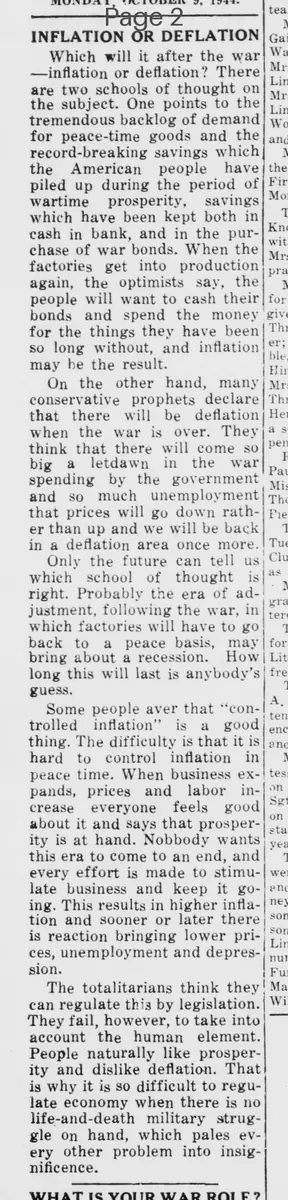
INFLATION OR DEFLATION
Which will it be after the war—inflation or deflation? There are two schools of thought on the subject. One points to the tremendous backlog of demand for peace-time goods and the record-breaking savings which the American people have piled up during the period of wartime prosperity, savings which have been kept both in cash in bank, and in the purchase of war bonds. When the factories get into production again, the optimists say, the people will want to cash their bonds and spend the money for the things they have been so long without, and inflation may be the result.
On the other hand, many conservative prophets declare that there will be deflation when the war is over. They think that there will come so big a letdown in the war spending by the government and so much unemployment that prices will go down rather than up and we will be back in a deflation area once more.
Only the future can tell us which school of thought is right. Probably the era of adjustment, following the war, in which factories will have to go back to a peace basis, may bring about a recession. How long this will last is anybody's guess.
Some people aver that "controlled inflation" is a good thing. The difficulty is that it is hard to control inflation in peace time. When business expands, prices and labor increase everyone feels good about it and says that prosperity is at hand. Nobody wants this era to come to an end, and every effort is made to stimulate business and keep it going. This results in higher inflation and sooner or later there is reaction bringing lower prices, unemployment and depression.
The totalitarians think they can regulate this by legislation. They fail, however, to take into account the human element. People naturally like prosperity and dislike deflation. That is why it is so difficult to regulate economy when there is no life-and-death military struggle on hand, which pales every other problem into insignificance.
Which will it be after the war—inflation or deflation? There are two schools of thought on the subject. One points to the tremendous backlog of demand for peace-time goods and the record-breaking savings which the American people have piled up during the period of wartime prosperity, savings which have been kept both in cash in bank, and in the purchase of war bonds. When the factories get into production again, the optimists say, the people will want to cash their bonds and spend the money for the things they have been so long without, and inflation may be the result.
On the other hand, many conservative prophets declare that there will be deflation when the war is over. They think that there will come so big a letdown in the war spending by the government and so much unemployment that prices will go down rather than up and we will be back in a deflation area once more.
Only the future can tell us which school of thought is right. Probably the era of adjustment, following the war, in which factories will have to go back to a peace basis, may bring about a recession. How long this will last is anybody's guess.
Some people aver that "controlled inflation" is a good thing. The difficulty is that it is hard to control inflation in peace time. When business expands, prices and labor increase everyone feels good about it and says that prosperity is at hand. Nobody wants this era to come to an end, and every effort is made to stimulate business and keep it going. This results in higher inflation and sooner or later there is reaction bringing lower prices, unemployment and depression.
The totalitarians think they can regulate this by legislation. They fail, however, to take into account the human element. People naturally like prosperity and dislike deflation. That is why it is so difficult to regulate economy when there is no life-and-death military struggle on hand, which pales every other problem into insignificance.
What sub-type of article is it?
Economic Policy
War Or Peace
What keywords are associated?
Inflation
Deflation
Post War Economy
Wartime Savings
Unemployment
Controlled Inflation
Economic Regulation
What entities or persons were involved?
American People
Government
Totalitarians
Editorial Details
Primary Topic
Post War Inflation Versus Deflation Debate
Stance / Tone
Cautious Analysis Of Economic Risks
Key Figures
American People
Government
Totalitarians
Key Arguments
Tremendous Backlog Of Demand And Wartime Savings Could Lead To Inflation As Consumers Spend On Peacetime Goods.
Reduced Government War Spending And Unemployment May Cause Deflation And Lower Prices.
Post War Factory Reconversion Likely To Bring A Recession Of Uncertain Duration.
Controlled Inflation Is Desirable But Difficult To Manage In Peacetime Due To Expansionary Pressures.
Human Preference For Prosperity Over Deflation Complicates Economic Regulation Without Wartime Urgency.