Thank you for visiting SNEWPapers!
Sign up free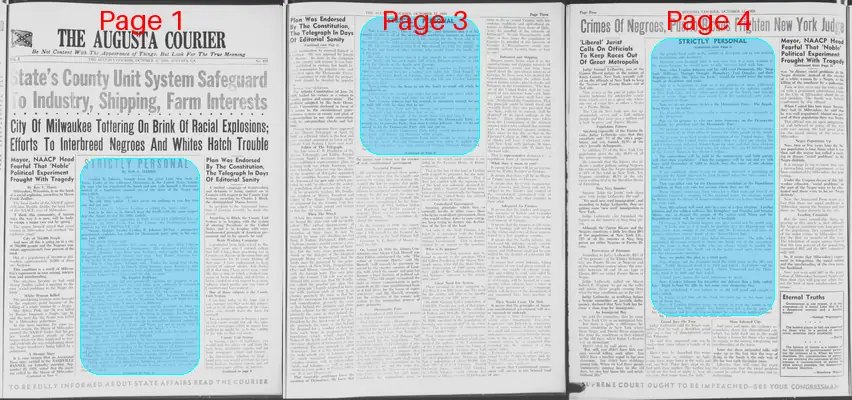
The Augusta Courier
Augusta, Richmond County, Georgia
What is this article about?
In this 1959 editorial, Roy V. Harris criticizes Senate Majority Leader Lyndon B. Johnson for promoting Democratic Party unity while advancing a civil rights bill that threatens Southern segregationist interests. Harris advocates for unpledged Southern electors to safeguard the South, comparing Johnson's actions to skinning a catfish.
Merged-components note: Multi-part 'STRICTLY PERSONAL' column by Roy V. Harris continued from page 1 to page 3 to page 4; partisan opinion on Lyndon B. Johnson and Southern politics.
Clippings
1 of 3
OCR Quality
Full Text
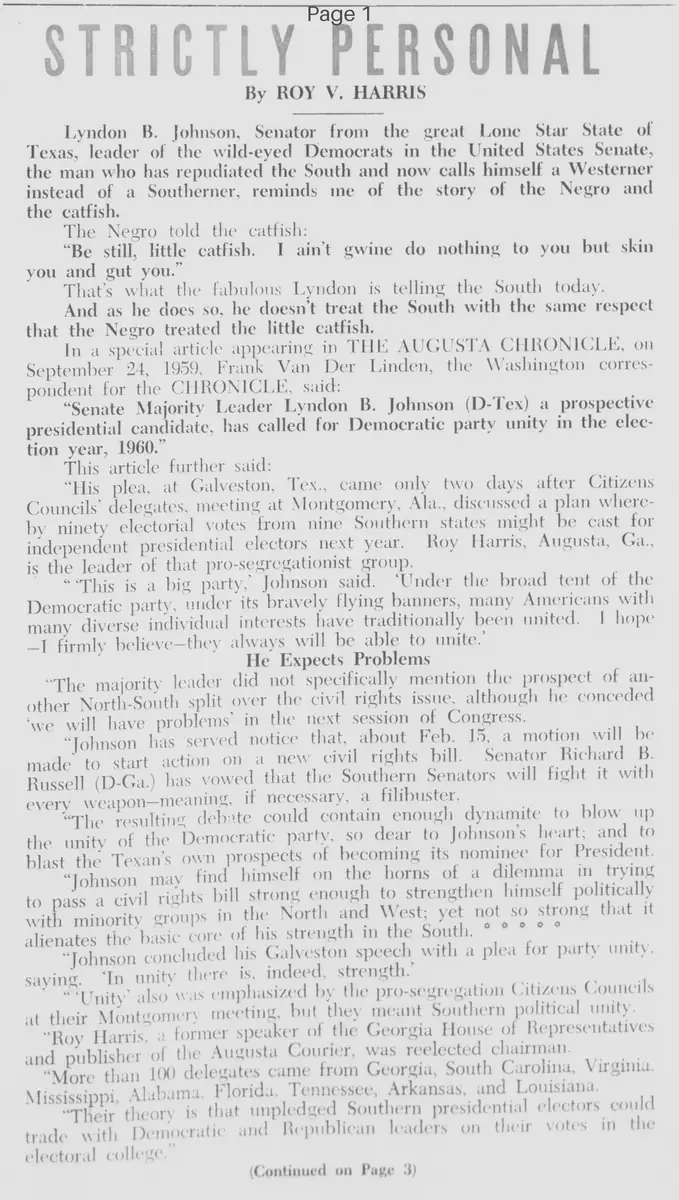
By ROY V. HARRIS
Lyndon B. Johnson, Senator from the great Lone Star State of Texas, leader of the wild-eyed Democrats in the United States Senate, the man who has repudiated the South and now calls himself a Westerner instead of a Southerner, reminds me of the story of the Negro and the catfish.
The Negro told the catfish:
"Be still, little catfish. I ain't gwine do nothing to you but skin you and gut you."
That's what the fabulous Lyndon is telling the South today.
And as he does so, he doesn't treat the South with the same respect that the Negro treated the little catfish.
In a special article appearing in THE AUGUSTA CHRONICLE, on September 24, 1959, Frank Van Der Linden, the Washington correspondent for the CHRONICLE, said:
Senate Majority Leader Lyndon B. Johnson (D-Tex) a prospective presidential candidate, has called for Democratic party unity in the election year, 1960.'
This article further said:
His plea, at Galveston, Tex., came only two days after Citizens Councils' delegates, meeting at Montgomery, Ala., discussed a plan where-
independent presidential electors next year. Roy Harris, Augusta, Ga., by ninety electoral votes from nine Southern states might be cast for is the leader of that pro-segregationist group.
This is a big party,' Johnson said. 'Under the broad tent of the Democratic party, under its bravely flying banners, many Americans with -I firmly believe-they always will be able to unite.' many diverse individual interests have traditionally been united. I hope
He Expects Problems
'we will have problems' in the next session of Congress. other North-South split over the civil rights issue, although he conceded The majority leader did not : specifically mention the prospect of an-
made to start action on a new civil rights bill. Senator Richard B. "Johnson has served notice that, about Feb. 15, a motion will be every weapon-meaning, if necessary, a filibuster. Russell (D-Ga.) has vowed that the Southern Senators will fight it with
the unity of the Democratic party, so dear to Johnson's heart; and to The resulting debate could contain enough dynamite to blow up blast the Texan's own prospects of becoming its nominee for President.
to pass a civil rights bill strong enough to strengthen himself politically "Johnson may find himself on the horns of a dilemma in trying with minority groups in the North and West; yet not so strong that it alienates the basic core of his strength in the South.
saying. 'In unity there is. indeed, strength.' "Johnson concluded his Galveston speech with a plea for party unity.
Unity' also was emphasized by the pro-segregation Citizens Councils at their Montgomery meeting, but they meant Southern political unity.
"Roy Harris. a former speaker of the Georgia House of Representatives and publisher of the Augusta Courier, was reelected chairman.
"More than 100 delegates came from Georgia, South Carolina, Virginia Mississippi, Alabama, Florida, Tennessee, Arkansas, and Louisiana.
"Their theory is that unpledged Southern presidential electors could trade with Democratic and Republican leaders on their votes in the electoral college.
(Continued on Page 3)
STRICTLY PERSONAL
(Continued from Page 1)
Now Lyndon says, "This is a big Party" and intimates that it is big enough to take in all of the diverse and conflicting interests in America.
He takes the position that it is big enough for the South and it is big enough for the wild-eyed radicals advocating punishing the South.
He takes the position that it is big enough to hold the people of the South and those of other sections who would throw the South out of the party.
He takes the position that it is big enough to contain the people of the South and the civil rights bill which Johnson promises to ram down the throats of the South next January.
Johnson serves notice that he will make a motion on February 15, 1960 for the Senate to write a radical civil rights bill. Dick Russell, of Georgia and Harry Byrd, of Virginia, have served notice that they and their other Southern colleagues will fight this bill and Lyndon Johnson to the last ditch.
Now Lyndon has the brass to ask the South to stand still while he disembowels us.
Lyndon says we should get under his tent and stay there while he takes a big Texas knife and skins us and guts us.
Now, Lyndon Johnson isn't big enough, or glamorous enough for me to hold still while he does that to me.
The Democratic Party isn't big enough and powerful enough for me to stand still while Lyndon does that to me.
Neither will the people of the South stand still and take it.
Now, we have no more desire to destroy the Democratic Party, or to split the Democratic Party, than does Lyndon Johnson.
But we do not intend to let the Democratic Party skin and gut us.
The policies of the Democratic Party today would absolutely destroy the South and destroy the Southern white people.
The policies of the Democratic Party today would be more destructive to the South than old Sherman's army was when it applied the scorched earth policy to a wide section of Georgia between Atlanta and the sea.
(Continued on Page 4)
STRICTLY PERSONAL
(Continued from Page 3)
My people lived right in the middle of that path and he left nothing but destruction and desolation.
Sherman even bragged after it was over that if a crow wanted to fly across Georgia he would have to take his own food with him.
Now, what Lyndon Johnson and his wild-eyed Democrats, like "Soap Suds" Williams, "Humpty Dumpty" Humphrey, Paul Douglas, and their Republican allies, like "Jakie the Javits", would do would leave the entire South in desolation and ruins.
And it is beginning to look as if the policies of these wild-eyed radicals are creating slum and crime conditions in the nation's capital, in New York City, and the other great cities of the North, and leaving them in worse shape than they would be if the scorched earth policy were applied to them.
Now we do not propose to leave the Democratic Party. The Republican Party is no better.
The Republican Party has sought to destroy us just as vigorously as has the Democrats.
But we do propose to take out some insurance on the Democratic candidate for president and the Democratic Party.
We propose to elect on the Democratic ticket in the Southern states electors who will use their office to protect the white people of the South.
We propose to go back to the Constitution of the United States. The Constitution of the United States provides that we elect one elector for each Congressman and each Senator from the state and that these electors be given the right to cast their votes for whom they see fit for President of the United States in the electoral college.
The conventions will be held in the summertime and both parties will elect their candidates. Then the campaign will be run and we will have until December of 1960 to decide how the votes of our electors will be cast.
If any candidate elects to run on policies directed at punishing or destroying the South, that can be kept in mind when the time comes for the electors to cast their votes.
They can either vote for the Democratic candidate or the Republican candidate, or they can vote for anyone whom they see fit.
These electors could cast their votes for a third man and then if no candidate received a majority of the electoral votes, the election would be thrown into the House of Representatives where each state would have one vote each.
Now, this scheme will work only in a case of a close election. Lyndon Johnson and the wildcat radicals, like Humphrey and Douglas and Senator Morse, may so disgust the people of the nation until Nixon and the Republican ticket will be swept in by a landslide.
Of course, if this should happen, our plan would not be worth anything. It looks now as if it might be possible that the Republicans will carry every state outside of the South and the Democrats will have no chance anywhere except South of the Mason-Dixon line.
This happened the first time Adlai Stevenson ran. The folks who nominated Stevenson wanted to throw the South out of the convention and the irony is that the folks who are always trying to punish the South, and to throw the South out of the party, can't carry their states for the Democratic nominee.
Now, we prefer this plan to a third party.
Tom Watson and the Populists tried the third party in the 90's and failed. Teddy Roosevelt tried it in 1912 and failed. LaFollette and his Progressives tried it and they failed. Strom Thurmond and the Dixiecrats tried it in 1948 and they failed.
A third party scares the local politicians to death.
Now, Lyndon Johnson has forgotten one defense that a little catfish has. Right behind his gills he has some very dangerous fins.
In my childhood, I was fishing in an old mill pond and caught a little catfish.
In trying to get him off the hook, he stuck me to the bone with one of those fins.
Now, If Lyndon Johnson keeps on trying to treat the South as the Negro treated the little catfish, the South may jab a fin in some of his vital organs and he will then no longer be a fabulous political figure.
So Lyndon look out for the little catfish.
What sub-type of article is it?
What keywords are associated?
What entities or persons were involved?
Editorial Details
Primary Topic
Criticism Of Lyndon B. Johnson's Civil Rights Policies And Advocacy For Unpledged Southern Electors
Stance / Tone
Strongly Pro Segregationist And Anti Civil Rights, Warning To Johnson
Key Figures
Key Arguments
- johnson's call for democratic unity ignores southern interests by pushing civil rights bill
- southern senators will filibuster the civil rights bill
- propose unpledged electors to protect southern whites from destructive policies
- democratic and republican parties both threaten the south
- prefer unpledged electors over third party, which has historically failed
- civil rights policies more destructive than sherman's march