Thank you for visiting SNEWPapers!
Sign up free
The North Carolina Standard
Raleigh, Wake County, North Carolina
What is this article about?
Editorial presents excerpts from a 1828-29 North Carolina legislative committee report criticizing state banks for fraudulent practices, excessive note issuance, usury, and charter violations. The editor defends Democratic Republicans against accusations, advocating for banks to be governed by laws rather than vice versa.
Merged-components note: Continuation of the same editorial on the Governor's message and banks; text flows directly from one to the next.
Clipping
OCR Quality
Full Text
GOVERNOR'S MESSAGE.
BUSINESS—CURRENCY—BANKS.
Our readers will recollect that we were compelled, last week, to omit part of the extracts from a report made by a Committee of the Legislature of North Carolina, at the session of 1828-29. They are as follows:
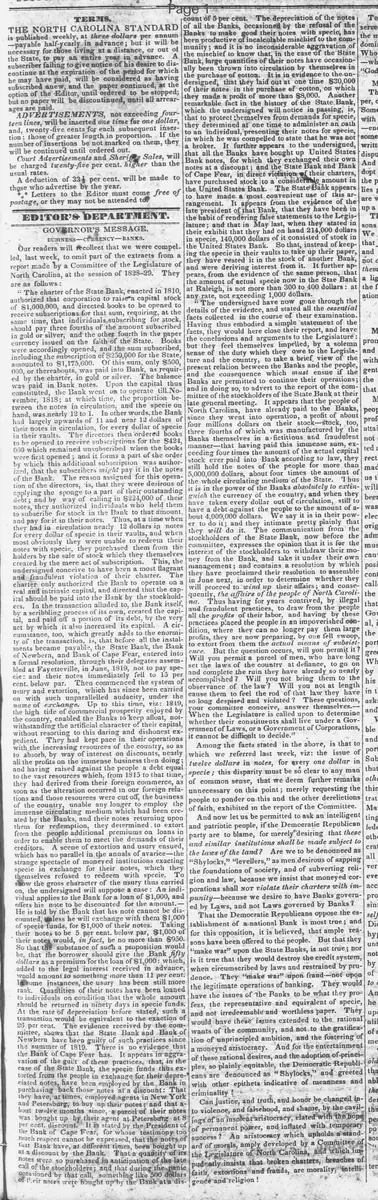
"The charter of the State Bank, enacted in 1810, authorized that corporation to raise a capital stock of $1,500,000, and directed books to be opened to receive subscriptions for that sum, requiring, at the same time, that individuals subscribing for stock, should pay three fourths of the amount subscribed in gold or silver, and the other fourth in the paper currency issued on the faith of the State. Books were accordingly opened, and the sum subscribed, including the subscription of $250,000 for the State, amounted to $1,175,600. Of this sum, only $500,000, or thereabouts, was paid into Bank, as required by the charter, in gold or silver. The balance was paid in Bank notes. Upon the capital thus constituted, the Bank went on to operate till November, 1818; at which time, the proportion between the notes in circulation, and the specie on hand, was nearly 12 to 1. In other words, the Bank had largely upwards of 11 and near 12 dollars of their notes in circulation, for every dollar of specie in their vaults. The directors then ordered books to be opened to receive subscriptions for the $424,000 which remained unsubscribed when the books were first opened; and it forms a part of the order by which this additional subscription was authorized, that the subscribers might pay it in the notes of the Bank. The reason assigned for this operation of the directors, is, that they were desirous of applying the sponge to a part of their outstanding debt; and by way of calling in $224,000 of their notes, they authorized individuals who held them to subscribe for stock in the Bank to that amount, and pay for it in their notes. Thus, at a time when they had in circulation nearly 12 dollars in notes for every dollar of specie in their vaults, and when most obviously they were unable to redeem their notes with specie, they purchased them from the holders by the sale of stock which they themselves created by the mere act of subscription. This, the undersigned conceive to have been a most flagrant and fraudulent violation of their charter. The charter only authorized the Bank to operate on a real and intrinsic capital, and directed that the capital should be paid into the Bank by the stockholders. In the transaction alluded to, the Bank itself, by a scribbling process of its own, created the capital, and paid off a portion of its debt, by the very act by which it also increased its capital. A circumstance, too, which greatly adds to the enormity of the transaction, is, that before all the installments became payable, the State Bank, the Bank of Newbern, and Bank of Cape Fear, entered into a formal resolution, through their delegates assembled at Fayetteville, in June, 1819, not to pay specie: and their notes immediately fell to 15 per cent. below par. Then commenced the system of usury and extortion, which has since been carried on with such unparalleled audacity, under the name of exchange. Up to this time, viz: 1819, the high tide of commercial prosperity enjoyed by the country, enabled the Banks to keep afloat, notwithstanding the artificial character of their capital without resorting to this daring and dishonest expedient. They had kept pace in their operations with the increasing resources of the country, so as to absorb, by way of interest on discounts, nearly all the profits on the immense business then doing; and having raised against the people a debt equal to the vast resources which, from 1815 to that time, they had derived from their foreign commerce, as soon as the alteration occurred in our foreign relations and those resources were cut off, the business of the country, unable any longer to employ the immense circulating medium which had been created by the Banks, and their notes returning upon them for redemption, they determined to extort from the people additional premiums on loans in order to enable them to meet the demands of their creditors. A scene of extortion and usury ensued, which has no parallel in the annals of avarice—the strange spectacle of moneyed institutions exacting specie in exchange for their notes, which they themselves refused to redeem with specie. To show the gross character of the usury thus carried on, the undersigned will suppose a case: An individual applies to the Bank for a loan of $1,000, and offers his note to be discounted for the amount. He is told by the Bank that his note cannot be discounted, unless he will exchange with them $1,000 of specie funds, for $1,000 of their notes. Taking their notes to be 5 per cent. below par, $1,000 of their notes would, in fact, be no more than $950. So that the substance of such a proposition would be, that the borrower should give the Bank fifty dollars as a premium for the loan of $1,000: which, added to the legal interest received in advance, would amount to something more than 11 per cent. In some instances, the usury has been still more rank. Quantities of their notes have been loaned to individuals on condition that the whole amount should be returned in ninety days in specie funds. At the rate of depreciation before stated, such a transaction would be equivalent to the exaction of 25 per cent. The evidence received by the committee, shows that the State Bank and Bank of Newbern have been guilty of such practices since the summer of 1819." There is no evidence that the Bank of Cape Fear has. It appears in aggravation of the guilt of these practices, that, in the case of the State Bank, the specie funds thus extorted from the people in exchange for their depreciated notes, have been employed by the Bank in purchasing back those notes at a discount: That they have, at times, employed agents in New York and Petersburg, to buy up their notes; and that about twelve months since, a parcel of their notes was bought up by their agent at Petersburg—at 8 per cent. discount. It is stated by the President of the Bank of Cape Fear, for whose testimony too much respect cannot be expressed, that the notes of that Bank have, at different times, been bought up at a discount by the Bank. That a quantity of its notes were so purchased in anticipation of the late call of the stockholders; and that during the panic occasioned by that call, something like $500 of their notes were bought up by the Bank at a discount of 5 per cent. The depreciation of the notes of all the Banks, occasioned by the refusal of the Banks to make good their notes with specie, has been productive of incalculable mischief to the community; and it is no inconsiderable aggravation of the mischief to know that, in the case of the State Bank, large quantities of their notes have occasionally been thrown into circulation by themselves in the purchase of cotton. It is in evidence to the undersigned, that they laid out at one time $30,000 of their notes in the purchase of cotton, on which they made a profit of more than $8,000. Another remarkable fact in the history of the State Bank, which the undersigned will notice in passing, is, that to protect themselves from demands for specie, they determined at one time to administer an oath to an individual, presenting their notes for specie, in which he was compelled to state that he was not a broker. It further appears to the undersigned, that all the Banks have bought up United States Bank notes, for which they exchanged their own notes at a discount; and the State Bank and Bank of Cape Fear, in direct violation of their charters, have purchased stock in a considerable amount in the United States Bank. The State Bank appears to have made a most convenient use of this arrangement. It appears from the evidence of the late president of that Bank, that they have been in the habit of rendering false statements to the Legislature; and that in May last, when they stated in their exhibit that they had on hand $214,000 dollars in specie, $140,000 dollars of it consisted of stock in the United States Bank. So that, instead of keeping the specie in their vaults to take up their paper, they have vested it in the stock of another Bank, and were deriving interest from it. It further appears, from the evidence of the same person, that the amount of actual specie now in the State Bank at Raleigh, is not more than 300 to 400 dollars: at any rate, not exceeding 1,000 dollars.
"The undersigned have now gone through the details of the evidence, and stated all the essential facts collected in the course of their examination. Having thus embodied a simple statement of the facts, they would here close their report, and leave the conclusions and arguments to the Legislature: but they feel themselves impelled, by a solemn sense of the duty which they owe to the Legislature and the country, to take a brief view of the present relation between the Banks and the people, and the consequence which must ensue if the Banks are permitted to continue their operations; and in doing so, to advert to the report of the committee of the stockholders of the State Bank at their late general meeting. It appears that the people of North Carolina, have already paid to the Banks, since they went into operation, a profit of about four millions dollars on their stock—stock, too, three fourths of which was manufactured by the Banks themselves in a fictitious and fraudulent manner—that having paid this immense sum, exceeding four times the amount of the actual capital stock ever paid into Bank according to law, they still hold the notes of the people for more than 5,000,000 dollars, about four times the amount of the whole circulating medium of the State. Thus it is in the power of the Banks absolutely to extinguish the currency of the country, and when they have taken every dollar out of circulation, still to have a debt against the people to the amount of about 4,000,000 dollars. We say it is in their power to do it; and they intimate pretty plainly that they will do it. The communication from the stockholders of the State Bank, now before the committee, expresses the opinion that it is for the interest of the stockholders to withdraw their money from the Bank, and take it under their own management; and contains a resolution by which they have proclaimed their resolution to assemble in June next, in order to determine whether they will proceed to wind up their affairs; and consequently, the affairs of the people of North Carolina.
Thus having for years contrived, by illegal and fraudulent practices, to draw from the people all the profits of their labor, and having by these practices placed the people in an impoverished condition, where they can no longer pay them large profits, they are now preparing, by one fell swoop, to extort from them the actual means of subsistence.
But the question occurs, will you permit it? Will you permit a parcel of men, who have long set the laws of the country at defiance, to go on and complete the ruin they have already so nearly accomplished? Will you not bring them to the observance of the law? Will you not at length cause them to feel the rod of that law they have so long despised and violated? These questions, your committee conceive, answer themselves. When the Legislature is called upon to determine whether their constituents shall live under a Government of Laws, or a Government of Corporations, it cannot be difficult to decide."
Among the facts stated in the above, is that to which we referred last week, viz: the issue of twelve dollars in notes, for every one dollar in specie; this disparity must be so clear to any man of common sense, that we deem further remarks unnecessary on this point; merely requesting the people to ponder on this and the other derelictions of faith, exhibited in the report of the Committee.
And now let us be permitted to ask an intelligent and patriotic people, if the Democratic Republican party are to blame, for merely desiring that these and similar institutions shall be made subject to the laws of the land? Are we to be denounced as "Shylocks," "levellers," as men desirous of sapping the foundations of society, and of subverting religion and law, because we insist that moneyed corporations shall not violate their charters with impunity—because we desire to have Banks governed by Laws, and not Laws governed by Banks?
That the Democratic Republicans oppose the establishment of a national Bank is most true; and for this opposition, it is believed, that ample reasons have been offered to the people. But that they "make war" upon the State Banks, is not true; nor is it true that they would destroy the credit system, when circumscribed by laws and restrained by prudence. They "make war" upon fraud—not upon the legitimate operations of banking. They would have the issues of the Banks to be what they profess, the representative and equivalent of specie, and not irredeemable and worthless paper. They would have these issues extended to the rational wants of the community, and not to the gratification of unprincipled ambition, and the fostering of a moneyed aristocracy. And for the entertainment of these rational desires, and the adoption of principles, so plainly equitable, the Democratic Republicans are denounced as "Shylocks," and greeted with other epithets indicative of meanness and criminality!
Can justice, and truth, and honor be changed into violence, and falsehood, and shame, by the cavillings of an insolent aristocracy, elated with the hope of permanent power, and inflated with temporary success? An aristocracy which upholds a standard of morals, amply developed by a Committee of the Legislature of North Carolina, and which impudently insists that broken charters, breaches of faith, extortions and frauds, are morality, intelligence and religion!
What sub-type of article is it?
What keywords are associated?
What entities or persons were involved?
Editorial Details
Primary Topic
Critique Of North Carolina State Banks' Fraudulent Practices And Defense Of Democratic Republicans
Stance / Tone
Strongly Critical Of Banks' Fraud And Supportive Of Legal Oversight By Democratic Republicans
Key Figures
Key Arguments