Thank you for visiting SNEWPapers!
Sign up free
Alexandria Gazette & Daily Advertiser
Alexandria, Virginia
What is this article about?
Congressional proceedings on January 2, 1820, in the Senate and House of Representatives. Senate discussed military petition, introduced bankruptcy bill, resolution for Missouri judicial authority, committee appointments, land patent maps, and college land grant. House reported bills, received reports from secretaries, passed resolutions on various inquiries including post routes, commerce, and manufacturing prohibitions, and debated printing a treasury document.
Clipping
OCR Quality
Full Text
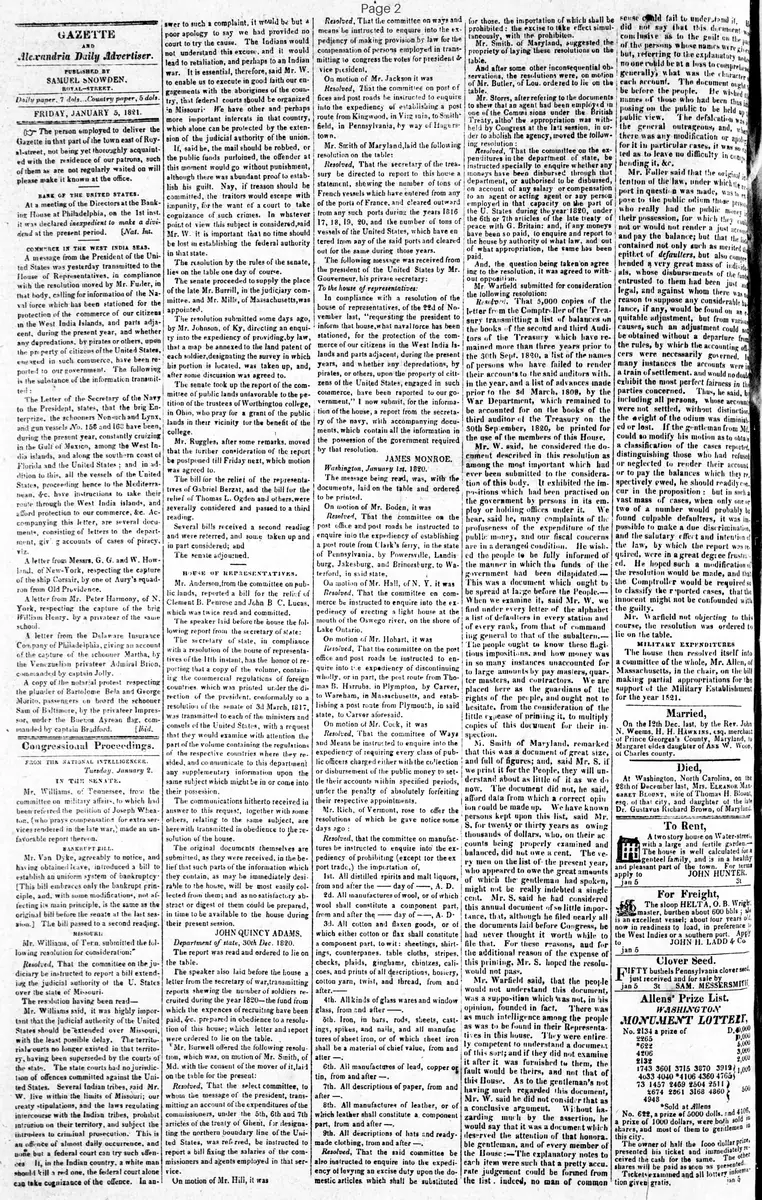
FROM THE NATIONAL INTELLIGENCER.
Tuesday, January 2.
IN THE SENATE.
Mr. Williams, of Tennessee, from the
committee on military affairs, to which had
been referred the petition of Joseph Wheaton,
(who prays compensation for extra services rendered in the late war,) made an unfavorable report thereon.
BANKRUPT BILL.
Mr. Van Dyke, agreeably to notice, and
having obtained leave, introduced a bill to
establish a uniform system of bankruptcy
[This bill embraces only the bankrupt prin-
ciple, and, with some modifications, not af-
fecting its main principle, is the same as the
original bill before the senate at the last ses-
sion.] The bill passed to a second reading.
MISSOURI:
Mr. Williams, of Tenn. submitted the following resolution for consideration:
"Resolved, That the committee on the judiciary be instructed to report a bill extending the judicial authority of the U. States
over the state of Missouri."
The resolution having been read—
Mr. Williams said, it was highly impor-
tant that the judicial authority of the United
States should be extended over Missouri,
with the least possible delay. The territorial courts no longer existed in that territory,
having been superseded by the courts of
the state. The state courts had no jurisdiction of offences committed against the United States. Several Indian tribes, said Mr.
W. live within the limits of Missouri; our
treaty stipulations, and the laws regulating
intercourse with the Indian tribes, prohibit
intrusion on their territory, and subject the
intruders to criminal prosecution. This is
an offence of almost daily occurrence, and
none but a federal court can try such offences in the Indian country. If, in the Indian country, a white man
should kill a red one, the federal court alone
can take cognizance of the offence. In answer to such a complaint, it would be but a
poor apology to say we had provided no
court to try the cause. The Indians would
not understand this excuse, and it would
lead to retaliation, and perhaps to an Indian
war. It is essential, therefore, said Mr. W.
to enable us to execute in good faith our engagements with the aborigines of the coun-
try, that federal courts should be organized
in Missouri. We have other and perhaps
more important interests in that country,
which alone can be protected by the extension of the judicial authority of the union.
If, said he, the mail should be robbed, or
the public funds purloined, the offender at
this moment would go without punishment,
although there was abundant proof to establish his guilt. Nay, if treason should be
committed, the traitors would escape with
impunity, for the want of a court to take
cognizance of such crimes. In whatever
point of view this subject is considered, said
Mr. W. it is important that no time should
be lost in establishing the federal authority
in that state.
The resolution by the rules of the senate,
lies on the table one day of course.
The senate proceeded to supply the place
of the late Mr. Burrill, in the judiciary com-
mittee, and Mr. Mills, of Massachusetts, was
appointed.
The resolution submitted some days ago,
by Mr. Johnson, of Ky. directing an enquiry
into the expediency of providing, by law
that a map be annexed to the land patent of
each soldier, designating the survey in which
his portion is located, was taken up, and,
after some discussion was agreed to.
The senate took up the report of the com-
mittee of public lands unfavorable to the pe-
tition of the trustees of Worthington college,
in Ohio, who pray for a grant of the public
lands in their vicinity for the benefit of the
college.
Mr. Ruggles, after some remarks, moved
that the further consideration of the report
be postponed till Friday next, which motion
was agreed to.
The bill for the relief of the representatives of Gabriel Berzat, and the bill for the
relief of Thomas L. Ogden and others, were
severally considered and passed to a third
reading.
Several bills received a second reading
and were referred, and some taken up and
in part considered; and
The senate adjourned.
HOUSE OF REPRESENTATIVES.
Mr. Anderson, from the committee on pub-
lic lands, reported a bill for the relief of
Clement B. Penrose and John B. C. Lucas.
which was twice read and committed.
The speaker laid before the house the fol-
lowing report from the secretary of state:
The secretary of state, in compliance
with a resolution of the house of representa-
tives of the 15th instant, has the honor of re-
porting that a copy of the volume, contain-
ing the commercial regulations of foreign
countries, which was printed under the di-
rection of the president, conformably to a
resolution of the senate of 3d March, 1817,
was transmitted to each of the ministers and
consuls of the United States, with a request
that they would examine with attention the
part of the volume containing the regulations
of the respective countries where they re-
sided, and communicate to this department
any supplementary information upon the
same subject which might be in or come into
their possession.
The communications hitherto received in
answer to this request, together with some
others, relating to the same subject, are
herewith transmitted in obedience to the re-
solution of the house.
The original documents themselves are
submitted, as they were received, in the be-
lief that such parts of the information which
may be immediately desirable to the house, will be most easily col-
lected from them; and as no satisfactory ab-
stract or digest of them could be prepared,
in time to be available to the house during
their present session,
JOHN QUINCY ADAMS.
Department of state, 30th Dec. 1820.
The report was read and ordered to lie on
the table.
The speaker also laid before the house a
letter from the secretary of war, transmitting
reports shewing the number of soldiers re-
cruited during the year 1820—the fund from
which the expences of recruiting have been
paid, &c. prepared in obedience to a resolu-
tion of this house; which letter and report
were ordered to lie on the table.
Mr. Burwell offered the following resolu-
tion, which was, on motion of Mr. Smith, of
Md. with the consent of the mover of it, laid
on the table for the present:
Resolved, That the select committee, to
whom the message of the president, trans-
mitting an account of the expenditures of the
commissioners, under the 5th, 6th and 7th
articles of the treaty of Ghent, for designa-
ting the northern boundary line of the Uni-
ted States, was referred, be instructed to
report a bill fixing the salaries of the com-
missioners and agents employed in that ser-
vice.
On motion of Mr. Hill, it was
Resolved, That the committee on ways and
means be instructed to enquire into the ex-
pediency of making provision by law for the
compensation of persons employed in trans-
mitling to congress the votes for president &
vice president.
On motion of Mr. Jackson it was
Resolved, That the committee on post offices and post roads be instructed to enquire
into the expediency of establishing a post
route from Kingwood, in Virginia, to Smith
field, in Pennsylvania, by way of Hagers-
town.
Mr. Smith of Maryland, laid the following
resolution on the table:
Resolved, That the secretary of the trea-
sury be directed to report to this house a
statement, shewing the number of tons of
French vessels which have entered from any
of the ports of France, and cleared outward
from any such ports during the years 1816
17, 18, 19, 20, and the number of tons of
vessels of the United States, which have entered from any of the said ports and cleared
out for the same during those years.
The following message was received from
the president of the United States by Mr.
Gouverneur, his private secretary
To the house of representatives:
In compliance with a resolution of the
house of representatives, of the 22d of No-
vember last, "requesting the president to
inform that house, what naval force has been
stationed, for the protection of the com-
merce of our citizens in the West India Islands and parts adjacent, during the present
year, and whether any depredations by
pirates, or others, upon the property of citizens of the United States, engaged in such
commerce, have been reported to our go-
vernment," I now submit, for the information of the house, a report from the secreta-
ry of the navy, with accompanying documents, which contain all the information in
the possession of the government required
by that resolution.
JAMES MONROE.
Washington, January 1st, 1820.
The message being read, was, with the
documents, laid on the table and ordered
to be printed.
On motion of Mr. Borden, it was
Resolved, That the committee on the
post office and post roads be instructed to
enquire into the expediency of establishing
a post route from Clark's ferry, in the state
of Pennsylvania, by Powersville, Landis-
burg, Jakesburg, and Brinorsburg, to Wa-
terford, in said state.
On motion of Mr. Hall, of N. Y. it was
Resolved, That the committee on com-
merce be instructed to enquire into the ex-
pediency of erecting a light house at the
mouth of the Oswego river, on the shore of
Lake Ontario.
On motion of Mr. Hobart, it was
Resolved, That the committee on the post
office and post roads be instructed to en-
quire into the expediency of discontinuing
wholly, or in part, the post route from Thomas B. Harris, in Plympton, by Carver,
to Wareham, in Massachusetts, and establishing a post route from Plymouth, in said
state, to Carver aforesaid.
On motion of Mr. Cobb, it was
Resolved, That the committee of Ways
and Means be instructed to enquire into the
expediency of requiring every class of public officers charged either with the collection or disbursement of the public money to set-
tle their accounts within specified periods,
under the penalty of absolutely forfeiting
their respective appointments.
Mr. Rich, of Vermont, rose to offer the
resolutions of which he gave notice some
days ago:
Resolved, that the committee on manufac-
tures be instructed to enquire into the ex-
pediency of prohibiting (except for the export trade,) the importation of.
1st. All distilled spirits and malt liquors,
from and after the -- day of --. A. D.
2d. All manufactures of wool, or of which
wool shall constitute a component part,
from and after the -- day of --, A. D.
3d. All cotton and flaxen goods, or of
which either cotton or flax shall constitute
a component part, to wit: sheetings, shirt-
ings, counterpanes, table cloths, stripes,
checks, plaids, ginghams, chintzes, cali-
coes, and prints of all descriptions, hosiery,
cotton yarn, twist, and thread, from and
after.
4th. All kinds of glass wares and window
glass, from and after
5th. Iron, in bars, rods, sheets, cast.
ings, spikes, and nails, and all manufac-
tures of sheet iron, or of which sheet iron
shall be a material of chief value, from and
after-:
6th. All manufactures of lead, copper or
tin, from and after-.
7th. All descriptions of paper, from and
after -.
8th. All manufactures of leather, or of
which leather shall constitute a component
part, from and after -
9th. All descriptions of hats and ready.
made clothing, from and after --
Resolved, That the said committee be
also instructed to enquire into the expediency of levying an excise duty upon the domestic articles which shall be substituted
for those, the importation of which shall be
prohibited: the excise to take effect simultaneously, with the prohibition.
Mr. Smith, of Maryland, suggested the
propriety of laying these resolutions on the
table.
And after some other inconsequential observations, the resolutions were, on motion
of Mr. Butler, of Lou. ordered to lie on the
table.
Mr. Storrs, after referring to the documents to shew that an agent had been employed in one of the Commissions under the British Treaty, altho' the appropriation was with-
held by Congress at the last session, in order to abolish the agency, moved the following resolution:
Resolved, That the committee on the ex-
penditures in the department of state, be
instructed specially to enquire whether any
moneys have been disbursed through that
department, or authorised to be disbursed,
on account of any salary or compensation
to an agent or acting agent or any person
employed in that capacity on the part of
the U. States during the year 1820, under
the 6th or 7th articles of the late treaty of
peace with G. Britain: and, if any moneys
have been so paid, to enquire and report to
the house by authority of what law, and out
of what appropriation, the same has been
paid.
And, the question being taken on agreeing to the resolution, it was agreed to without opposition.
Mr. Warfield submitted for consideration the following resolution:
Resolved, That 5,000 copies of the
letter from the Comptroller of the Trea-
sury transmitting a list of balances on
the books of the second and third Auditors of the Treasury which have remained more than three years prior to
the 30th Sept. 1820, a list of the names
of persons who have failed to render
their accounts to the said auditors within the year, and a list of advances made
prior to the 3d March, 1800, by the
War Department, which remained to
be accounted for on the books of the
third auditor of the Treasury on the
30th September, 1820, be printed for
the use of the members of this House.
Mr. W. said, he considered the document described in this resolution as
among the most important which had
ever been submitted to the consideration of this body. It exhibited the im-
positions which had been practised on
the government by persons in its employment or holding offices under it. We
hear, said he, many complaints of the
profuseness of the expenditure of the
public money, and our fiscal concerns
are in a deranged condition. He wished the people to be fully informed of
the manner in which the funds of the
government had been dilapidated.
This was a document which ought to
be spread at large before the People.
When we examine it, said Mr. W. we
find under every letter of the alphabet
a list of defaulters in every station and
of every rank, from that of commanding general to that of the subaltern.
The people ought to know these flagitious impositions, and how money was
in so many instances unaccounted for
to large amounts by pay masters, quarter masters, and contractors. We are
placed here as the guardians of the
rights of the people, and ought not to
hesitate, from the consideration of the
little expense of printing it, to multiply
copies of this document for their inspection.
Mr. Smith of Maryland, remarked
that this was a document of great size,
and full of figures; and, said Mr. S. if
we print it for the People, they will understand about as little of it as we do
now. The document did not, he said,
afford data from which a correct opinion could be made up. We have known
persons kept upon this list, said Mr.
S. for twenty or thirty years as owing
thousands of dollars, who, on their accounts being properly examined and
balanced, did not owe a cent. The very men on the list of the present year,
who appeared to owe the great amounts
of which the gentleman had spoken,
might not be really indebted a single
cent. Mr. S. said he had considered
this annual document of so little importance, that, although he filed nearly all
the documents laid before Congress, he
had never thought it worth while to
file that. For these reasons, and for
the additional reason of the expense of
this printing, Mr. S. hoped the resolution would not pass.
Mr. Warfield said, that the people
would not understand this document,
was a supposition which was not, in his
opinion, founded in fact. There was
as much intelligence among the people
as was to be found in their Representa-
tives in this house. They were entirely competent to understand a document
of this sort; and if they did not examine it after it was furnished to them, the
fault would be theirs, and not that of
this House. As to the gentleman's not
having much regarded this document,
Mr. W. said he did not consider that as
a conclusive argument. Without hazarding much by the assertion, he
would say that it was a document which
deserved the attention of that honorable gentleman, and of every member of
the House:—The explanatory notes to
each item were such that a pretty accurate judgment could be formed from
the list. Indeed, no man of common sense could fail to understand it. He
did not say that this document was conclusive as to the guilt on the part
of the persons whose names were given,
but, referring to the explanatory notes,
no one could be at a loss to comprehend generally, what was the character
of each account. The document ought
to be before the people.
He wished the names of those who had been thus im-
posing on the public to be held up to
public view.
The defalcation was in the general
outrageous, and, where
there was any modification or apology
for it in particular cases, it was so stated as to leave no difficulty in comprehending it, &c.
Mr. Fuller said that the original intention of the law, under which the report in question was made, was to expose to the public odium those persons
who really had the public money in
their possession, for which they could
not or would not render a just account
and pay the balance; but that the list
contained not only such as merited the
epithet of defaulters, but also comprehended a very great mass of individuals, whose disbursements of the funds
entrusted to them had been just and
legal, and against whom there was no
reason to suppose any considerable balance, if any, would be found on an equitable adjustment, but from various
causes, such an adjustment could not
be obtained without a departure from
the rules, by which the accounting officers were necessarily governed. In
many instances the accounts were in
a train of settlement, and would no doubt exhibit the most perfect fairness in the
parties concerned. Thus, he said, by
including all persons, whose accounts
were not settled, without distinction,
the weight of the odium was diminished or lost. If the gentleman from Md.
could so modify his motion as to obtain
a classification of the cases reported,
distinguishing those who had refused
or neglected to render their accounts
or to pay the balances which they respectively owed, he should readily concur in the proposition: but in such a
vast mass of cases, when only one or
two of a number would probably be
found culpable defaulters, it was impossible to make a due discrimination
and the salutary effect and intention of
the law, by which the report was required, were in a great degree frustrated. He hoped such a modification of
the resolution would be made, and that
the Comptroller would be required so
to classify the reported cases, that the
innocent might not be confounded with
the guilty.
Mr. Warfield not objecting to this
course, the resolution was ordered to
lie on the table.
MILITARY EXPENDITURES
The house then resolved itself into
a committee of the whole, Mr. Allen, of
Massachusetts, in the chair, on the bill
making partial appropriations for the
support of the Military Establishment
for the year 1821.
What sub-type of article is it?
What keywords are associated?
What entities or persons were involved?
Where did it happen?
Domestic News Details
Primary Location
Washington
Event Date
January 2, 1820
Key Persons
Event Details
The Senate handled an unfavorable report on Joseph Wheaton's petition, introduced a bankruptcy bill, discussed extending judicial authority to Missouri emphasizing Indian relations and federal crimes, appointed Mr. Mills to judiciary committee, agreed to soldier land patent maps, postponed Worthington college land grant, and advanced relief bills. The House reported a relief bill, received reports from Secretary of State on commercial regulations and Secretary of War on recruiting, laid resolutions on commissioner salaries, vote transmission compensation, post routes, French vessel tonnage, presidential message on naval protection, lighthouse erection, route changes, officer account settlements, manufacturing import prohibitions with excise, treaty agent expenditures, and debated printing treasury defaulter lists before tabling; then entered committee on military appropriations.