Thank you for visiting SNEWPapers!
Sign up free
Story
March 31, 1809
The Enquirer
Richmond, Henrico County, Virginia
What is this article about?
In a US Senate speech on February 13, 1809, Mr. Giles supports repealing the Embargo Act except against Britain and France, denouncing British Foreign Secretary Canning's persistence with Orders in Council as motivated by fear of misinterpretation rather than justice, despite ineffective French decrees.
Clipping
OCR Quality
95%
Excellent
Full Text
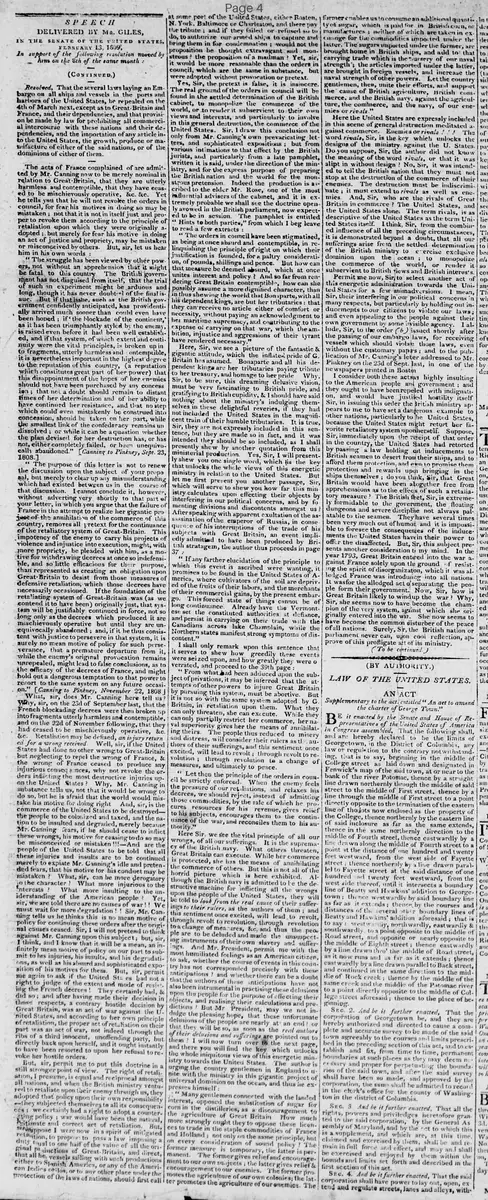
SPEECH
DELIVERED BY MR. GILES,
IN THE SENATE OF THE UNITED STATES,
FEBRUARY 13, 1809,
In support of the following resolution moved by
him on the 8th of the same month :
(Continued.)
Resolved, That the several laws laying an Embargo on all ships and vessels in the ports and
harbors of the United States, be repealed on the
4th of March next, except as to Great-Britain and
France, and their dependencies, and that provision
be made by law for prohibiting all commercial
intercourse with these nations and their dependencies, and the importation of any article into
the United States, the growth, produce or manufacture of either of the said nations, or of the
dominions of either of them.
The acts of France complained of are admitted
by Mr. Canning now to be merely nominal in
relation to Great-Britain, that they are utterly
harmless and contemptible, that they have ceased
to be mischievously operative, &c. &c. Yet
he tells you that he will not revoke the orders in
council, for fear his motives in doing so may be
mistaken : not that it is not in itself just and proper
to revoke them according to the principle of
retaliation upon which they were originally adopted ; but merely for fear his motive in doing
an act of justice and propriety, may be mistaken
or misconceived by others. But, sir, let us hear
him in his own words :
" The struggle has been viewed by other powers,
not without an apprehension that it might
be fatal to this country The British government
has not disguised from itself, that the trial
of such an experiment might be arduous and
long, though it has never doubted of the final issue.
But if that issue, such as the British government
confidently anticipated, has providentially arrived much sooner than could even have
been hoped ; if the blockade of the continent,
as it has been triumphantly styled by the enemy,
is raised even before it had been well established, and if that system, of which extent and continuity were the vital principles, is broken up into
fragments, utterly harmless and contemptible,
it is nevertheless important in the highest degree
to the reputation of this country, (a reputation
which constitutes great part of her power) that
this disappointment of the hopes of her enemies
should not have been purchased by any concession; that not a doubt should remain to distant
times of her determination and of her ability to
have continued her resistance, and that no step
which could even mistakenly be construed into
concession, should be taken on her part, while
the smallest link of the confederacy remains undissolved: or while it can be a question whether
the plan devised for her destruction has, or has
not, either completely failed, or been unequivocally
abandoned." [Canning to Pinkney, Sept. 23,
1808.]
The purpose of this letter is not to renew
the discussion upon the subject of your proposal, but merely to clear up any misunderstanding
which had existed between us in the course of
that discussion. I cannot conclude it, however,
without adverting very shortly to that part of
your letter, in which you argue that the failure of
France in the attempt to realize her gigantic project of the annihilation of the commerce of this
country, removes all pretext for the continuance
of the retaliatory system of Great-Britain. This
impotency of the enemy to carry his projects of
violence and injustice into execution, might, with
more propriety, be pleaded with him, as a motive for withdrawing decrees at once so indefensible,
and so little efficacious for their purpose,
than represented as creating an obligation upon
Great-Britain to desist from those measures of
defensive retaliation, which those decrees have
necessarily occasioned. If the foundation of the
retaliating system of Great-Britain was (as we
contend it to have been) originally just, that system will be justifiably continued in force, not so
long only as the decrees which produced it are
mischievously operative but until they are unequivocally abandoned ; and, if it be thus consistent
with justice to persevere in that system, it is
surely no mean motive of policy for such perseverance, that a premature departure from it,
while the enemy's original provocation remains
unrepealed, might lead to false conclusions, as to
the efficacy of the decrees of France, and might
hold out a dangerous temptation to that power to
resort to the same system on any future occasion." [Canning to Pinkney, November 22, 1808.]
What, sir, does Mr. Canning here tell us?
Why, sir, on the 23d of September last, that the
French blockading decrees were then broken up
into fragments utterly harmless and contemptible,
and on the 22d of November following, that they
had ceased to be mischievously operative, &c.
&c. Retaliation may be defined, an injury returned for a wrong received Well, sir, if the United
States had done no other wrong to Great-Britain
but neglecting to repel the wrong of France, &
the wrong of France ceased to produce any
injurious consequences, why not revoke the orders inflicting the most destructive injuries upon the United States? Why, Mr. Canning in
substance tells us, not that it would be wrong to
do so, but he is afraid that the world would mistake his motive for doing right And, sir, is the
commerce of the United States to be destroyed-
the people to be colonized and taxed, and the nation to be insulted and degraded, merely because
Mr. Canning fears, if he should cease to inflict
these wrongs, his motive for ceasing to do so may
be misconceived or mistaken!!! And are the
people of the United States to be told that all
these injuries and insults are to be continued
merely to expiate Mr. Canning's idle and pretended fears, that his motive for his conduct may be
mistaken ? What, sir, can be more derogatory
to the character ? What more injurious to the
interests ? What more insulting to the understanding of the American people ? Yet,
sir, we are told there are no causes of war !! We
must wait for more degradation! ! Sir, Mr. Canning tells us he thinks this is no mean motive of
policy for continuing these orders after the original causes ceased. Sir, I will not pretend to think
against Mr. Canning upon this subject; but, sir,
I think, and I know that it will be a mean, an infinitely mean motive of policy on our part to submit to his injuries, his insults, and his degradations, as well as his absurd and sophisticated exposition of his motives for them. But, sir, permit
me again to ask if the United States had not a
right to judge of the extent and mode of resisting the French decrees! They certainly had, &
did so; and after having made their decision in
those respects, a contrary hostile decision by
Great Britain, was an act of war against the U.
ited States, and according to her own principle
of retaliation, the proper act of retaliation on their
part was an act of war, not indeed through the
ribs of a third innocent, unoffending party, but
directly back upon herself, and it ought instantly
to have been resorted to upon her refusal to revoke her hostile orders.
But, sir, permit me to put this doctrine in a
still stronger point of view. The right of retaliation, I presume, is equal and reciprocal amongst
all nations, and when the British ministry ventured to retaliate upon their enemy through us, they
adopted that policy upon their own responsibility-they subjected themselves to all its consequences ; we certainly had a right to adopt a counter.
acting policy ; war would have been the natural,
legitimate and correct act of retaliation. But,
sir suppose I were now in a spirit of mitigated
retaliation, to propose to pass a law imposing a
duty equal to one half of the value of all the original productions of Great-Britain, and direct,
that all her vessels sailing with such productions
either to Spanish America, or any of the American Indies or islands, or to any other place under the
DELIVERED BY MR. GILES,
IN THE SENATE OF THE UNITED STATES,
FEBRUARY 13, 1809,
In support of the following resolution moved by
him on the 8th of the same month :
(Continued.)
Resolved, That the several laws laying an Embargo on all ships and vessels in the ports and
harbors of the United States, be repealed on the
4th of March next, except as to Great-Britain and
France, and their dependencies, and that provision
be made by law for prohibiting all commercial
intercourse with these nations and their dependencies, and the importation of any article into
the United States, the growth, produce or manufacture of either of the said nations, or of the
dominions of either of them.
The acts of France complained of are admitted
by Mr. Canning now to be merely nominal in
relation to Great-Britain, that they are utterly
harmless and contemptible, that they have ceased
to be mischievously operative, &c. &c. Yet
he tells you that he will not revoke the orders in
council, for fear his motives in doing so may be
mistaken : not that it is not in itself just and proper
to revoke them according to the principle of
retaliation upon which they were originally adopted ; but merely for fear his motive in doing
an act of justice and propriety, may be mistaken
or misconceived by others. But, sir, let us hear
him in his own words :
" The struggle has been viewed by other powers,
not without an apprehension that it might
be fatal to this country The British government
has not disguised from itself, that the trial
of such an experiment might be arduous and
long, though it has never doubted of the final issue.
But if that issue, such as the British government
confidently anticipated, has providentially arrived much sooner than could even have
been hoped ; if the blockade of the continent,
as it has been triumphantly styled by the enemy,
is raised even before it had been well established, and if that system, of which extent and continuity were the vital principles, is broken up into
fragments, utterly harmless and contemptible,
it is nevertheless important in the highest degree
to the reputation of this country, (a reputation
which constitutes great part of her power) that
this disappointment of the hopes of her enemies
should not have been purchased by any concession; that not a doubt should remain to distant
times of her determination and of her ability to
have continued her resistance, and that no step
which could even mistakenly be construed into
concession, should be taken on her part, while
the smallest link of the confederacy remains undissolved: or while it can be a question whether
the plan devised for her destruction has, or has
not, either completely failed, or been unequivocally
abandoned." [Canning to Pinkney, Sept. 23,
1808.]
The purpose of this letter is not to renew
the discussion upon the subject of your proposal, but merely to clear up any misunderstanding
which had existed between us in the course of
that discussion. I cannot conclude it, however,
without adverting very shortly to that part of
your letter, in which you argue that the failure of
France in the attempt to realize her gigantic project of the annihilation of the commerce of this
country, removes all pretext for the continuance
of the retaliatory system of Great-Britain. This
impotency of the enemy to carry his projects of
violence and injustice into execution, might, with
more propriety, be pleaded with him, as a motive for withdrawing decrees at once so indefensible,
and so little efficacious for their purpose,
than represented as creating an obligation upon
Great-Britain to desist from those measures of
defensive retaliation, which those decrees have
necessarily occasioned. If the foundation of the
retaliating system of Great-Britain was (as we
contend it to have been) originally just, that system will be justifiably continued in force, not so
long only as the decrees which produced it are
mischievously operative but until they are unequivocally abandoned ; and, if it be thus consistent
with justice to persevere in that system, it is
surely no mean motive of policy for such perseverance, that a premature departure from it,
while the enemy's original provocation remains
unrepealed, might lead to false conclusions, as to
the efficacy of the decrees of France, and might
hold out a dangerous temptation to that power to
resort to the same system on any future occasion." [Canning to Pinkney, November 22, 1808.]
What, sir, does Mr. Canning here tell us?
Why, sir, on the 23d of September last, that the
French blockading decrees were then broken up
into fragments utterly harmless and contemptible,
and on the 22d of November following, that they
had ceased to be mischievously operative, &c.
&c. Retaliation may be defined, an injury returned for a wrong received Well, sir, if the United
States had done no other wrong to Great-Britain
but neglecting to repel the wrong of France, &
the wrong of France ceased to produce any
injurious consequences, why not revoke the orders inflicting the most destructive injuries upon the United States? Why, Mr. Canning in
substance tells us, not that it would be wrong to
do so, but he is afraid that the world would mistake his motive for doing right And, sir, is the
commerce of the United States to be destroyed-
the people to be colonized and taxed, and the nation to be insulted and degraded, merely because
Mr. Canning fears, if he should cease to inflict
these wrongs, his motive for ceasing to do so may
be misconceived or mistaken!!! And are the
people of the United States to be told that all
these injuries and insults are to be continued
merely to expiate Mr. Canning's idle and pretended fears, that his motive for his conduct may be
mistaken ? What, sir, can be more derogatory
to the character ? What more injurious to the
interests ? What more insulting to the understanding of the American people ? Yet,
sir, we are told there are no causes of war !! We
must wait for more degradation! ! Sir, Mr. Canning tells us he thinks this is no mean motive of
policy for continuing these orders after the original causes ceased. Sir, I will not pretend to think
against Mr. Canning upon this subject; but, sir,
I think, and I know that it will be a mean, an infinitely mean motive of policy on our part to submit to his injuries, his insults, and his degradations, as well as his absurd and sophisticated exposition of his motives for them. But, sir, permit
me again to ask if the United States had not a
right to judge of the extent and mode of resisting the French decrees! They certainly had, &
did so; and after having made their decision in
those respects, a contrary hostile decision by
Great Britain, was an act of war against the U.
ited States, and according to her own principle
of retaliation, the proper act of retaliation on their
part was an act of war, not indeed through the
ribs of a third innocent, unoffending party, but
directly back upon herself, and it ought instantly
to have been resorted to upon her refusal to revoke her hostile orders.
But, sir, permit me to put this doctrine in a
still stronger point of view. The right of retaliation, I presume, is equal and reciprocal amongst
all nations, and when the British ministry ventured to retaliate upon their enemy through us, they
adopted that policy upon their own responsibility-they subjected themselves to all its consequences ; we certainly had a right to adopt a counter.
acting policy ; war would have been the natural,
legitimate and correct act of retaliation. But,
sir suppose I were now in a spirit of mitigated
retaliation, to propose to pass a law imposing a
duty equal to one half of the value of all the original productions of Great-Britain, and direct,
that all her vessels sailing with such productions
either to Spanish America, or any of the American Indies or islands, or to any other place under the
What sub-type of article is it?
Historical Event
What themes does it cover?
Justice
Deception
What keywords are associated?
Embargo Repeal
British Orders In Council
French Decrees
Retaliation Policy
Canning Motives
Us Senate Speech
What entities or persons were involved?
Mr. Giles
Mr. Canning
Pinkney
Where did it happen?
Senate Of The United States
Story Details
Key Persons
Mr. Giles
Mr. Canning
Pinkney
Location
Senate Of The United States
Event Date
February 13, 1809
Story Details
Mr. Giles argues for repealing the Embargo Act except against Britain and France, criticizing Canning's refusal to revoke Orders in Council despite French decrees being ineffective, claiming it stems from fear of misconstrued motives rather than justice.