Thank you for visiting SNEWPapers!
Sign up free
Story
August 1, 1873
Bozeman Avant Courier
Bozeman, Gallatin County, Montana
What is this article about?
Article on the painless death of Chief-Justice Chase from cerebral artery rupture while asleep, followed by philosophical reflections on death as a natural, non-painful process akin to sleep, and human fears surrounding it.
Clipping
OCR Quality
96%
Excellent
Full Text
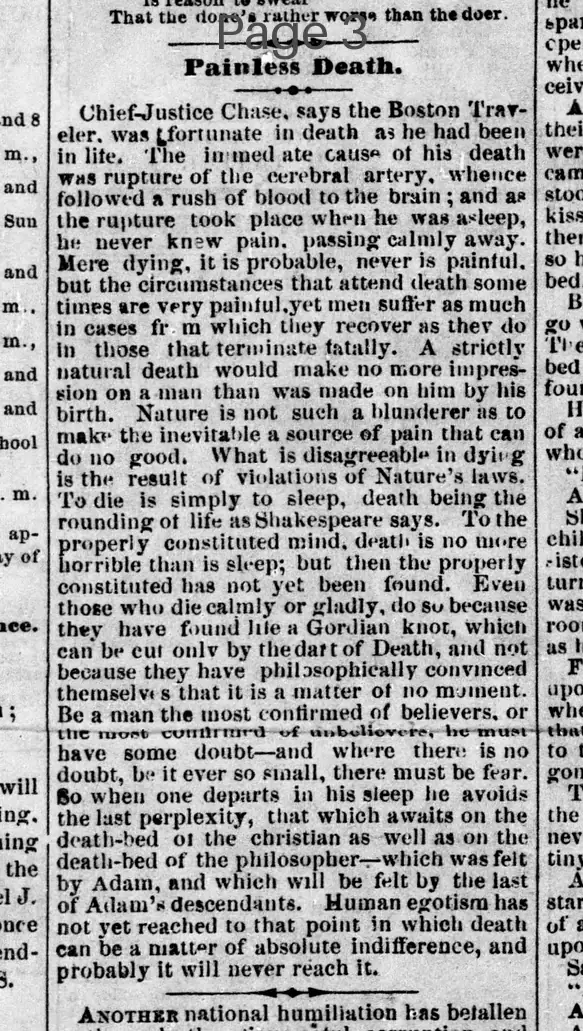
Painless Death,
Chief-Justice Chase, says the Boston Traveller, was as fortunate in death as he had been in life. The immediate cause of his death was rupture of the cerebral artery, whence followed a rush of blood to the brain; and as the rupture took place when he was asleep, he never knew pain, passing calmly away.
Mere dying, it is probable, never is painful. But the circumstances that attend death sometimes are very painful, yet men suffer as much in cases from which they recover as they do in those that terminate fatally. A strictly natural death would make no more impression on a man than was made on him by his birth. Nature is not such a blunderer as to make the inevitable a source of pain that can do no good. What is disagreeable in dying is the result of violations of Nature's laws.
To die is simply to sleep, death being the rounding of life as Shakespeare says. To the properly constituted mind, death is no more horrible than is sleep; but then the properly constituted has not yet been found. Even those who die calmly or gladly, do so because they have found life a Gordian knot, which can be cut only by the dart of Death, and not because they have philosophically convinced themselves that it is a matter of no moment.
Be a man the most confirmed of believers, or the most confirmed of unbelievers, he must have some doubt—and where there is no doubt, be it ever so small, there must be fear. So when one departs in his sleep he avoids the last perplexity, that which awaits on the death-bed of the Christian as well as on the death-bed of the philosopher—which was felt by Adam, and which will be felt by the last of Adam's descendants. Human egotism has not yet reached to that point in which death can be a matter of absolute indifference, and probably it will never reach it.
Chief-Justice Chase, says the Boston Traveller, was as fortunate in death as he had been in life. The immediate cause of his death was rupture of the cerebral artery, whence followed a rush of blood to the brain; and as the rupture took place when he was asleep, he never knew pain, passing calmly away.
Mere dying, it is probable, never is painful. But the circumstances that attend death sometimes are very painful, yet men suffer as much in cases from which they recover as they do in those that terminate fatally. A strictly natural death would make no more impression on a man than was made on him by his birth. Nature is not such a blunderer as to make the inevitable a source of pain that can do no good. What is disagreeable in dying is the result of violations of Nature's laws.
To die is simply to sleep, death being the rounding of life as Shakespeare says. To the properly constituted mind, death is no more horrible than is sleep; but then the properly constituted has not yet been found. Even those who die calmly or gladly, do so because they have found life a Gordian knot, which can be cut only by the dart of Death, and not because they have philosophically convinced themselves that it is a matter of no moment.
Be a man the most confirmed of believers, or the most confirmed of unbelievers, he must have some doubt—and where there is no doubt, be it ever so small, there must be fear. So when one departs in his sleep he avoids the last perplexity, that which awaits on the death-bed of the Christian as well as on the death-bed of the philosopher—which was felt by Adam, and which will be felt by the last of Adam's descendants. Human egotism has not yet reached to that point in which death can be a matter of absolute indifference, and probably it will never reach it.
What sub-type of article is it?
Biography
Curiosity
What themes does it cover?
Fate Providence
Moral Virtue
What keywords are associated?
Painless Death
Chief Justice Chase
Philosophy Of Death
Natural Death
Human Fear
What entities or persons were involved?
Chief Justice Chase
Story Details
Key Persons
Chief Justice Chase
Story Details
Chief-Justice Chase died painlessly from cerebral artery rupture while asleep. The article philosophizes that natural death is painless like sleep, and human fear of death stems from doubt and egotism, unavoidable even for believers or philosophers.